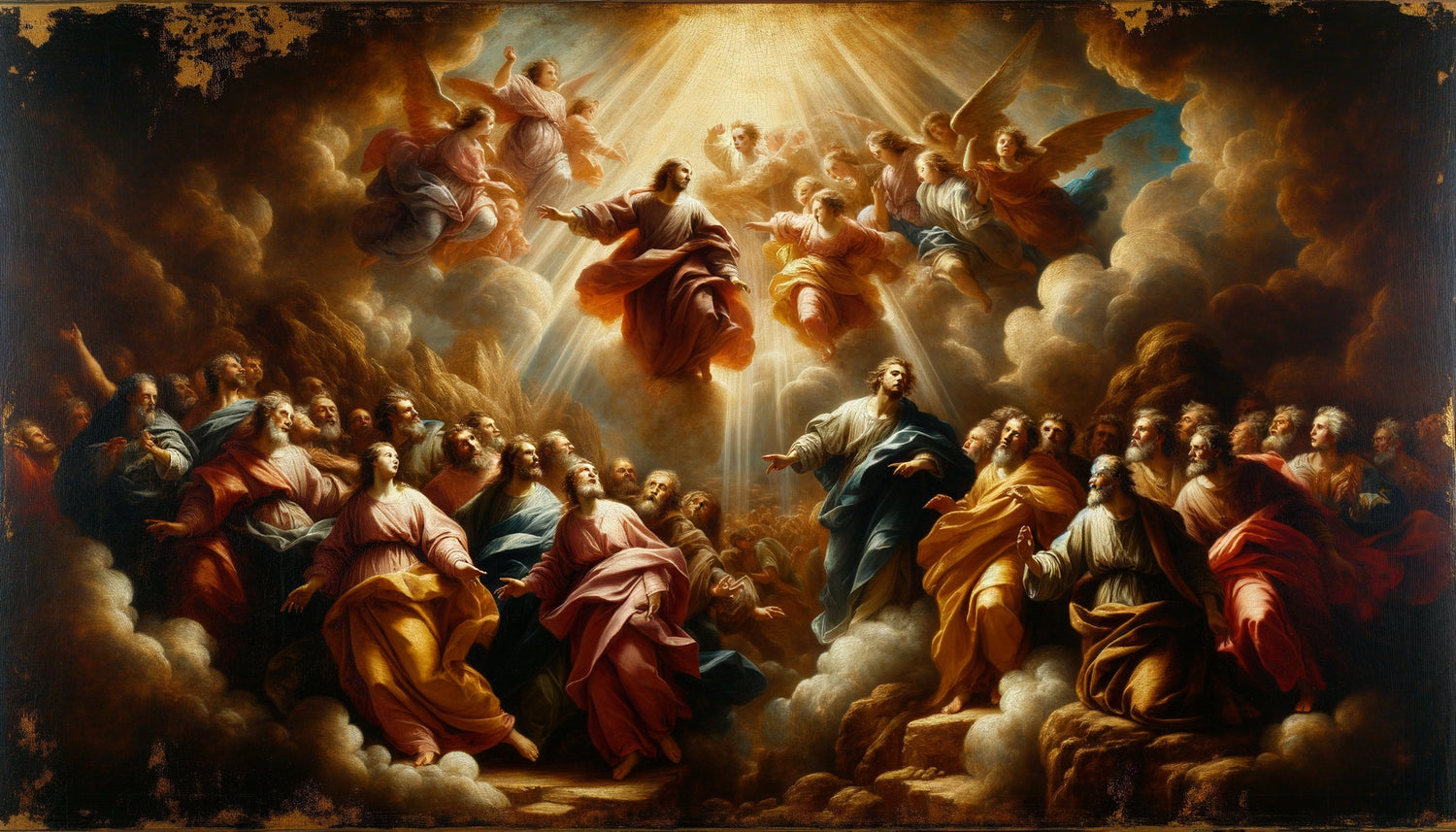
Last year, at a private auction in Lyon, I witnessed a couple discreetly – but firmly – arguing over the acquisition of a 17th-century Annunciation. They were neither religious collectors nor even practicing Catholics. Simply fascinated by the narrative power and technical mastery of this sacred scene. This anecdote perfectly summarizes the evolution of the market: historical paintings depicting religious scenes are experiencing a spectacular renaissance, far beyond their spiritual dimension.
Here's what these works bring to your interior: exceptional narrative depth that transforms a wall into a conversation piece, pictorial quality inherited from ancient masters that enhances any space, and surprising accessibility on the secondary market for authentic pieces.
Many still hesitate. How to integrate a Crucifixion into a contemporary living room without creating discomfort? Do these works risk devaluing, being considered outdated? What if your non-religious guests felt uncomfortable with a Pietà above the sofa?
Rest assured: savvy collectors have understood for a long time that religious iconography transcends its primary function. These paintings have become historical testimonies, artistic feats and prized conversation pieces in the most refined interiors – from New York lofts to London penthouses.
In this article, I will reveal to you why this segment of the market is exploding, what types of historical religious scenes are seducing new collectors, and how to choose a work that will enrich your aesthetic and financial heritage.
The unexpected renaissance of a century-old market
For three decades, antique religious paintings have been the poor relatives of auction rooms. Between 1990 and 2015, their prices stagnated, or even fell. Heirs were selling off grandmother's Holy Families, convinced that no one wanted them anymore. I personally acquired pieces from the 18th century at derisory prices during this period.
But since 2018, the wind has radically changed. Auction bids for quality biblical scenes have increased by 40 to 180% depending on the periods and schools. What happened? Three converging phenomena explain this spectacular renewal.
First, the emergence of a generation of collectors detached from denominational dimensions. For them, a 17th-century Nativity is not an object of devotion but a window onto art history, a testimony to lost pictorial techniques, a narrative composition of rare sophistication. They appreciate these works as they would admire a mythological scene – for their aesthetic and historical value.
Secondly, the progressive scarcity of the market. Unlike industrial reproductions, authentic historical paintings depicting religious scenes are in limited numbers. Museums hold the majority, and successions release fewer and fewer. This mechanical scarcity creates tension on prices, particularly for pieces in good condition.
Finally, the influence of eclectic interior design. Forward-thinking decorators have understood the visual power of a large antique religious painting in a contemporary minimalist interior. This bold contrast – an 18th-century Christ on the cross in an industrial loft – creates an emotional depth impossible to achieve with standard contemporary art.
Which religious scenes truly seduce collectors?
Not all subjects are equal on the market. Some religious scenes are highly sought after, while others struggle to find buyers. Twenty years of observing the market have taught me how to distinguish promising themes.
The Annunciations: elegance and discreet symbolism
The Annunciations currently dominate high-end sales. Why? Their balanced composition (the angel, the Virgin, often an architectural landscape), their generally soft colors, and their accessible symbolism even for non-initiates. A beautiful 16th-century Florentine Annunciation can now exceed 50,000 euros for a workshop piece with provenance.
These religious paintings integrate particularly well into bedrooms and libraries, where their contemplative atmosphere enriches the space without weighing it down. Collectors appreciate the delicate gestures, the mastered draperies, and the often diaphanous light of these compositions.
Scenes of saints in meditation: strength and interiority
Representations of saints in mystical ecstasy or meditation – Saint Jerome in his cave, Penitent Mary Magdalene, Saint Francis receiving the stigmata – are experiencing remarkable enthusiasm. Their dramatic power, the often spectacular chiaroscuro inherited from Caravaggio, and their intense psychological dimension fascinate contemporary buyers.
These historical paintings work beautifully in main living spaces. Their often generous format and expressiveness make them natural focal points. I have seen a 17th-century Neapolitan Saint Jerome literally transform a modern living room that was already sophisticated.
Nativity and Adoration Scenes: narrative warmth
Contrary to popular belief, Nativity scenes are no longer limited to the Christmas season. Their narrative richness – the multiplicity of characters, the diversity of attitudes, the frequent presence of animals and ruined architecture – makes them compositions of captivating visual density.
Adorations of the Magi, in particular, seduce with their exoticism (the precious gifts, the oriental costumes) and their often warm palette. A beautiful 17th-century Flemish Adoration, with its deep reds and golds, brings a rare chromatic opulence to antique art.

Why These Paintings Transform Your Interior (Beyond Aesthetics)
Owning a historical painting of a religious scene goes far beyond simple wall decoration. These works generate unexpected effects that my clients regularly report to me.
First, they slow down the gaze. In our interiors saturated with screens and rapid visual stimuli, an antique religious painting imposes a different temporality. Its details – a hand gesture, a fold of fabric, an exchanged look – are revealed gradually. Several collectors have confided in me that they discover new elements months after acquisition. This slow contemplation creates a welcome breath in our accelerated lives.
Next, these works instantly elevate the conversation. Unlike a contemporary abstract painting which provokes conventional comments (“that’s interesting, what does it evoke for you?”), a biblical scene opens discussions about history, pictorial technique, iconography, and the evolution of representations. Even your non-expert guests are naturally interested.
Finally, a little-known but crucial dimension: their patrimonial solidity. While contemporary art experiences violent speculative bubbles, high-quality antique religious paintings constitute a stable investment. A good 17th or 18th century piece, properly authenticated and restored, will never lose its value. The very materiality of the object – old canvas, natural pigments, authentic cracks – guarantees a permanence that digital prints or conceptual works do not possess.
How to Choose Wisely: The Experts' Criteria
The market for historical religious paintings holds exceptional opportunities, but also pitfalls for inexperienced buyers. Here are the decisive criteria that I systematically apply.
Condition is paramount above all else. A 16th-century painting repainted in the 20th century is worth less than an 18th-century piece in its original condition, even with a few minor restorations. Examine the cracks (they should be natural and irregular), the consistency of the pictorial layer, the condition of the frame. A good antique religious painting can have survived three centuries and remain perfectly readable.
Provenance and attribution are enormously important. A painting “school of” or “entourage of” is worth 10 to 50 times less than a firm attribution. But don't fantasize about the big names: an excellent religious scene by a well-documented regional master often constitutes a better investment than a dubious piece attributed to a famous artist.
Expressiveness trumps academic perfection. Between a technically flawless but cold painting, and a more modest but vibrant work of art, always choose the latter. It is this intensity that you will contemplate daily. I have seen collectors tire of perfect but inexpressive pieces, never of imperfect but inhabited works.
Size also matters. Large format religious paintings (over 100 cm) are proportionally less expensive than medium formats, because they impose hanging constraints. If your space allows it, prioritize large sizes: their presence and visual impact are incomparable.

Contemporary integration: dare to contrast boldly
The question inevitably arises: how to integrate a historical religious painting into a modern interior without creating a "chapel" or "dusty museum" effect?
The answer lies in one word: contrast. Avant-garde decorators have understood this for a long time. A 17th century Christ on the cross takes on a multiplied force against an immaculate white wall, in a purified space with contemporary lines. This confrontation between old and new, sacred and profane, creates a sophisticated aesthetic tension.
Absolutely avoid multiplying markers of antiquity. An antique religious painting enhanced by sleek contemporary furniture creates a spectacular effect. The same painting surrounded by Renaissance cabinets and chandeliers transforms your living room into an ancient parish hall.
Lighting radically transforms the perception of the work. Forget gilded museum-style sconces. Opt for contemporary directional but soft LED lighting that reveals the pictorial matter without creating reflections. Some collectors even use intelligent lighting systems that adapt the intensity according to the time of day.
Dare unexpected pieces. Who decreed that a religious scene should be confined to the living room? I have seen a magnificent Mary Magdalene enhance a contemporary bathroom with raw materials. An Annunciation from Florence can sublimate a design kitchen. These bold choices create unique, personal, memorable spaces.
Transform your interior with a work full of history
Discover our exclusive collection of historical paintings that bring narrative depth and timeless sophistication to your living spaces.
The market today: opportunities and price ranges
The market for historical paintings of religious scenes currently offers a surprising accessibility for those who know where to look. Contrary to popular belief, these works are not all out of reach.
For 1,500 to 4,000 euros, you can acquire excellent religious scenes from the 18th or 19th century, often from regional French, Italian or Flemish schools. These pieces, although unsigned by famous masters, possess remarkable pictorial quality and an undeniable presence. I particularly recommend the provincial French schools – Lyonnaise, Toulouse, Provence – whose rating remains moderate but the quality exceptional.
Between 4,000 and 15,000 euros, you access pieces from documented workshops, sometimes attributed to secondary masters. The formats are often more generous, the state of conservation better, the provenance traceable. It is in this range that I generally guide serious beginner collectors.
Beyond 15,000 euros, you enter the realm of firm attributions, prestigious schools (Neapolitan Caravaggists, Flemish Primitives, Fontainebleau school), or even established masters. But even at these levels, religious paintings are 30 to 50% cheaper than comparable secular subjects – a market anomaly that is unlikely to last.
Where to look? Regional auction houses remain the best hunting ground. Provincial auctioneers still see successions containing underestimated antique religious paintings. Online specialized platforms are also developing, but require an experienced eye to avoid unpleasant surprises.
The future of this market: why invest now
All indicators suggest that we are on the cusp of a sustainable revaluation of historical religious paintings. Several structural factors support this forecast.
Demographic pressure on supply is intensifying. The generation currently inheriting these works is often the last to own them in number. Future successions will contain fewer and fewer antique paintings. This mechanical scarcity should support prices in the medium term, particularly for quality pieces.
The geographic expansion of demand is also at play. Asian, Middle Eastern and South American collectors are now interested in European antique art, including religious scenes, perceived as testimonies of technical excellence and fascinating historical documents. This internationalization of demand creates upward pressure.
Finally, the generational shift among collectors favors these works. New buyers, less conditioned by the religious taboos of their elders, appreciate these paintings for their pure artistic value. This paradoxical desacralization – which frees the work from its liturgical function to reveal its aesthetic dimension – opens the market to an infinitely wider audience.
My advice: if a historical religious scene touches you, acquire it now. Current prices still offer opportunities that we will probably not see again in ten years.
Starting your collection: concrete first steps
You are convinced but don't know where to start? Here is the path I systematically recommend to new collectors of antique religious paintings.
Train your eye before opening your wallet. Visit auction houses during pre-auction exhibitions. Handle catalogs. Observe the paintings closely: the craquelure, the pictorial matter, the thickness of the layer, the consistency of the varnish. Nothing replaces this direct sensory education. After about ten visits, you will naturally begin to distinguish good pieces from mediocre ones.
Identify your thematic and stylistic preferences. Are you sensitive to the complex compositions of Adorations or the intensity of solitary saints? Do you prefer the warm palette of Italian schools or the cooler tones of Northern schools? This clarification will guide your research and avoid regretted impulsive purchases.
Establish a realistic budget including ancillary costs. In addition to the acquisition price, add 10 to 20% for framing (a good antique painting deserves a worthy frame), sometimes 5 to 15% for light restoration (cleaning, consolidation), and shipping costs if the work is bulky. A painting costing 3,000 euros can ultimately cost 4,000 once properly presented.
Prioritize quality over quantity. An excellent XVIIth century religious painting will always be worth more than three mediocre pieces from the XIXth century. A coherent collection is built slowly, through thoughtful additions of pieces that dialogue with each other.
Never hesitate to seek expertise. For any purchase exceeding 2,000 euros, have the work examined by an independent expert. Their fees (generally 100 to 300 euros) will save you from costly mistakes. A good expert detects repaints, authenticates the period, sometimes specifies the attribution.
Imagine yourself in six months, your first historical religious scene painting beautifully framed facing your sofa. Your guests approach, intrigued by this Annunciation whose light seems to change with the hour. Conversations deepen. Your interior has gained a narrative dimension that was lacking. And you know that this work will last through the decades, gaining value as trends come and go.
Start by visiting an auction house this month. Attend an exhibition. Let your sensitivity guide your steps towards the work that calls to you. The acquisition will follow naturally, and with it, entry into the fascinating universe of antique art collecting.
Frequently Asked Questions
Will an antique religious painting create discomfort among my non-believing guests?
This concern frequently arises but almost always proves unfounded. Collectors I accompany report exactly the opposite: their paintings of religious scenes evoke curiosity and admiration, rarely discomfort. Why? Because the context of display transforms perception. In a church, a Crucifixion calls for contemplation. In a contemporary living room, it becomes a historical document, a technical feat, a conversation piece. Your atheist guests will appreciate the mastery of chiaroscuro, the dramatic composition, the expressiveness of the faces – just as they would admire a Greek mythological scene without believing in Zeus. The key is integration: an antique religious painting surrounded by resolutely contemporary elements loses its devotional charge to reveal its purely aesthetic dimension. If you are still hesitant, start with less frontal subjects: a gentle Annunciation, a saint in meditation, a narrative Nativity. These compositions offer all the pictorial richness of religious scenes without the dramatic intensity of the Passion.
How can I be certain that a painting is genuinely antique and not a recent copy?
The authentication of historical paintings relies on several converging examinations that you can partially perform yourself. First, observe the craquelure: on a truly old painting, it is natural, irregular, follows the movements of the canvas and pictorial layer. False craquelure obtained by rapid firing appears too regular, superficial. Then examine the back: an old canvas has a consistent patina, traces of natural wear, sometimes labels or stamps from ancient collections. Beware of backs that are too clean or artificially aged. The frame itself speaks volumes: tenon and mortise joints, marks of hand tools, old wood species (oak, poplar) testify to manufacturing from the period. Stylistic consistency also counts: each era has codes (anatomical proportions, rendering of fabrics, color palette) that a forger struggles to reproduce perfectly. But for any serious purchase, consult a certified expert. Their tools (UV light revealing repaints, X-ray analysis penetrating layers, comparative documentation) far exceed the capabilities of naked eye observation. Investing in expertise (150 to 400 euros depending on complexity) protects you from costly errors and provides the necessary documentation for future resale or insurance of your antique religious painting.
What is the minimum budget to consider when acquiring a quality antique religious painting?
The answer will pleasantly surprise you: entering the collection of historical religious paintings is much more accessible than one might imagine. With 1,500 to 2,500 euros, you can acquire an authentic religious scene from the 18th or early 19th century in good condition, generally from a French or Italian regional school. These pieces, although unsigned by famous masters, possess real pictorial quality and undeniable presence once properly framed. I particularly recommend this segment to novice collectors: it allows you to train your eye without major financial risk. Between 3,000 and 6,000 euros, you access larger formats, excellent condition, sometimes attributions to documented workshops. It is within this range that the best current market opportunities are located – magnificent pieces still undervalued because the general public ignores their existence. Beyond 8,000 euros, you enter the domain of prestigious schools and firmer attributions. But never forget: add 15 to 25% to the purchase price for professional framing and possible light restoration. An antique painting deserves a quality frame that respects its era and dignity. This overall envelope will guarantee you an acquisition that you will be proud of for decades, and which will increase in value while you enjoy it daily.