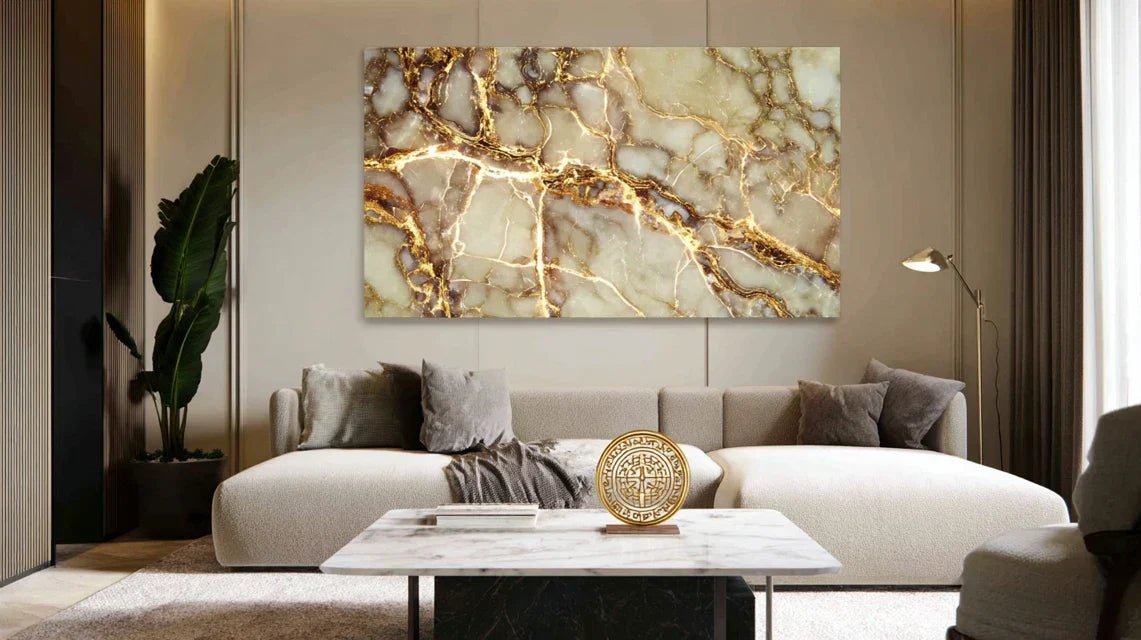
You’ve just hung this beautiful artwork in your living room, but something feels off. The ambiance isn't what you hoped for, and you feel uncomfortable in a room that has been carefully renovated.
The colors appeal to you, the style matches your taste, but there’s no harmony. This feeling of suffocation, this impression that energy doesn’t flow... as if your interior is resisting you.
You've followed all the decor advice from magazines, respected trends, and chosen quality works. But no one has told you about the energetic impact of your artistic choices on your daily well-being.
It’s normal to feel lost: modern decoration often ignores the millennia-old principles that govern energy flow in our living spaces. The result? Interiors that look beautiful in photos but are stifling on a daily basis.
By the end of this article, you will know precisely how to choose and position your artwork according to the rules of feng shui to create a home that recharges and inspires you every day.
Why do your artworks influence your energy more than you think?
Your wall art acts as an invisible energy regulator in your home. Every color, every shape, every subject conveys a vibration that interferes with your state of mind. Ignoring this dimension is like installing an air conditioning system without thinking about the orientation of the vents.
🏠 Customer testimonial: Sarah, an interior architect, didn't understand why her clients complained of sleep disturbances after redecorating their bedrooms. By simply replacing their red-toned abstract painting with a work in blue and green shades, the problems disappeared within a week.
💬 Conversation with a decor expert
Golden rule: Your wall art should serve your well-being, not just your ego: Just as a gardener chooses plants according to the exposure of their land, select your artworks according to the energy of each room. Guaranteed result: a home that revitalizes you from the moment you wake up, visible from the first week.
What’s behind your decorative malaise
You may be experiencing that inexplicable fatigue when you return home, difficulty concentrating in your office, or a feeling of oppression in certain rooms. Your decor is likely to blame.
The problem isn't your taste or budget, but the ignorance of the fundamental energetic laws that govern our living spaces. Your interior works against you instead of supporting you.
It’s like trying to grow tropical plants in the middle of winter: even with the best tools, if you don't respect the natural growing conditions, nothing will work.
Mistake #1: Ignoring the energetic function of each room
Contrary to popular belief, each space in your home has a specific energetic purpose. Your living room promotes conviviality, your bedroom regenerates, your office stimulates creativity. Hanging any artwork anywhere disrupts these natural functions.
Imagine an orchestra where each musician played their favorite piece without caring about the overall harmony. That's exactly what happens when you ignore the energy of your rooms.
This lack of awareness generates energetic dissonances that unconsciously exhaust you. As a result, you never truly feel at home in your own home.
🔍 Quick test: Close your eyes in your living room and take a deep breath. Do you feel a sensation of expansion or contraction in your chest? This first impression reveals the energetic state of your space.
Mistake #2: Choosing colors based on trends rather than your constitution
Home decor magazines bombard you with "trendy" palettes without ever explaining their impact on your nervous system. Each color generates a specific vibrational frequency that can energize or exhaust you depending on your personal constitution.
It’s like taking medication without consulting the dosage: even the best remedy becomes toxic at the wrong dose.
That's why you might love a painting in a store and hate it at home after a few weeks. Your body is sending you signals that your mind isn’t interpreting.
Mistake #3: Neglecting orientation and natural flows
Your walls are not neutral surfaces: they channel or block energetic flows depending on their exposure and decoration. A poorly positioned painting can create invisible but very real "energy bottlenecks."
Observe your cat: it instinctively avoids certain areas of your home. Animals perceive these energetic disturbances that we have unlearned to feel.
These blockages manifest as areas you unconsciously avoid, spaces that always remain messy, or rooms where you never manage to relax.
5 energetic warning signs:
- The avoidance of the gaze: You systematically avoid looking at certain artworks, a sign of vibrational dissonance
- Localized fatigue: You feel exhausted in certain well-arranged rooms
- Nocturnal restlessness: Your sleep is disturbed without apparent medical reason
- Mental dispersion: You can't concentrate in your workspace
- Unconscious avoidance: You always favor the same areas of your home
The trigger factor: Personal resonance
The secret to harmonious wall art lies in the resonance between your personal frequencies and those of your artworks. Like a tuning fork that makes another tuning fork vibrate at the same frequency, your energy must be in phase with your decor. Identify this resonance by observing your spontaneous physical reactions: chest expansion, shoulder relaxation, automatic smile.
Decorative law of attraction: A painting that makes you feel good at first glance will continue to energize you over time. Always test your bodily reaction before your intellectual one.
| ❌ Classic decor | ✅ Feng shui approach | 💡 Key difference | 🎯 Feeling experienced |
|---|---|---|---|
| Pure aesthetic choice | Energy harmony | Taking well-being into account | Feeling of fulfillment |
| Standard positioning | Respect for natural flows | Optimization of circulation | Daily dynamism |
| Trendy colors | Personalized hues | Adaptation to your constitution | Emotional balance |
| Uniform decor | Specialized zones | Function of each space | Natural efficiency |
The progressive method for harmonizing your paintings according to feng shui
Don't panic: transforming the energy of your home doesn't require a revolution or a colossal budget. Like a gardener who prepares his soil before planting, we will proceed in logical and progressive steps. Each level will bring you visible improvements before moving on to the next.
🎯 3-phase roadmap: Energy diagnosis (you identify imbalances), basic harmonization (you correct malfunctions), then advanced optimization (you sublimate your well-being). Expected result: a home that recharges you from the first week.
Phase 1: Energy diagnosis of your space
Before reorganizing, you must understand the current state of your home. This diagnostic phase will reveal the energetic strengths and weaknesses of each room. It's like examining a patient before prescribing treatment: essential to avoid costly mistakes.
Diagnostic tools needed
- A compass or mobile application: To determine the exact orientation of your rooms according to the cardinal points, which is the basis of traditional feng shui. Verify accuracy by comparing with multiple sources. Avoid fanciful compasses: geomancy requires accuracy within 15 degrees./
- A feelings journal: Paper support for noting your sensations in each zone over a full week. The principle: your body perceives imbalances before your mind does. Observe fatigue, irritability, well-being according to the hours and spaces./
- A plan of your home: Scale drawing to visualize flows and identify energy accumulation or dispersion areas. A simple sketch is sufficient; what's important is the representation of openings and volumes./
Let's move on to practice with methodology
Energy mapping of your home
Orientation recording: Stand in the center of each room with your compass and note the orientation of the main walls. This information determines the feng shui elements (wood, fire, earth, metal, water) to prioritize for each space. Take the time to make several measurements to eliminate errors.
⏱️ Time: 20 minutes | ✅ Successful when: You have the precise orientation of each room | ⚠️ Attention: Electronic devices can affect the compass, move away from screens
Natural circulation test: Walk through your home with your eyes closed, following your spontaneous impulses. Note where you feel attracted, where you slow down, and where you feel resistance. These sensations reveal the energy highways and traffic jams in your space.
⏱️ Time: 15 minutes | ✅ Successful when: You have identified 3 zones of attraction and 3 zones of resistance | ⚠️ Attention: Your mind will want to rationalize, rely only on bodily sensations
Analysis of your current artworks: Photograph each painting and note your first emotional reaction (maximum 3 words). Then classify by element: warm/cold colors, angular/round shapes, dynamic/soothing subjects. This typology reveals the imbalances in your current collection.
⏱️ Time: 30 minutes | ✅ Successful when: Each artwork is categorized and emotionally evaluated | ⚠️ Attention: Do not judge your tastes, simply observe objectively
✅ Validation of step 1: You now have the energy map of your home: orientations, natural flows, and emotional impact of your artworks. If some data seems unclear, take measurements again at a different time of day. This solid foundation conditions the success of the following steps.
OUR RECOMMENDED PRODUCTS
Phase 2: Harmonization According to the 5 Elements
Now that you know your terrain, we will balance energies according to the theory of the five elements of feng shui. This step corrects major malfunctions and brings a noticeable improvement in your well-being. The domino effect begins: a harmonized room positively influences other spaces.
Decorative Elements to Consider
- Artwork with Specific Dominances: Works representing each element (landscapes for wood, red abstract art for fire, ochre tones for earth, metallic for metal, blues for water). Prioritize high-end canvas reproductions over posters: the texture influences the energetic quality.
- Frames Adapted to the Elements: Natural wood, gold/silver metal, organic materials depending on the element to be strengthened. The frame acts as an amplifier of the artwork's energy. Avoid plastic which blurs energetic frequencies.
- Repositioning Supports: Adjustable hooks, rails or modular systems to test different locations without damaging your walls. Flexibility is crucial in this experimentation phase.
Element Allocation by Zone
Zoning According to Orientations: Assign a primary element to each room according to its orientation (East/Southeast = Wood, South = Fire, Southwest/Center = Earth, West/Northwest = Metal, North = Water). Then select artworks that strengthen this element while creating a harmonious cycle with the secondary elements.
⏱️ Time: 45 minutes | ✅ Success When: Each room has its primary element and its supports | ⚠️ Attention: Respect the cycles of generation (wood feeds fire, fire creates earth, etc.)
Positioning Test: Temporarily hang your artworks according to the established plan and live with this configuration for a full week. Daily note your energy level, sleep quality, general mood. Your body quickly indicates whether harmony is settling in.
⏱️ Time: 7 days of observation | ✅ Success When: Noticeable improvement in at least 2 well-being indicators | ⚠️ Attention: Change one element at a time to identify impacts
Phase 3: Personalized Optimization and Refinements
Your home already breathes better, it is time to finely personalize according to your specific needs. This phase elevates your home to the rank of personal sanctuary, perfectly attuned to your lifestyle and aspirations. It's the difference between a pleasant melody and your favorite song.
Micro-Adjustments According to Your Chronobiology
Adapting to daily cycles: Observe how natural light interacts with your artworks at different times. Slightly adjust positions to optimize effects: energizing in the morning to the east, soothing in the evening to the west. These subtleties create a decorative rhythm that supports your natural chronobiology.
⏱️ Time: 2 weeks of observation | ✅ Success when: Natural awakening in the morning, automatic relaxation in the evening | ⚠️ Attention: Seasonal changes modify brightness, anticipate adjustments
Harmonizing intensities: Balance strong artworks (vivid colors, dynamic subjects) with areas of visual rest (neutral tones, soft shapes). Create a visual rhythm that naturally guides the gaze and energy in each room. The goal: smooth circulation without snags or saturation.
⏱️ Time: 1 week of adjustments | ✅ Success when: The gaze circulates naturally without fatigue | ⚠️ Attention: Too many strong artworks create an energy overload
Feng shui progression rule: Move to the next step when you feel a stable improvement for 15 consecutive days. Be patient with fine adjustments: the energy of a space takes 21 days to stabilize completely.
Congratulations, you now master the fundamentals of feng shui wall art. Here are some expert subtleties that will make all the difference and set you apart from superficial approaches found everywhere.
🎭 Master feng shui tip: Change a minor artwork every season to maintain the energetic vitality of your home. This rotation prevents stagnation and keeps your space in perpetual motion, like nature itself. Prioritize small formats for these cyclical changes.
🤔 Frequent question from our readers
"I'm renting, can I really apply these principles without major renovations?"
Absolutely! I understand this concern: many think feng shui requires structural transformations. In reality, 80% of the impact comes from the choice and positioning of your artworks, not from modifying walls. Use removable hanging systems and focus on the most important areas: your bedroom and main living space. Even in a studio, you can create distinct energy zones with your wall art.
💡 Immediate action: Test moving a single picture in your bedroom this weekend and observe its impact on your sleep for a week. This experience will convince you of the effectiveness of the approach.
Energy pitfalls to avoid at all costs
Now that you know how to do it, let's talk about what not to absolutely not do. These mistakes can undo all your efforts or even create disruptions worse than before. They are understandable but avoidable with the right information.
- ⚡ Overloading an accent wall: It's tempting to concentrate all your best works in one place, but this creates an exhausting "energy bottleneck". One strong work per wall, complemented by discreet pieces. Your living room is not an art gallery.
- 🌊 Ignoring the water element in bedrooms: Paintings depicting water (oceans, rivers, rain) disrupt sleep and can generate symbolic humidity. Reserve them for passageways or workspaces. This mistake is very common because water seems soothing.
- 🔥 Placing "fire" works facing the bed: Bright reds, scenes of violence, wild animals create subconscious agitation harmful to rest. Even hidden at night, they continue to influence your subconscious. Move them to the living room or entrance.
- 🖼️ Hanging too high by habit: The "eye-level" rule does not apply in feng shui. A painting that is too high "draws" energy towards the ceiling and disconnects from the earthly anchor. Adjust according to function: lower for soothing, standard for neutrality.
- 🔄 Multiplying contradictory elements: Mixing fire and water, metal and wood without a logical cycle creates permanent energy conflicts. Respect the cycles of generation or control depending on the desired effect. A harmonious room favors one main element.
🛡️ Quick check system: Observe your first reaction when entering a room: expansion or contraction of the chest, desire to stay or flee, feeling of lightness or heaviness. Also monitor areas avoided by your guests or pets.
🎁 Special readers offer
Because you took the time to inform yourself, enjoy 10% discount on your first order:
⏰ Valid 72h after reading • Applicable to all our products
Your practical questions about feng shui paintings
You can start with a €50-100 budget by repositioning your current works and adding 1-2 strategic pieces. The impact is felt from the first week. First optimize with what you have: 70% of the result comes from positioning, 30% from the choice of artworks.
3 weeks to 2 months depending on the size and complexity. Allow 1 week per main room for fine adjustments. The essential feeling is felt immediately, subtleties reveal themselves gradually. Your energetic sensitivity refines with practice.
Absolutely! Create virtual energy zones with your artworks: soothing on the night side, dynamism on the day side, neutrality in transitions. A screen or a large plant defines the spaces. The key: respect orientations even in a single volume.
Test your solar plexus reaction: relaxation and openness = good sign, contraction or closure = to be avoided. Imagine the artwork in your home for 30 seconds with your eyes closed. If the image soothes you, go for it. If it generates tension, even subtle, move on.
Start with personal spaces (office, dressing room) to demonstrate effectiveness without imposing. Suggest "temporary tests" of 2 weeks in common areas. Often, the benefits on mood and energy convince better than theoretical explanations.
Your transformation begins now
In 3 weeks, you will enter your home with a totally different feeling. Your home will welcome you as a protective cocoon that instantly recharges you. Your guests will notice this particular atmosphere without being able to explain it. You will sleep better, concentrate more easily, smile more spontaneously.
This mastery of feng shui wall art will exceed your initial expectations: you will develop a energetic sensitivity valuable in all your future decor choices. This skill will follow you in all your moves and transform each new home into a personal sanctuary in just a few days.
The hardest part was understanding the mechanisms, it's done. Now, start by testing your feeling in your favorite room tonight. Observe, feel, adjust. Your rediscovered intuition will be your best guide to decorative harmony.
🌟 Your new decorative power: You now have the keys to create spaces that nourish you energetically every day. Trust your sensations: they never lie about what really makes you feel good.