I almost made a mistake that could have cost me dearly. It was during a small autumn exhibition in the Marais, where I had spotted a captivating work: a painting on canvas depicting a surreal pumpkin, half-organic and half-phantom, signed by an artist no one knew yet. The price was accessible, the emotion immediate. I took out my credit card... and the artist handed me the artwork wrapped in kraft paper, with no documents whatsoever. Nothing. No certificate, no detailed invoice, just a smile and a « thank you ». That day, I realized that authenticity is not presumed, it is documented.
Here's what certificates of authenticity bring to your collection: the guarantee of the artwork’s origin, its complete traceability for future resale, and your legal protection against disputes. Without these documents, your Halloween painting by an emerging artist is worth little more than its canvas and pigments.
Many novice collectors think that certificates only concern major names in contemporary art. A serious mistake. Today's emerging artists are tomorrow’s sought-after signatures, and a painting purchased without adequate documentation becomes almost impossible to value. You might possess a nugget, but without papers, it will remain invisible to the art market.
Rest assured: demanding the right documents is neither intimidating nor pretentious. It's simply protecting your emotional and financial investment. And that’s precisely what we are going to explore together, so that your acquisition becomes a solid asset.
The certificate of authenticity: the legal DNA of your artwork
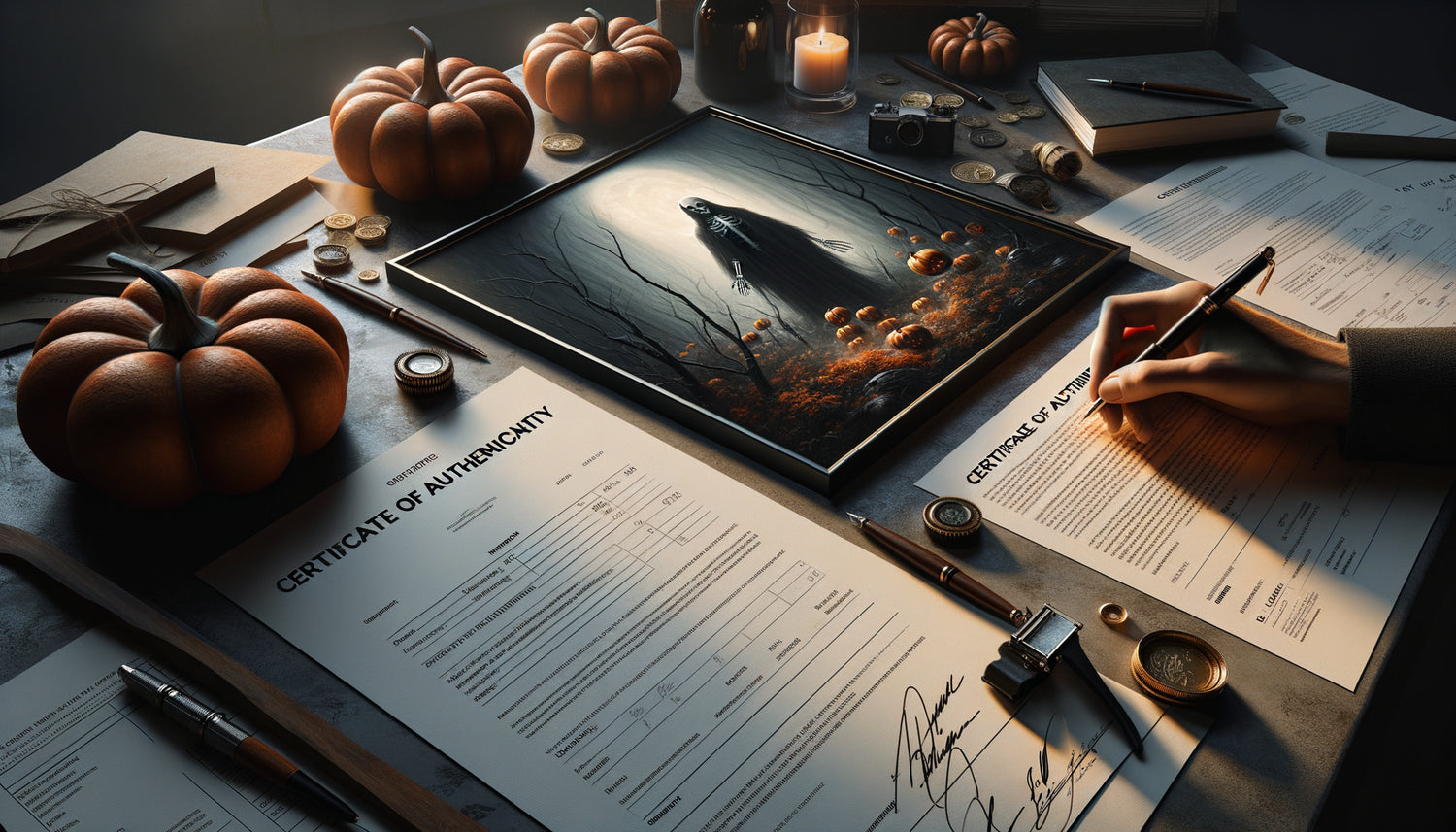
The certificate of authenticity is your Halloween painting's passport. This document, written and signed by the artist themselves, certifies that the work is indeed their handiwork and is part of their official production. For emerging artists, this is even more crucial than one might imagine: their rating can explode in a few years, and this little paper becomes your sesame for galleries, auctioneers and serious collectors.
A complete certificate must contain the exact title of the work, its precise dimensions in centimeters, the technique used (oil on canvas, acrylic on wood, mixed media...), the year of creation, and above all a unique identification number. This number acts like a DNA: it allows you to find the artwork in the artist's archives and proves that it is not a copy or unauthorized reproduction.
For a Halloween painting specifically, verify that the theme is mentioned in the description. If the artist has created a limited series for this season – spectral pumpkins, contemporary witches, autumnal vanities – the certificate must specify the number in the series (example: 3/10, meaning third copy out of ten unique pieces). This information literally multiplies the value of your acquisition.
The signature and stamp: more than a formality
The certificate of authenticity must bear the original handwritten signature of the artist, ideally accompanied by a personal stamp or seal. I have seen too many buyers accept photocopied or digitally signed certificates. It is insufficient. The handwritten signature creates a direct legal link between the creator and the acquirer. It transforms a simple piece of paper into legal proof.
Some emerging artists add a photograph of the artwork directly to the certificate, thus creating an undeniable visual link. This practice, which I strongly encourage, prevents any fraudulent substitution and greatly facilitates future appraisals. For an Halloween painting with its characteristic autumnal colors – deep oranges, intense blacks, unsettling greens – this photo becomes a faithful witness of the original condition.
The detailed invoice: your tax and heritage shield
The importance of the purchase invoice is dramatically underestimated. Yet, this document is your absolute protection in case of dispute, resale, or even inheritance. A complete invoice must mention the artist's full identity (name, first name, professional address, SIRET number if applicable), the exact date of the transaction, the total price paid including VAT details, and a comprehensive description of the artwork.
For an emerging artist selling an Halloween painting, the invoice creates an essential economic traceability. It proves the amount of your initial investment, which becomes crucial for calculating capital gains during a future resale. Without this document, you will not be able to justify the acquisition price, and the tax administration may consider the entire resale price as taxable income.
I particularly insist on this point with seasonal acquisitions like Halloween paintings: these works tend to increase in value over the years, as they become witnesses of specific creative periods. An emerging artist selling canvases for €800 today could see his rating rise to €5000 in five years. Your invoice then becomes a valuable heritage document.
The receipt in case of direct purchase in the studio
You buy directly from the artist's studio? Wonderful experience, but double vigilance on documents. Even for an informal transaction, demand a handwritten receipt if the artist does not have a professional invoice. This receipt must be dated, signed, and include all descriptive elements of the artwork. Photograph it immediately and keep a secure digital copy.

The certificate of provenance documents the complete journey of the work from its creation. For an emerging artist's Halloween painting, this document may seem superfluous – after all, you are the first buyer. Strategic mistake. Even in primary acquisition, request a document attesting that you are buying directly from the artist, and that the artwork has never been exhibited, sold, or reproduced elsewhere.
This initial provenance becomes the first chapter of your work's story. If you resell it tomorrow, the new owner will add their name to this documentary chain. The longer and more documented this chain is, the more valuable and credible the artwork becomes. Major collectors and institutions are only interested in works with an impeccable history.
For Halloween paintings specifically, the provenance may mention the context of creation: was the work created for a themed exhibition? Is it part of a special commission? Was it presented at an artistic event related to this holiday? This contextual information considerably enriches the narrative of the artwork and facilitates its future valuation.
The additional documents that make the difference
Beyond the three pillars (certificate of authenticity, invoice, provenance), some additional documents transform a simple acquisition into a thoughtful investment. Ask the emerging artist for an updated artistic CV: training background, collective and individual exhibitions, awards or residencies obtained, public or private collections owning their works. This CV, which may seem modest today, becomes a treasure in ten years.
If your Halloween painting has been exhibited, request the exhibition catalog or, failing that, photographs of the artwork in situ with visible labels. These exhibition proofs mechanically increase the value of the artwork: they demonstrate that it was selected, validated by a curator or gallery owner, and presented to the public. It is a form of early institutional recognition.
The press kit and publications
Even emerging artists are sometimes the subject of local press articles, mentions in specialized blogs or reviews in regional art magazines. Systematically collect these press clippings, even modest ones. They gradually build the documented notoriety of the artist. For a Halloween painting, specifically look for autumn publications or lifestyle magazines that may have featured the artwork or its creator.
Some artists keep an artist's sketchbook where they document each creation with photos of the creative process, preparatory sketches, and statements of intent. If the artist agrees to provide you with copies of these pages concerning your painting, you obtain exceptional narrative supplementation, perfect for future buyers or donations to institutions.

When the emerging artist lacks all the paperwork
Let's be realistic: many emerging artists, especially at the beginning of their career, haven't yet structured their administrative documentation. They create with passion, sell with enthusiasm, but sometimes neglect the paperwork. This is not a deal-breaker, but it requires you to adopt a kind and educational stance.
Offer the artist to co-create the missing documents. Many willingly accept if you provide them with an authenticity certificate template or assist them in writing a provenance document. This collaborative approach also creates a privileged relationship between collector and creator, often fruitful in the long term.
If the artist categorically refuses to provide the requested documents, do not buy. No matter how beautiful the artwork is, no matter how accessible the price, a Halloween painting without documentation becomes a decorative object with no patrimonial value. You deserve better than this future frustration. Art is collected with your head as much as with your heart.
Create your own acquisition file
If you can't obtain all the official documents, create your own acquisition file. Photograph the artwork from several angles with neutral lighting. Document the purchase context: date, location, circumstances. Keep all email or message exchanges with the artist. Ask them to sign a simple handwritten declaration attesting that they sold you this specific work. These alternative proofs, although imperfect, are better than no documentation at all.
Ready to invest in an authenticated and secured artwork?
Discover our exclusive collection of Halloween paintings that combine seasonal creativity and complete professional documentation.
Protecting your documents: preservation is part of the collection
Having the right certificates is not enough: you also need to keep them properly. I personally use a double system: physical originals stored in a neutral polypropylene sleeve, protected from light and humidity, and digital copies secured in a private cloud as well as on an external hard drive.
For each Halloween painting acquired, create a digital folder named after the artist and the title of the work. Scan all documents at high resolution (minimum 300 dpi). Add photographs of the artwork taken on the day of acquisition, as well as regular photos to document its condition over time.
This level of documentation may seem excessive for an emerging artist, but it will become your best asset when reselling. Serious buyers, galleries, and auction houses require this level of traceability. Your anticipation today is your profit tomorrow.
Investment begins with documentation
Imagine yourself in ten years, facing an auctioneer examining your Halloween painting that has become a sought-after piece. The emerging artist of yesterday is now rated, exhibited in institutions, their works are selling out. You bring out the complete file: original certificate of authenticity, purchase invoice, documented provenance, exhibition catalog from the time. The auctioneer smiles. Your work goes on sale with a high estimate. Your foresight today turns into financial recognition.
This scene is nothing like fiction. I have lived it several times, and the difference between documented collectors and others is abysmal. The former multiply their initial investment by five or ten. The latter struggle to resell, even when the artist has become famous, simply because they cannot prove the authenticity of their acquisition.
So, before hanging this beautiful Halloween painting in your living room, before enjoying its autumnal hues and mysterious atmosphere, take the time to create its complete identity file. Demand certificates of authenticity, a detailed invoice, provenance. Supplement with additional documents. Keep everything preciously. You are not simply collecting a work: you are building a documented artistic heritage, traceable, valorizable. It is this rigor that transforms a crush into a smart investment.
Frequently asked questions about certificates of authenticity
Does a printed certificate of authenticity have the same value as a handwritten one?
No, and this distinction is crucial. A certificate can be printed for descriptive information (title, dimensions, technique, identification number), but it must absolutely include an original handwritten signature from the artist. This signature creates the legal link between the creator and the artwork. A fully printed certificate, with a digital or photocopied signature, has no legal value in case of dispute. Always require the artist to sign each certificate by hand, ideally in your presence. Some artists even add a small drawing or personal stamp, further reinforcing the authenticity of the document. For an emerging artist's Halloween artwork, this handwritten signature is your only guarantee that the work truly belongs to the creator’s official catalog and is not an unauthorized reproduction or future false attribution.
What to do if I bought a Halloween artwork without a certificate of authenticity?
Don't panic, all is not lost, but act quickly. Immediately contact the artist to ask them to retroactively provide the missing documents. Most emerging artists are happy to do so, especially if you remind them of the circumstances of the purchase (date, location, price). Provide them with photos of the artwork and, if possible, proof of payment (bank statement, even informal receipt). If the artist is unreachable or refuses, create your own traceability file: photograph the work from all angles, document in writing everything you remember about the transaction, search for other similar works by this artist to establish stylistic comparisons. Keep all communication records with the seller. This alternative file will never replace an official certificate, but it constitutes a minimum documentary basis. For the future, consider this episode as a lesson: never again buy without complete documentation, no matter how tempting the artwork.
Are digital or blockchain certificates reliable for emerging artists?
Digital certificates and blockchain technologies represent the future of artistic authentication, but with important nuances for emerging artists. A blockchain certificate creates a counterfeit-proof and permanent traceability of the artwork, which is theoretically excellent. However, this technology is only reliable if the artist themselves is verifiably registered on the blockchain platform used. For an emerging, little-known artist, without a gallery or institutional representation, nothing guarantees that their blockchain identity is authentic. My advice: accept a blockchain certificate, but also require a traditional paper certificate with handwritten signature. This double security combines innovation and tradition. Furthermore, blockchain systems vary in reliability depending on the platforms: prioritize solutions recognized by the professional art market. For an Halloween painting, this double authentication becomes an additional selling point during a future resale, as you offer the buyer the choice between traditional and modern traceability.