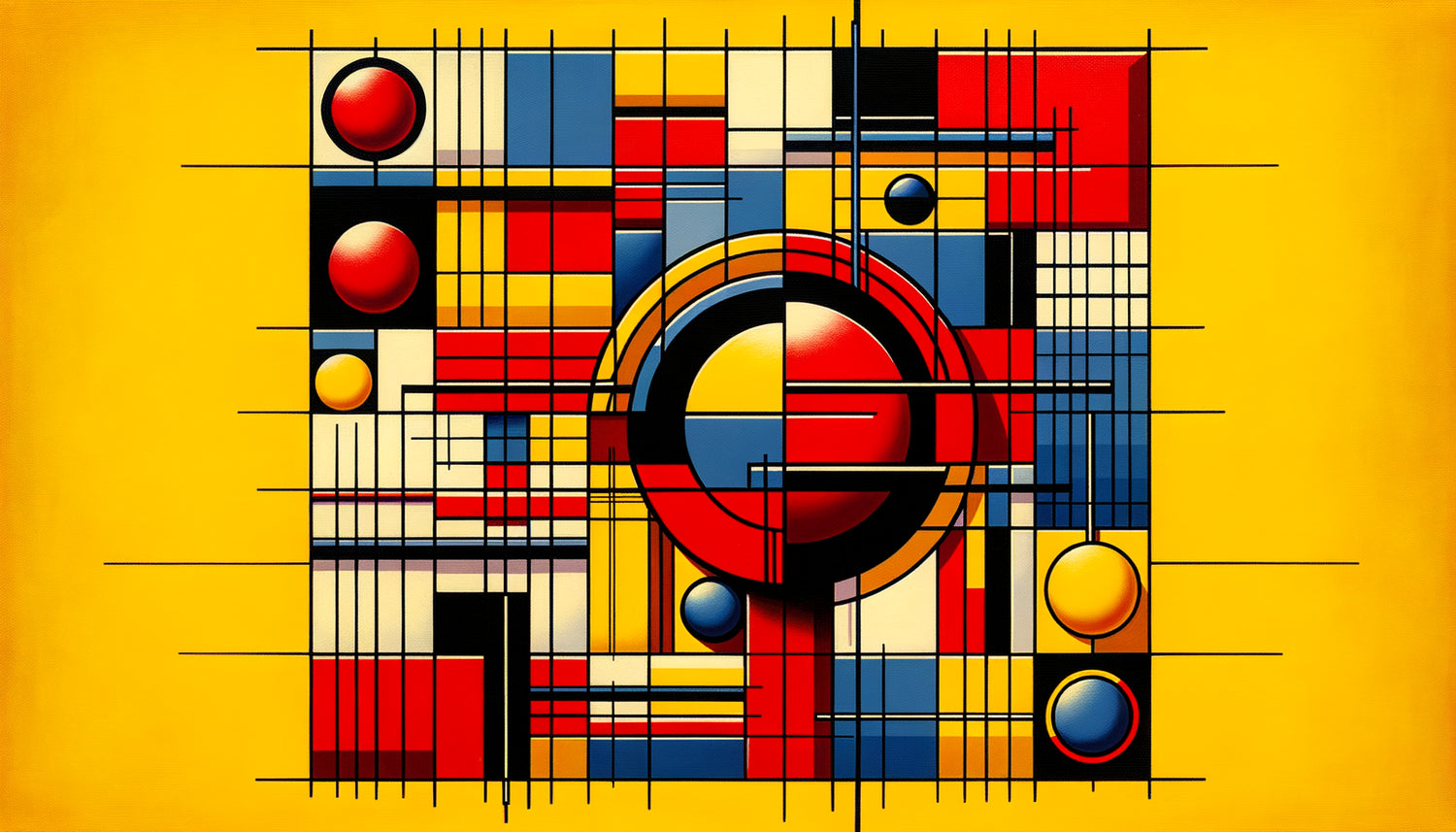
Imagine a vibrant red rectangle conversing with a deep blue circle on an immaculate white background. Nothing else. No perspective, no decor, no narrative. Just the absolute purity of geometric forms. This visual revolution spearheaded by Bauhaus painters transformed our relationship with space and continues to inspire contemporary interiors. But why did these artists radically abandon all spatial representation to embrace geometric abstraction?
Here's what this artistic revolution still brings today: a liberation of breathing space, a purified visual hierarchy that soothes the eye, and a universal language that transcends cultures. This transformation was not merely an aesthetic whim, but a profound response to the upheavals of an era. You might wonder how squares and circles can embody a worldview? How have these abstract compositions revolutionized not only painting, but architecture, design, and even our living spaces? I'll take you into the workshops of the Bauhaus, in Weimar then Dessau, where this revolution took shape between 1919 and 1933. Together, we will understand why this radical break with tradition still resonates in every contemporary minimalist interior.
The trauma of an era: when reality demands a new vision
Bauhaus painters lived through the collapse of a world. The First World War had torn Europe apart, questioning all certainties. How to represent the depth and perspective of a bourgeois living room when reality itself had collapsed? Johannes Itten, Paul Klee, Wassily Kandinsky – these teaching artists understood that it was necessary to rebuild from the foundations.
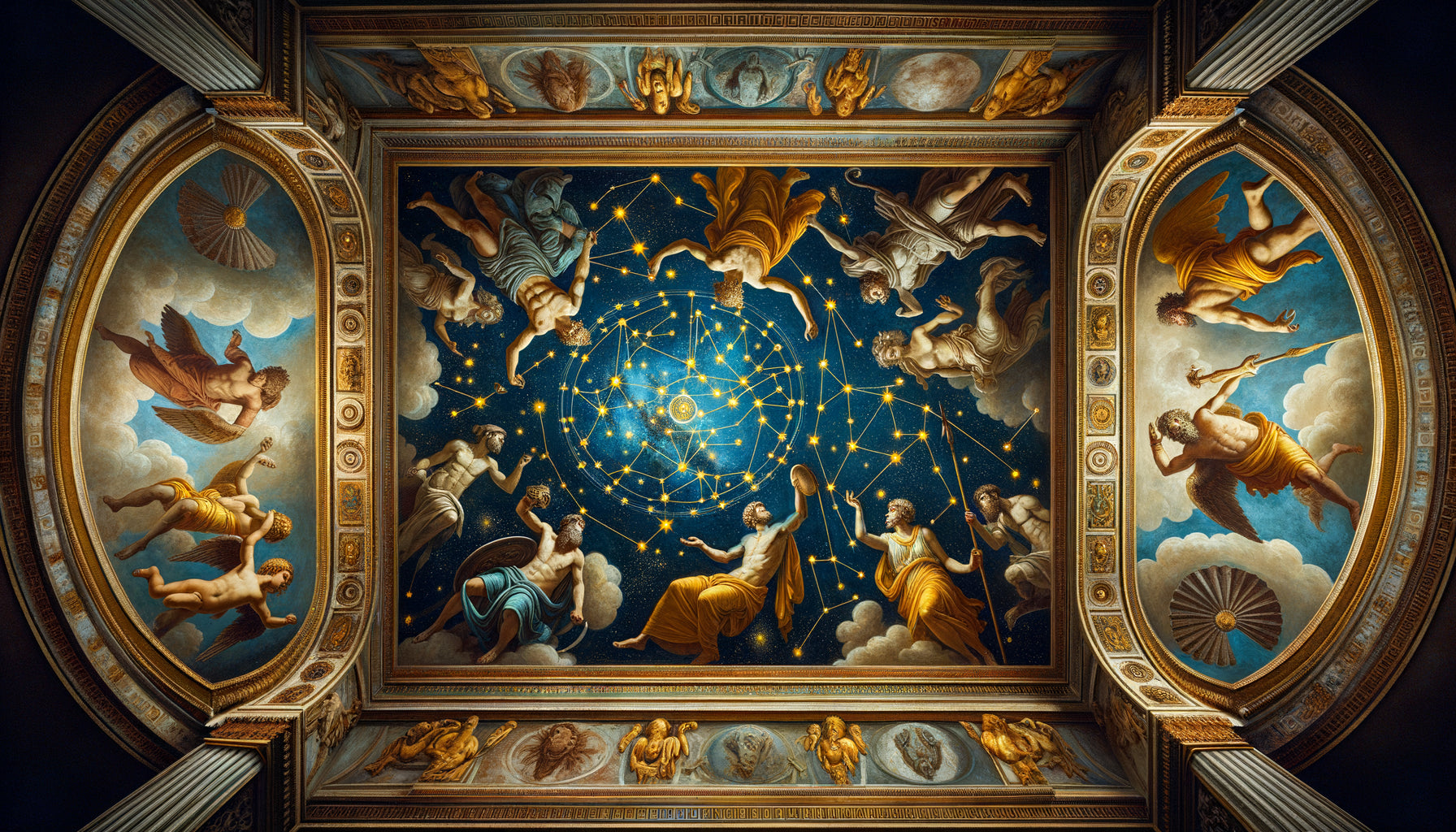
Geometric abstraction offered them this possibility. By rejecting spatial representation, they refused the deceptive illusion of traditional depth. No more trompe-l'oeil tricks, no more servile imitation of nature. The Bauhaus advocated for honesty of materials and the truth of forms. A triangle remains a triangle, a plane remains two-dimensional – why lie by creating an illusion of a third dimension?
This visual frankness corresponded to a quest for transparency in all areas of life. Walter Gropius's glass and steel architecture, Marcel Breuer's tubular furniture – everything was to reveal its structure, its function, its essence. Painting followed the same logic: geometric abstraction showed what it truly was, a flat surface organized by shapes and colors.
The utopia of a universal language beyond borders
This is what deeply motivated these creators: the conviction that a circle speaks the same language in Berlin, Tokyo or New York. Bauhaus painters rejected spatial representation because it remained captive to cultural codes. A Renaissance landscape means something to a cultured European, but remains hermetic elsewhere.
Geometric abstraction, on the other hand, transcends boundaries. A red square possesses an immediate, visceral presence that requires no erudition. Josef Albers devoted decades to exploring chromatic interactions in his nested squares. His compositions tell no story, represent no place – yet they communicate directly with our perception.
This universality served the ambition of the Bauhaus: to create a total art for a renewed society. In their vision, the German worker and the Japanese intellectual should be able to inhabit spaces designed according to the same fundamental principles. Pure geometry became this common language, stripped of superfluous ornamentation and elitist references.
Color freed from representation
Kandinsky theorized it masterfully: each color possesses an intrinsic spiritual value. Yellow advances, blue recedes, red vibrates with energy. But these properties dilute when color serves only to represent an object. A blue used to paint the sky loses its abstract power.
By rejecting spatial representation, the painters of the Bauhaus freed color. It was no longer in the service of illusion, but became a constructive element in its own right. In their geometric compositions, red dialogues with black, yellow creates tension with blue – without reference to the outside world. This autonomy of color still influences contemporary interior design.

The machine as muse: adapting art to the industrial age
It is impossible to understand this shift without grasping the industrial context. The Bauhaus was born in a Germany rebuilding itself, where mass production promised to democratize beauty. However, traditional spatial representation resists industrial reproduction. Each nuance, each subtle gradient of perspective requires craftsmanship.
Geometric abstraction, on the contrary, adapts perfectly to standardization. Simple shapes, blocks of color, compositions based on the grid – all of this can be mechanically reproduced without losing its impact. The painters of the Bauhaus did not shun the machine; they embraced it as the tool of their time.
This approach revolutionized graphic design. Herbert Bayer’s posters, the sans-serif typefaces created at the school – all stem from this reproducible geometric aesthetic. Why create a complex illusion of depth when a red triangle and a yellow circle are enough to capture the eye and convey a message?
When the square becomes spiritual: the quest for the essential
Here's perhaps the most fascinating aspect: for these artists, geometric abstraction was not simplification but intensification. Kandinsky, deeply mystical, saw in pure forms a direct access to the spiritual. A perfect circle embodied infinity, the square represented terrestrial stability, the triangle pointed towards the transcendent.
By eliminating spatial representation, Bauhaus painters suppressed narrative distractions. When faced with a Kandinsky composition, you don't ask what story it tells. You directly feel the balance of masses, the tension of colors, the rhythm of forms. It’s a meditative, almost architectural experience.
Paul Klee, for his part, explored how geometry could capture the invisible essence of things. His juxtaposed color squares evoke gardens, cities, landscapes – without ever representing them. This suggestive abstraction opens up a space for contemplation that traditional representation closes with its descriptive precision.
The canvas space as lived space
Paradoxically, by rejecting the illusion of depth, Bauhaus painters created a new type of space. Their geometric compositions do not simulate a space into which one could enter – they create an autonomous visual space that interacts with our real environment.
Hang a Kandinsky abstract canvas in your living room: it doesn't create a window to a fictitious elsewhere, it functions as an architectural element that modifies the very space you are standing in. The colors resonate with your walls, the shapes dialogue with your furniture. This is what explains why geometric abstraction still dominates contemporary interior design.

The invisible legacy: how this revolution shapes your daily life
Look around you. The interfaces of your applications, urban signage, the logos of major brands – everywhere, you recognize the legacy of this radical shift. By rejecting spatial representation, Bauhaus painters created the visual vocabulary of modernity.
This influence extends far beyond painting. Current minimalist architecture, with its clean volumes and large colored surfaces, descends directly from this revolution. Scandinavian furniture, contemporary Japanese interiors, Apple's aesthetic – all draw from this source: the conviction that a pure geometric form communicates more than a representation laden with detail.
Geometric abstraction has also transformed our relationship to domestic space. Before Bauhaus, walls were decorated with landscapes, historical scenes, portraits – as many windows onto other worlds. Today, we accept that a simple assemblage of colored rectangles can sublimate an interior. This mental evolution is a direct legacy of the Bauhaus revolution.
Let pure geometry transform your space
Discover our exclusive collection of space art that captures this revolutionary vision to sublimate your walls with the timeless elegance of geometric abstraction.
The boldness that changes everything: daring radical simplicity
Ultimately, understanding why Bauhaus painters rejected spatial representation is grasping a moment when creators had the courage to start from scratch. They could have continued to perfect inherited techniques, to paint more beautiful landscapes, more subtle perspectives. But they chose the most radical path: eliminating anything that was not essential.
This approach resonates particularly today, in our age saturated with information and images. Geometric abstraction offers what our exhausted gaze seeks: clarity, order, peace. A black square on a white background does not shout, seduce, or tell a story – it is simply there, present, stable, soothing.
Living with geometric abstraction means accepting that less can truly be more. It means understanding that a composition of three primary colors can generate more emotion than a detailed landscape. It means trusting the power of simplicity – exactly what the Bauhaus revolutionaries taught us a century ago.
Now imagine your interior transformed by this philosophy. White walls welcoming a few vibrant geometric shapes. Spaces that breathe, freed from visual clutter. A harmony born not of excessive decoration, but of the precise balance between form, color and void. That is the living legacy of Bauhaus.
This revolution doesn't belong to the past – it continues to inspire every conscious choice towards simplicity, every decision to prioritize essence over ornament. The Bauhaus painters rejected spatial representation not out of provocation, but from a deep conviction that art should reflect its time. A century later, in our hyper-connected and often chaotic lives, their message of geometric clarity is more relevant than ever.
Frequently Asked Questions About Bauhaus Geometric Abstraction
Isn't geometric abstraction too cold for a warm interior?
This is a concern I often hear, and it’s perfectly legitimate. Yet, experience proves the contrary. Bauhaus geometric abstraction works with vibrant primary colors – red, yellow, blue – which bring immediate energy to a space. Think of Kandinsky's compositions: they are never cold, but pulse with an inner life. The secret lies in balance: a room with neutral tones is instantly illuminated by a colored geometric artwork. Moreover, these clean shapes allow your existing decor to breathe – your textiles, plants, personal objects. Abstraction creates a soothing framework that highlights the warmth of your daily life, rather than competing with it. Just try it: you'll discover that a yellow circle on your white wall creates a luminous, almost solar presence that warms up the entire room.
How do you choose a geometric abstract artwork when you don't know much about it?
Excellent question, and here’s the wonderful news: you don't need any expertise. That's precisely why Bauhaus painters rejected complex spatial representation – to create art that is immediately accessible. Trust your visceral feeling. Are you drawn to a composition with a dominant red triangle? That's your answer. Does this series of blue rectangles soothe you? Listen to that intuition. Geometric abstraction works on a direct perceptual level, before any intellectual analysis. A few practical tips: for a small space, prioritize compositions with plenty of white and a few clean shapes; for a large room, dare to use denser artworks with multiple geometric elements. Think about the colors already present in your home – an artwork can either repeat them (to create harmony) or contrast them (to energize). And remember: there are no wrong choices in abstraction, only works that resonate or don't with you.
Can geometric abstraction and figurative elements be mixed in your decor?
Absolutely, and it’s even fascinating! While Bauhaus painters radically rejected spatial representation in their artistic approach, that doesn't mean you have to ban all depictions of your interior. On the contrary, geometric abstraction excels as a structuring element. Imagine a gallery wall combining a family photograph, a botanical watercolor, and a Bauhaus geometric composition – the latter provides a visual anchor that unifies the whole. The key lies in balance: if your decor already includes many detailed figurative elements (landscapes, portraits, narrative scenes), a geometric abstract artwork creates a soothing counterpoint, a visual breathing space. Conversely, in a very minimalist interior, you can add a few figurative touches that will gain impact thanks to the clean setting. This coexistence also reflects our contemporary life: we constantly navigate between the concrete and the abstract, the narrative and the conceptual. Your decor can harmoniously reflect this richness.