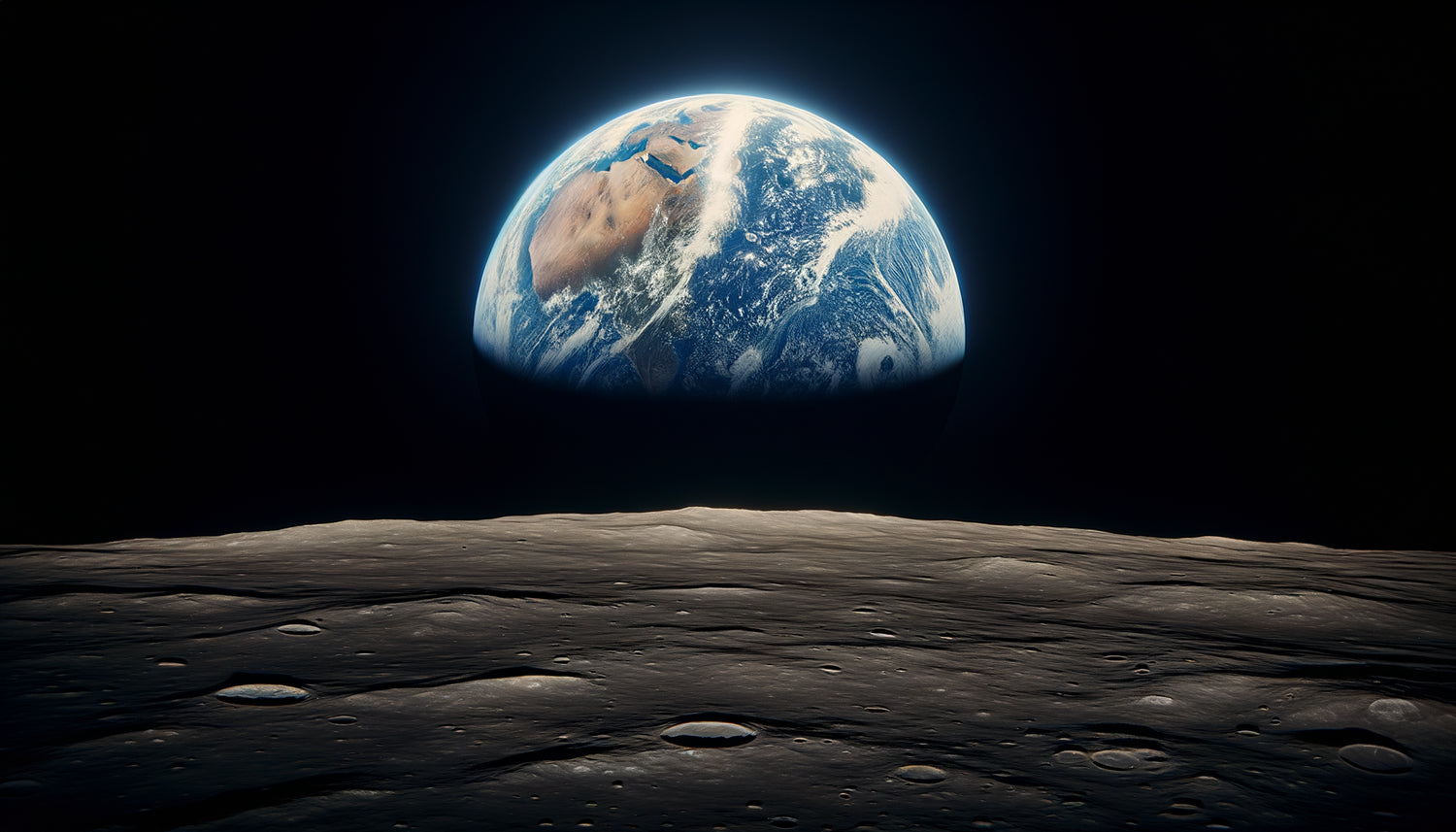
December 24, 1968. Three men float 380,000 kilometers from home. Suddenly, above the gray and desolate surface of the Moon, something emerges: a blue and white sphere, fragile, suspended in cosmic emptiness. William Anders grabs his Hasselblad and captures Earthrise. This photograph would forever change our way of perceiving ourselves in the universe – and radically transform space art for decades to come.
Here's what the Apollo 8 mission brought to space art: a new perspective on our planet as an object of universal beauty, the emergence of an artistic movement centered on terrestrial fragility, and the inspiration of a generation of artists seeking to capture cosmic emotion in our interiors.
Before Apollo 8, Earth seen from space was just an abstraction. Artists imagined futuristic visions, stylized planets, soulless technical representations. Humanity dreamed of conquering space, but had never really seen where it came from. This emotional distance was reflected in the works: cold, conceptual, disconnected.
But you are not condemned to this distant vision. Since that Christmas morning in 1968, space art has gained a profoundly human dimension, accessible to all who seek to introduce cosmic wonder into their daily lives. I will show you how this mission revolutionized the artistic representation of our planet – and how you can be part of it.
The moment everything changed: Earthrise and the birth of an icon
Imagine the scene. The crew of Apollo 8 is performing its fourth lunar orbit. Frank Borman, Jim Lovell, and William Anders are focused on their mission: photographing potential landing sites. Then Borman rotates the spacecraft. That's when it happens.
The Earth rises above the lunar horizon. Not as a scientific concept, but as an aesthetic revelation. Anders frantically searches for color film. 'Oh my God, look at that image there! The Earth rising. Wow, it’s beautiful!' he says in the cockpit recording. In a few seconds, he captures what will become one of the most influential images in human history.
This photograph instantly created a new visual language. For the first time, Earth was no longer the center of the universe, but an object of contemplation, floating in immensity. Artists around the world realized that a new era had begun: the one where our planet became a subject of art in its own right, worthy of admiration, protection, celebration.
The creative explosion: how artists seized this vision
In the months following Apollo 8, something extraordinary happened in the world of art. Galleries in New York, London, and Paris saw the emergence of a movement that no one had anticipated: Earth art seen from space.
Artists like Robert Rauschenberg immediately incorporated Apollo imagery into their works. His series Stoned Moon (1969-1970) blends NASA photographs with avant-garde printing techniques, creating pieces where Earth becomes both documentation and dream. The traditional landscape painter suddenly faced a new subject: the cosmic landscape.
The impact on artistic representation manifested at several levels. Color palettes changed: that deep blue of the Earth's atmosphere, those swirling whites of clouds, that absolute black of space. Artists began to explore these hues with a newfound intensity, seeking to reproduce not technical reality, but the emotion of this visual discovery.
From Science Fiction to Space Poetry
Before Apollo 8, space art was dominated by pulp science fiction: chrome rockets, green aliens, planets in garish colors. After Earthrise, a shift occurred towards what I call space poetry – an approach that prioritizes contemplation, fragility, and interconnectedness.
Artists like Vija Celmins began to create hypnotic works of the night sky, each star meticulously drawn. Alexei Leonov, cosmonaut and painter, produced watercolors of Earth as seen from orbit that breathe intimacy rather than technology. The Apollo 8 mission had proven that space was not only a frontier to be conquered but a mirror in which to contemplate our humanity.

Fragile Earth: The Birth of the Environmental Art Movement
Here's something fascinating: art historians agree that Earthrise not only changed space art – it catalyzed an entire artistic movement around ecological awareness.
Seeing our planet as a vulnerable sphere in the void, without visible borders, without apparent political divisions, artists realized they had a new mission: to translate this fragility into images that would touch hearts. The first Earth Day (1970) came less than two years after Apollo 8. Coincidence? Absolutely not.
Artists like Agnes Denes have created monumental installations that directly engage with this cosmic vision. Her Wheatfield – A Confrontation (1982), where she planted a field of wheat in the middle of Manhattan, was a direct response to the perspective offered by Apollo 8: our Earth is a precious garden in the cosmic desert. The artistic representation of the Earth has become an act of advocacy, a celebration and a warning at once.
Space art in your interior: from mission to wall
Now, let's talk about you. How can this artistic revolution transform your living space? Because that’s where all the magic lies: space-inspired art isn’t just for museums. It has created an accessible, contemplative aesthetic, perfect for contemporary interiors.
Representations of the Earth seen from space bring to an interior what few other subjects can offer: a simultaneous sense of expansion and intimacy. When you hang a work inspired by Earthrise in your living room, you create a focal point that invites reflection. Deep blues harmonize with Scandinavian interiors, black-space contrasts work beautifully in industrial lofts, and spherical compositions of the Earth bring organic softness to minimalist spaces.
The three dominant styles born from Apollo 8
The mission gave rise to three distinct artistic approaches, each suited to different decorative sensibilities:
The poetic documentary style: reproductions or reinterpretations of the actual photographs from Apollo, treated with artistic techniques (watercolors, lithographs, metallic prints). Perfect for interiors that blend history and modernity.
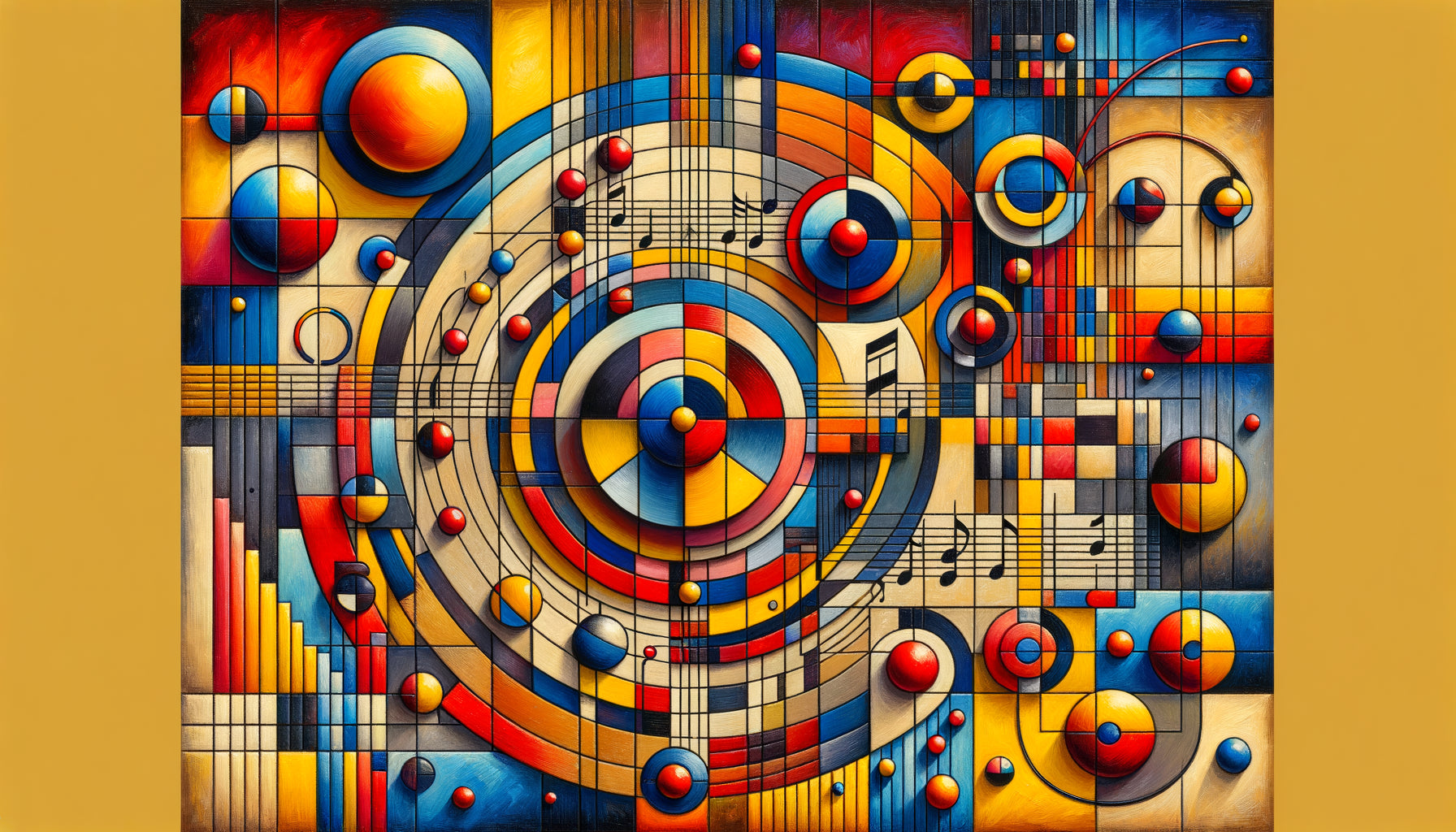
The cosmic abstraction style: artists who break down the Earth's form into games of colors, textures, light. These works work wonderfully in contemporary spaces where one seeks emotion rather than literal representation.
The ecological vision style: artworks that emphasize fragility, often with integrated textual or symbolic elements. Ideal for spaces that reflect values of sustainability and environmental awareness.
Transform your interior with the cosmic perspective of Apollo 8
Discover our exclusive collection of space paintings that captures the emotion of this historic moment and brings stellar wonder into your daily life.

The Living Legacy: How Apollo 8 Continues to Inspire Artists Today
More than fifty years later, the Apollo 8 mission continues to exert a hypnotic influence on artistic creation. Contemporary artists constantly revisit this founding moment, each generation finding new meanings within it.
Artist Michael Benson spent years reworking NASA's raw data to create stunning large-format prints that reveal details astronauts themselves could not have seen. Japanese photographer Hiroshi Sugimoto created a series where he rephotographs Apollo’s lunar images to explore questions of perception and reality. The impact of the mission on artistic representation is measured precisely by this constant ability to regenerate.
In digital art and generative art, Apollo 8 remains an essential reference. Artists use algorithms to create thousands of variations of Earthrise, exploring what might have been seen from other angles, at other moments, under different lights. This approach creates unique works that maintain the spirit of discovery while embracing contemporary technologies.
Your Own Cosmic Journey Begins Here
Close your eyes for a moment. Imagine yourself in that spacecraft, floating above the Moon, looking at this blue marble that contains everything you have ever known, loved, lived. It is this emotion that art inspired by Apollo 8 seeks to capture. And it is this emotion that you can invite into your home.
The Apollo 8 mission transformed the artistic representation of Earth by giving it its deepest dimension: that of a cosmic hearth, precious and unique. Artists realized they were no longer simply painting a planet but telling a story of belonging, fragility, and wonder.
Today, when you choose a work inspired by this cosmic vision, you are not simply decorating a wall. You are connecting to that extraordinary moment when humanity saw its own reflection in space and truly understood for the first time what it means to be at home. You extend the legacy of Apollo 8 into your daily life, transforming your space into a place of contemplation and inspiration.
Start with a single piece. Let this cosmic perspective enter your life. You will discover that space art is not cold or distant – it is the most intimate celebration of our shared humanity.
Frequently Asked Questions About the Artistic Impact of Apollo 8
Why is the Earthrise photo considered so important for art?
Earthrise revolutionized our visual perception of Earth by transforming it from an abstract concept into a contemplative beauty object. Before this image, no one had really seen our planet as a whole, coherent, fragile and magnificent. For artists, this opened up a completely new territory: the possibility of representing Earth not as a background or context, but as the main subject of a work. This photograph proved that science and emotion could merge, that documentary could be poetic. It has inspired thousands of artists to explore themes of perspective, ecological fragility, and our place in the universe – questions that remain at the heart of contemporary art today.
How to integrate Apollo 8 inspired aesthetics into a modern interior?
Art inspired by Apollo 8 integrates beautifully into contemporary interiors thanks to its naturally sophisticated palettes: deep blues, velvety blacks, cloudy whites. For maximum effect, choose a medium to large centerpiece for a focal wall – this creates a contemplation point that visually opens up the space. Representations of Earth work particularly well above a sofa or in a meditation area. In terms of style, they harmonize with Scandinavian minimalism (which values nature), industrial interiors (the metal-cosmos contrast is striking), and even bohemian decors (for their spiritual dimension). The trick is to let the artwork breathe: avoid clutter around it, use indirect lighting that evokes natural light from space. You will create a corner of the universe that invites calm and reflection.
Which contemporary artists continue to explore the legacy of Apollo 8?
The legacy of Apollo 8 lives on with many contemporary artists. Michael Benson creates monumental photographic prints from NASA archives, revealing details invisible at the time. German artist Thomas Ruff has produced a fascinating series that reinterprets lunar images using digital techniques. Scottish artist Katie Paterson has created conceptual works like Light bulb to Simulate Moonlight which directly dialogue with our post-Apollo space experience. In generative art, creators such as Refik Anadol use artificial intelligence to reimagine Apollo 8 data into immersive installations. Even in contemporary photography, artists like Vincent Fournier create series that explore our fascination with space exploration. What unites these creators is their ability to maintain the original wonder while posing contemporary questions about our relationship to Earth, technology, and infinity.