

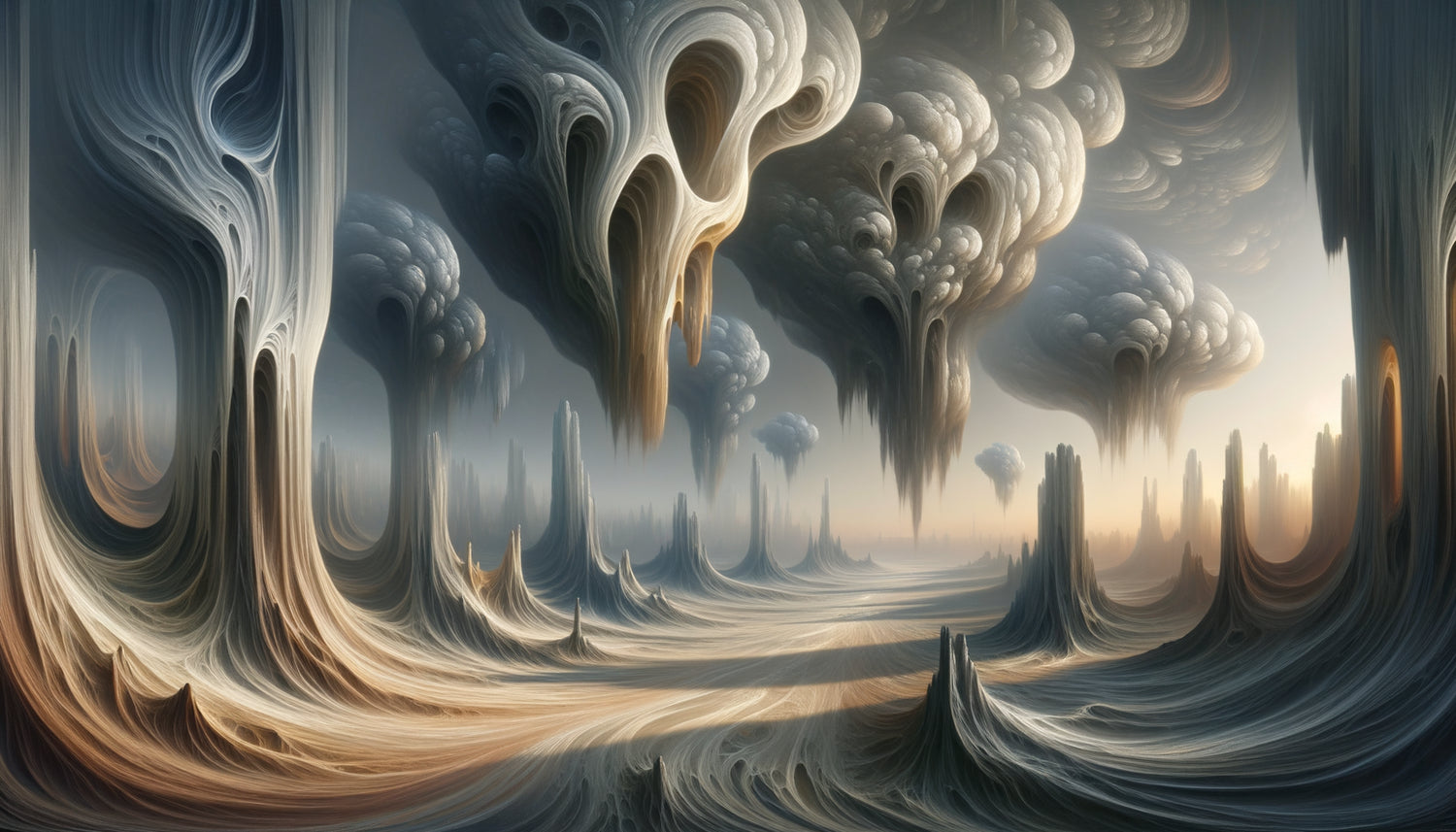
1927. Yves Tanguy, a Breton autodidact painter, sets his brush before a canvas that seems to reveal a world no one has ever walked on. Infinite horizons, organic shapes suspended in a mineral void, light from another world. Twenty-two years before humanity sent its first satellite into orbit, Tanguy and his Surrealist contemporaries were already painting Mars, Neptune, nameless planets. How did these artists manage to imagine the unimaginable with such visionary accuracy?
Here's what the surreal extraterrestrial landscapes reveal to us: exploration of the inner territories of the unconscious, liberation from terrestrial landscape conventions, and a spatial aesthetic that shaped our cosmic imagination long before the first NASA photographs. These canvases did not document space – they invented it.
The problem is that we now view these works through the filter of satellite images, Martian rovers, and space telescopes. We have lost this ability to marvel at pure unknown, this audacity to paint what does not exist anywhere. Yet, understanding how Tanguy and his peers created these parallel universes reconnects us to an essential creative power: that of materializing our wildest dreams.
The good news? These Surrealist methods remain accessible, inspiring, deeply current for anyone seeking to transform their interior into a portal to elsewhere. Let me guide you through the secret workshops of these explorers of the impossible.
The unconscious as the first extraterrestrial territory
Before painting Mars, the Surrealists mapped a continent far more mysterious: the human unconscious. Yves Tanguy discovers his vocation as a painter in 1923 during a lightning revelation before a canvas by Giorgio de Chirico. No academic training, no learning of terrestrial landscape codes – absolute freedom.
This lack of formatting becomes his strength. Tanguy develops a technique of psychic automatism inspired by the writings of André Breton: letting the hand trace without conscious control, welcoming the forms that emerge from the gesture before thought. His extraterrestrial landscapes are thus born from an almost mediumistic process, as if his brush captured signals from a parallel dimension.
In Maman, Papa is hurt! (1927), Tanguy lays the foundations of his universe: a low and distant horizon, an immense sky that seems to breathe, and in the foreground, indefinable biomorphic shapes. Neither rocks, nor plants, nor creatures – something between the three. This ontological blur creates an absolute strangeness, more destabilizing than any identifiable monster.
The technique of systematic displacement
Max Ernst, another master of surrealist landscapes, develops radical methods to short-circuit visual habits. Frottage (rubbing a pencil over a textured surface placed under the paper) and grattage reveal unpredictable organic textures that evoke eroded extraterrestrial soils weathered by chemical winds.
In his series Natural History (1926), Ernst creates a flora and fauna of a world that exists only in the folds of matter itself. His petrified forests, fossil oceans foreshadow the first planetary surface photographs we will discover forty years later.
The light of another world: chromatic secrets
What makes Tanguy's extraterrestrial landscapes so unsettling is their impossible light. Neither day nor night, neither dawn nor dusk on Earth. A diffuse, milky luminescence that seems to emanate simultaneously from the ground and the sky. How to achieve this effect?
Tanguy works through successive glazes: thin layers of translucent paint superimposed, creating an unreal atmospheric depth. His skies range from pale blue-gray to beige-green, tones belonging to no known earthly hour. This technique gives the impression that the air itself is a visible, almost palpable substance.
In The Sun in its Setting (1937), the palette oscillates between muted ochres and metallic blues. Shadows, inexplicably oriented, suggest multiple light sources – exactly what a Martian landscape would present with its two moons, Phobos and Deimos, visible simultaneously in the sky.
The absence of terrestrial reference
Radical strategy of surrealist painters: eliminate all familiar landmarks. No recognizable trees, no identifiable mountains, no human architecture. Salvador Dalí, in his metamorphosed Catalan landscapes, sometimes retains recognizable elements (soft watches, elephants with insect legs) that create a surrealism by deformation.
Tanguy, on the other hand, operates a surrealism by pure invention. His forms have never existed anywhere. This abstinence from references creates a cognitive vertigo: our brain desperately seeks a familiar anchor and finds none. It is exactly what our eyes would feel facing the first true extraterrestrial landscape.

The infinite space: geometry of the unlimited
The spatial composition of the surrealistic landscapes anticipates the vertiginous vastness of space. Tanguy systematically uses an extremely low horizon, often located in the lower quarter of the canvas. This unusual proportion creates a feeling of oppression by the celestial void – exactly what astronauts describe when contemplating the universe from orbit.
In
Kay Sage, Tanguy's wife and talented surrealist painter, develops impossible architectures in desert plains that evoke the abandoned constructions of an extraterrestrial civilization. Her scaffolding structures, her precarious towers, her ladders leading nowhere compose an archaeology of the future.
Cosmic solitude as an aesthetic emotion
Beyond technical prowess, the extraterrestrial landscapes surrealists convey a particular emotion: metaphysical loneliness. These worlds are always uninhabited, silent, frozen in a mineral eternity. This emotional dimension explains why these canvases resonate so deeply with our existential condition.
Giorgio de Chirico, precursor of surrealism with his metaphysical painting, creates deserted Italian squares bathed in unreal light as early as 1910. His oversized shadows, his impossible architectures, his dreamlike atmosphere foreshadow Tanguy's planetary desolations. The difference? De Chirico distorts the familiar; Tanguy invents the unprecedented.
When science fiction meets canvas
The reciprocal influence between surrealist painters and science-fiction writers remains largely unknown. Yet, in the 1930s-1950s, these two avant-gardes mutually nourish each other. The covers of pulp magazines like
Conversely, Tanguy devours the stories of H.P. Lovecraft, Edgar Rice Burroughs and their strange worlds. This cross-contamination produces an aesthetics of elsewhere that will become the visual vocabulary of our spatial imagination. When Stanley Kubrick designs the sets for
Wolfgang Paalen, Austrian-Mexican surrealist painter, pushes this fusion even further. His cosmic landscapes of the 1940s incorporate precise astronomical knowledge while retaining dreamlike strangeness. His nebulae, his nascent planets seem painted from observation – when no telescope of the time allowed such visions.

Transform your interior into a cosmic portal
Today, the legacy of these surreal extraterrestrial landscapes finds new life in contemporary interiors. Integrating a reproduction by Tanguy or a work inspired by this aesthetic creates a visual vanishing point in your space – a mental window to infinity.
Strategic placement: facing your workspace or meditation area. These landscapes naturally invite deep contemplation, constructive mental escape. Unlike terrestrial landscapes that bring us back to the familiar, surreal extraterrestrial landscapes stimulate pure imagination, divergent thinking.
In terms of palette, these works work remarkably well with contemporary minimalist interiors. Their neutral and sophisticated tones (grey-blues, ochres, beiges) harmonize with modern materials such as polished concrete, brushed steel, glass. The contrast between contemporary architectural rationality and surreal poetic irrationality creates a fertile tension.
Lighting as an amplifier of strangeness
A set designer's secret: surreal extraterrestrial landscapes reveal unexpected dimensions under different lighting. A sidelight at the end of the afternoon accentuates the imaginary reliefs of the painting. White cool LED lighting (5000K) reinforces the space atmosphere, while a warm temperature (2700K) softens its strangeness.
Installing indirect lighting behind the canvas creates a backlighting effect that dematerializes the frame and gives the impression that the landscape emits its own light – exactly the effect sought by Tanguy in his luminescent glazes.
Transform your view of infinity
Discover our exclusive collection of space paintings that captures this visionary surreal aesthetic and opens a cosmic window into your daily life.
The Living Legacy: From Surrealism to Contemporary Space Art
The influence of Surrealist painters like Tanguy extends far beyond the history of art. When the first images of Mars arrived in 1965 via the Mariner 4 probe, scientists themselves noted the unsettling resemblance to Surrealist canvases. This visual prophecy retrospectively validates the method of psychic automatism: by delving into the unconscious, artists had touched upon universal archetypes of elsewhere.
Contemporary artists continue this legacy. Zdzisław Beksiński, Polish painter who died in 2005, creates post-apocalyptic landscapes that owe everything to Tanguy. His twilight horizons, his organic architectures, his absence of humanity reprise Surrealist vocabulary while imbuing it with contemporary existential anguish.
More recently, artificial intelligence image generators are massively producing extraterrestrial landscapes – but their aesthetics remain largely indebted to the Surrealist corpus on which they are trained. Even our machines dream in Surrealism.
Why These Images Still Fascinate Us
Beyond the technical prowess, Surrealist extraterrestrial landscapes respond to a fundamental human need: wonder at the unknown. In our hyper-documented, photographed, mapped world, these canvases preserve virgin territories for the imagination.
They also remind us that space exploration is first and foremost an inner adventure. Before conquering Mars, Tanguy and his contemporaries conquered the infinite spaces of the human psyche. Their paintings are immobile vessels, static portals to dimensions that only art can materialize.
Hanging a extraterrestrial Surrealist landscape in your home is installing a daily reminder of this truth: what is impossible today becomes tomorrow's reality, and art always paves the way.
Conclusion: The Immobile Explorers
Imagine: you return home after a day trapped in the predictable. Your gaze rests on this impossible landscape, this horizon that exists nowhere and everywhere at once. For a few seconds, you are no longer in your living room but on this mineral plain bathed in light from another world. You breathe air that has never been breathed.
That's exactly what Tanguy and the Surrealist painters offered us: the possibility of traveling without moving, exploring without leaving, discovering worlds that patiently await for our eyes to make them exist. Their greatest feat? Having painted the future of our spatial imagination before humanity left the terrestrial cradle.
So, which extraterrestrial landscape will you choose to transform your wall into a personal cosmogony?
FAQ : Your questions about extraterrestrial surreal landscapes
Why do Tanguy’s landscapes seem so realistic when they are imaginary?
The compelling power of Tanguy's extraterrestrial landscapes lies in a rigorous pictorial technique: consistent perspective, unified light, illusionistic rendering of textures. Unlike a decorative fantasy landscape, Tanguy paints with the precision of a documentarian – but he documents an inner world. His psychic automatism allows him to access universal visual archetypes: the horizon, depth, mineral solitude. These elements resonate unconsciously within us as memories of a place we have never visited but mysteriously recognize. It is this combination of technical rigor and psychic exploration that creates their unsettling realism.
How to integrate a surreal extraterrestrial painting into a modern interior without creating dissonance?
Excellent question! Surreal landscapes harmonize remarkably well with minimalist contemporary interiors, contrary to what one might think. Their often neutral palette (grays, beiges, ochres) naturally dialogues with modern materials. The key: create a controlled contrast. Surround the canvas with a visually clear space – no accumulation of objects nearby. A white or light gray wall highlights the depth of the landscape. Avoid overly ornate frames; prefer a simple, matte wood or brushed metal framing. The work then becomes a meditative window, a poetic counterpoint to the surrounding architectural rationality. This tension between geometric order and dreamlike mystery considerably enriches the space.
Did surrealist painters draw inspiration from scientific knowledge about space?
Paradoxically, yes and no. In the 1920s-1940s, popular astronomy experienced a significant boom with the work of Edwin Hubble and the popularization of Einstein's relativity. Surrealist painters avidly read the scientific and science fiction magazines of the time. However, their approach was not illustrative but intuitive. Tanguy did not seek to represent Mars as it is, but to materialize the very essence of spatial otherness. Wolfgang Paalen, more scientific, consciously integrated astronomical data. But most favored the unconscious as an inner telescope. The fact that their visions visually anticipate the real planetary surfaces discovered later is less a matter of premonition than access to universal archetypal forms – deserts, minerality, void – which effectively constitute the dominant aesthetic of the solar system.


