


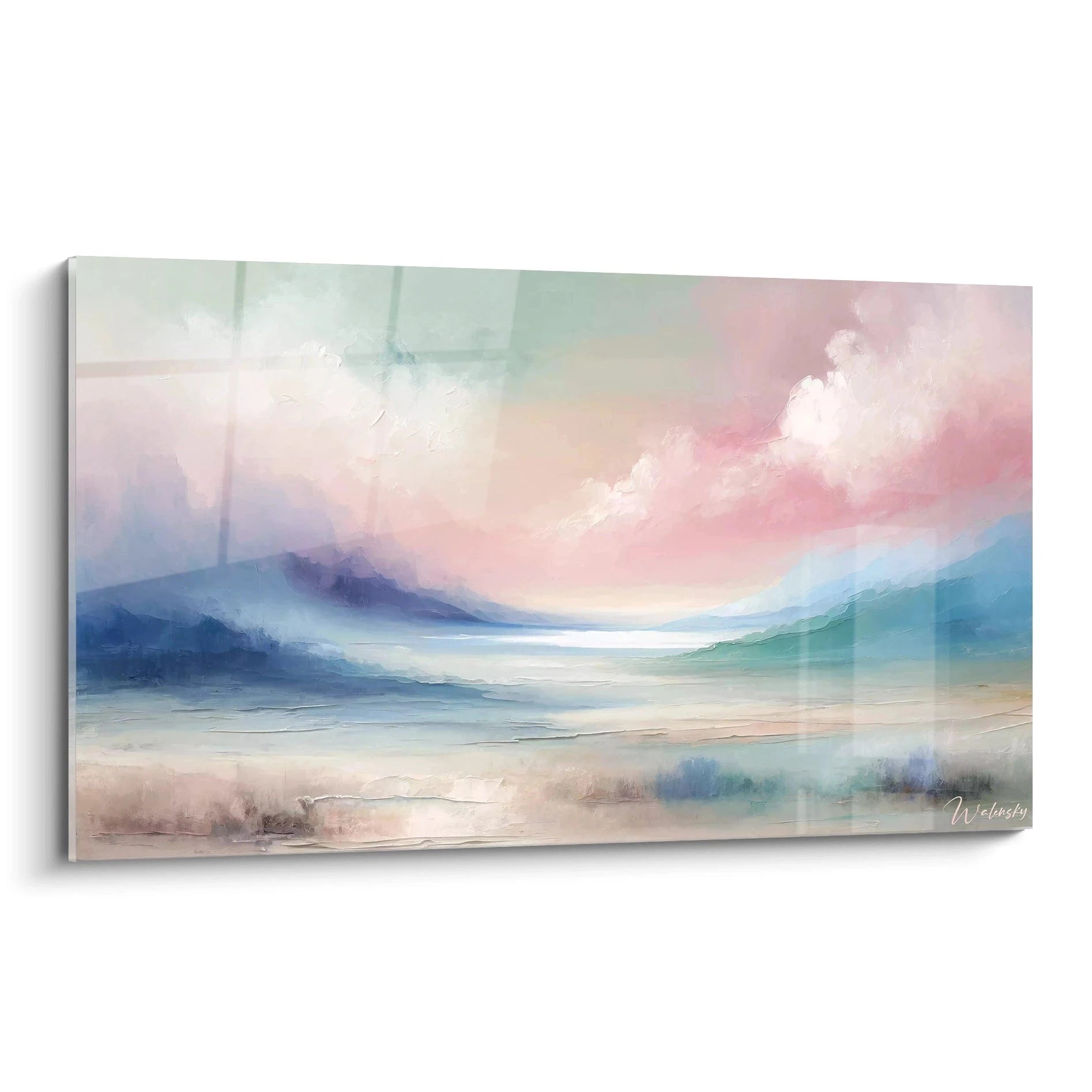

How Did Turner Incorporate Atmospheric and Celestial Phenomena into His Wash Technique?
November 18, 2025 · 10 min read · by Walensky
Imagine yourself before a landscape where the border between sky and sea fades into a golden mist, where clouds seem to breathe and light dances on the water. This feeling of infinity, this delightful vertigo in the face of nature's forces, Joseph Mallord William Turner captured with a revolutionary technique: atmospheric wash. Far from being a simple pictorial method, his approach transformed watercolor into a true theater of the elements. Storms, fogs, incandescent sunrises: each celestial phenomenon became under his brush a visual meditation.
Here's what Turner's wash technique brings to our understanding of atmospheric art: A masterful dissolution of forms in favor of pure light, a subtle orchestration of transparencies to translate the intangible, and a unique ability to make the space between contemplation and wonder vibrate. These innovations revolutionized landscape painting and continue to inspire our relationship with nature.
Many admire Turner's works without understanding how he managed to create such captivating atmospheres. How could a simple mixture of water and pigments evoke the violence of a storm at sea or the ethereal softness of a misty morning? The wash technique, known for centuries, found under his hands a totally unprecedented dimension.
Rest assured: understanding his method does not require being an experienced painter. By deciphering his creative process, you will discover how a visionary artist managed to capture the elusive, and perhaps find inspiration to enrich your own aesthetic sensibility. Let's explore together the secrets of this alchemy between technique and contemplation.
Water as raw material for the atmosphere
At the heart of Turner's wash technique was an obsession: water was not a simple diluent, but the very essence of the atmosphere. Unlike traditional watercolorists who used washes to build precise shapes, Turner saw in the aqueous fluidity the means of translating meteorological phenomena in their moving reality. He worked on wet paper, sometimes soaked to saturation, letting the pigments diffuse organically.
This revolutionary approach created natural mist effects. Colors blended into each other without a clear border, just as in nature where clouds interpenetrate and light knows no contours. Turner sometimes superimposed fifteen to twenty extremely diluted washes, each bringing an imperceptible but essential nuance to the whole. This extraordinary patience allowed him to build atmospheres of vertiginous depth.
The master modulated the amount of water according to the desired effect. For a threatening storm sky, he used less water in order to obtain more concentrated pigments creating dark and heavy masses. Conversely, to represent the morning vapor rising from a river, he literally soaked his paper, allowing the pigments to float in suspension, creating that characteristic vaporous texture of his misty seascapes.
Celestial light as an invisible structure
What fascinated Turner above all was the way atmospheric light structures space without defining it. In his wash technique, he never began by drawing a subject to then color it. No, he first built luminous masses, those areas of clarity and darkness that give architecture to celestial phenomena. A sunrise began with reserves of pure white, carefully preserved at the center of the composition.
Around these zones of absolute light, Turner applied his washes in concentric circles of increasingly saturated color. This method naturally created those luminous halos observed in real skies when the sun breaks through mist or clouds. Pale yellow at the center, then orange, then pink, finally violet at the ends: this chromatic gradation was not theoretical but deeply observed.
He also integrated atmospheric optical phenomena into his compositions. Diffraction effects, the way air humidity multiplies and softens light, the transformation of colors according to the thickness of the atmosphere traversed: all this informed his choices of wash layering. His notebooks reveal detailed notes on weather conditions, hours of the day, seasonal variations in light.
The white of the paper as a light source
Unlike oil painting where the white comes from an added pigment, Turner's wash used the whiteness of the paper as a primary light source. This technical constraint became his greatest creative strength. He meticulously planned where to preserve these virgin zones, knowing that once covered, they could not be recovered. This approach literally sculpted light by subtraction rather than addition.

Capturing the movement of atmospheric elements
Clouds, wind, rain: all these phenomena are defined by their perpetual motion. Turner had understood that a static wash could never adequately evoke them. He therefore developed revolutionary gestural techniques to integrate dynamics into his watercolors. His brush did not simply place the color, it projected it, brushed it, sponged it, creating visible trajectories.
To depict a downpour, he dramatically tilted his wet paper, allowing pigments to flow in vertical streaks. Sometimes, he would scrape the still-damp paper with the handle of his brush or even his fingernails, creating bright striations evoking lightning flashes or rays piercing through clouds. This physical interaction with the material gave his washes an energy rarely seen in the academic watercolor painting of his time.
Turner also used natural sponges to selectively absorb pigments, creating those cloud formations so characteristic of his tormented skies. He tapped, wiped, layered textures with a freedom that shocked his contemporaries. Some criticized his works as unfinished, not understanding that this apparent spontaneity resulted from an absolute technical mastery of the properties of water and pigments.
— Our selection


The pigments of the sky: an atmospheric palette
Turner's palette for his celestial phenomena was both restricted and sophisticated. He favored transparent pigments that allowed for the luminous superimpositions essential to his wash technique. Indian yellow for incandescent dawns, diluted vermilion for twilights, cobalt blue for celestial depths, and especially madder red for those characteristic atmospheric pinks.
What distinguished his approach was his understanding of the optical properties of pigments in aqueous suspension. Some, like ultramarine, settle and create grainy textures evoking the density of storm clouds. Others, such as aureolin, remain perfectly suspended, ideal for fleeting mists. Turner exploited these chemical behaviors as miniature atmospheric phenomena on his paper.
He rarely mixed his colors on a preliminary palette. Preferring optical mixtures directly onto the paper, he superimposed washes of pure colors that visually combined, creating vibrant tones impossible to obtain by physical mixing. This technique amplified the luminosity and gave his skies that radiant quality that still fascinates today.
The chemistry of the atmosphere on paper
Turner experimented with additives in his washes: honey to slow drying, gum arabic to intensify brilliance, alcohol to accelerate certain diffusions. These alchemical recipes were jealously guarded and contributed to the unique atmospheric effects of his works. Each celestial phenomenon required its specific formulation.

— You may also like


Observe to transcend: weather notebooks
Turner’s wash technique could never have achieved this accuracy without his extraordinary work of observation. He filled entire notebooks with quick atmospheric sketches, annotated with notes on lighting conditions, wind direction, and perceived humidity. These studies made in real time then became the raw material for his studio compositions.
Turner went out to draw in all weathers, particularly seeking extreme conditions. He had himself tied to a ship’s mast during a storm to directly observe the fury of the elements. This quest for authentic atmospheric experience nourished his intimate understanding of the phenomena he then translated into washes. He did not paint from imaginative memory but from bodily and sensory memory.
His notebooks reveal a particular attention to atmospheric transitions: the precise moment when fog lifts, the progression of an approaching storm, the change in light as a cloud passes in front of the sun. These micro-temporal observations informed his technique of layering washes, each layer corresponding to a stage of atmospheric transformation.
Let the celestial immensity transform your interior
Discover our exclusive collection of space paintings that capture the same fascination for atmospheric phenomena and celestial light, bringing depth and contemplation to your living spaces.

In the same vein
Andromeda Galaxy Painting - Cosmic Vision - Galaxy Edition
233,90€
Discover this artwork →Atmospheric heritage: from Turner to today
Turner’s technical revolution with atmospheric washes profoundly influenced modern art. French Impressionists, particularly Monet, acknowledged their debt to his research on light and atmosphere. His way of integrating celestial phenomena as subjects in their own right, and not as mere decoration, redefined landscape as a pictorial genre.
Even today, his technique inspires contemporary artists working with watercolor. This approach where the wash becomes a metaphor for impermanence, where the fluidity of water evokes the changing nature of atmospheric phenomena, resonates particularly in our era of ecological awareness. Turner reminds us that patient observation of nature reveals unsuspected beauties.
Beyond pure technique, Turner bequeathed to us a philosophy: that of seeing in atmospheric and celestial manifestations not obstacles to clear representation, but the very subjects worthy of our creative attention. Mists, storms, changing lights are not challenges to be overcome but invitations to contemplation and technical innovation.
When observing his washes, we don't simply see old watercolors, but a timeless celebration of the relationship between humans and natural forces. This ability to translate the ephemeral, to fix the fleeting moment when light pierces a cloud or when mist reveals then conceals a landscape, remains an ideal for any creator seeking to capture the essence rather than the appearance.
The next time you observe a changing sky, a veiled sunrise, or an approaching storm, think of Turner and his quest to translate these wonders into superimposed transparencies. Perhaps you will feel that same urgency to capture the elusive, that same fascination for the invisible architectures drawn by light in the atmosphere. For ultimately, his wash technique was not just a method: it was a way of looking at the world, of marveling at the celestial phenomena we cross every day without really seeing them. And perhaps that is his greatest legacy: having taught us to look up and contemplate.
Frequently Asked Questions
What was the main difference between Turner's washes and those of other watercolorists of his time?
The fundamental difference lay in his radically atmospheric rather than descriptive approach. While his contemporaries used washes to construct precise shapes with defined outlines, Turner employed them to capture the very essence of celestial and meteorological phenomena. He worked with extremely numerous layers of highly diluted washes, sometimes up to twenty coats, creating an unprecedented atmospheric depth. His use of water was not simply technical but conceptual: he made the fluidity of the medium itself a metaphor for natural elements. This approach freed the wash from its traditionally architectural function to make it a tool for transcribing the intangible, movement and pure light. His compositions prioritized luminous masses and atmospheric transitions rather than topographical details, often shocking critics who found his works too vague or unfinished, without understanding that he was pursuing an atmospheric truth rather than a descriptive one.
How did Turner manage to create these particular light effects with washes?
Turner's secret lay in his masterful handling of the white of the paper and his understanding of the optical properties of transparent pigments. Unlike oil painting, where white is added to lighten colors, washes work by subtraction: the light comes from the paper itself. Turner meticulously planned his areas of pure light, preserving them as virgin surfaces, then building around them concentric halos of increasingly saturated colors. He used extremely diluted pigments in multiple layers, creating optical mixtures directly on the paper rather than on a palette. This technique allowed underlying layers to show through, amplifying brightness. He also exploited the specific chemical behaviors of each pigment: some sediment and create textures, others remain suspended for vaporous effects. By tilting the wet paper, using sponges to selectively absorb or by scraping the wet surface, he literally sculpted light, creating those effects of rays piercing clouds or solar halos that remain unmatched in the history of watercolor.
Do you need to be a painter to fully appreciate Turner's wash technique?
Absolutely not, and that’s precisely what makes his work so universally fascinating. Of course, understanding the technical aspects enriches the experience, but the emotional power of his atmospheric washes directly touches our natural sensitivity to celestial phenomena. We have all contemplated a spectacular sunset, felt the oppression of a stormy sky or the soothing effect of a morning mist. Turner translates these universal experiences with a precision that resonates intuitively within each of us. His genius was to capture not the precise appearance of a place, but the feeling of being immersed in a particular atmosphere. This sensory and emotional dimension is immediately accessible, even without artistic knowledge. Then, discovering his method – how he orchestrated water, pigments, paper to create these effects – adds an extra layer of fascination, like understanding how a magician performs a trick without diminishing the wonder. On the contrary, it deepens our admiration for his technical mastery serving a poetic vision of the natural world.
Explore our collections


