I discovered my first ancient Chinese celestial map at an auction in Beijing in 2011. The unfurled scroll revealed a universe unlike the European planispheres I had been collecting for years. Where our Western maps ordered the cosmos according to rigid mathematical grids, this one breathed another philosophy: organic constellations, symbolic colors, a geometry that embraced movement rather than freezing it. That day, I realized that each civilization hadn't simply mapped the sky differently – it had literally seen another universe.
Here’s what Chinese celestial maps from the Tang and Song dynasties reveal: a circular and organic vision of the cosmos (contrary to the European rectangular projection), remarkable observational accuracy with over 1,400 stars listed (long before Western catalogs), and a philosophical dimension where astronomy served imperial harmony rather than maritime navigation. These differences are not merely technical – they tell two fundamentally distinct ways of inhabiting the world.
You may be fascinated by ancient astronomy but lost in the complexity of Asian representations. The symbols elude you, the circular logic disorients your eye accustomed to Cartesian coordinates. Rest assured: this disorientation is precisely the gateway to a richer understanding of our relationship with the cosmos. I invite you to explore these major differences between Chinese and European celestial maps, to enrich your vision – and perhaps your decor – with an unsuspected depth.
The geometry of the cosmos: living circles versus fixed grids
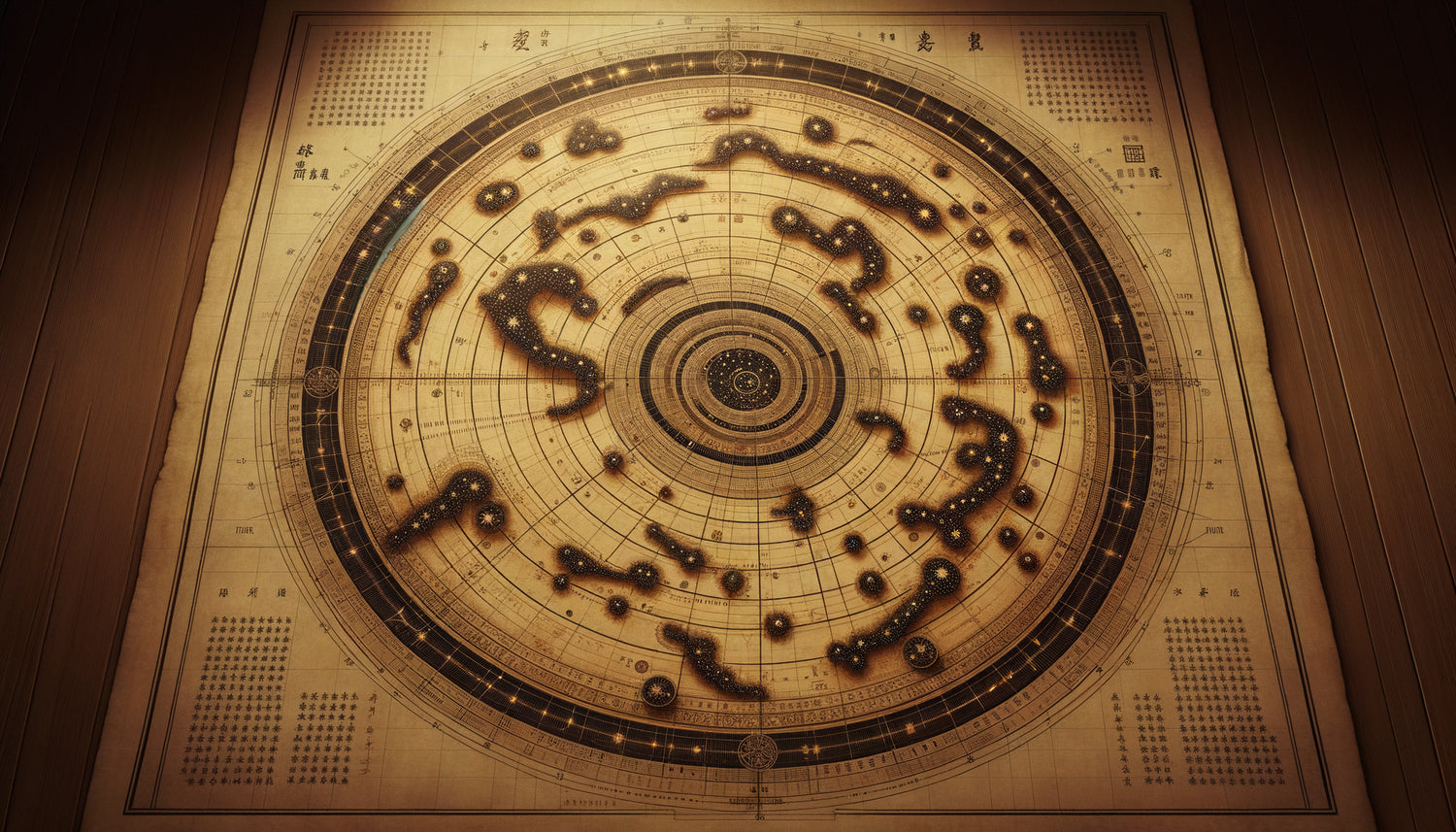
The first difference is striking as soon as you compare a Tang Chinese celestial map (618-907) and a medieval European planisphere. Chinese representations systematically adopt a circular structure centered on the North Celestial Pole, considered the cosmic pivot, residence of the Celestial Emperor. This circularity is not merely aesthetic: it reflects the conception of a universe in perpetual rotation, organic, living.
Europeans, heirs to Ptolemaic traditions, prefer rectangular or hemispherical projections cut according to precise coordinates. Their sky is a grid, a territory to be intellectually conquered. The famous Almagest by Ptolemy (2nd century) structures the cosmos into geometric zones, already preparing the maritime cartography of great explorations.
Under the Song (960-1279), this Chinese circular approach reaches its peak with the Suzhou map (1247), engraved on stone: a perfect disk where 1,434 stars are positioned with astonishing accuracy. Each constellation forms an organic ensemble, the stars connected by lines suggesting mythological figures or celestial administrative tools. In contrast, contemporary European maps struggle to exceed 500 stars and prioritize Greco-Roman zodiacal figures.
When observation surpasses theory
Here's a little-known fact: Tang and Song astronomers had more precise star catalogs than their European counterparts, and that was several centuries before the Renaissance. The reason? A tradition of systematic observation in service of the imperial state. Celestial phenomena – comets, eclipses, novae – were interpreted as divine messages concerning the legitimacy of power. This political motivation paradoxically generated exceptional scientific rigor.
From the Tang dynasty, Chinese celestial charts list stars according to their brightness, classified by magnitude. The famous Dunhuang map (7th century), discovered in Buddhist caves, already shows this sophistication: more than 1,300 stars, notations of color (red, yellow, white) indicating their nature, and planetary trajectories traced with precision.
In medieval Europe, astronomy remained largely dependent on ancient texts. European representations from the 12th or 13th century faithfully reproduce Ptolemy without systematic observational verification. It will take Tycho Brahe (16th century) for comparable rigor to emerge in Western celestial cartography. The Song, meanwhile, produced predictive ephemerides of impressive reliability.
Color as Cosmic Language
One visual element immediately distinguishes Chinese celestial charts: the symbolic use of color. Each zone of the sky corresponds to a cardinal point and a ritual color: East to blue-green (spring, Azure Dragon), South to red (summer, Vermilion Bird), West to white (autumn, White Tiger), North to black (winter, Black Tortoise). This chromocosmogony integrates astronomy into a total philosophical system, that of the Five Elements (wu xing).
European representations, even carefully illuminated, use color decoratively or hierarchically (gold for major stars), never as a system of thought. This difference reflects two epistemologies: for Tang and Song China, the cosmos is a unified organism where everything resonates with everything; for medieval Europe, it is a mechanism created by God, analyzable in parts.

Imperial Constellations versus Mediterranean Myths
Look up at Orion, and you will see a hunter according to Greek tradition. A Chinese person from the Song dynasty would see Shen, a celestial general, and his stars would be part of a cosmic administrative system. This difference in reading radically transforms the appearance of celestial charts.
The Chinese divide the sky into 284 official asterisms (xingquan), grouped into three enclosures and twenty-eight lunar houses (ershiba xiu). Each constellation bears a name evoking imperial administration: the Celestial Market, the Empire's Granary, the Forbidden Purple Palace (circumpolar zone). The cosmos reproduces earthly order, validating social hierarchy by symmetry.
Medieval Europe inherits 48 Ptolemaic constellations, enriched with Babylonian zodiacal figures and Greek-Roman mythological tales. Its charts tell heroic epics – Hercules, Perseus, Andromeda – rather than a bureaucratic organizational chart. This difference is visually apparent: where a Song chart shows a cosmos structured like a palace, a European chart unfolds a mythological theater.
Social function: imperial prediction versus merchant navigation
Why so many differences between Chinese celestial charts and European ones? The answer lies in one word: use. In China, astronomy was a state monopoly. The Imperial Astronomical Bureau employed dozens of officials tasked with observing, calculating, predicting. Any celestial anomaly – comet, unexpected eclipse – could signal the loss of the Mandate of Heaven. Charts therefore served political legitimization and agricultural planning (precise calendars for sowing).
In Europe, especially from the 13th century onwards, maritime astronomy takes over. Celestial charts become navigation tools for Venetian, Genoese, and then Iberian merchants. They seek practical reference points – height of Polaris, position of guide stars – rather than divine omens. This pragmatic purpose explains the evolution towards flat projections, easier to use on a ship's deck than Chinese circular mandalas.
The well-kept secret of Song charts
A fascinating detail: the most accurate Song celestial charts were classified as state secrets. Their dissemination outside the Astronomical Bureau constituted a crime of lèse-majesté. This confidentiality contrasts totally with the relatively free circulation of astronomical texts in medieval Europe, copied in monasteries and universities. Paradoxical result: the Chinese produced technically superior charts, but their influence remained confined to East Asia; European charts, less precise, circulated and improved through constant exchanges.

The aesthetic heritage in our contemporary interiors
Today, collecting or displaying a reproduction of a Chinese celestial chart is not just a decorative gesture. It's inviting into your home an alternative vision of the cosmos, a philosophy where harmony prevails over conquest, where patient observation precedes speculative theory. In a contemporary interior, these circular charts bring a meditative depth that rectangular planispheres cannot offer.
I have hung a reproduction of the Suzhou chart in my office. Every morning, before starting my research, I contemplate it for a few moments. Its circular movement, its constellations with poetic names – the Celestial Weaver, the Silver River – remind me that our relationship to the sky shapes our relationship to the world. The differences between Chinese and European celestial charts are not just technical: they embody civilizational choices about what deserves to be observed, preserved, transmitted.
Let the cosmos inspire your living space
Discover our exclusive collection of space art that celebrates the beauty of ancient and contemporary celestial representations, to transform your interior into a cosmic journey.
Towards a synthesis of perspectives
What I have learned by comparing these cartographic traditions for fifteen years is that neither is wrong, neither is superior. Tang and Song charts teach us patient observation, the integration of the cosmos into a holistic view of the world. European charts show us the audacity of mathematical projection, the courage to question ancient authorities.
For those of you seeking to enrich your visual culture or your decor with an authentic cosmic dimension, I recommend exhibiting both traditions side by side. Observe how your eye travels differently across the Chinese circle and the European rectangle. Feel how one invites centripetal contemplation, the other centrifugal exploration. These celestial charts are not just historical documents – they are invitations to inhabit the world otherwise.
Start simply: choose a quality reproduction of a Song map and a contemporary European celestial sphere. Hang them in your thinking space. Let their silent dialogue remind you that the cosmos, inexhaustible, always awaits new gazes to reveal other secrets. The differences between these traditions are not gaps to be filled, but bridges to cross.
Frequently Asked Questions about Chinese and European Celestial Maps
Were Chinese celestial maps really more accurate than European ones?
Yes, and it is documented. The Chinese stellar catalogs of the Tang and Song dynasties listed between 1,300 and 1,450 stars with their relative positions, when medieval European sources barely reached 500 to 600 stars. This accuracy is explained by a tradition of continuous observation over several centuries, with sophisticated instruments such as armillary spheres and giant gnomons. The Chinese also systematically noted transient phenomena (comets, novae, eclipses) in imperial annals, creating an astronomical database without equal in the West until the 16th century. Their empirical approach, motivated by the needs of agricultural calendars and imperial divination, produced a remarkable observational accuracy, even if their theoretical framework differed radically from the Greek geocentric model.
Can you decorate your interior with reproductions of ancient celestial maps?
Absolutely, and it is even a strong trend in contemporary interior decoration. Chinese celestial maps, with their circular aesthetics and symbolic colors, bring a meditative and sophisticated dimension to living spaces. They work particularly well in offices, libraries or bedrooms, where their visual complexity invites contemplation. For an authentic rendering, prioritize reproductions on textured parchment-like paper or canvas, with natural tones (sepia, midnight blue, deep black). European maps, more geometric, are ideal for interiors with an industrial or scientific style. The decorative trick: create a comparison wall with a circular Chinese map facing a rectangular European projection - the visual contrast becomes a permanent conversation about our ways of seeing the cosmos.
Why didn't Europeans adopt the Chinese circular system?
This question touches on deep cultural differences. The Chinese circular system centered on the north celestial pole reflected a cosmology where the Middle Kingdom occupied the center of the world, under the gaze of the Celestial Emperor. Europeans, heirs to the Ptolemaic tradition and focused on maritime navigation, needed projections usable for calculating positions during voyages. The rectangular projection allowed easy measurement of coordinates (right ascension, declination) and their transfer onto nautical instruments. Moreover, exchanges between China and Europe remained limited until the Jesuit missions of the 17th century. When European scholars finally discovered Chinese maps, they admired their accuracy but retained their system, already integrated into a complete scientific infrastructure. It was less a rejection than a fidelity to a paradigm already operational for their specific needs.