



French Science Fiction and Its Influence on European Space Art
October 12, 2025 · 4 min read · by Walensky
Imagine a living room where walls tell tales of interstellar journeys, where each artwork becomes a window to infinity. This is not mere decoration; it's a true visual odyssey inspired by decades of French imagination that has shaped our aesthetic relationship with space.
When Jules Verne painted the future with words
Long before Neil Armstrong set foot on the Moon, Jules Verne took us From the Earth to the Moon with a visionary precision that still fascinates today. This Nantes pioneer was not just a writer: he was the first great artistic director of our space dreams. His meticulous descriptions of spacecraft, lunar landscapes, and futuristic technologies have nourished the imagination of generations of European artists.
In our contemporary interiors, this Vernian heritage translates into a retro-futuristic aesthetic where copper meets stars, where antique navigation instruments dialogue with cosmic representations. This is what we call spatial steampunk, this delightful fusion between 19th-century elegance and galactic immensity.
The French school of space comics: a visual laboratory
Moebius, Dionnet, Christin, Mézières... These names resonate like a constellation in the firmament of European science fiction. The magazine Métal Hurlant, created in 1975, literally revolutionized our way of visualizing space. No more gray and functional spacecraft from American SF: make way for organic curves, psychedelic colors, a sensual and almost Mediterranean approach to the cosmos.
Jean-Claude Mézières, with his series Valerian and Laureline, created such a rich visual universe that even Hollywood borrowed it (sometimes without credit). His influence is evident today in contemporary wall art: compositions where floating cities blend with nebulae, where impossible architecture defies the laws of physics with a distinctly French grace.
Métal Hurlant: when counterculture meets the stars
This artistic revolution of the 70s did more than create beautiful images. It established a decorative philosophy: space is not cold and hostile, it is living, sensual, habitable. This optimistic and hedonistic vision of space exploration now permeates European decorative art.
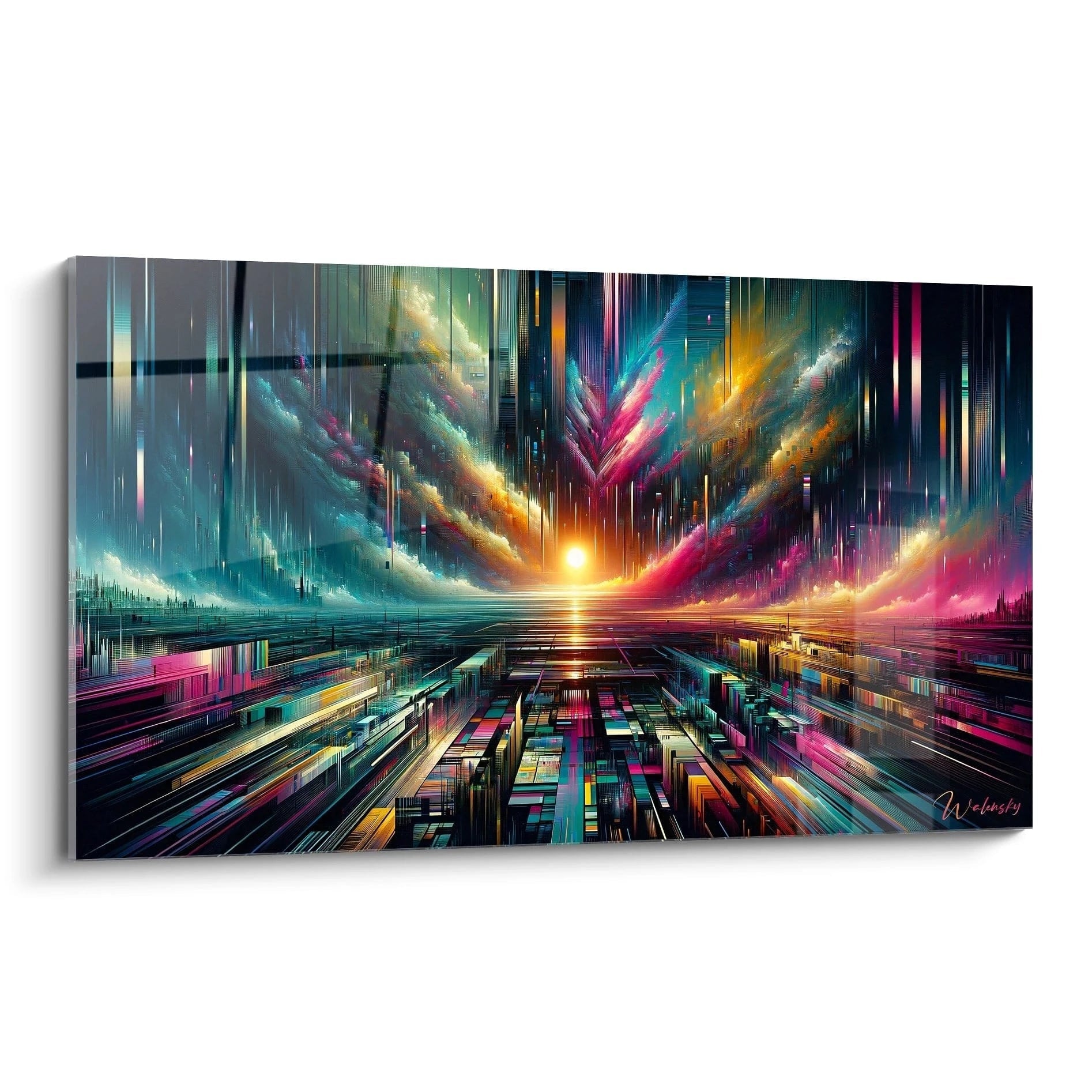
Unlike the austerity of Scandinavian design or American minimalism, the French approach to space art dares color, complexity, emotion. We find this boldness in contemporary paintings that adorn our lofts and apartments: vibrant canvases where the purple of nebulae meets the turquoise of distant planets, creating atmospheres that are both mysterious and deeply warm.
Architectural influence: from science fiction to our walls
French architecture has always flirted with futurism. From the Centre Pompidou to the Géode, and the Grande Arche de la Défense, we have domesticated spatial aesthetics to create living spaces. This tradition continues in our interiors, where space art naturally finds its place.
The sleek curves of imagined spacecraft are reflected in our designer furniture, while panoramic views of distant galaxies advantageously replace traditional terrestrial landscapes. It's a subtle way to push back the walls, invite infinity into our daily lives, and transform a simple living room into a cosmic exploration cockpit.
— Our selection


Pierre Christin and the urban poetry of space
With cartoonist Jean-Claude Mézières, Pierre Christin created in Valérian galactic cities that are variations on the theme of urban planning and coexistence. Their spatial cities are not military fortresses, but markets, cosmic caravanserais, places of exchange and culture.
This humanist vision of space is reflected today in our decorative choices. Rather than cold representations of technology, we seek works that evoke travel, discovery, wonder. Paintings that ask the question: what if space was simply an extension of our desire for elsewhere, beauty, transcendence?
How to integrate this aesthetic into your home
French space art is characterized by its emotional accessibility. You don't need to be an astrophysicist to appreciate a beautiful representation of a nebula! The trick is to choose works that dialogue with your existing palette while bringing that touch of infinity that changes everything.
For a contemporary interior, opt for large formats that create a true window onto space. In an industrial loft, metallic tones and geometric compositions reminiscent of spacecraft will add high-tech sophistication. For more classic interiors, representations of planetary systems in muted tones (ochres, deep blues, purples) will bring depth and mystery without breaking the harmony.
Looking to transform your living space into a true visual exploration vessel? Discover our collection of space paintings that capture this unique essence of European science fiction: poetic, bold, and infinitely stylish.

You may also like
Black Hole Cosmic Wall Art - Mysterious Galactic Spiral - Diverse Space Edition
233,90€
Discover this artwork →Contemporary legacy: a vision that still inspires
Today, as space exploration becomes relevant again with Martian projects and orbital tourism, the influence of French SF is experiencing a resurgence. Young European artists are rediscovering Moebius, revisiting Verne, drawing inspiration from this tradition that has never separated art from science, dream from technique.
This creative continuity is manifested in a new generation of space paintings that blend digital techniques and classic sensibilities, that dare color and emotion in a field often dominated by austere black and white. It's an art that asserts: yes, space can be beautiful, habitable, desirable. And this beauty deserves to enter our homes.
Space is no longer a distant frontier, it's a source of daily inspiration, a way to dream bigger, see further, and live more intensely. And it all sometimes starts with a simple painting hung in the right place, which reminds us every morning that infinity is within sight.


Explore our collections


