When I visited this art gallery in Stockholm in 2019, an installation literally stopped me in my tracks. An entire room plunged into a bluish twilight, where metallic tentacles descended from an artificial starry ceiling, framing a black velvet sofa. The artist had achieved the impossible: transforming Lovecraft's cosmic dread into a habitable, fascinating and strangely soothing space. It was my first encounter with spatial gothic, this aesthetic that combines cosmic horror and interior design.
Here’s what this decorative approach brings: mysterious depth that transforms your space into a narrative sanctuary, dark sophistication that escapes fleeting trends, and an immersive atmosphere that stimulates the imagination while preserving comfort. I'll show you how this unlikely fusion between fantasy literature and interior architecture creates spaces of rare intensity.
Lovecraftian origins: when architecture becomes narrative
Howard Phillips Lovecraft wasn't simply writing horror stories. He was building geographies of dread. In his tales, the spaces themselves become characters: the house on Benefit Street in Providence, with its non-Euclidean angles, or the cyclopean cities of R'lyeh emerging from the abysses. These precise architectural descriptions created a sense of spatial alienation – the impression that familiar space concealed forbidden geometry.
This narrative approach to space has directly influenced contemporary design. Architects and decorators who draw inspiration from it are not seeking to reproduce horror, but to capture this cosmic sense of mystery. They create interiors where every element suggests a larger story, a connection with infinity. It's a decoration that rejects superficiality to embrace narrative depth.
The chromatic palette of the interstellar void
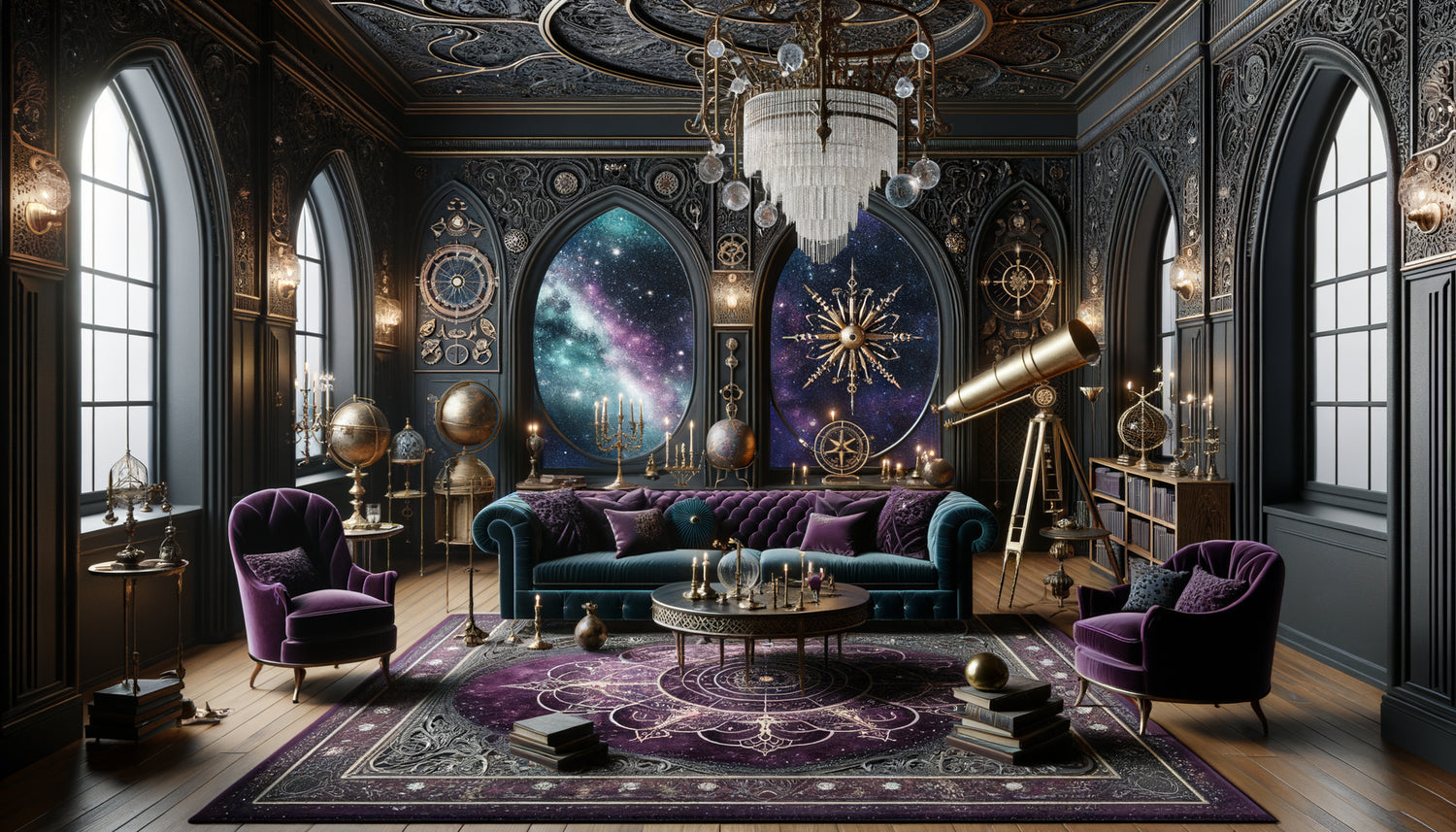
Spatial gothic relies on a very specific color palette that I call deep space hues. Forget uniform black: think instead of Prussian blues, those dark shades almost black with icy undertones. Add in ink purples, these saturated purples observed in nebulae, and oxidized emerald greens reminiscent of antique observatory copper.
Metallic accents play a crucial role. Aged brass evokes Victorian scientific instruments, an era when astronomy met the occult. Tarnished silver reflects moonlight. Patinated copper suggests ancient and mysterious mechanisms. These metals should never be shiny – their oxidation tells the passage of time, essential to the cosmic aesthetic.
Lighting: sculpting darkness
The most common mistake? Trying to illuminate these spaces. Spatial gothic, on the contrary, requires sculpting with shadow. I use multiple and indirect light sources: blue LED string lights hidden behind furniture, carbon filament lamps creating amber halos, RGB projectors projecting galaxies onto the ceiling. The goal is not to illuminate evenly, but to create archipelagos of light in an ocean of shadow.

Discover this inspiring artwork
Materials and textures: the cosmic tactile
Velvet reigns supreme in this aesthetic. Not just any velvet: that with deep pile, almost black, which absorbs light like a black hole absorbs matter. I combine it with aged leather with patinated cracks, reminiscent of the bindings of ancient grimoires. These luxurious textures counterbalance the conceptual coldness of the space aesthetic.
Reflective surfaces bring an essential dimension. Smoked mirrors with complex frames create an infinite multiplication of space. Bubbled or striated glass subtly distorts reality. Black lacquered surfaces reflect like pools of cosmic ink. Each material must suggest either spatial infinity or temporal depth.
Tentacular and geometric patterns
Lovecraftian iconography naturally invites itself: stylized tentacles in wrought iron, fractal motifs evoking non-Euclidean geometries, spirals recalling galaxies. But be careful with subtlety – an art deco wallpaper with astronomical motifs works better than an explicit representation of Cthulhu. Suggestion always prevails over evidence.
Composing your cosmic cabinet of curiosities
Gothic space furniture mixes eras and references. A blackened mahogany Victorian bookcase houses antique editions and scientific objects. A suspended egg chair in black resin evokes a spaceship capsule. A glass and raw metal coffee table resembles a fragment of an orbital station.
Decorative objects tell stories. Spheres armillaires and astrolabes coexist with specimens under glass. Antique telescopes become functional sculptures. Raw crystals – obsidian, labradorite, amethyst – add a mineral and mystical dimension. Each object should be able to spark a conversation, carry an enigma.
Transform your walls into windows to infinity
Discover our exclusive collection of space paintings that capture cosmic majesty and anchor your spatial gothic aesthetic in a contemporary vision.

Discover this inspiring artwork
Wall art: portals to the unknown
Walls are your narrative portals. Which artworks to prioritize? Large format astronomical photographs printed on brushed aluminum, creating an almost three-dimensional depth. Antique constellation engravings framed in blackened wood. Abstract canvases with cosmic hues – these contemporary works that evoke nebulae and black holes without literally representing them.
I particularly like asymmetrical wall compositions: a large central painting surrounded by smaller frames arranged like a constellation. This approach creates movement and suggests the infinite expansion of space. The frames themselves deserve attention – prioritize complex geometric structures, oxidized gilding, raw materials such as patinated steel.
Creating zones of narrative intensity
A spatial gothic interior works by gradation of intensity. Don't transform every room into a cosmic sanctuary – instead create centers of mystery. A reading corner becomes a nocturnal observatory with a deep armchair, arc lamp and astronomy library. A bedroom transforms into an intimate space capsule with a starry ceiling and enveloping textiles.
Transition spaces – hallways, entrances – are crucial. I install kinetic light installations there, mirrors creating infinite perspectives, wallpapers creating illusions of depth. These areas psychologically prepare for the shift between everyday and cosmic, between familiar and strange.
This approach requires balance. Too many elements create saturation, too few dilute the impact. I recommend the rule of three focal points: in each room, identify three strong attention points (a major work, a sculptural piece of furniture, spectacular lighting) and let the rest subtly support this visual hierarchy.
Living in spatial gothic: practicality and poetry
This aesthetic is not just a visual performance – it must remain livable on a daily basis. Dark textiles are regularly cleaned (gentle vacuuming for velvet). Patinated metal surfaces are protected with matte varnishes. Soft lighting is complemented by point sources for precise tasks – reading lights, kitchen spotlights.
Modularity is essential. Programmable RGB lighting systems allow you to vary the atmosphere according to your mood. Blackout curtains instantly transform a bright room into a cosmic cavern. Interchangeable textiles – cushions, throws – adjust the intensity of the atmosphere with the seasons.
This decoration evolves with you. Start with reversible elements: wall art, textiles, lighting. Test the intensity that suits you. Some comfortably live in total immersion, others prefer subtle touches evoking the aesthetic without fully deploying it. There is no dogma, only your own balance between cosmic mystery and domestic comfort.
Spatial gothic represents more than a fleeting decorative trend. It's a philosophy of habitation that recognizes our fascination with infinity, our need for mystery in an over-explained world. By transforming our interiors into narrative spaces inspired by Lovecraftian cosmic horror, we create sanctuaries that nourish the imagination while offering the comfort of a domestic cocoon. These spaces daily remind us of our paradoxical place: minuscule in the cosmic immensity, yet capable of capturing that immensity within the intimacy of our walls. They transform existential angst into aesthetic wonder, proving that even abysses can become habitable when tamed with creativity and sensitivity.
FAQ: Your questions about spatial gothic
Is spatial gothic suitable for small spaces?
Absolutely. Small spaces particularly benefit from this aesthetic which creates perceptual depth. Favor smoked mirrors, dark colors that abolish visual limits, and indirect lighting that sculpts the space rather than revealing it entirely. A 25m² studio can become an infinitely vaster spaceship perceptually than a poorly arranged 100m² loft.
How to balance gothic space and natural light?
Natural light is not the enemy of spatial gothic – it becomes its diurnal variation. Use dark translucent curtains (midnight blue, deep purple) that filter without completely blocking. Velvet textiles and dark surfaces absorb excess light during the day. In the evening, artificial lighting takes over to create the complete cosmic atmosphere. Think day-night cycle rather than opposition.
Could this decoration seem oppressive in the long term?
It all depends on dosage and your personal sensitivity. If you fear an oppressive effect, adopt a hybrid approach: more neutral common areas with cosmic touches, one dedicated room (bedroom, office) in complete immersion. Integrate warm elements – wood, soft textiles, amber lighting – that counterbalance the spatial coolness. Mature gothic space combines mystery and comfort, not discomfort and excessive theatricality.