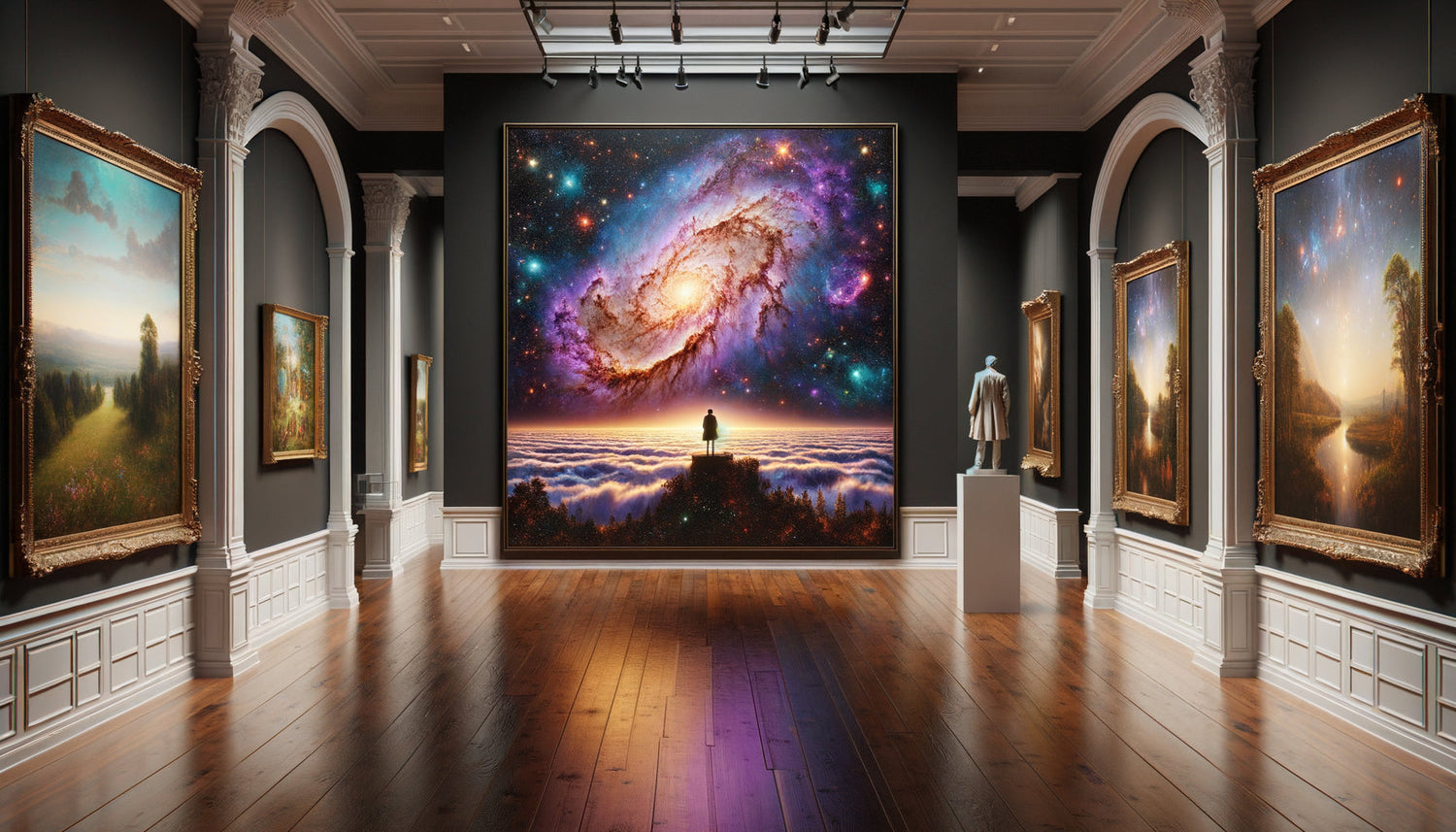
The first time I observed The Traveler Contemplating a Sea of Clouds by Caspar David Friedrich, I felt that dizzying sensation when facing immensity. This confrontation with infinity that the Romantics called the cosmic sublime transcends eras to inhabit our interiors today. Because beyond a simple decorative trend, integrating this visual power into your home is inviting daily wonder, reconnecting with our human scale in relation to the universe, and transforming our spaces into true contemplative refuges.
Here's what the cosmic sublime in art brings to your interior: an emotional depth that transcends ordinary decoration, a meditative window onto infinity, and a constant dialogue between domestic intimacy and universal grandeur.
Perhaps you feel this frustration in front of your too-wise walls, this impression that your decor lacks soul, that dimension that makes you look up and suspends your breath? You are not alone. Many seek to go beyond surface aesthetics without falling into pretension or a cold gallery effect.
Rest assured: the cosmic sublime is not reserved for erudite collectors nor vast lofts. This visual power can be tamed, declined, and adapted to every space. I invite you to traverse two centuries of wonder to understand how this timeless aesthetic can transform your daily life.
When the Romantics painted infinity: birth of the cosmic sublime
At the turn of the 19th century, a silent revolution shook European painting. Tired of academic compositions and the reason of the Enlightenment, Romantic artists turned to what escapes measurement: ocean storms, misty mountain peaks, stormy skies tearing the horizon.
The cosmic sublime is born from this fascination with that which surpasses us. Friedrich in Germany, Turner in England, Martin in France share this obsession: representing not the beautiful mastered, but the vertiginous, the crushing, the transcendent. Their canvases do not decorate, they overwhelm.
What fascinates me about these works is their paradoxical construction. A minuscule figure from behind facing a celestial abyss. Deliberately overwhelming proportions. Games of light that draw the eye towards the infinite. Cosmic romanticism uses painting as a portal to elsewhere, to the mystery that reminds us of our human condition while celebrating our capacity for wonder.
The founding visual codes of the sublime
Analyzing these paintings reveals fascinating constants. The vertiginous perspectives that draw the gaze into the depths. The contrasting lights where light dramatically pierces the darkness. The unbalanced scales that miniaturize humans in relation to nature or the celestial. And above all, this poetic indeterminacy: mists, nebulae, clouds that dissolve contours and open up the imagination.
These techniques create what philosophers of the time called the sentiment of the sublime: a mixture of reverential awe and fascination, an emotion that expands us by reminding us of our smallness. This is exactly what today's person seeks when choosing to hang a cosmic representation in their living room.
The revolution of telescopes: when the real universe joins the romantic dream
Decades pass, and science accomplishes what the romantic imagination had anticipated: space telescopes now capture nebulae, distant galaxies, star fields in their stunning reality. Images from Hubble, the James Webb telescope or ground observatories literally realize the cosmic sublime.
This convergence between art and astronomy is staggering. Photographs of the Orion Nebula, with its purple and turquoise veils, evoke Turner's storms. Deep fields revealing thousands of galaxies recall Van Gogh’s infinite starry skies. The authentic cosmic beauty often surpasses the imagination of painters.
This shift transforms our decorative relationship to space. We no longer contemplate an artistic interpretation of infinity, but infinity itself, captured and brought down to human scale. Contemporary cosmic sublime combines romantic emotion with scientific truth, creating a new depth of meaning.

Discover this inspiring artwork
How cosmic sublime transforms an ordinary interior into a visual sanctuary
Hanging a cosmic work in your home is not just a decorative choice, it's a philosophical decision. You install a permanent window to elsewhere, a visual vanishing point that changes the perception of your space itself.
I have observed this phenomenon in countless interiors: a large format representing a spiral galaxy or a nebula instantly transforms a wall into a portal. The room seems to breathe differently. Proportions change. The gaze no longer bumps against plaster but escapes towards light-years of depth.
Spaces that flourish with the cosmic
Contrary to popular belief, cosmic sublime is not only suitable for vast minimalist lofts. A family living room gains breath facing a stellar composition in deep tones. A bedroom becomes a meditative cocoon with a soothing nebula. Even an office charges up with inspiration facing galactic immensity.
The secret lies in balance. A powerful cosmic work requires visual space around it - not necessarily a large wall, but breathing room. Avoid drowning it in accumulation. The sublime demands emptiness, the visual silence that allows its strength to express itself.
Cosmic palettes also offer unsuspected richness. Deep blues and violets of nebulae blend beautifully into cool contemporary interiors. Oranges and reds of stellar clouds warm Nordic spaces. Black and white compositions, direct heirs to romanticism, bring timeless elegance.
From Romanticism to Your Wall: Composing with the Sublime Today
How to concretely translate two centuries of sublime art into your decoration? The key lies in understanding what truly creates the dizzying effect.
Prioritize generous formats. The sublime requires sufficient physical presence to create immersion. A small 40x30 cm frame showing a galaxy remains cute; a 120x80 cm becomes hypnotic. The empirical rule: the work must occupy at least 60% of the width of the furniture it surmounts, or constitute an independent focal point.
Seek visual depth. Flat cosmic representations disappoint. What fascinates is the sensation of being able to dive into the image, perceiving successive planes, veils of gas that overlap, stars at different distances. Quality prints revealing subtle details multiply this impression.
Creating Dialogue Between Ancient and New Sublime
A particularly successful approach is to mix the eras of the sublime. A contemporary reproduction of a romantic Friedrich dialogues beautifully with a current photograph of a nebula. Both speak the same emotional language while marking the historical continuity of our fascination for infinity.
This strategy works remarkably in eclectic interiors where the cosmic sublime becomes the connecting thread uniting different periods. Romanticism brings the human and melancholic dimension, contemporary space images bring scientific precision and spectacular color.

Discover this inspiring artwork
The lighting of the sublime: revealing infinity through light
An often overlooked aspect can transform or ruin a cosmic work: its lighting. The cosmic sublime in art fundamentally plays with light - that which pierces romantic clouds, that which emanates from distant stars.
Absolutely avoid direct frontal lighting which flattens the image and creates reflections. Opt for a soft lateral lighting that gradually reveals nuances without dazzling. Adjustable track spotlights allow you to fine-tune the angle to eliminate reflections while enhancing details.
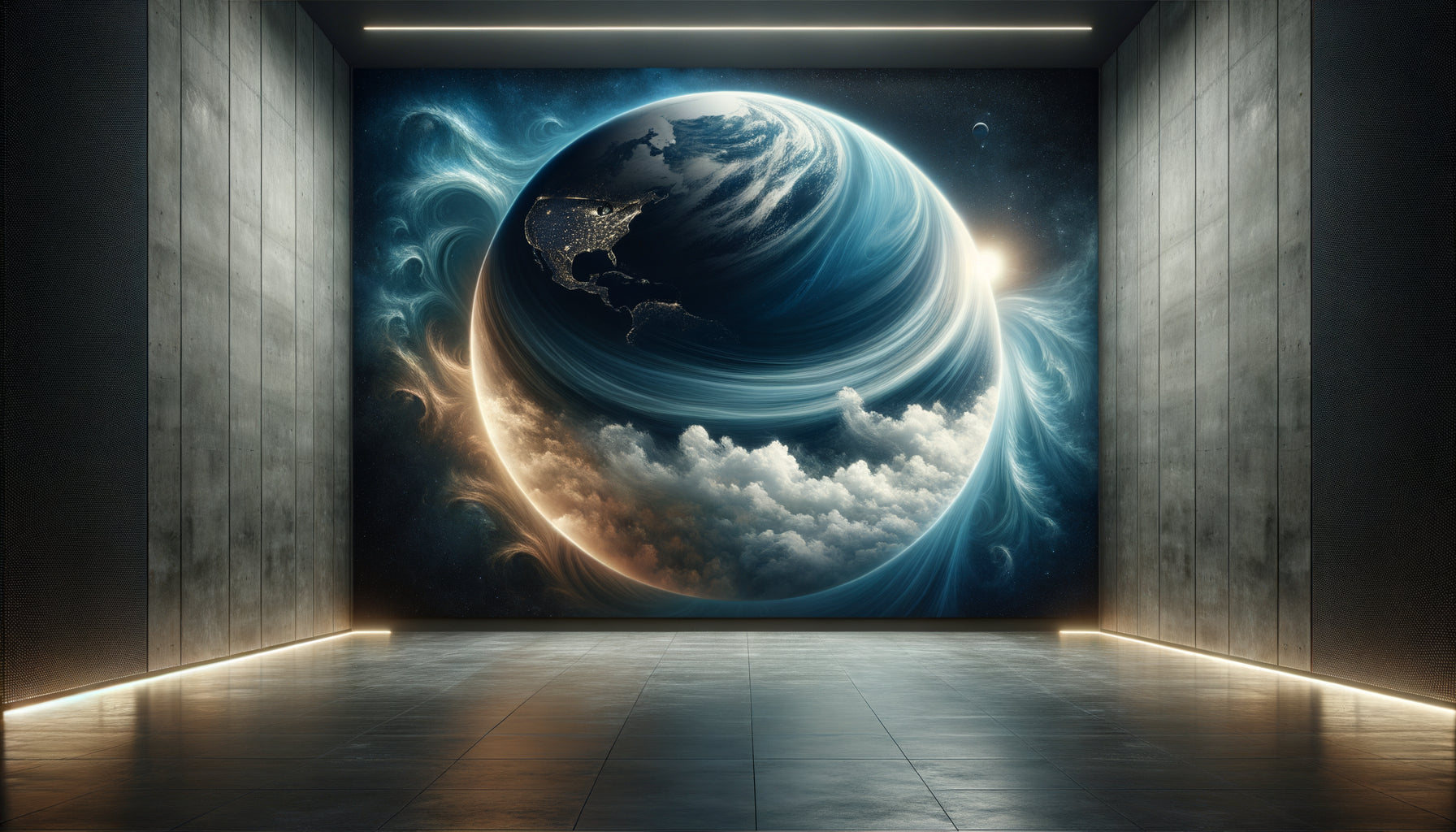
Some backlit formats create a spectacular effect with space compositions, literally transforming the wall into a luminous window towards the cosmos. This contemporary solution radicalizes the romantic concept of painting as a portal to elsewhere.
The ambient lighting of the room also counts. A cosmic work thrives in subdued light rather than harsh light. It then becomes a natural focal point, attracting the gaze like stars emerge at dusk.
Ready to open a window onto infinity in your interior?
Discover our exclusive collection of space artworks that capture the power of the cosmic sublime, from timeless romanticism to contemporary astronomical wonders.
Living daily with infinity: the meditative impact of the sublime
Beyond aesthetics, the cosmic sublime acts as a meditative presence. In our existences saturated with information and solicitations, these windows onto immensity offer essential contemplative pauses.
I have noticed that people living with these artworks develop spontaneous rituals: that morning moment when the gaze rests on the nebula before starting the day, that evening pause facing the starry field after work. The sublime becomes an anchor, a silent reminder that beyond everyday life there is a vastness that relativizes our anxieties.
This soothing function is not anecdotal. Studies on the contemplation of grandiose natural scenes - oceans, mountains, starry skies - reveal measurable effects: reduced stress, increased sense of connection, broadened perspective on our concerns. The cosmic sublime in art reproduces these benefits in an accessible daily version.
This may be romanticism's most valuable legacy: having identified that we physiologically and emotionally need to confront our gaze with what surpasses us. Our ancestors looked up at the stars every night; our urban interiors deprive us of this. Cosmic works restore this primordial connection.
Conclusion: from Friedrich to your living room, the same thirst for infinity
Two centuries separate Friedrich's romantic mists from the James Webb telescope photographs. Yet, the same emotion runs through this continuum: wonder at immensity, the delicious vertigo of our smallness in the universe, the quest for the absolute that defines humanity.
Integrating the cosmic sublime into your home is not following a decorative trend; it's joining this unbroken lineage of contemplators who understood that true beauty lies in what escapes our total understanding. It's transforming your interior into a place not only inhabited, but habitable in the profound sense: a space that nourishes the soul as much as it shelters the body.
Start simply. Observe what type of sublime attracts you: the melancholy of romantic landscapes or the wonder of photographed nebulae? Identify the wall that calls for this opening to elsewhere. And dare to take the step. Your gaze will thank you every day.
FAQ: Your questions about the cosmic sublime in decoration
Does the cosmic sublime suit small spaces?
Absolutely, and it's particularly interesting! In a small space, a cosmic work creates an effect of perceptual enlargement by visually opening the wall towards infinity. The trick is to choose compositions with marked depth rather than flat surfaces. Favor a proportionate format: in a 12m² room, an 80x60 cm is enough to create the portal effect without crushing the space. Dark tones with bright spots (stars, nebulae) work better than very light compositions that can visually shrink the space. Just make sure to leave the work breathing with clean adjacent walls. The cosmic sublime requires less square meters than you might think, but demands visual calm around it to unleash its contemplative power.
How to choose between a historical romantic work and a contemporary space photograph?
This decision often reflects your personal relationship with wonder. Reproductions of romantic works - Friedrich, Turner, Martin - bring a melancholic, philosophical, deeply human dimension. They are wonderfully suited to classic interiors, cozy atmospheres, and introspective personalities. They speak the language of solitary contemplation and spiritual quest. Contemporary space photographs, on the other hand, celebrate scientific beauty, offer spectacular color palettes, and naturally integrate into modern interiors. They fascinate with their authenticity: it is truly the universe captured. My suggestion? If your interior leans towards classic or vintage, opt for romanticism. If you live in a contemporary or minimalist world, space images will naturally impose themselves. And why not both in different rooms, creating a historical dialogue on the sublime throughout your home?
What furniture colors go with a cosmic work?
The cosmic sublime has this rare quality of harmonizing with almost all palettes, provided you respect one principle: not to compete with its visual power. Monochrome interiors - white, gray, black - constitute the ideal setting, allowing the work to breathe fully. Natural wood furniture, from light oak to dark walnut, creates a magnificent warm contrast with cosmic compositions, avoiding a cold gallery effect. If your decor already incorporates colors, look for tonal harmonies: a nebula with blue and purple hues will go well with textiles in those same color families. However, avoid busy patterns and saturated colors in large quantities that would fragment attention. Gold, brass, and gold metals create sublime associations with space works, evoking stars and starlight. Think minimalist and natural: the cosmos already provides all the necessary visual complexity.