1610. In his Tuscan observatory, Galileo points his telescope towards the sky and discovers the impossible: Venus changes its face. Sometimes a delicate crescent, sometimes a luminous disk, the shepherd's star transforms before his amazed eyes. This revolutionary observation overturns cosmology and has inspired uninterrupted artistic fascination for four centuries. Today, the phases of Venus transcend astronomical treatises to invest our interiors with a disturbing visual poetry. Here is what integrating the phases of Venus into your decoration brings: an immediate cosmic connection, a narrative sophistication that transforms your walls into conversation, and an evolving aesthetic that renews daily perspective. The problem? Faced with standardized space representations, it's difficult to find this dimension that is both scientific and deeply emotional, this tension between precision and reverie. Rest assured: understanding the artistic journey of Venusian phases will allow you to choose the work that truly resonates with your space. I take you on a journey where astronomy and aesthetics merge to create a decoration that tells the story of our understanding of the universe.
When Galileo transforms Venus into an artistic manifesto
The drawings of Galileo dated 1610 are unlike anything that existed. On his yellowed notebooks, delicately shaded circles show Venus in crescent, quarter, almost full. These sketches are much more than scientific notes: they become the first works of art based on telescopic observation. The beauty of these sketches lies in their tension between mathematical precision and human wonder. Each charcoal stroke captures the moment when science becomes poetry.
This aesthetic of observation is found in 17th-century engravings. Astronomical plates by Johannes Hevelius transform the phases of Venus into compositions of astonishing elegance. The graduated circles, the Latin annotations, the meticulous shadows create a visual language that still influences contemporary design. These historical representations possess this rare quality: they document while sublimating.
Integrating a reproduction of these historical drawings into an office or library instantly brings intellectual depth. The aged paper, handwritten notations, this patina of ancient knowledge creates a fascinating contrast with our clean interiors. It is the perfect alliance between scientific heritage and decorative refinement.
Modern art appropriates Venusian cycles
In the 20th century, the phases of Venus migrate from scientific treatises to artists' workshops. Surrealists, obsessed with cycles and transformations, find a powerful symbol in them. Max Ernst and Joan Miró integrate circular shapes evoking planetary metamorphoses into their compositions. These partially illuminated spheres become metaphors for the unconscious, cyclical femininity, perpetual transformation.
The geometric abstraction of the 1960s amplifies this fascination. Victor Vasarely and Op Art artists create visual sequences directly inspired by astronomical progressions. Eight circles aligned horizontally, each revealing a different phase of Venus, from a thin crescent to a full disc: these compositions create a hypnotic visual rhythm. Movement is suggested by the gradual transformation, like a film broken down into frames.
This sequential approach particularly echoes in contemporary interiors with minimalist aesthetics. A series of eight black frames presenting the phases of Venus in progression creates a narrative frieze that guides the eye along a hallway or above a sofa. It is decoration that becomes visual storytelling, inviting a spatial and temporal reading of the work.

Discover this inspiring work
Why Venusian phases captivate our modern interiors
The resurgence of the phases of Venus in contemporary decoration is not insignificant. It responds to a deep need for cosmic reconnection in urban existences disconnected from the night sky. Hanging a representation of the phases of Venus is bringing infinity into the fineness of your living room, it is re-inscribing your daily life in the great celestial mechanics.
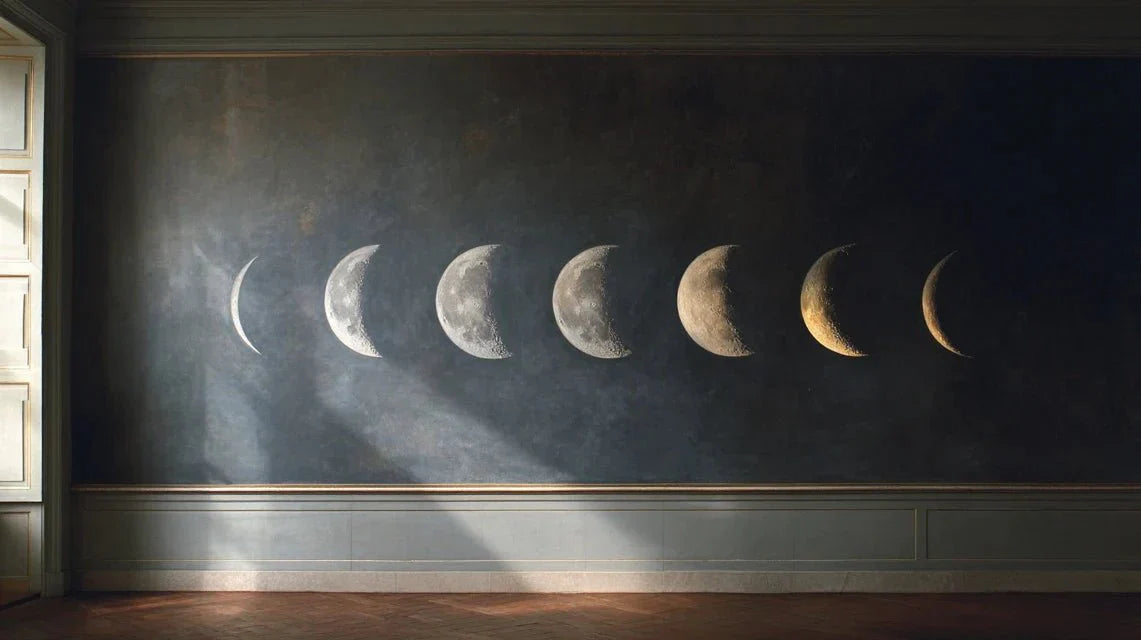
Current aesthetics favor clean compositions on a deep black background. The phases of Venus appear as luminous pearls suspended in the cosmos, each crescent finely detailed reveals the invisible topography of the planet. This sobriety maximizes visual impact: in an interior with neutral tones, these works become powerful visual anchors, irresistibly attracting the eye.
The feminine dimension of Venus also enriches the symbolism. Goddess of love in mythology, planet with cycles in astronomy, Venus embodies cyclical transformation, changing beauty, eternal renewal. For a space dedicated to well-being, a bedroom, a yoga studio, this symbolic resonance adds a layer of meaning that goes beyond simple decoration to touch the archetype.
How to integrate Venusian phases into your decor
The classic linear composition
The traditional approach presents the eight phases of Venus in a horizontal sequence. This layout works beautifully above a low piece of furniture, along a hallway, or on the main wall of an office. The rhythm created by the progression of shapes creates a soothing visual movement. Opt for a black or deep navy blue background to maximize contrast and dramatic effect.
For maximum impact, play with dimensions: a panoramic format of 150x40 cm transforms this composition into a true cosmic fresco. The details of Venusian craters, the subtle gradations of light on each phase become visible, transforming the work into an object of prolonged contemplation.
The contemporary circular composition
A bolder approach arranges the phases of Venus in a circle or spiral. This configuration evokes the orbital cycle, the wheel of the zodiac, the cosmic mandala. Particularly suitable for meditative spaces or ceilings (why not transform your bedroom into a private observatory?), this composition creates a centripetal focal point that structures space differently.
This layout works wonderfully in square rooms or reading corners, where it creates a visual bubble, a microcosm that invites contemplation. Paired with indirect lighting, the effect becomes almost hypnotic.
Association with other celestial elements
The phases of Venus dialogue wonderfully with other astronomical representations. A wall composition combining the phases of Venus, the moon phases and Saturn's rings creates a coherent cosmic symphony. The important thing is to maintain stylistic unity: the same palette (deep blacks, lunar grays, touches of gold), the same graphic treatment (realistic photographic or scientific illustration).
This multi-planetary approach is particularly suitable for large spaces, cathedral-like living rooms or lofts, where several walls can be orchestrated as a visual journey through the solar system. Your interior becomes your personal cosmic gallery.
Transform your space into a poetic observatory
Discover our exclusive collection of space paintings that captures the mysterious beauty of Venusian phases and awakens cosmic fascination in your daily life.

Discover this inspiring artwork
The secrets of a successful staging
Owning an artwork depicting the phases of Venus is one thing, showcasing it is another. Lighting becomes crucial: these compositions on dark backgrounds require targeted lighting that reveals nuances without creating reflections. Adjustable LED spotlights with a 3000K color temperature (warm white) create this intimate observatory atmosphere.
The hanging height deserves consideration. Unlike standard rules (center of the artwork at 1.60m), a composition depicting the phases of Venus is better placed slightly higher, inviting the gaze upwards, mimicking the ancestral gesture of looking up at the night sky. This subtle elevation subconsciously reinforces the celestial dimension of the work.
The surrounding furniture must respect cosmic sobriety. Dark woods (walnut, stained oak), brushed metals (aged brass, black steel), deep textiles (navy velvet, anthracite linen) create a setting that amplifies the visual impact without competing with the artwork. Think modern cabinet of curiosities rather than clinical showroom.
From scientific observation to decorative emotion
What makes the phases of Venus so powerful in decoration is this dual nature: scientific rigor and visual poetry. Each phase represents a precise astronomical reality, a calculable solar illumination angle, a determinable orbital position. Yet, aligned on your wall, they transcend data to become a metaphor for change, transformation, and cyclical beauty.
This duality satisfies both our thirst for knowledge and our need for beauty. In a world saturated with purely ornamental decoration, an artwork based on the phases of Venus offers this rare intellectual satisfaction: understanding what you are contemplating. Each look becomes a mini-astronomy lesson, a humble reminder of our place in the vastness of the cosmos.
The conversations that these artworks spark are also valuable. Your guests question, approach, and ask for explanations. Your interior becomes an informal educational space, a place of exchange around science and art. Few decorative choices generate so much spontaneous intellectual engagement.
Imagine your daily life transformed
Visualize your morning transformed. Your coffee in hand, you contemplate the phases of Venus aligned before you. This day of stressful meetings takes on a different perspective: you are connected to cosmic cycles that have been playing out for billions of years. This simple visual presence recalibrates your timescale, relativizes the artificial urgency of everyday life.
In the evening, subdued lighting reveals the luminous crescents in another way. These shapes that fascinated Galileo four centuries ago exert the same mysterious attraction on you. Your interior is no longer a simple functional refuge but a personal observatory, a bridge stretched between your earthly existence and sidereal infinity.
Start simply: identify the wall that will receive this cosmic window. Measure the available space. Imagine the sequence of phases unfolding horizontally or circularly. Then let this vision guide your choice. The phases of Venus are waiting to transform your daily gaze, to awaken that primal fascination for the sky that our urban existences have lulled to sleep. It's time to bring the stars home.
Frequently asked questions about Venus phases in decoration
Are the phases of Venus really visible as represented in art?
Absolutely, and that's precisely what makes these representations so fascinating. Galileo was the first to observe with a telescope that Venus exhibits phases similar to the Moon, thus proving that it orbits around the Sun and not the Earth. Artists draw inspiration from these real observations to create compositions that respect the authentic astronomical progression: thin crescent, quarter, gibbous, almost full. Current decorative works generally rely on data from NASA or professional observatories, guaranteeing scientific fidelity. You are therefore not hanging a simple artistic fantasy, but a faithful representation of a real cosmic phenomenon that you could observe yourself with an amateur telescope. This authenticity considerably strengthens the emotional and intellectual value of the work in your interior.
In what type of interior do Venus phases work best?
The Phases of Venus remarkably adapt to various styles, but particularly excel in three universes. Firstly, minimalist and contemporary interiors: the understated black background and the pure geometry of the phases create a striking contrast with white walls and clean furniture. Secondly, industrial atmospheres: the metal-wood-cosmos combination works wonderfully, the scientific aspect resonating with the workshop aesthetic. Thirdly, libraries and study spaces: the intellectual and historical dimension of Venusian phases naturally dialogues with books and objects of knowledge. Avoid, however, interiors that are too cluttered with patterns or bright colors, which would dilute the visual impact of these compositions requiring contemplation. The essential thing is to create a sober setting that allows the cosmic majesty of the work to breathe. If your decoration favors simplicity and quality over quantity, the Phases of Venus will find their ideal place.
How to choose between photographic representation and artistic illustration?
This decision depends on the desired effect and your personal sensitivity. Realistic photographic representations, based on telescopic images, offer stunning precision: craters, atmospheric nuances, subtle light gradations. They are suitable for astronomy enthusiasts, scientific minds, those who want an authentic window onto the cosmos. The impact is documentary, almost meditative. Artistic illustrations, on the other hand, stylize the phases with creativity: graphic outlines, enriched color palettes (gold, copper, silver), more free compositions. They seduce artistic sensibilities, integrate more easily into colorful interiors, generate a poetic emotion rather than contemplative. My advice? If your decoration is very minimalist and monochrome, prioritize realistic photography for its striking authenticity. If your interior already has an established personality, the artistic illustration will dialogue better with your existing universe. In all cases, ensure that the print quality is impeccable: the subtle gradations of the Phases of Venus do not forgive technical approximations.