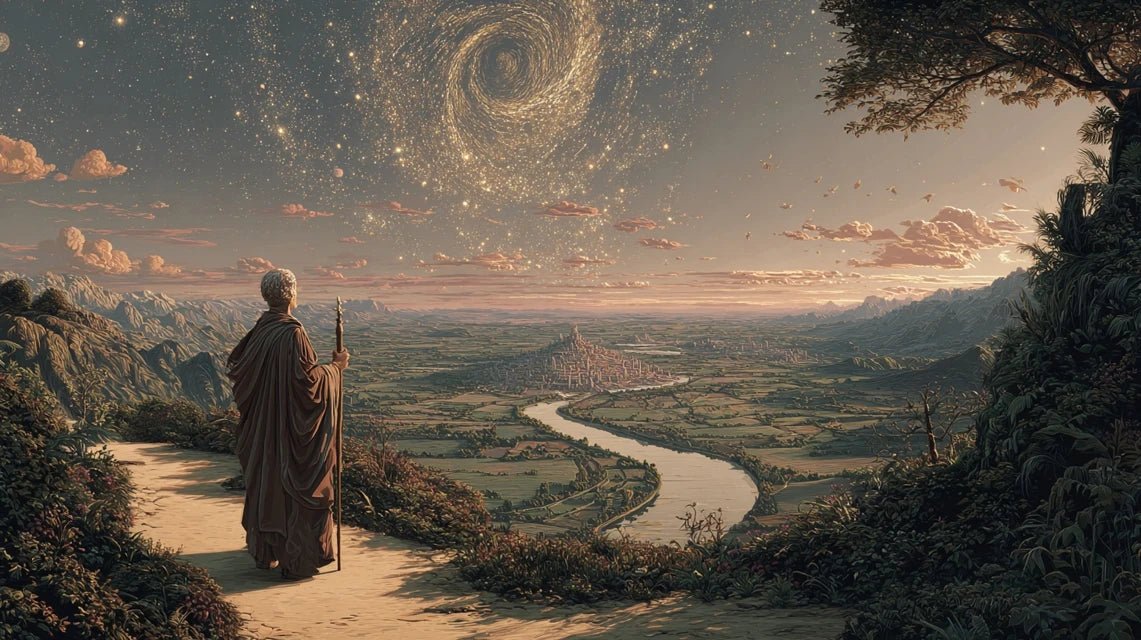
Look up on a moonless night, far from city lights. This milky streak across the sky has made civilizations' hearts beat for millennia. The Greeks saw it as Hera’s milk, the Mayans a road to the afterlife, and the Aboriginal people a cosmic river populated by spirits. Even today, the Milky Way fascinates, inspires and makes you dream. But how could this same celestial band have given rise to such different stories around the world?
Here's what the myth of the Milky Way brings to your universe: a deep connection with the founding narratives of humanity, an inexhaustible source of inspiration for your interior decoration, and an invitation to a cosmic journey from your living room. Are you looking to understand why this river of stars captivates so much? Do you wonder how to integrate this ancestral magic into your daily life? These millennial legends reveal more than just a simple astronomical observation: they unveil the soul of the peoples who imagined them. Let's embark together on the discovery of these fascinating myths that have shaped our view of the cosmos.
The divine milk of the Greeks: when Hera nourishes the stars
In Greek mythology, the Milky Way bears a name that speaks volumes about its origins: Galaxias Kyklos, the milky circle. The legend tells that Hera, wife of Zeus, nursed the little Heracles at her breast. But when she discovered that this child was the fruit of an infidelity by her husband with a mortal woman, she pushed him away violently. The divine milk then flowed into the sky, creating the white streak we still admire.
This myth reveals the Greek vision of the cosmos: a universe where the gods live their human passions on a celestial scale. The Milky Way thus becomes the permanent testimony of a moment of divine anger, a luminous scar in the firmament. Greek philosophers like Democritus already understood that it was an accumulation of distant stars, but the poetry of the myth endured, nourishing the imagination of artists for centuries.
Influence in art and decoration
This legend has inspired countless paintings, from Rubens to Tintoretto, where the lactating scene of Hera unfolds in all its baroque splendor. Today, these representations find their place in interiors that celebrate classical mythology and celestial aesthetics.
The path of souls: the mystical vision of the Mayans
For the Mayans, the Milky Way was not simply an astronomical phenomenon. They called it Xibalba be, literally “the way to the place of fear.” This celestial road led the deceased to Xibalba, the formidable underworld ruled by the lords of death.
In the Popol Vuh, a sacred Mayan text, the heroic twins Hunahpu and Xbalanque took this path to challenge the gods of death. The Milky Way therefore represented the link between the world of the living and that of the dead, a cosmic boundary that only the bravest dared to cross. During the rainy season, when the Milky Way appears differently in the sky, the Mayans saw it as the great celestial serpent bringing vital water.
This duality between death and rebirth, between drought and fertility, permeated their entire cosmology. Mayan temples were oriented according to the position of the Milky Way, creating an architecture in dialogue with the cosmos. Each ceremony, each ritual took into account this stellar path that structured their understanding of time and space.

Discover this inspiring artwork
The celestial river of Aboriginal mythologies
The Indigenous peoples of Australia possess some of the oldest astronomical traditions in the world, dating back over 65,000 years. For them, the Milky Way is not just a streak of stars: it's a cosmic river that reflects terrestrial waterways.
In the Yolngu tradition of the Northern Territory, the Milky Way represents Barnumbir’s canoe, the morning star (Venus), which travels along this celestial river. Other groups see the journey of the great rainbow serpent, creator of the landscape and ancestral laws. What is particularly fascinating is that Aboriginal people do not just look at the stars: they also observe the dark spaces between them.
These areas of darkness form negative constellations representing the emu, kangaroo or snake. This inverted reading of the sky testifies to a remarkable astronomical sophistication. The Milky Way thus becomes an open book telling the stories of the Dreamtime, that mythical era when ancestors created the world.
A wisdom for our contemporary interiors
This holistic vision where earth and sky are reflected inspires today's decorations that seek harmony between the interior space and the exterior cosmos, creating environments where celestial nature finds its domestic echo.
The celestial Ganges of Hindu mythology
In Hindu sacred texts, the Milky Way represents Akasha Ganga, the celestial Ganges. According to legend, King Bhagiratha prayed so intensely that he convinced the goddess Ganga to descend to earth to purify the ashes of his ancestors. But the force of the heavenly river would have destroyed the earth if the god Shiva had not retained its waters in his tangled hair.
This myth beautifully illustrates the connection between heaven and earth in Vedic thought. The Milky Way becomes the original river of which earthly rivers are only manifestations. Pilgrims bathing in the Ganges today symbolically purify themselves in these cosmic waters, establishing a direct connection with the starry river.
Festivals like the Kumbh Mela are organized according to precise astronomical configurations involving the position of the Milky Way. This intersection between mythology, astronomy and spiritual practice demonstrates how a celestial phenomenon can structure an entire civilization for millennia.

Discover this inspiring artwork
The European Way of St. James in the sky
In medieval Europe, the Milky Way acquired a new Christian meaning: it became the Way of Saint-James. According to legend, the apostle James appeared to Charlemagne and showed him the route to his tomb in Galicia following this starry trail.
Medieval pilgrims traveling to Santiago de Compostela used the Milky Way as a nocturnal compass. This luminous band literally pointed west towards the sacred destination. Romanesque churches along the way often depicted the Milky Way in their frescoes and stained glass, creating a dialogue between earthly architecture and celestial geography.
This Christian myth recycled ancient Celtic beliefs that already saw the Milky Way as a path to the Otherworld. The Welsh Caer Gwydion, the "castle of Gwydion," designated this same starry trail as a route to magical realms. This mythological continuity shows how cultures absorb and transform cosmic narratives from their predecessors.
Chinese cranes and the Japanese magpie bridge
In East Asia, the Milky Way carries romantic and poetic meanings. In China, it is said that it was created by the flight of thousands of celestial cranes whose white feathers traced this luminous route. But the most touching myth remains that of Qixi, Chinese Valentine's Day.
The celestial weaver Zhinü (the star Vega) fell in love with the herdsman Niulang (the star Altair). Their love distracted them so much from their duties that the Jade Emperor separated them by placing the Milky Way between them. But once a year, on the seventh day of the seventh lunar month, thousands of magpies form a bridge across the Milky Way to allow the lovers to reunite.
In Japan, this myth becomes Tanabata, celebrated with bamboo decorations where wishes are hung. The Milky Way, Amanogawa (the celestial river), symbolizes both separation and reunion, obstacle and bridge. This poetic duality permeates Japanese art, from Hokusai's prints to Bashō's haikus.
Transform your space into a cosmic sanctuary These varied tales about the Milky Way reveal a universal truth: humanity has always sought to give meaning to this celestial spectacle. Whether it's divine milk, a path of souls, a sacred river or a bridge for lovers, each culture has projected its values, fears and hopes onto this starry band. Today, science explains that we are observing our own galaxy from within, a disk of 200 billion stars whose sun is only an infinitesimal grain. But this knowledge does not erase the poetic power of myths. On the contrary, it enriches it. Knowing that we are literally made of stardust, that the atoms in our bodies were forged in long-dead suns, gives a new resonance to these ancestral legends. Integrating these myths into your decor is reconnecting with this cosmic dimension of human existence. A painting depicting the Milky Way does not simply decorate a wall: it opens a window onto infinity, recalls our place in the universe, invites contemplation. Every civilization has intuitively understood that this luminous trail was a mirror in which humanity could read its own condition. Imagine yourself in your living room, under a representation of the Milky Way that merges the mythologies of the world. You are no longer observing a simple astronomical phenomenon: you contemplate Hera's milk, the path of Saint-Jacques, the river of the Dream Time, the celestial Ganges and the bridge of reunited lovers. All these tales coexist in this same ribbon of light, testifying to humanity's extraordinary ability to transform observation into wonder, science into poetry. Choose a work that resonates with these millennial legends, and every glance at your wall will become a journey through the mythologies of the world, a connection with the stargazers who preceded us under the same infinite sky. The Milky Way is one of the most spectacular and visible celestial phenomena to the naked eye, especially before modern light pollution. Its constant and mysterious presence has naturally sparked human imagination. Each culture has interpreted this band of light according to its own beliefs, values, and environment. Peoples living near great rivers saw it as a heavenly river, pastoral civilizations perceived milk, spiritual societies distinguished a path to the afterlife. This diversity is a testament to human creativity in the face of the unknown. Even today, these myths fascinate us because they reveal how our ancestors understood their place in the universe. Integrating these stories into your decor honors this millennial tradition of cosmic wonder and creates a space that dialogues with infinity. Unfortunately, light pollution makes observing the Milky Way difficult from urban areas. To contemplate it in all its splendor, you must move at least 50 kilometers away from major cities, ideally to areas classified as "dark sky reserves." The best times are moonless nights between June and September in the Northern Hemisphere, when the galactic center is visible. But if you can't travel regularly to these places, there is a solution: invite the Milky Way into your home through a quality artistic representation. A cosmic painting
The choice depends entirely on your personal values and the atmosphere you want to create. If you are looking for spirituality and purification, the Hindu myth of the celestial Ganges will resonate with you. For a romantic and poetic atmosphere, the Asian lovers' bridge brings softness and hope. Adventurous souls might prefer the path of the Mayan dead or the medieval pilgrimage route, evoking travel and transformation. The Aboriginal vision suits contemplative spirits seeking harmony with nature. What is important is not so much choosing a specific myth, but feeling which story makes your soul vibrate. A representation of the Milky Way often transcends a single narrative: it embodies all these legends at once, creating a universal focal point that invites each visitor to project their own interpretation of the cosmos and their place in its immensity.
Discover our exclusive collection of space art
How these myths transform our relationship with the cosmos
Frequently Asked Questions about the Milky Way Myths
Why have so many cultures imagined myths about the Milky Way?
How can I observe the Milky Way from home today?
Which Milky Way myth should I choose to inspire my decor?