In the evening of 1895, while examining a stained-glass window at Maison Horta in Brussels, a revelation struck me: these sinuous lines that curl towards the ceiling do not simply represent plant stems. They evoke the spiral nebulae that astronomers were just beginning to photograph. Art Nouveau did not only revolutionize architecture and design – it created a visionary bridge between terrestrial nature and cosmic immensity, transforming our way of conceiving the universe.
Here's what the influence of Art Nouveau on representations of organic cosmos brings us: a unified vision where vegetal and celestial merge, an aesthetic that makes infinity accessible and human, and above all, a visual language that transforms cold science into habitable poetry. These artists captured something essential: the universe breathes, grows and unfolds exactly like plants.
Many think that cosmic representations should be cold, mathematical, distant. That space belongs to scientists and telescopes. Yet, when you contemplate a spiral galaxy or a nebula, don't you feel this strange familiarity? This impression of having already seen these forms somewhere, in a garden perhaps?
Rest assured: you are not alone. The masters of Art Nouveau – Mucha, Gallé, Klimt, Mackintosh – felt exactly the same thing over a century ago. And they created a visual vocabulary that finally allows us to tame immensity. In this article, I take you to discover how these visionaries transformed our relationship with the cosmos by making it as organic as a bud opening.
When stars embrace the curves of life
Art Nouveau emerges at a fascinating time: the years 1890-1910, when astronomy reveals unprecedented images of the universe thanks to celestial photography. For the first time, humanity discovers that galaxies are not luminous points, but organic spirals. This coincidence is not one.
Artists of this movement immediately recognized in these cosmic forms the same structures as in terrestrial nature. Look at a poster by Alphonse Mucha: aren't these feminine hairs that curl into hypnotic volutes embodied nebulae? These floral decorations framing his compositions follow exactly the same parabolic trajectories as the spiral arms of galaxies.
In my workshop, I keep a reproduction of a vase by Émile Gallé where dragonflies with translucent wings seem to fly between crystallized stars in glass. This piece perfectly summarizes the Art Nouveau approach to the cosmos: no border between the terrestrial microcosm and the celestial macrocosm. Everything is continuum, everything is alive, everything breathes according to the same organic laws.
The Cosmic Whiplash Line
The whiplash, this graphic signature of Art Nouveau, deserves attention. This line that undulates, accelerates, then unfolds in an arabesque strangely resembles representations of solar winds or comet tails. It's not just a decoration – it's a profound intuition about universal dynamics.
Victor Horta, when designing his stair railings, was not drawing simple wrought ironwork. He captured the very movement of cosmic energy, this invisible force that makes planets turn and stems push towards the light. Each curve is a trajectory, each volute a gravitational swirl translated into metal and light.
Habitable Nebulae: Decorating Infinity
What particularly fascinates me about the influence of Art Nouveau on organic representations of the cosmos is this audacious ambition: to make space habitable. Not in an astronautical sense, but in an emotional and aesthetic one.
Louis Comfort Tiffany's stained glass windows are a perfect example. His famous Wisteria create ceilings where clusters of colored light hang, instantly evoking star clusters. Entering a room topped with such a stained-glass window, you’re no longer looking at a ceiling – you’re living under a domesticated celestial vault.
I had the chance to study the Cauchie House in Brussels, where the exterior sgraffitos show female figures with hair sprinkled with what looks like comets and constellations. These women are not contemplating the cosmos – they are woven into it, they are its earthly incarnations. This fusion of the human body and the starry sky creates a cosmology where man is no longer a spectator but an integral part of the universe.
The Motif of the Universal Spiral
The spiral obsesses Art Nouveau. It can be found everywhere: in René Lalique's jewelry, William Morris' fabrics, Georges de Feure's posters. This form is not an arbitrary choice – it’s the fundamental structure that unites seashells, emerging ferns and distant galaxies.
Gustav Klimt, in his Tree of Life, created what remains for me the most beautiful synthesis of this organic cosmic vision. The branches spiral into infinite fractals, dotted with circular motifs that simultaneously evoke cells, planets and flowers. Everything is linked by the same sacred geometry, one that nature uses indifferently at all scales.

Discover this inspiring artwork
Architecture as an organic vessel
If you enter the Stoclet Palace in Brussels or Gaudí's Casa Batlló, you immediately understand that these buildings are not simply inspired by nature – they function like living organisms open to infinity.
Gaudí particularly embodied this cosmic organic vision. His inclined columns in the Sagrada Familia follow the exact angles of tree trunks, but also the trajectories of light rays in curved space. His vaulted ceilings simultaneously evoke underwater caves and colorful nebulae.
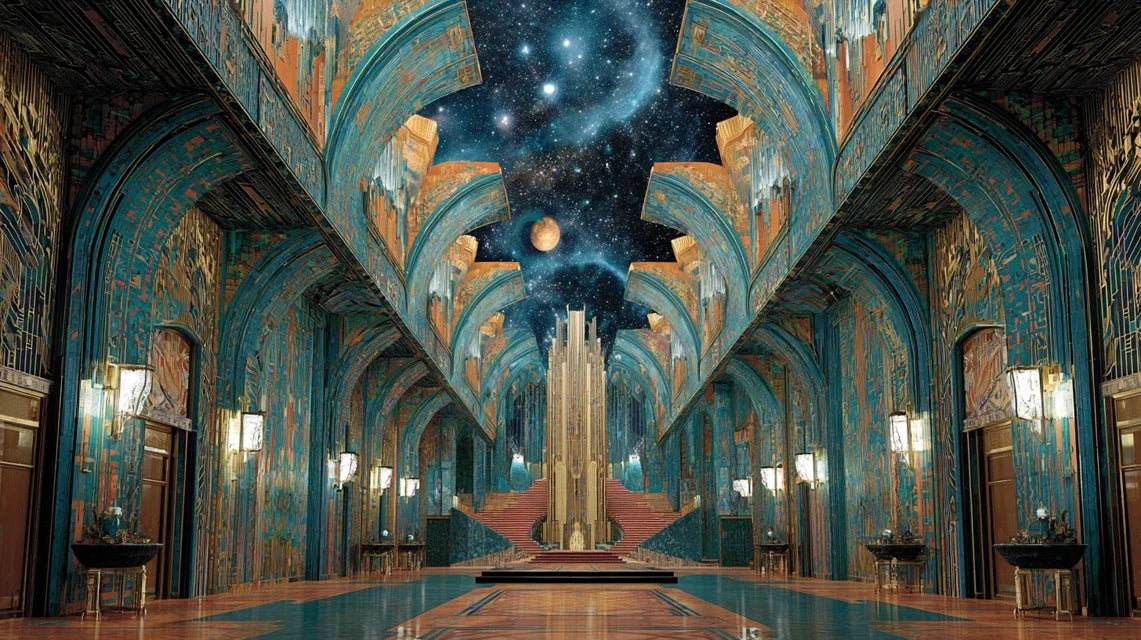
In my conservation work, I have analyzed how Art Nouveau used natural light to create cosmic effects. Skylight-like stained glass windows, spectral-colored stained glass, strategically placed mirrors: everything is designed so that the interior becomes a luminous microcosm, a small universe where day turns into a domestic constellation.
Stellar materials
Art Nouveau artists understood something essential: materials carry within them the cosmic history. Glass, a fusion of silica at high temperature, captures light as a star does. Forged iron, extracted from the bowels of the earth formed in ancient supernovae, retains memory of its stellar origin.
Émile Gallé worked glass by including bubbles, mineral inclusions, creating depths that evoke interstellar space. René Lalique set opals with nebulous reflections, understanding that these stones are fragments of frozen cosmos. Each jewel, each vase becomes a portable window onto infinity.
From celestial botany to your interior
How can this influence of Art Nouveau on representations of organic cosmos transform your living space today? The answer lies in this central intuition: your home can become a place where earth and sky dialogue.
Start by observing the curves. A simple Art Nouveau lamp, with its lampshade shaped like an inverted flower, creates a luminous constellation on the ceiling. The stylized floral motifs of this movement – irises, water lilies, wisteria – work perfectly as visual metaphors for nebulae and star clusters.
Art Nouveau textiles, with their intertwined vine motifs, create an upward dynamic that draws the eye up, towards infinity. A William Morris wallpaper doesn't simply decorate a wall – it transforms it into a vertical garden open onto eternity.
In my consultations, I often recommend incorporating Art Nouveau elements into contemplative spaces: libraries, reading corners, bedrooms. Why? Because these objects carry within them this dual earthly-celestial nature that fosters mental escape while creating a strong sensory anchor.
Cosmic Organic Colors
Art Nouveau developed a unique color palette that perfectly translates this fusion of the vegetal and the celestial. The deep greens of algae and ferns coexist with the blues of starry nights. Golds evoke both pollen and stardust. Iridescences recall both dragonfly wings and auroras.
These colors are never flat or primary. They are nuanced, changing according to the light, just as natural and cosmic phenomena are. A blue Art Nouveau always contains green or violet – it breathes, it lives, it captures this organic quality of the living universe.
Transform your interior into a habitable cosmos
Discover our exclusive collection of wall art space that captures this magical fusion between the organic and the celestial, to create a universe in your home where earthly beauty and cosmic infinity are one.

Discover this inspiring artwork
The living heritage: contemporary organic cosmos
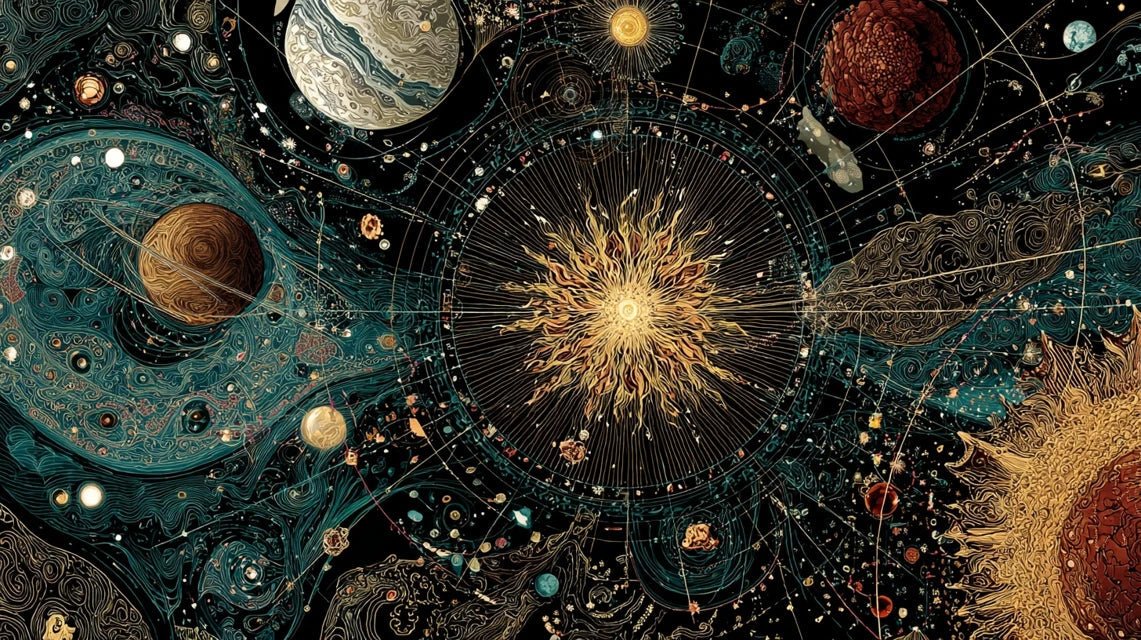
More than a century after its heyday, the influence of Art Nouveau on representations of the organic cosmos remains surprisingly relevant. Current images from the James Webb Space Telescope, with their saturated-colored nebulae and filamentous structures, resonate deeply with the Art Nouveau aesthetic.
Contemporary designers are rediscovering this approach. Architectural biomimicry – these buildings that imitate natural structures – directly extends the Art Nouveau intuition: the same laws govern the infinitely small and the infinitely large. A Zaha Hadid facade or a Marc Newson piece carries this legacy of organic cosmic fluidity.
In my practice, I observe that younger generations, saturated by rectilinear and cold technology, are precisely seeking this reconciliation between nature and cosmos that was offered by Art Nouveau. They want spaces that breathe, that undulate, that simultaneously evoke the primordial forest and the birth of stars.
This vision is not nostalgic – it is prophetic. As we begin to understand that the universe functions holographically, fractally, where each part contains information about the whole, we realize that Art Nouveau artists were right from the beginning: an iris contains a galaxy, a wrought iron scroll captures the gravitational dance of celestial bodies.
Today, integrating this aesthetic into your interior is not a retro style exercise. It's asserting a worldview where humanity is not separated from the cosmos but is its conscious expression. It’s transforming your living room into a poetic observatory, your bedroom into a soothing nebula, your entrance hall into a portal to organic infinity.
Imagine yourself in six months, in your space transformed by this philosophy. You wake up under a luminaire whose curves recall cosmic ferns. Your gaze glides over a painting where vegetable and galactic spirals merge. Your footsteps resonate on a floor with motifs evoking floral constellations. You no longer simply inhabit a house – you inhabit a fragment of a universe conscious of itself.
The influence of Art Nouveau on organic representations of the cosmos teaches us this: beauty is not in the separation between nature and science, earth and sky, interior and infinity. It is born instead from their fusion, from this recognition that everything is linked by the same creative forces. Your home can become a living witness to this unity.
Start simply. An object, a motif, a curve. Let in this vision where each decorative element becomes a meditation on our place in the universe. And observe how your space transforms into an active contemplation place, where each day you rediscover that you are made of stardust inhabiting a living planet, under an infinite sky – and that your interior can reflect this magnificence.
Frequently Asked Questions
How to recognize the cosmic influence in an Art Nouveau object?
Look for three distinctive signs: swirling lines that evoke galaxies, stylized organic motifs (flowers, insects, algae) that seem to float in an undefined space, and above all the use of translucent or iridescent materials (opal glass, color-changing enamels) that create cosmic depth effects. A true Art Nouveau object on a cosmic scale never literally depicts stars or planets – it captures universal dynamics through earthly forms. Look particularly at the works of Gallé, Lalique and Tiffany: their creations always seem to contain an infinite space, as if you were looking simultaneously at a terrestrial garden and a distant nebula. This double reading is the signature of the organic cosmic approach.
Can this aesthetic be integrated into a contemporary interior without falling into pastiche?
Absolutely, and it is even recommended! The key is to understand the principles rather than copy the forms. Instead of accumulating Art Nouveau reproductions, integrate contemporary pieces that share the same values: organic curves, reference to living things, noble materials. A modern design luminaire with flowing lines will dialogue perfectly with an authentic Art Nouveau chair. Prioritize one or two Art Nouveau statement pieces (mirror, lamp, vase) in a clean contemporary environment. The contrast enhances the cosmic dimension of these pieces. Contemporary creators such as Zaha Hadid, Ross Lovegrove or the Bouroullec brothers work precisely this organic-cosmic fusion – their creations are direct heirs to Art Nouveau, in a 21st century vocabulary.
What colors should be chosen to capture this organic cosmic atmosphere?
Forget the stereotypical black space! The Art Nouveau approach favors transition colors: deep blue-green (like deep algae or twilight sky), purple-violet (irises and nebulae), green-bronze (oxidation and vegetation), pale gold (pollen and stardust). These shades have an essential quality: they change according to the light, just like natural and cosmic phenomena. Avoid flat and saturated colors. Seek complex nuances: a blue that contains gray, a green that turns golden, a violet that hesitates towards brown. Finishes are as important as colors: prioritize iridescent surfaces, velvety matte or slightly pearlescent which create this characteristic depth. And don't forget: in cosmic Art Nouveau, gold is never flashy – it is always veiled, aged, like light that has traveled for years before reaching you.