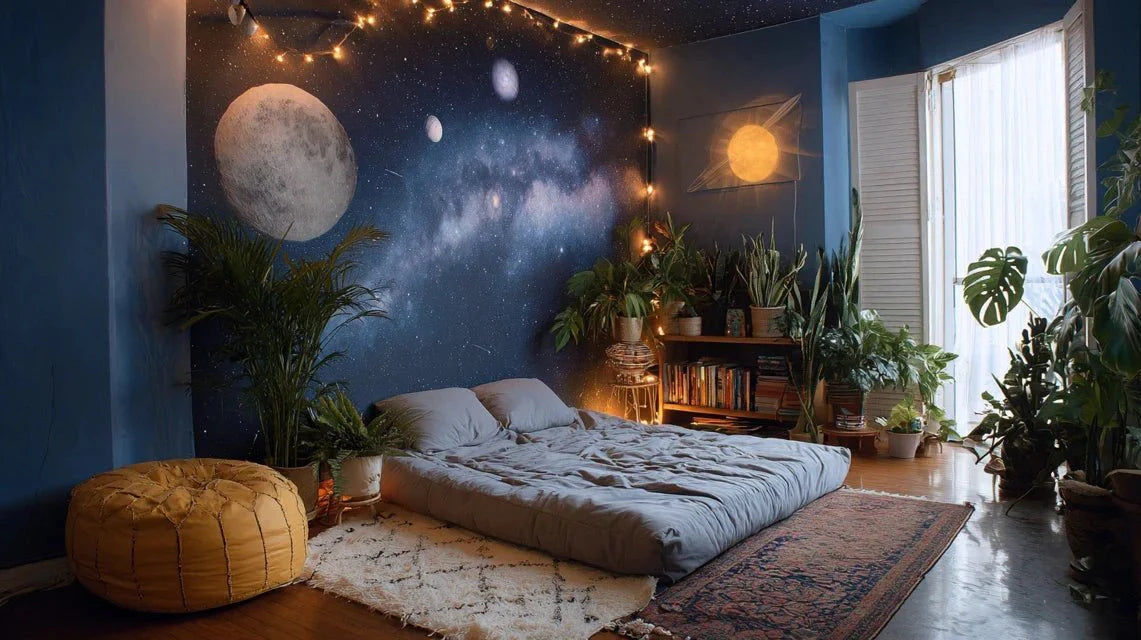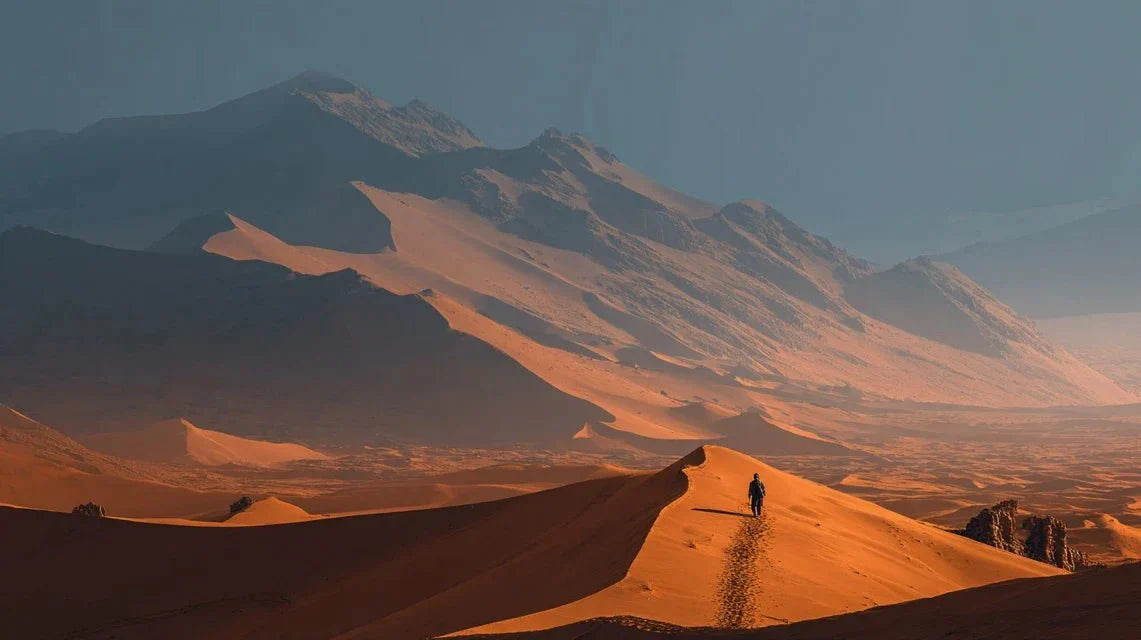
When Denis Villeneuve unveiled his adaptation of Dune in 2021, something profound happened beyond the movie theaters. These monumental images of burnt ochre, stellar copper and indigo skies awakened a primal nostalgia: that of a desert touching the stars. Since then, this desert-cosmic aesthetic has colonized our interiors, transforming living rooms and bedrooms into contemplative sanctuaries where sand and cosmos merge.
Here's what the influence of Dune brings to our living spaces: a powerful color palette that anchors and elevates simultaneously, a spiritual dimension that transforms decoration into a sensory experience, and a visual connection between the infinitely small (a grain of sand) and the infinitely large (the vault of heaven).
Perhaps you feel this weariness with the cold and minimalist interiors that have dominated for years. You are looking for warmth that is not that of Scandinavian hygge, a sophistication that avoids maximum opulence, an earthly anchor that retains a dreamy dimension.
Rest assured: this quest for balance finds its answer in these desert-cosmic palettes, accessible to all budgets and adaptable to all existing styles. You don't need to rethink everything: a few strategic touches are enough to create this visual alchemy.
Let's discover together how this cinematic influence redefines our decorative codes and how to integrate it with justness into your personal universe.
The chromatic revolution from Arrakis
The visual universe of Dune has crystallized what designers had sensed for a few years: the need for a palette that reconciles matter and spirituality. Desert tones are no longer those neutral and faded beiges, but saturated ochres, burnt Sienna earths, oxidized coppers that vibrate with a telluric intensity.
This influence is first manifested in the complexity of neutrals. Off-whites are enriched with pink undertones evoking dawn over the dunes. Grays warm up with golden particles like a sandstorm seen from orbit. Black itself becomes deeper, almost midnight blue, recalling those starry desert skies where the rarefied atmosphere reveals galaxies.
But the real innovation lies in the bold association between these warm tones and deep cosmic blues: indigo, Prussian blue, nocturnal ultramarine. This juxtaposition creates a fascinating visual tension, as if your living room contained simultaneously the ground of an arid planet and the stellar immensity that overlooks it.
Chromatic triads inspired by the film
Three major families of palettes emerge from this desert-cosmic influence. The first, the « Deep Dune » palette, combines burnt terracotta, anthracite black and touches of electric indigo: dramatic, it is suitable for spaces where you are looking for an intense meditative atmosphere.
The second, “Sable and Stars”, softens the approach with warm beiges, lunar grays, and bronze accents: more accessible, it integrates easily into existing interiors without a total revolution.
Finally, the “Mystic Spice” palette dares to use deep saffron, cosmic purple, and burnt caramel: boldly maximalist, it celebrates the sensory richness of the desert as a space of raw luxury.
Materials and textures: when tactile meets stellar
The influence of Dune on interiors is not limited to color. It introduces a fascinating dialectic between roughness and cosmic fluidity. The coarse weaves of linen and hemp coexist with deep velvets that capture the light like nebulae. Raw mineral surfaces dialogue with polished metals reflecting infinity.
This tactile approach radically transforms our relationship with materials. Polished concrete is no longer cold but telluric, evoking rock beneath the sand. Weathered wood becomes an archaeological artifact. Brushed brass suggests the metallic structures of a spaceship aged by particle storms.
Textiles play a central role in this desert-cosmic aesthetic. Favor thick cottons with irregular weaves, mohairs with changing reflections, raw wools that retain the memory of their animal origin. Layer them: a saffron throw on an anthracite sofa, indigo cushions on a sand-colored rug.
Ceramics regain nobility, especially pieces with imperfect glazes where the chance of fire creates cosmic effects: metallic streaks, crystalline cracks, chromatic variations reminiscent of planetary surfaces seen from space.

Discover this inspiring artwork
Wall art as a window to elsewhere
Within this decorative logic inspired by Dune, the wall no longer simply defines space: it becomes a portal to other dimensions. Wall art plays a strategic role in anchoring this desert-cosmic atmosphere, creating focal points that mentally expand volumes.
Aerial photographs of terrestrial deserts – Sahara, Atacama, Namibia – capture this organic abstraction where the eye loses its scale. Their natural compositions of dunes, shadows, and mineral textures create involuntary works of rare graphic power.
But it is the spatial imagery that truly completes this aesthetic. The Martian landscapes, with their planetary sandstorms and dizzying canyons, resonate directly with the visual universe of Arrakis. Nebulae in copper and orange tones extend the desert palette into interstellar space. Artistic representations of distant solar systems suggest the immensity that contextualizes our terrestrial presence.
This cosmic dimension brings a philosophical depth to decoration. It doesn't just embellish: it invites contemplation, mental travel, that expanded awareness provided by the vastness of the desert under the stars.
Spatial composition: creating your own Sietch
The influence of Dune also manifests in our way of organizing living space. The Sietch – these Fremen troglodyte habitats carved into the rock – inspire an architectural approach where shelter becomes sanctuary, where intimacy does not mean claustrophobia but regenerative protection.
This philosophy translates into the creation of strategic contemplative zones: a reading corner framed by thick textiles forming an alcove, a meditation space delimited by an ochre rug under a copper suspension, a desk positioned facing a stellar artwork as a mental window.
Lighting adopts the dramaturgy of the desert, alternating deep shadows and focused lights. Forget uniform general lighting: multiply indirect light sources at varying heights. Arch floor lamps projecting their light onto the ceiling recreate the blaze of a sunset. Warm-toned LED string lights suggest a starry vault. Ceramic terracotta accent lamps diffuse a dimmed, meditative light.
Furniture follows this organic logic. The pure geometric shapes of minimalist interiors give way to eroded curves, sculptural volumes evoking rocks polished by the wind. A sand-colored egg chair becomes a protective cocoon. An irregularly shaped solid wood coffee table recalls a rocky outcrop.
Desert vegetation as a living signature
Integrating the vegetal dimension reinforces the authenticity of this desert-cosmic aesthetic. Succulents and cacti are no longer Instagram trends but coherent sculptural presences within this universe: Candelabra Euphorbia, branched Aloe Vera, arborescent Crassula create graphic silhouettes evoking an extraterrestrial flora.
Arrange them in raw containers – unglazed terracotta, oxidized metal, poured concrete – which reinforce this feeling of a domesticated xerophytic garden. Their living but water-efficient presence symbolically resonates with the ecological philosophy of the Fremen and their culture of resource preservation.
Invite cosmic immensity into your daily life
Discover our exclusive collection of space paintings that transform your walls into contemplative portals to the starry infinite.

Discover this inspiring artwork
Accessorize without overwhelming: the Fremen refinement
The aesthetics of Dune celebrates ascetic refinement, that elegance which arises from rigorous selection rather than accumulation. Each object must merit its presence, bring a function or a contemplative dimension.
Handcrafted raw ceramic, mineral sculptures, patinated metal containers constitute visual anchors without cluttering the space. A hand-thrown stoneware bowl in earth color becomes as much sculpture as container. An amethyst geode literally captures the mineral cosmos within its crystalline structure.
Layered textiles create richness and depth: a Berber throw with geometric patterns evokes the stillsuits of the Fremen, an indigo velvet cushion recalls the desert night, a crumpled linen throw suggests the folds of a dune.
This approach rejects gratuitous decoration in favor of objects charged with meaning, authentic materials, forms that dialogue between earthly and cosmic. The desert-cosmic influence is not a superficial decorative style but a coherent aesthetic philosophy which transforms habitat into a space for contemplative renewal.
Your personal sanctuary awaits its metamorphosis
Imagine yourself in your transformed space: the evening light makes the ochres of your textiles vibrate while a cosmic artwork on the wall seems to contain infinity. The atmosphere is neither cold nor cluttered, but perfectly calibrated between earthly anchoring and mental elevation. Each material under your hands tells a story of deserts and stars.
This metamorphosis begins with a simple decision: identify the central element that will carry this new energy into your interior. A stellar wall artwork, a generous ochre textile, a repainted palette, a redesigned lighting. Let the influence of Dune infuse gradually, through coherent touches rather than by brutal revolution.
The desert-cosmic universe beckons you. It only asks to transform your daily life into a sensory experience where the gaze travels, where the hand rediscovers authentic textures, where the mind finally finds that contemplative breathing space that our compressed urban existences so often deny us.
Frequently asked questions about desert-cosmic palettes
How to integrate this aesthetic without completely redesigning my decor?
Start with textile layering: a terracotta throw on your existing sofa, deep indigo cushions, a rug in sandy tones. These movable elements instantly create the desert-cosmic atmosphere without major work or investment. Then add a starry wall art as a focal point that visually anchors this new aesthetic direction. Lighting is your third lever: replace some bulbs with warmer temperatures (2700K), add a terracotta ceramic table lamp. This gradual approach allows you to experiment with color combinations and validate that this influence from Dune really corresponds to your sensitivity before committing to permanent changes such as wall painting.
Won't these desert colors darken my small space?
This is a legitimate but unfounded concern if you dose intelligently. In a small volume, prioritize the "Sand and Stars" palette rather than "Deep Dune": warm beiges and lunar grays as a base, with only accents of saturated ochre and indigo. Apply the 60-30-10 rule: 60% light tones (beige, light gray), 30% medium tones (soft terracotta, bronze), 10% dramatic accents (deep indigo, starry black). Strategically use mirrors framed with copper metal to multiply natural light. The desert-cosmic influence can even visually enlarge the space thanks to wall art depicting stellar immensity or desert perspectives: they create a mental window that widens the walls. The key is to avoid total saturation and retain visual breaths.
Won't this Dune-inspired trend quickly become outdated?
The influence of Dune actually catalyzes a deeper decorative movement that far exceeds it: the return to complex natural palettes after years of cold monochrome minimalism. Desert tones (ochre, terracotta, sand) have spanned eras from antiquity to mid-century modern through Art Deco. Their association with deep cosmic blues responds to a lasting psychological need: to connect earthly anchoring and spiritual elevation. To ensure the durability of your decoration, build a timeless foundation with warm neutrals and authentic materials (linen, earthenware, wood, metal), then add more assertive touches via elements that are easily replaceable (cushions, wall art, decorative objects). Thus, even if the fashion effect fades, your interior will retain a natural elegance that transcends ephemeral trends. The well-calibrated desert-cosmic aesthetic ages beautifully.