


Cosmic Nostalgia: Why We Idealize the Space Age
October 11, 2025 · 8 min read · by Walensky
I remember that auction in Miami in 2019. A 1960s Sputnik lamp, estimated at $800, sold for $4,200. The buyer, a young tech entrepreneur, confided to me: “It reminds me of a time when the future seemed infinite.” I've seen this scene dozens of times. We don’t collect objects from the space age; we collect a dream.
Here's what cosmic nostalgia reveals about our relationship with design: it embodies our desire for technological optimism, nourishes our fascination with the bold shapes of yesterday's future, and reactivates our ability to marvel at the unknown. Yet, many hesitate to incorporate these space references into their interiors, fearing kitsch or a sense of being out of place. Rest assured: vintage cosmic aesthetics possess a timeless elegance that transcends trends. I’ll show you why this period continues to fascinate architects, designers and collectors around the world, and how it still influences our decorative choices today.
The moment everything shifted: 1957-1969
On October 4, 1957, the beep of Sputnik resonated in American living rooms. Within months, lighting fixtures were adorned with chrome satellites, fabrics featured atomic prints, and furniture took on orbital shapes. I have appraised catalogs from this era: between 1958 and 1962, more than 60% of new designs incorporated a space reference. It wasn't a style; it was a secular religion.
The Apollo 11 moon landing in July 1969 marked the peak of this fervor. Architects designed bubble houses. Designers imagined chairs shaped like spacecraft capsules. Futurism even conquered kitchens with streamlined appliances. This space age radically transforms our relationship to domestic aesthetics: for the first time, the home becomes a reflection of a collective dream turned towards the stars.
Technological optimism as an antidote
Why does this period obsess us today? Because it embodies something we have lost: the certainty that technology would make us better. In my consultations, I notice a clear trend: lovers of vintage space design are often between 30 and 50 years old, work in innovative sectors, but express disillusionment with current progress.
The space age represented a desirable future. No climate deregulation in the imaginations of the time, no ethical questioning about artificial intelligence, no digital anxiety. Just the luminous promise of a united humanity exceeding its limits. By incorporating a 1960s sunburst clock or a vintage NASA poster into their living room, my clients are not doing retro decoration. They're giving themselves a window onto a lost optimism.
The color of cosmic hope
The palettes of the era are revealing. Space turquoise, atomic orange, lunar white: vibrant hues that contrast with the dominant minimalist grays today. These colors communicate an energy, a confidence in the future. They literally transform the atmosphere of a space, charging it with a positive electricity that I consistently observe during my post-installation visits.
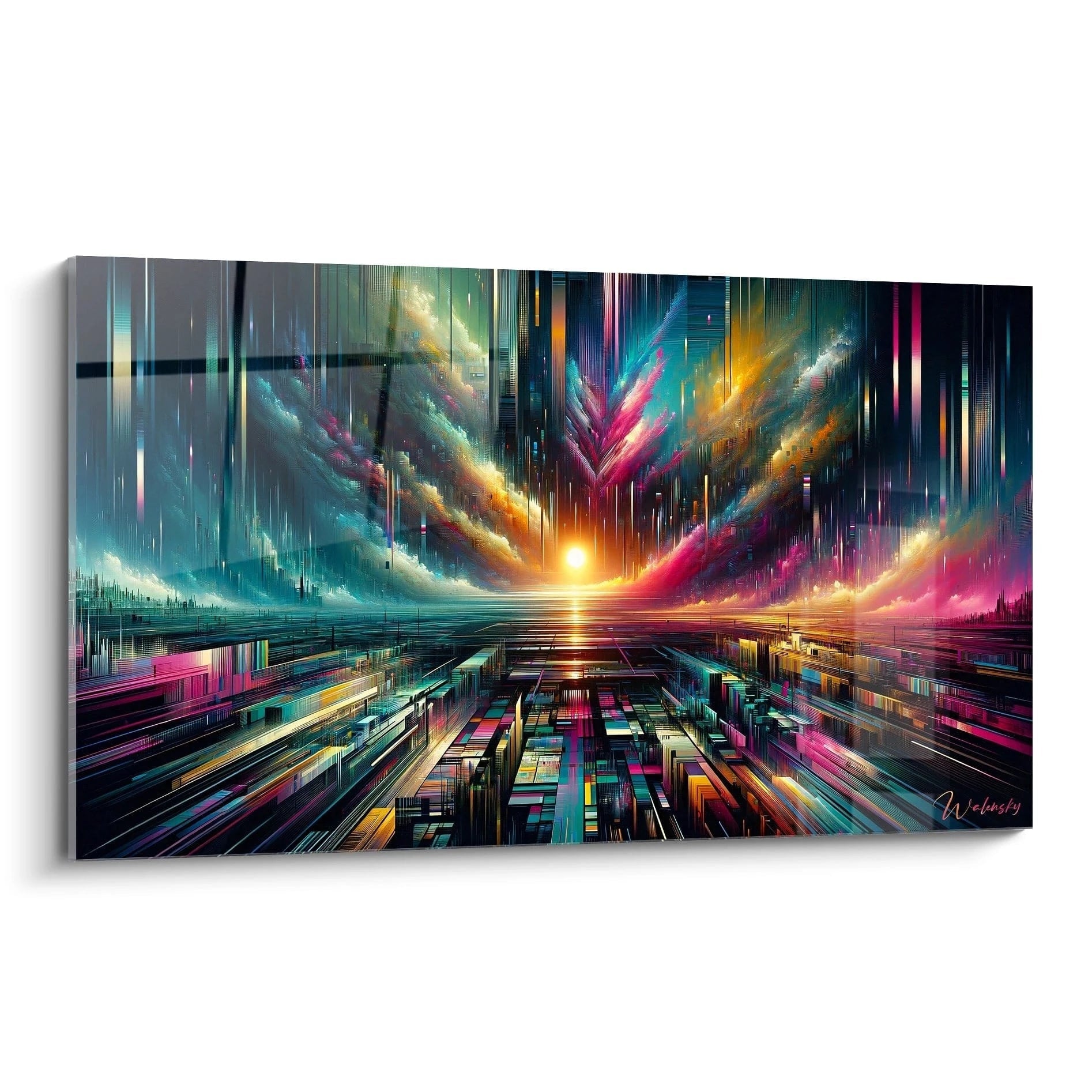
Discover this inspiring artwork

The shapes that defy gravity
Cosmic nostalgia also anchors itself in a unique formal vocabulary. Designers of the space age freed furniture from terrestrial constraints. Eero Saarinen's Tulip chair (1956) eliminates traditional legs. Eero Aarnio's Ball Chair (1963) transforms the seat into a spherical cocoon. These creations did not respond to a new functional need: they materialized an aspiration for weightlessness.
I recently acquired a Space Age side table signed Pierre Paulin for a collector client. Its organic curves seem molded by the absence of gravity. Placing it in his contemporary loft created a magnetic focal point. Guests literally gravitate around it, fascinated by its extraterrestrial silhouette. This is the sculptural power of vintage space aesthetics: it transforms the functional into the poetic.
Chrome and the myth of the immutable
The materials of the era also speak: polished chrome, molded plastics, fiberglass. Smooth, reflective, hygienic surfaces. This futuristic materiality evoked a world free from the roughness of the past, almost sterilized in its perfection. Today, these shiny finishes offer a striking contrast with the dominant raw wood and natural textures, creating visual dialogues of unsuspected richness.
— Our selection


When Hollywood reactivates collective memory
Cosmic nostalgia experiences cyclical peaks, often synchronized with pop culture. The film 2001: A Space Odyssey (1968) propelled the minimalist space aesthetic. Alien (1979) introduced a darker, industrial version. More recently, Interstellar (2014) and First Man (2018) have revived interest in the vintage authenticity of space exploration.
I notice a direct correlation in my sales. Following the release of the series For All Mankind in 2019, searches for reproductions of vintage NASA posters surged by 340%. The phenomenon is not superficial: these works reactivate a shared cultural memory, even among those who did not live through the era. They function as generational totems, transmitting an emotional heritage more than factual information.
Discover this inspiring artwork
The necessary idealization of the past technology
But let's be clear: our vision of the space age is highly selective. We forget the Cold War that motivated it, the arms race it masked, the colossal budgets diverted from terrestrial needs. We retain the glamorous images: the heroic astronauts, the sophisticated dashboards, the immaculate spacesuits.
This idealization is not a flaw. It's a psychological strategy. By museumifying this period in our interiors through carefully selected objects, we create sanctuaries against contemporary chaos. A client architect recently confided that he systematically installs a Space Age element in his residential projects: “It’s a reminder that we have already accomplished the impossible.”. Cosmic nostalgia then becomes a motivational tool, fuel for the imagination.
The paradox of vintage authenticity
Ironically, many of the “iconic” pieces from the space age were not accessible to the general public at the time. Jacobsen's Egg chairs furnished luxury hotels, not suburban villas. We idealize a democratic future that was, in reality, elitist. Today, reproductions make this dream accessible, truly democratizing the aesthetic that the era promised without delivering.
— You may also like


Integrating cosmic heritage without kitsch
How to capture this magic without turning your interior into a 1960s museum? The key lies in strategic selectivity. A single strong element is enough: a Sputnik suspension above a contemporary table, a reproduction of an Apollo mission poster framed on a clean white wall, a vintage egg chair as the centerpiece of a reading corner.
I apply the "temporal witness" rule: vintage spatial objects must dialogue with the present, not dominate it. In a recently renovated Parisian apartment, I paired a George Nelson atomic-lined clock with ultra-contemporary LED lighting. The contrast creates a fascinating temporal tension, as if past and future meet in the room's present.
Materials also offer subtle bridges. Corduroy from the 1970s can welcome cushions with cosmic geometric patterns. Brushed brass, a noble timeless material, connects vintage chrome to current finishes. Spatial wall art remains the most accessible solution: a stylized constellation, a minimalist lunar phase, or an abstract representation of planets are enough to infuse this cosmic dimension without overloading.
Transform your interior into a tribute to the golden age of space exploration
Discover our exclusive collection of space paintings that capture the optimism and visual boldness of the space age, perfectly suited to contemporary interiors.

In the same vein
Stellar Nebula Painting - Cosmic Aurora - Diverse Space Edition
233,90€
Discover this artwork →The future we still deserve
Cosmic nostalgia is not a regressive escape. It's a reminder that we have already known how to dream big, collectively, without cynicism. In 1962, Kennedy promised the Moon not because it was easy, but because it was difficult. This rhetoric of joyful effort has disappeared from our cultural vocabulary, replaced by permanent crisis management.
Objects from the space age in our interiors act as anchors of hope. They remind us that innovation can be beautiful, that progress can be desirable, that collective adventure remains possible. Every time my gaze meets my vintage Apollo 17 poster in my office, I feel this impulse: if we did that, what else can we achieve?
The real question is not why we idealize this period. It's: how to reactivate this mindset? Perhaps by starting modestly, by integrating these witnesses of boundless ambition into our daily visual life. Perhaps by refusing austere minimalism in favor of forms that celebrate boldness. Perhaps simply by looking at the stars, as our predecessors did, with the certainty that we have a place there.
The vintage space aesthetic didn't die with the last moon landing in 1972. It pulses discreetly within every interior that dares to affirm that another future remains possible. A future where technology elevates rather than alienates, where design inspires rather than simply functions, where our living spaces reflect our aspirations rather than our resignations. That’s the future we are installing, piece by piece, into our interiors. And that's exactly why this cosmic nostalgia has never been so relevant.
Frequently Asked Questions
Will the vintage space style quickly go out of fashion?
It's a legitimate concern, but the history of design teaches us otherwise. Iconic pieces from the space age like Tulip chairs or Sunburst clocks cross decades without losing their relevance, precisely because they embody universal formal principles: balance, dynamism, innovation. Unlike ephemeral trends, vintage cosmic aesthetics has a timeless dimension linked to its symbolic charge. It doesn't simply decorate: it tells a story of human ambition that resonates with each generation. To secure your aesthetic investment, prioritize pieces with clean design rather than overly dated literal references. A stylized constellation motif will age better than a hyperrealistic astronaut reproduction.
How to integrate space elements without my interior looking like a museum?
The key lies in the principle of the “single focal point”. Choose one strong piece per space: a sculptural suspension in the living room, a cosmic wall art in the bedroom, a vintage clock in the office. Let the rest of the decor breathe within a neutral and contemporary register. The contrast amplifies the impact of your space element rather than diluting it. Also consider scales: a large abstract painting evoking space creates a dramatic effect without physically cluttering, perfect for small spaces. Finally, work on chromatic links: pick up a color from your space piece (the cosmic blue, the stellar gold) in discreet accessories such as cushions or decorative objects to create a subtle coherence without falling into excessive thematization.
Should I prefer authentic vintage pieces or modern reproductions?
Both approaches have their merits, depending on your priorities. Authentic pieces possess a patina and tangible history that emotionally enrich your interior, but often require a significant budget and specific maintenance. Contemporary reproductions offer the advantage of modern durability, accessible prices, and sometimes functional adaptations (LEDs instead of energy-consuming halogen bulbs, more eco-friendly materials). For wall art in particular, museum-quality prints allow access to iconic space age visuals at reasonable costs. My advice: invest in an authentic vintage piece as an emotional anchor for your space, then complement it with contemporary elements inspired by space to gradually build your universe. What's important is not the material authenticity, but the authenticity of the emotion these objects evoke in you.
Explore our collections


