The first time I laid eyes on a painted ceiling depicting an abyss of stars dotted with ethereal tentacles, I understood that something profoundly different was emerging in the world of interior decoration. This fascination with cosmic horror, this aesthetic born from the writings of H.P. Lovecraft, is no longer limited to book covers or movie posters. It now seeps into our living spaces, creating spatial gothic interiors that marry the dark elegance of Victorian Gothic with the dizzying immensity of the cosmos. Here's what this trend brings: unparalleled psychological depth that transforms your living room into a meditative sanctuary, narrative sophistication that tells a story to every visitor, and aesthetic boldness that radically distinguishes you from conventional interiors. Many hesitate, fearing that cosmic horror will create oppressive or morbid spaces. Rest assured: when mastered, this aesthetic produces interiors of hypnotic beauty, both contemplative and surprisingly soothing. I'll show you how to transform this literary inspiration into coherent and livable decor.
The philosophical foundations of cosmic horror in habitat
Understanding H.P. Lovecraft’s cosmic horror is essential before embodying it in your interior. Unlike traditional Gothic, centered on death and earthly decay, cosmic horror contemplates the infinitely large, the incomprehensible, the exquisite insignificance of humanity in the face of the universe. This philosophy translates into decoration through specific visual codes: cool color palettes dominated by nebular blues, interstellar violets, and deep blacks dotted with starlight. Tentacular and organic motifs recall Lovecraftian entities, while impossible geometric references evoke the non-Euclidean architecture of his stories.
This aesthetic works particularly well in spaces dedicated to reflection: personal libraries, creative offices, bedrooms. The atmosphere it generates invites contemplation rather than frenetic socialization. Spatial gothic interiors create what I call “psychic decompression zones” where the gaze can get lost in the infinitely complex, paradoxically allowing the mind to recenter. It is this duality – between the immense and the intimate, between the strange and the familiar – that makes this approach so powerful on an emotional level.
Color palette: orchestrating stellar darkness
Creating a spatial gothic interior begins with mastering nuances. Forget uniform black: cosmic horror demands layered blacks – a charcoal black for the main walls, a bluish black for paneling, an anthracite black for textiles. This subtle variation creates essential three-dimensional depth. Accents should evoke cosmic phenomena: cobalt blue recalling nebulae, deep emerald green like certain stellar auroras, plum purple evoking ionized interstellar clouds.
The crucial element often overlooked: metallic touches. Aged silver, oxidized copper and especially black gold (alloy of gold and cobalt) bring these essential starlight reflections. They must be used sparingly – a frame here, an sconce there – to create points of light that evoke distant stars. I have observed that the most successful interiors use a 70-20-10 rule: 70% dark tones (blacks and deep blues), 20% saturated cosmic colors (purples, greens), and 10% precious metals. This proportion guarantees an immersive atmosphere without tipping into visual heaviness.
Lighting: Sculpting cosmic shadow and light
Lighting in a spatial gothic interior should never be uniform. Favor multiple and indirect light sources: LED strips hidden behind cornices diffusing a bluish glow, exposed filament lamps creating contrasting warm points, spotlights directed at specific architectural elements. Dimmers are non-negotiable – they allow you to adjust the intensity according to the time of day and mood. To accentuate the cosmic horror effect, integrate color-changing light sources that can evoke the pulsations of variable stars or magnetic auroras.

Discover this inspiring artwork
Furniture and architecture: strange geometries and earthly comfort
The furnishings of a spatial gothic interior must solve a delicate equation: evoke cosmic strangeness while remaining functional. Organic forms work admirably – armchairs with tentacular curves, bookshelves with asymmetrical shelves reminiscent of coral branches, coffee tables with sinuous legs. Look for Victorian or Art Nouveau pieces whose natural ornamentation can be reinterpreted in a Lovecraftian key. Corduroy velvet, patinated leather, and dark wood (ebony, smoked walnut) are the materials of choice.
Interior architecture deserves particular attention. If structural modifications are possible, consider asymmetrical arches, ceilings with varying heights or deep wall niches that can accommodate dramatic lighting and curiosities. These elements subtly evoke the impossible architecture of Lovecraft’s tales without compromising the building's solidity. Antique mirrors with ornate frames, strategically positioned, create plays of reflection that multiply space and accentuate the impression of infinite depth – a characteristic sensation of cosmic horror.
Wall decoration: when space art meets gothic iconography
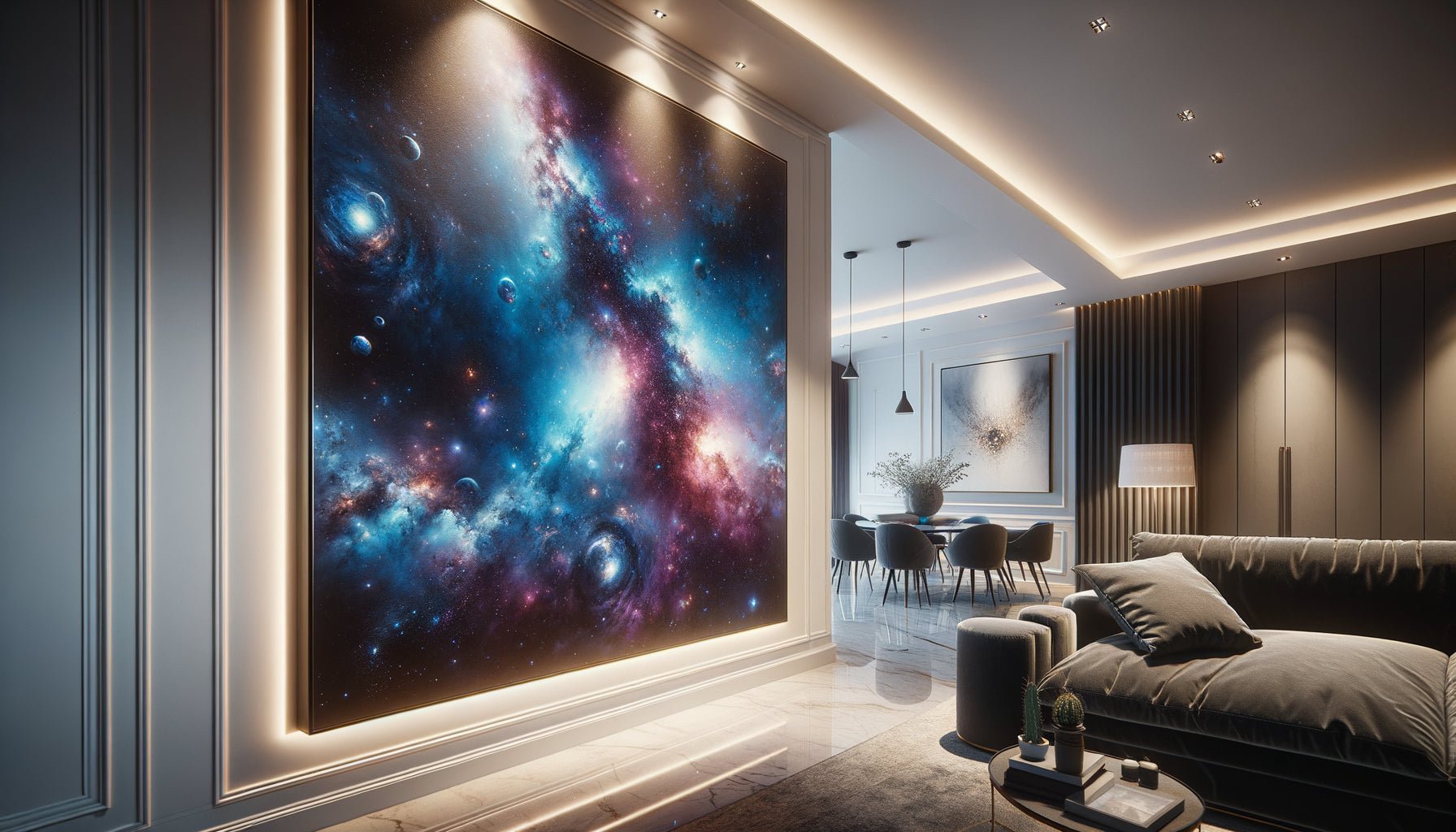
The walls of a spatial gothic interior are narrative canvases. Paintings depicting space are the central element of this aesthetic, but not just any paintings. Avoid NASA photographs that are too documentary; instead, favor artistic interpretations where nebulas take unsettling organic forms, where star clusters evoke countless eyes scrutinizing the observer. Works fusing astronomical imagery and esoteric symbolism – alchemical circles superimposed on constellations, sacred geometries integrated into lunar landscapes – perfectly embody the spirit of cosmic horror.
For wall composition, adopt a cabinet of curiosities approach: mix formats and frames in asymmetrical but balanced ways. A large space painting can be surrounded by smaller Victorian engravings depicting strange anatomies or ancient astronomical diagrams. The frames themselves deserve consideration: blackened gilding, carved wood with stylized floral motifs that may evoke tentacles, or even metal frames with unconventional angles. This visual stratification creates a narrative richness where each look reveals new details, maintaining interest and mystery.
Textiles and textures: earthly softness in the cosmic immensity
Textiles temper the potential coldness of a spatial gothic interior. Layer materials: thick velvet for curtains (ideally midnight blue or deep purple), damask silks for cushions with subtle patterns reminiscent of constellations or organic arabesques, antique Persian rugs with complex geometric motifs. These elements bring the necessary tactile warmth to keep the space welcoming despite its dark palette. Faux fur or chunky knit throws, in anthracite or lunar grey tones, add that essential cocooning dimension.

Discover this inspiring artwork
Curiosities: Materializing the incomprehensible
Spatial gothic interiors are fueled by unique objects that serve as narrative anchors. Seek out antique scientific instruments – brass telescopes, armillary spheres, aged celestial globes – which establish a link between cosmic exploration and vintage aesthetics. Specimens under glass (crystals, meteorite fragments, shells with strange shapes, preserved exotic insects) evoke this Lovecraftian fascination for unusual forms of life. Old leather-bound books, particularly those dealing with astronomy, occultism or zoology, are essential decorative elements, stacked with calculated negligence.
Don't forget sculptural elements. From reproductions of marine fossils with tentacular shapes to patinated neoclassical busts and wrought iron chandeliers with organic branches – each object should seem to carry a story. Controlled accumulation is key: enough to create richness and mystery, not too much to avoid clutter. Organize these curiosities by thematic vignettes – a shelf dedicated to observation instruments, a corner dedicated to natural specimens – which function as micro-exhibitions within your interior.
Ready to invite cosmic immensity into your daily life?
Discover our exclusive collection of space paintings that will transform your walls into portals to infinity, combining artistic sophistication and narrative depth to create the visual soul of your spatial gothic interior.
Iconic pieces: where to embody cosmic horror
Some spaces are particularly well-suited to cosmic horror. The personal library constitutes the ideal terrain: dark walls covered with books, subdued lighting, enveloping armchair facing a window or a large space painting. This is the archetype of the contemporary Lovecraftian sanctuary, where reading and cosmic contemplation meet. The creative office also benefits beautifully from this approach – the introspective atmosphere promotes concentration and unbridled imagination.
The spatial gothic bedroom requires more subtlety. Favor slightly lighter tones (midnight blue rather than absolute black), integrate more fluffy textiles, and ensure that lighting is perfectly adjustable. The ceiling is a strategic surface here: painted with a starry sky or decorated with wallpaper depicting a nebula, it transforms falling asleep into a cosmic journey. For shared living spaces such as the living room, adopt a gradual approach: start with a dark accent wall adorned with space paintings, then gradually extend the palette according to the comfort of the occupants.
Balancing boldness and daily livability
The major challenge of spatial gothic interiors is to create spaces dramatic enough to be memorable, but balanced enough to live comfortably in. The solution: visual breathing zones. Even in the darkest rooms, provide surfaces that capture and reflect light – an antique mirror, a Carrara marble console with veining, cushions in lighter tones. These elements prevent visual oppression while maintaining aesthetic consistency.
Also consider seasonal evolution. A cosmic horror interior naturally thrives during the dark months, but may seem disconnected in full summer. Provide subtle adjustments: lighter textiles in warm season, increased light intensity, introduction of a few plants with dark foliage (ferns, purple foliage plants) that bring life without compromising the palette. This flexibility ensures that your interior remains in harmony with natural cycles while retaining its unique identity.
From literary inspiration to domestic reality
Transforming the universe of Lovecraft into functional decor requires translating abstract concepts into concrete choices. His descriptions of cyclopean architectures and non-Euclidean geometries can inspire surprising asymmetrical arrangements – a bookcase whose shelves follow an unusual progression, a hallway where perspectives are accentuated by lighting and color to appear deeper than it is. His tentacled entities find their echo in the sinuous organic motifs of furniture and textiles.
But above all, capture the emotional essence of cosmic horror: this mixture of wonder and unease at the immensity, this awareness of our insignificance that can paradoxically be deeply soothing. A successful spatial gothic interior evokes these sensations without resorting to literally horrific elements. It suggests rather than imposes, invites contemplative reverie rather than discomfort. This sophistication in interpretation is what differentiates a successful themed decor from an awkward pastiche.
Your space becomes much more than just an interior: it transforms into a narrative environment where every element contributes to a silent story. When you enter your home, you don't simply cross a door – you penetrate a parallel universe, a pocket of alternative reality where dark beauty and cosmic contemplation meet. It is this ability to transform daily life that makes the approach of cosmic horror in decoration so powerful: it does not merely beautify your environment, it re-enchants your relationship with habitat.
Conclusion : Living infinity with elegance
Spatial gothic interiors inspired by Lovecraftian cosmic horror represent much more than a fleeting decorative trend. They embody a philosophical approach to habitat where cosmic contemplation and aesthetic refinement meet to create spaces of rare emotional depth. By mastering stellar color palettes, selecting furniture and objects that carry narration, and balancing visual boldness with daily comfort, you build a personal sanctuary that reflects the fascinating complexity of the universe itself. Start modestly – an accent wall, a few carefully chosen spatial paintings, a redesigned lighting – and let your interior evolve organically towards this unique aesthetic. Cosmic infinity does not wait in inaccessible distances; it can live, starting today, between your four walls.
FAQ : Your questions about spatial gothic interiors
Isn't a cosmic horror inspired interior too dark to be enjoyable on a daily basis?
This is the most common concern, and it's legitimate. The key lies in balance and luminous layering. A well-designed spatial gothic interior is never uniformly dark – it presents variations in depth and strategic bright spots that create dynamism and depth. Using dimmers allows you to adapt the atmosphere according to the moments: brighter for activities requiring concentration, more subdued for contemplative relaxation. Many inhabitants of these interiors paradoxically report a greater sense of calm, as dark tones create a protective cocoon effect that pleasantly contrasts with the visual overstimulation of contemporary urban environments. The essential thing is to introduce this aesthetic gradually, starting with a room or delimited space, to verify your personal comfort before extending the approach. Also remember that well-used dark colors visually enlarge the space by blurring physical boundaries, creating just that sought-after cosmic immensity.
How to integrate this aesthetic without scaring away your guests or future buyers if I resell?
The modular approach is your best ally. Concentrate the boldest elements in private spaces (bedroom, personal office) where your individual expression takes precedence, and adopt a muted version in common areas. For the living room, prioritize impactful but easily changeable wall decor – paintings can be taken down, unlike an integral black mural. Use textiles as primary vectors of the aesthetic in shared spaces: curtains, cushions and rugs bring the dark palette without permanent commitment. Regarding real estate resale, know that interiors with strong personalities often attract specific buyers willing to pay more for a finished and coherent decoration. Nevertheless, if you anticipate a sale, avoid irreversible structural modifications (painting woodwork black, for example) and favor interventions that can be easily neutralized. In reality, a well-executed spatial gothic interior generally impresses visitors with its sophistication and originality – the “wow” effect outweighs the initial apprehension.
What budget to plan to create a true interior inspired by cosmic horror?
The beauty of this aesthetic lies in its budgetary flexibility. Unlike Scandinavian minimalist styles requiring expensive designer pieces, the spatial gothic approach values eclectic accumulation and the patina of time, making secondhand finds particularly appropriate. You can start with a minimal budget: painting walls (€50-150 depending on surface area), a few carefully selected spatial artworks (from €30-150 per piece for quality prints), dark textiles (curtains and cushions for €100-200), and ambient lighting (LED strips and dimmers for €50-100). This base can be established for €300-600 and will already radically transform your space. Subsequent levels involve acquiring vintage furniture (budget varies greatly depending on scavenging and patience), curiosities (from a few euros at flea markets to hundreds for exceptional pieces), and possibly architectural modifications or more sophisticated lighting. The major advantage: this decoration is built gradually and organically, each new acquisition enriching the overall narrative. Many also find that the hunt for perfect pieces becomes a passion in itself, an integral part of the aesthetic pleasure. Start modestly, let your vision become clearer over time, and gradually invest in the elements that resonate most deeply with your personal interpretation of cosmic horror.