In 1944, as World War II still raged, a 56-year-old American illustrator published in the magazine
Here's what Bonestell's legacy and Space Art bring today: a poetic vision of the cosmos that transforms science into emotion, a recognizable aesthetic that still influences contemporary design, and an inexhaustible source of inspiration to create interiors that invite travel and contemplation.
You are fascinated by space but find scientific images too cold, too technical? You dream of integrating this cosmic dimension into your decoration without falling into kitsch science fiction? You are not alone. For decades, the universe seemed inaccessible to decorative art, trapped between austere astronomical photographs and pulp magazine illustrations.
Good news: Chesley Bonestell solved this dilemma long before we even asked ourselves the question. His approach, combining scientific rigor and artistic sensitivity, created a visual language that remains surprisingly current. Understanding his process is discovering how to transform infinity into intimacy, how to bring the cosmos into our living spaces with elegance and depth.
The architect who became a painter of stars
Before becoming the father of Space Art, Chesley Bonestell was an architect. He worked on iconic projects such as the Chrysler Building in New York and the Golden Gate Bridge in San Francisco. This initial training explains everything: his space paintings possess this structural rigor, this attention to proportions and perspectives that radically distinguish them from the fanciful illustrations of the time.
When he turned to space art in the 1940s, Bonestell applied a revolutionary methodology. He consulted the latest astronomical data, calculated solar light angles, respected probable geological compositions of planetary surfaces. His space paintings are not mere daydreams: they are scientifically informed visual hypotheses.
This approach creates a striking effect: his works seem to be photographs of a future yet to come. When space probes actually explore the solar system in the 1960s and 1970s, some images will strangely recall Bonestell's visions, confirming his extraordinary visual intuition.
Saturn from Titan: The image that changed everything
His most famous painting depicts Saturn as seen from the surface of its moon Titan. In the foreground, a rocky and desolate landscape. On the horizon, the immense sphere of Saturn floats in a black sky, its spectacular rings crossing the composition diagonally. This image, published in 1944, provokes an unprecedented aesthetic shock.
For the first time, space was no longer abstract. Bonestell offered a human perspective, a visual experience that anyone could imagine living. His paintings function as windows: we do not look at space from the outside, we are in it. This immersive dimension explains why his works decorate our contemporary interiors so well.
The cultural impact is immediate. Wernher von Braun, the father of the Saturn V rocket, collaborates with Bonestell on several popularization projects. Walt Disney hires him for the famous television episodes about space exploration broadcast in the 1950s. Space Art becomes a genre in its own right, influencing cinema, literature, and of course, interior decoration.

Discover this inspiring work
An aesthetic between sublime and everyday
What makes Bonestell’s work so relevant to our living spaces is its balance between cosmic grandeur and earthly intimacy. His compositions do not shout: they invite silent contemplation. The color palettes, dominated by deep blues, mineral ochres and velvety blacks, naturally integrate into contemporary interiors.
Unlike current space representations, often saturated with artificial colors, the Bonestell style favors a certain chromatic restraint. His black skies are never completely opaque; they contain subtle gradations, a depth that captures the ambient light of a room. His textured planetary surfaces add a tactile, almost sensual dimension.
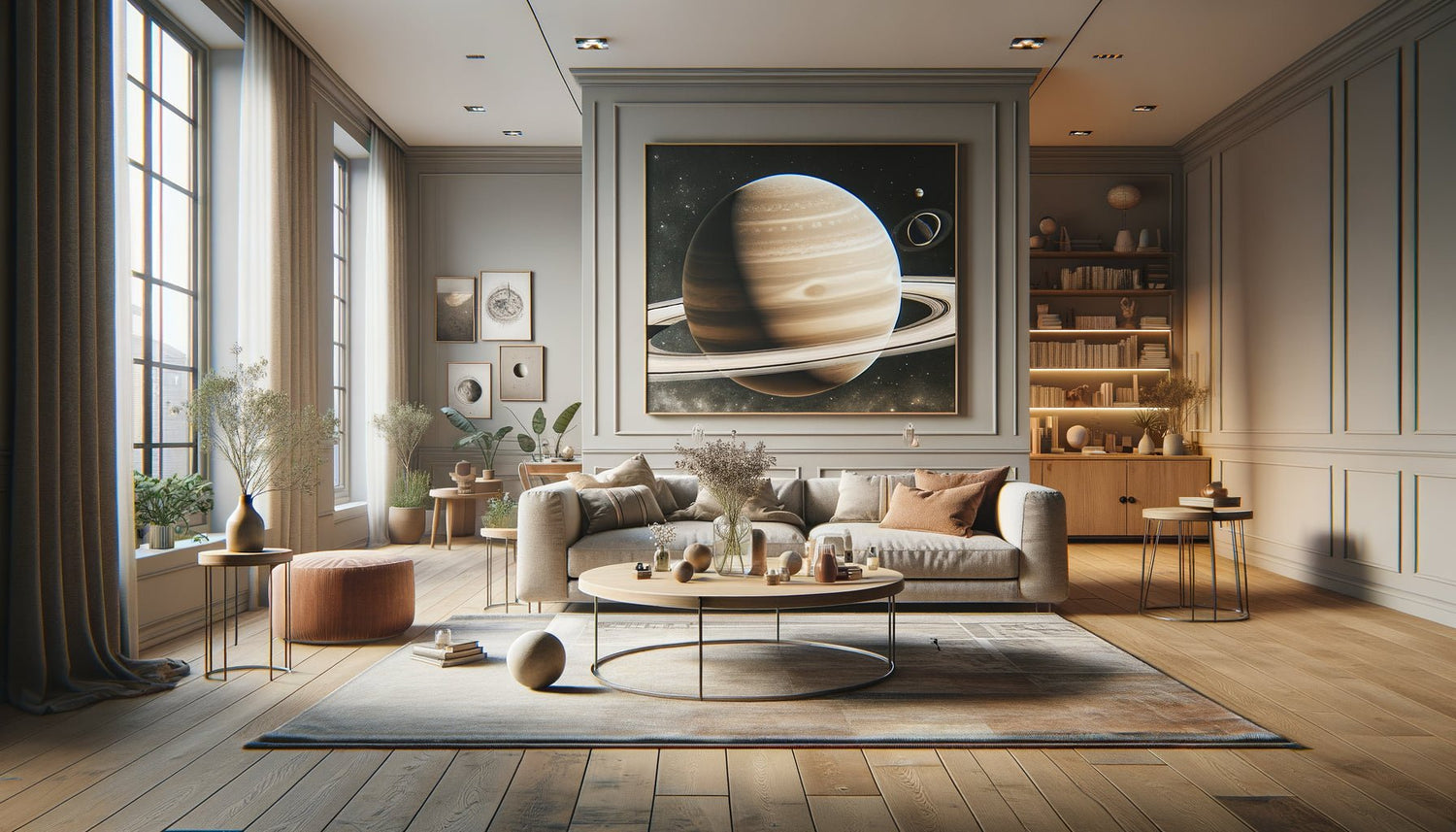
This approach creates space artworks that work beautifully above a sofa, in an office or bedroom. They bring a meditative dimension without imposing a too dramatic presence. One can live daily with a Bonestell-inspired painting without fatigue, because each look discovers new details, new depths.
The Bonestell legacy in contemporary decoration
Today, the influence of Chesley Bonestell permeates all spatial visual culture. From 2001: A Space Odyssey to Interstellar, and through NASA's visual campaigns, his aesthetic persists. This longevity is due to a rare quality: his images have never ceased to seem contemporary.
In our interiors, this space aesthetic responds to deep aspirations. At a time when we spend most of our time in constrained urban spaces, saturated with information and solicitations, Bonestell's visions offer a contemplative escape. They create an opening towards infinity in our enclosed spaces, an essential visual breath.
Space wall art inspired by his work works particularly well in minimalist and modern decorations. Their natural geometry dialogues with the clean lines of contemporary furniture. Their restricted but sophisticated palette complements noble materials such as wood, brushed metal or polished concrete. They bring depth without visually cluttering.

Discover this inspiring artwork
Integrating the Bonestell vision into your home
How to bring this heritage into your daily life? First, by understanding that authentic Space Art is not just about colorful planets on a black background. It's about creating a window to elsewhere, a focal point that transforms the energy of a room.
In a living room, a large format representing a lunar or Martian landscape becomes a calming presence, a counterpoint to the frenetic pace of our lives. In an office, a view of Earth from orbit recalls the necessary perspective to relativize our daily concerns. In a bedroom, stellar depths naturally invite letting go and introspection.
Lighting plays a crucial role. Works inspired by Bonestell benefit from indirect lighting that accentuates their subtle nuances. Avoid direct spotlights that flatten textures. Prefer soft light that allows dark areas to retain their mystery, reflections to play on planetary surfaces.
Ready to transform your interior into a window on infinity?
Discover our exclusive collection of space paintings that perpetuate the visionary legacy of Chesley Bonestell and invite the cosmos into your daily life with elegance.
Why Bonestell Remains Timeless
More than forty years after his death in 1986, Chesley Bonestell remains the absolute reference of Space Art. This longevity is based on a fundamental intuition: space is not just a scientific subject, it is a universal emotional dimension. His paintings do not document astronomy; they translate our existential relationship with immensity.
In an era when space exploration is becoming relevant again with Martian and lunar projects, his aesthetics are experiencing a resurgence of interest. But beyond trends, what fascinates is this unique ability to make the impossible familiar. His extraterrestrial landscapes seem to have been waiting for us forever, like memories of places never visited.
For those seeking to create interiors that tell a story, that go beyond ephemeral trends, Bonestell's legacy offers a royal path. His compositions possess the rare quality of great works: they enrich the space they inhabit without ever depleting it. One does not tire of contemplating Saturn above an alien horizon, any more than one tires of a grand master hanging in a museum.
Imagine yourself in the morning, with a cup of coffee in hand, your gaze drifting towards that painting on the wall. Not just any image, but a window open onto Titan, onto the rings of Saturn, onto those mineral expanses that no one has yet set foot on. A few seconds of contemplation that recalibrate your day, that reconnect you to something greater. That's exactly what Chesley Bonestell offered the world: not images, but portals to infinity. It is now up to you to cross the threshold and let this cosmic perspective into your daily life.
Frequently Asked Questions
What is Space Art and how did Chesley Bonestell invent it?
Space Art is an artistic genre that represents space, planets and cosmic phenomena with an approach combining scientific rigor and aesthetic sensitivity. Chesley Bonestell truly created it in the 1940s by applying his architectural training to the representation of alien worlds. Before him, space was either treated purely scientifically and technically or illustrated fancifully in science fiction magazines. Bonestell found the right balance: his paintings respected known astronomical data while creating a powerful visual emotion. He established the visual codes that we still associate with space aesthetics today: realistic color palettes, immersive perspectives, attention to geological details and light effects. His influence on visual culture is such that even real images of space, photographed by spacecraft probes, sometimes seem to confirm his artistic intuitions. He literally invented how we visualize the cosmos.
How to integrate a space painting inspired by Bonestell into a modern decor?
A space painting in the spirit of Bonestell integrates wonderfully into contemporary decoration thanks to several intrinsic qualities. First, prioritize a large format to create this characteristic window sensation typical of his approach: the work should invite the eye to get lost in it, rather than simply decorate a wall. Place it on a clean wall, ideally as a unique centerpiece rather than in the middle of an overloaded gallery. The Bonestell aesthetic works particularly well with minimalist, Scandinavian or industrial interiors: gray, deep blue and black color palettes blend perfectly with natural wood, concrete, metal. In terms of lighting, avoid direct spotlights that create reflections; prefer indirect lighting or ambient lamps that allow the work to breathe. In a living room, it becomes a point of soothing contemplation; in an office, it offers an inspiring perspective; in a bedroom, it invites nocturnal reverie. The essential thing is to let it create its own visual breathing space.
Why does the Bonestell aesthetic remain current when it dates back to the 1940s?
The timelessness of Chesley Bonestell rests on several essential factors. First, he worked from universal principles: the laws of perspective, light, and spatial composition do not change with trends. Secondly, his approach favored chromatic sobriety rather than spectacular effects, which avoids the rapid aesthetic aging of works that are too dramatic or colorful. His paintings possess a contemplative quality, almost meditative, which particularly resonates with our contemporary needs for disconnection and visual breathing space. Unlike current spatial representations often saturated digitally, his oil work retains a texture, a material depth that dialogues well with our physical interiors. Finally, he visually anticipated what science would later confirm: his images never seemed completely outdated, even after the actual exploration of the solar system. This combination of timeless rigor and visual poetry means that his works cross decades without aging, always offering the same invitation to immobile travel sought by so many decorators today.