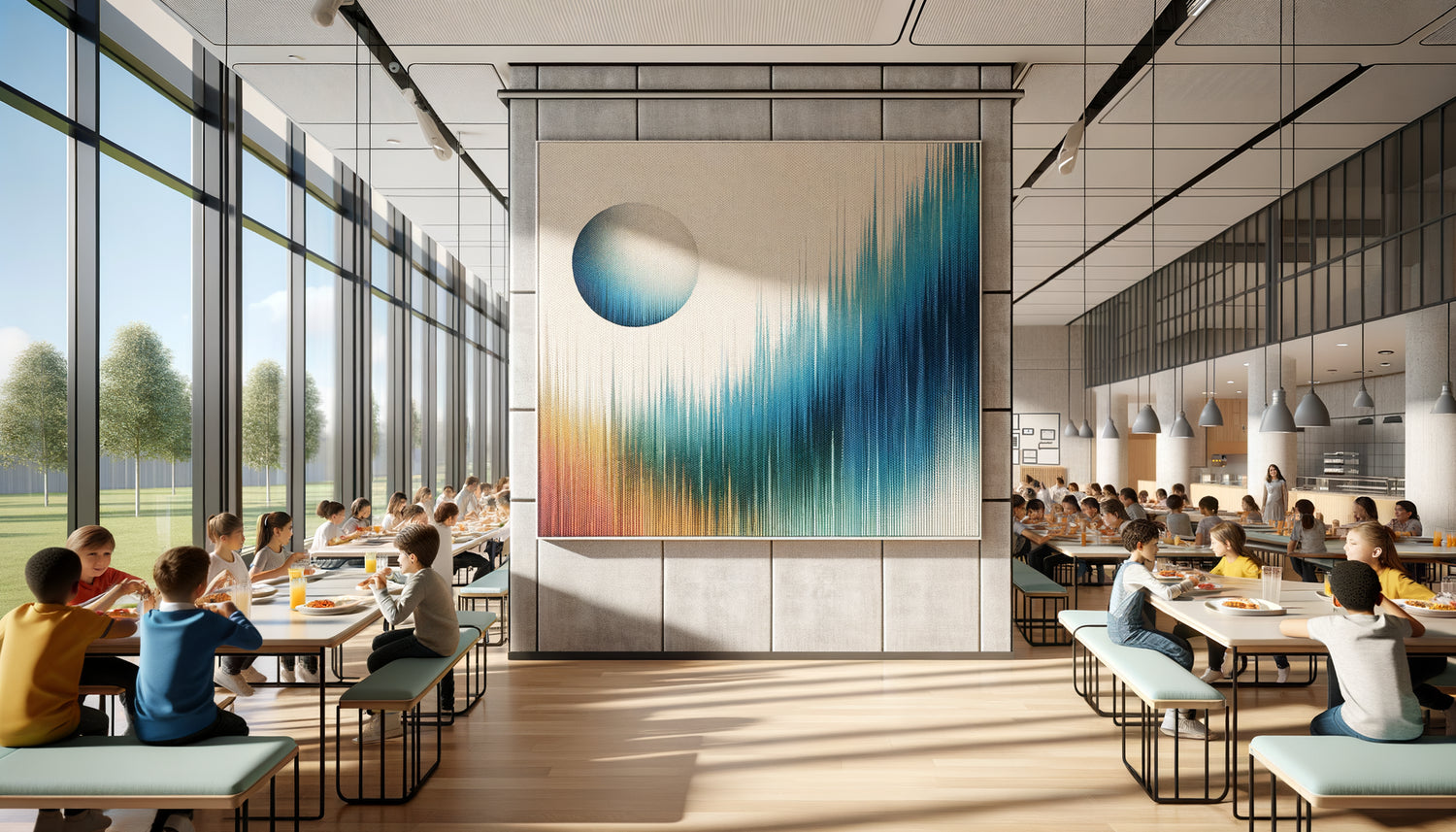
Every day at 11:45 a.m., it's the same ritual: the noise level rises, chairs scrape the floor, and suddenly, the artwork you carefully hung last week vibrates against the wall. In a school cafeteria, decorative art doesn't just embellish walls – it must withstand, absorb, and soothe. Here's what a reinforced canvas specifically designed for this purpose brings to this unique environment: exceptional durability against sound impacts, acoustic properties that transform the atmosphere, and a stable visual presence despite daily vibrations.
You know if you manage school decor: cafeterias are harsh environments. Between decibel levels reaching up to 85 dB during peak hours, the humidity from hot meals, and the overflowing energy of children, everything that decorates these spaces must be thought of as equipment in its own right. Too often, traditional paintings warp, frames loosen, and the visual rendering loses its appeal within just a few months.
Rest assured: textile innovations have revolutionized the world of artistic supports for collective spaces. Today there are technical canvases that combine mechanical strength, acoustic qualities and lasting aesthetics. Understanding their specificities will allow you to transform your cafeteria into a place where beauty and functionality coexist harmoniously.
I invite you to discover precisely which reinforced canvases to choose so that a painting survives – and even thrives – in the demanding environment of a noisy school cafeteria, while actively contributing to the acoustic comfort of your students.
High-density polyester canvas: the anti-vibration shield
In a cafeteria where the sound level constantly fluctuates, acoustic vibrations spread through the walls and literally shake decorative elements. Traditional cotton canvases, even mounted on frames, absorb these waves unevenly, creating micro-deformations that gradually alter the printed image.
High-density polyester canvas (minimum 280 g/m²) offers a remarkable alternative. Its tight weave and stable molecular structure give it exceptional vibrational inertia. In concrete terms, when decibels rise, this canvas remains perfectly taut, without parasitic undulations. I have observed installations in cafeterias hosting 300 students daily: after two years of intensive use, these canvases retained their original flatness.
Polyester also has a shape memory superior to cotton. Under the effects of humidity variations – inevitable with cooking vapors – it does not relax like natural fibers. This dimensional stability ensures that your painting maintains its optimal tension, thus preserving the sharpness of visual details even in the face of daily environmental aggressions.
The woven reinforcement: an invisible architecture
Some polyester canvases incorporate a woven reinforcement – an ultra-resistant thread grid woven into the very structure of the support. Initially developed for technical tarpaulins, this process provides additional rigidity without adding weight to the canvas. In high-traffic areas like canteens, where a stray ball or a backpack thrown with enthusiasm can hit a wall, this invisible protection makes all the difference.
Technical acoustic canvases: when art improves sound comfort
Here's an innovative approach: what if your canvas didn't just resist noise but actively contributed to reducing it? Micro-perforated acoustic canvases transform this vision into a tangible reality.
These special supports feature thousands of micro-perforations invisible to the naked eye (diameter less than 0.3 mm) that allow sound waves to penetrate the canvas rather than bounce off it. Paired with an absorbent panel placed behind the frame, they create a true decibel trap. Acoustic studies conducted in canteens equipped with these devices show reductions in ambient noise levels of 4 to 7 dB – a perceptible difference that significantly improves meal comfort.
The beauty of this system? It remains completely transparent to the eye. Printing on acoustic canvas retains all its color vibrancy, nuances and depth. Your students admire a colorful and soothing work of art, unaware that it is quietly working to make their environment more serene. This is the perfect combination of decorative function and environmental performance.
Absorption coefficient: a key indicator
To evaluate the acoustic efficiency of a canvas, refer to the absorption coefficient αw. A standard canvas displays an αw of 0.05 (it absorbs 5% of the sound). A technical acoustic canvas reaches 0.30 to 0.50 depending on the thickness of the associated absorbent panel. The closer this coefficient is to 1, the more the canvas captures sounds instead of reflecting them towards the ears of diners.

The lin-polyester composite canvas: the intelligent compromise
Some establishments seek a balance between aesthetic authenticity and technical performance. The composite canvas, a blend of linen fibers (30-40%) and polyester (60-70%), brilliantly meets this dual requirement.
Linen brings that natural grain and organic texture that gives prints a particular depth, almost pictorial. It is this quality that facility managers seek to create a warm atmosphere, away from the clinical aspect of some collective spaces. Polyester, on the other hand, ensures the mechanical resilience and dimensional stability essential in a demanding environment.
I particularly appreciate these composite canvases in primary school canteens where we want to awaken children's artistic sensitivity. The slightly grainy texture captures light better, creating material effects that enrich the visual experience. Unlike perfectly smooth surfaces which can seem impersonal, this hybrid canvas retains a tactile soul – even though, of course, it remains protected behind its finishing varnish.
Surface treatment: invisible and decisive protection
Reinforced canvas is only as good as its ability to resist the daily assaults of a canteen. The applied protective treatments make all the difference between a painting that lasts for years and a disappointing investment.
Matte acrylic varnish remains the standard for school environments. It creates an impermeable barrier against food splashes, humidity and fingerprints. Its matte finish avoids distracting reflections under the often direct lighting in canteens. Test its quality by checking that it offers UV protection: essential if your painting is exposed near windows, this filter prevents progressive pigment discoloration.
For areas with very high traffic, consider an oleophobic and hydrophobic treatment. These special molecules literally repel water and grease. A tomato sauce stain wipes off with a simple damp cloth without leaving a halo. This ease of maintenance transforms the upkeep of your spaces: where a traditional painting requires delicate cleaning, the treated canvas can withstand quick daily wiping.
The antibacterial treatment: a welcome sanitary protection
Since increased health concerns, some manufacturers offer antibacterial treatments integrated into the canvas. These additives prevent microbial proliferation on the surface of the painting, an asset not to be neglected in a collective catering space where hygiene remains a priority.

The mounting system: stability begins on the wallPrivilégiez les fixations à vis traversantes plutôt que les simples crochets. Le tableau doit être solidement ancré dans le mur – idéalement avec des chevilles adaptées au support (placo renforcé pour les cloisons, chevilles mécaniques pour la maçonnerie). Un point de fixation tous les 40 cm sur la largeur garantit une répartition optimale des contraintes.Les entretoises murales méritent votre attention. Ces petits espaceurs de 1 à 2 cm créent un vide d'air entre le tableau et le mur, offrant plusieurs avantages : meilleure circulation de l'air (prévention de l'humidité), isolation acoustique supplémentaire (le coussin d'air atténue la transmission des vibrations murales), et protection contre les condensations.
Les entretoises murales méritent votre attention. Ces petits espaceurs de 1 à 2 cm créent un vide d'air entre le tableau et le mur, offrant plusieurs avantages : meilleure circulation de l'air (prévention de l'humidité), isolation acoustique supplémentaire (le coussin d'air atténue la transmission des vibrations murales), et protection contre les condensations.
Dimensions and formats: adapt the canvas to the acoustics of the space
The size of your artwork directly influences its acoustic impact. In a noisy cafeteria, a small-sized artwork (50x70 cm) will only have a limited decorative effect on the sound ambiance. To create a real difference perceptible, aim for generous formats.
Panoramic artworks (minimum 120x80 cm, ideally 150x100 cm) offer significant absorption surface when using an acoustic canvas. Strategically placed on the main walls, they become islands of visual and sound calm. Their imposing presence captures the eye, creating focal points that visually structure the space and soothe ambient agitation.
Some establishments opt for modular compositions: several medium-sized artworks (60x80 cm) arranged in a triptych or grid. This approach has the advantage of distributing acoustic absorption zones while creating a dynamic visual rhythm. Students find themselves surrounded by artistic islands that fragment large reverberant wall surfaces.
Transform your cafeteria into a space where beauty rhymes with serenity
Discover our exclusive collection of artworks for School that combine high-performance reinforced canvases and captivating designs to create soothing and durable environments.
The choice of visuals: when the image extends the calming effect
The technical quality of the reinforced canvas must be accompanied by a thoughtful visual choice. In a noisy cafeteria, the printed image plays a psycho-acoustic role that is often underestimated: it influences the occupants' perception of noise.
Natural landscapes – forests, beaches, mountains – generate a calming effect documented by numerous studies in environmental psychology. Faced with sonic turmoil, the brain finds visual refuge in these nature scenes. The dominant greens and blues possess soothing properties that counterbalance ambient excitement.
Abstract compositions with organic shapes also work remarkably well. Their soft curves and color gradients create a flowing visual dynamic that contrasts with the disordered agitation of a bustling cafeteria. Avoid angular geometric patterns or violent contrasts which can, paradoxically, accentuate the feeling of chaos.
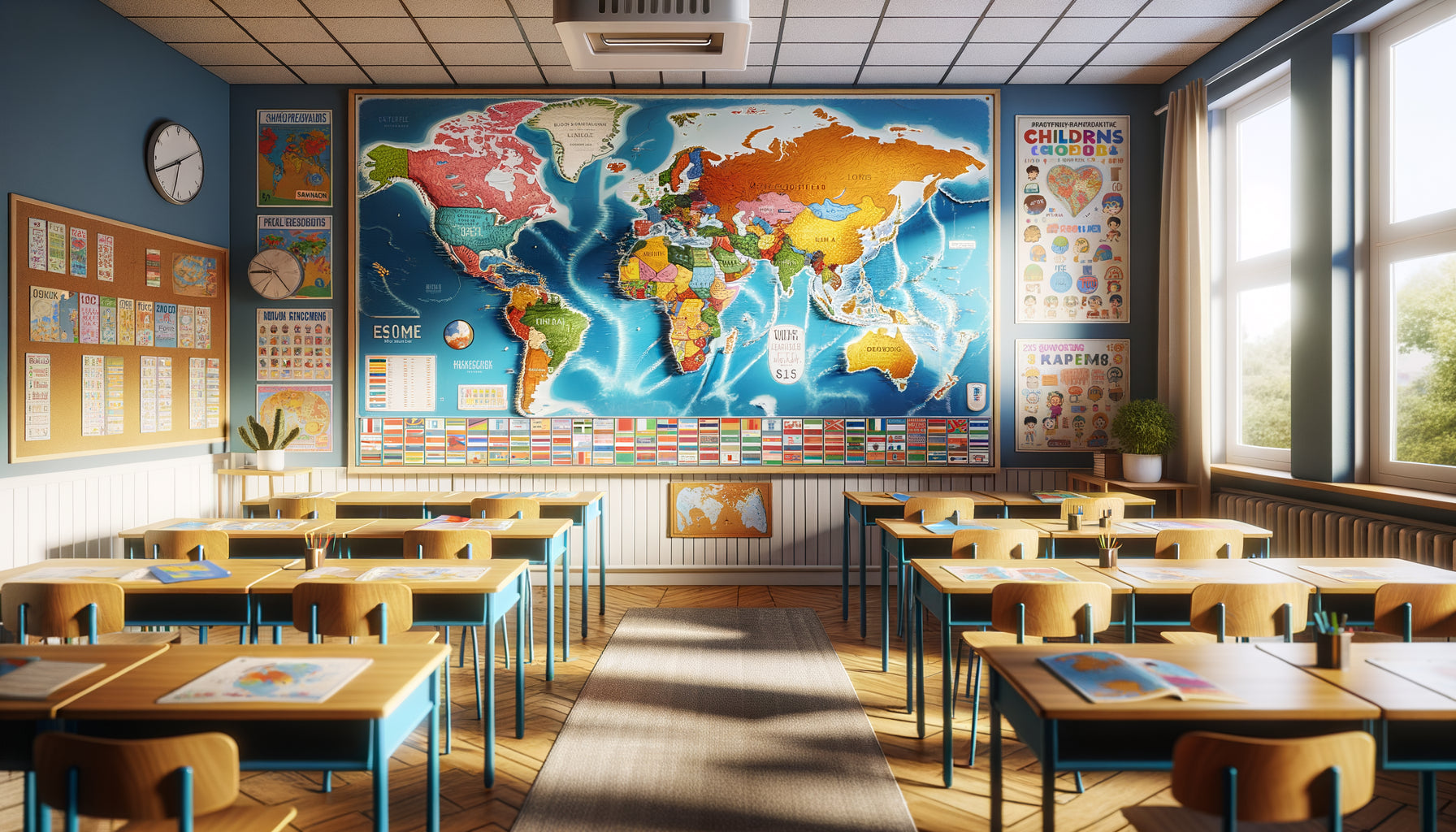
Also consider educational artworks that stimulate imagination: stylized world map, illustrated alphabet, artistic timeline. These paintings transform meal times into informal learning moments, diverting children's attention from noise to visual discovery.
Maintaining reinforced canvases: preserving the investment
A well-chosen and properly installed reinforced canvas can last a decade without weakening – provided it receives minimal but regular maintenance. In the demanding environment of a cafeteria, this preventative maintenance makes all the difference.
A monthly dusting with a dry microfiber cloth is generally sufficient. Airborne particles in cafeterias (dust, micro-food particles) gradually settle on all surfaces. Their accumulation creates a dull film that attenuates colors. A quick wipe restores original brilliance.
For accidental stains, intervene quickly with a slightly damp cloth and mild pH neutral soap. The gesture should be gentle, by dabbing rather than rubbing. Oleophobic treated canvases greatly facilitate this operation: the stain does not penetrate the surface and is removed effortlessly.
Check the canvas tension on its frame semiannually. Thermal and hygrometric variations, even minimal, can induce slight slackening. A keyed frame allows easy re-tensioning of the canvas by adjusting the angles. This simple operation preserves the perfect flatness of the painting.
Imagine your cafeteria transformed: walls are no longer mere inert surfaces, but active allies in creating an environment where your students dine serenely. Specialized reinforced canvases have absorbed excess decibels, resisted daily projections, and maintained their beauty intact despite the assaults of time. It's not just a painting hanging on the wall – it’s an environmental equipment combining art, acoustics and durability.
Your concrete action for tomorrow? Accurately measure available wall surfaces in your cafeteria, identify the most reverberant areas (often walls opposite windows), and select suitable reinforced canvases that will transform these spaces into islands of visual and sound calm. Your students, your teams and your ears will thank you every day.
Frequently asked questions about reinforced canvases in school cafeterias
Does an acoustic canvas really reduce noise noticeably in a cafeteria?
Yes, measurably and noticeably. A large format micro-perforated acoustic canvas (minimum 150x100 cm) combined with a dorsal absorbent panel can reduce the ambient sound level by 4 to 7 decibels within its area of influence. This difference may seem modest on paper, but the decibel scale is logarithmic: a reduction of 6 dB is equivalent to dividing the perceived sound energy in half. In concrete terms, your students feel a noticeably more comfortable atmosphere. The effect is maximized by installing several acoustic canvases strategically distributed on the main wall surfaces. Also consider that the impact is not only quantitative: these canvases absorb particularly well the middle and high frequencies – precisely those of voices and dish noises which fatigue the ear the most. The felt comfort often exceeds simple decibelmetric measurement thanks to this selective filtration of unpleasant frequencies.
How long does a reinforced canvas last in a school cafeteria before it needs to be replaced?
A high density polyester canvas correctly installed and maintained offers exceptional durability of 8 to 12 years in a school cafeteria environment. The factors that influence this longevity include the quality of the surface treatment (a good protective varnish is essential), exposure to direct light (UV remains the main enemy of pigments), and maintenance frequency. Establishments I have accompanied testify that their canvases retain 90% of their color brilliance after five years of intensive use. The structure itself of the reinforced canvas – its tight weave and dimensional stability – prevents deformations which quickly affect traditional supports. Compare this performance to laminated paper posters that yellow in 18 months, or standard canvas prints that sag in 2-3 years: the higher initial investment is largely worthwhile. Also consider that the reinforced canvas maintains its professional appearance throughout its lifetime, preserving the qualitative image of your establishment.
Can a reinforced canvas be easily cleaned after food splatters?
Absolutely, and that is precisely one of the decisive advantages of these canvases for a collective catering environment. Reinforced canvases treated with protective varnish and oleophobic treatment naturally repel water and grease. A splash of sauce, juice or even mashed potatoes can be wiped away with a simple pass of a damp microfiber cloth, without vigorous rubbing. The key lies in reactivity: intervene within the hour following the incident to prevent the material from drying. For stubborn stains, a mixture of warm water and mild pH neutral soap (such as liquid Marseille soap) works wonders. Apply by gentle dabbing rather than circular friction which could alter the varnish over time. Rinse then with a clean slightly damp cloth to remove any soap residue. The surface dries quickly in the open air. This ease of maintenance radically transforms the upkeep of your spaces: where other supports require replacement after an incident, the treated reinforced canvas regains its impeccable appearance in just a few minutes of simple intervention. Your maintenance teams will appreciate this resilience which considerably simplifies their daily routine.