The school alarm blares. A basketball has struck the glazed frame of an educational poster in the hallway. Shards scatter, a student is cut. This scenario, experienced by far too many schools, is not inevitable. In school spaces where energy overflows, where jostling is unavoidable and safety is paramount, every decorative element must meet strict impact resistance requirements.
Here's what an EN 12600 standard verification provides: the guarantee that your wall art resists daily school impacts, peace of mind regarding children’s safety, and regulatory compliance for your institution. This European standard classifies glazing according to its behavior in the event of impact, a determining criterion for venues hosting young people.
Many facility managers feel helpless when faced with these technical questions. How can you distinguish a suitable wall art from a risky product? What certificates should you require? How do you interpret enigmatic codes like « 2B2 » or « 1C3 »?
Rest assured: the EN 12600 standard is based on precise and verifiable criteria. Once the principles are understood, you will know exactly what to look for and how to effectively protect your educational spaces. We will decipher this standard together, its concrete tests, and above all how to apply it to the choice of your wall art for schools.
The EN 12600 standard: the invisible shield for your educational spaces
EN 12600 defines a standardized test method for evaluating the impact resistance of safety glazing. Developed for the building industry, it is perfectly applicable to glazed frames of decorative wall art intended for schools, colleges and high schools.
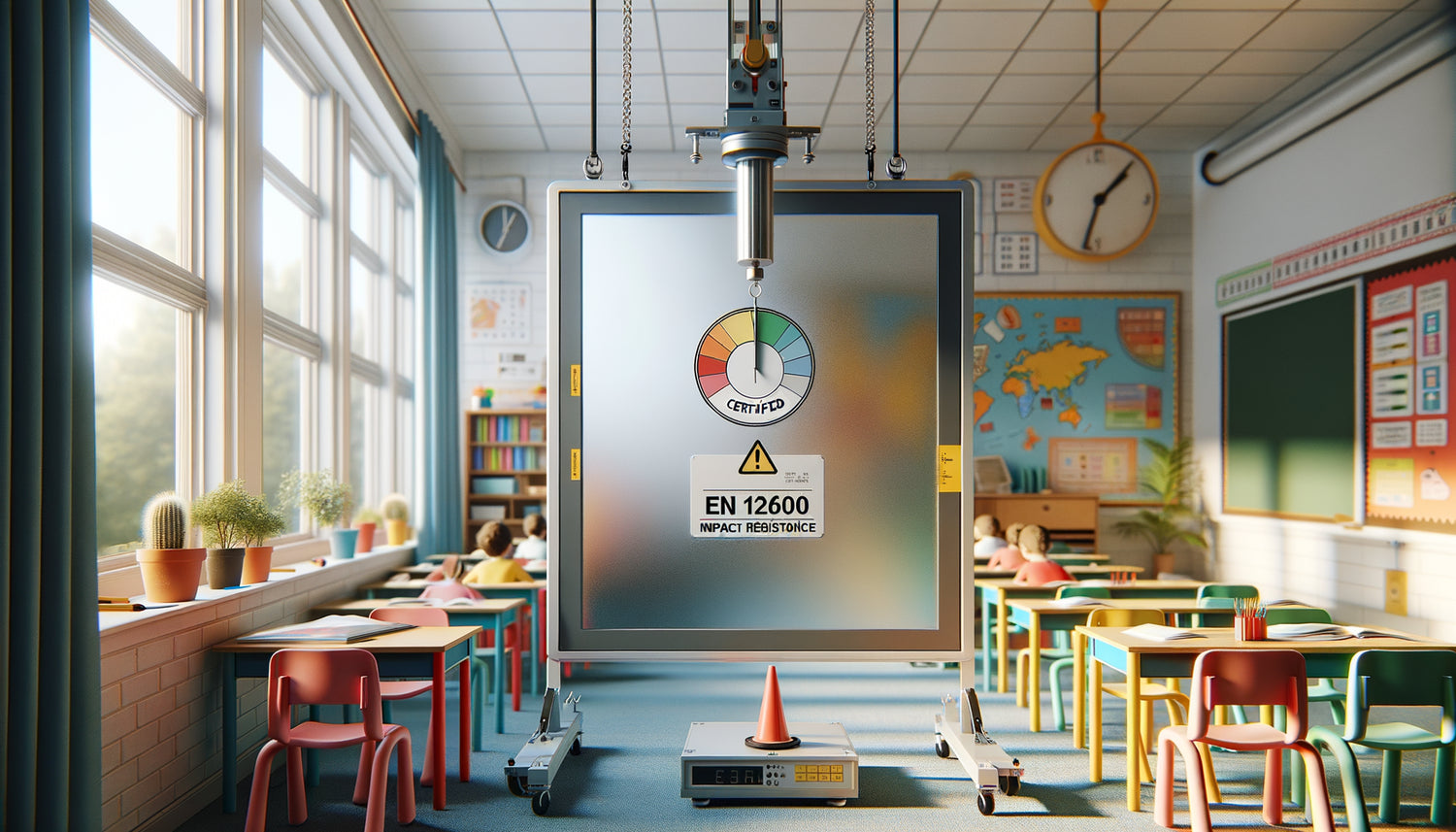
The principle? A pendulum body simulates the impact of a human shock at different heights and intensities. The glazing is subjected to a 50 kg mass falling from variable heights (190 mm, 450 mm or 1200 mm), reproducing real-life situations: a child tripping, a teenager jostled, or a more violent impact.
What differentiates this standard from generic tests is its three-level classification system which simultaneously evaluates resistance to breakage, fragmentation mode and particle size. Each tested wall art receives an alphanumeric code revealing its exact performance.
For schools, this standard guarantees that the glazing, if it breaks, will not cause serious injuries. Fragments must remain small, non-sharp or adhere to a safety film. This is the difference between a minor accident and a hospital emergency.
Deciphering mysterious codes: understanding classification
Faced with a label mentioning « Class 2B2 according to EN 12600 », do you feel lost? Let's break down this code together.
The first number: the drop height
It indicates the impact resistance measured by the drop height of the pendulum:
- Class 2 : 450 mm (medium impact, standard shock in a frequently used hallway)
- Class 1 : 1200 mm (high impact, violent shock or act of vandalism)
- Class A : Numerous fragments with cracks, but remaining in place (laminated glazing)
- Class B : Large fragments with sharp edges (non-secure glazing - to be avoided in schools)
- Class C : Disintegration into small, non-sharp granular pieces (tempered glass)
- Class 1 : No passage possible (maximum security)
- Class 2 : Passage of a sphere with a diameter of 76 mm
- Class 3 : Passage of a sphere with a diameter of 406 mm
For primary schools, class 2 is generally sufficient. For middle and high schools, class 1 offers reinforced security against more energetic impacts.
The letter: the fragmentation mode
It describes how the glazing behaves when breaking:
Classes A and C are preferred for educational institutions, class B being discouraged as potentially dangerous.
The last digit: the opening created
It measures the size of the opening after impact:
For wall art, class 1 or 2 is recommended, preventing a child from passing through in case of breakage.

Laboratory tests: when science meets school reality
Specifically, how does the verification according to EN 12600 take place? The process follows a rigorous protocol in an accredited laboratory.
The glazing sample is fixed in a rigid metal frame, reproducing the conditions of a framed picture. The pendulum, consisting of two assembled tires weighing 50 kg, is released from the height corresponding to the tested class. The impact occurs at the center of the glazing, the most vulnerable area.
Technicians observe three decisive criteria: does the glazing resist without breaking? If it breaks, how does it fragment? And what opening is created? Each answer feeds the final classification.
For a wall art piece intended for schools, the ideal scenario looks like this: the pendulum strikes the glass frame, the material absorbs the impact, and either it remains intact, or it breaks into tiny, non-cutting fragments that fall to the floor without dangerous projections. No sharp edges remain. No gaping openings form.
Certified laboratories then issue a test report detailing the exact performance. This document serves as your proof of compliance with inspections, insurance policies, and parents.
Check before buying: essential documents to request
You are ready to order wall art for your institution? Do not validate any order without obtaining these three essential elements.
Firstly, request the EN 12600 certificate issued by an accredited laboratory. This document must explicitly mention the classification obtained (example: "Complies with EN 12600 class 1C1”). Be wary of vague mentions like “compliant with European standards” without specification.
Secondly, verify that the certificate corresponds exactly to the product offered. The thickness of the glass, the type of treatment (tempered, laminated), and even the dimensions can influence resistance. A certificate for 6 mm glazing is not valid for a 4 mm model.
Thirdly, request the manufacturer's technical data sheet specifying the materials used. Tempered glass of at least 4 mm thickness or laminated safety glass with PVB film are the standards for school spaces. Alternatives like acrylic may offer acceptable resistance if certified, but their fire behavior differs.
Do not hesitate to contact the manufacturer directly to obtain these documents. A serious supplier will transmit them without delay. Their absence or reluctance should trigger an immediate alert regarding the reliability of the product.

Beyond the standard: additional criteria for total safety
Compliance with EN 12600 is not enough to guarantee a secure installation. Other factors deserve your attention when choosing wall art for schools.
The mounting system plays a decisive role. Resistant glazing becomes dangerous if its frame comes loose at the slightest impact. Favor robust wall fixings, tested to support at least three times the weight of the artwork. Systems with multiple fixing feet offer better distribution of stress.
The installation position also influences the risks. Narrow corridors, play areas, gyms and covered playgrounds present a high probability of impact. In these spaces, opt for the most demanding classifications (class 1) and avoid oversized formats that multiply potential impact surfaces.
Also consider corner protection. Even with EN 12600 compliant glazing, the corners of the metal frame can cause injury in a fall. Manufacturers specializing in school furniture offer flexible, discreet but effective corner protectors.
Finally, think about traceability. Keep all certificates and invoices in a dedicated folder for the safety of the establishment. In case of an incident, these documents will prove your diligence and protect your legal liability.
Transform your educational spaces without compromising safety
Discover our exclusive collection of wall art for School that combines inspiring aesthetics and full compliance with impact resistance standards, to decorate all your teaching spaces serenely.
When walls tell stories safely
Imagine these school corridors transformed. Reproductions of famous works awaken artistic curiosity. Geographical maps invite travel. Motivational quotes accompany students to their classrooms. All these decorative paintings embellish everyday life while respecting the strictest safety requirements.
Verification according to EN 12600 is not a tedious administrative obstacle, but a guarantee of peace of mind. It allows you to decorate ambitiously, knowing that each wall element has been designed to withstand the exuberant energy of youth.
Start today: list the spaces requiring secure decoration, contact specialized suppliers, demand EN 12600 certificates, and transform your establishment into a place that is both stimulating and protective. Your walls deserve to tell beautiful stories without ever compromising the safety of those who interact with them every day.
Frequently asked questions about impact resistance of school paintings
Is the EN 12600 standard mandatory for all paintings in schools?
Legally, the EN 12600 standard is not always strictly mandatory, but it serves as the European reference for demonstrating compliance with safety requirements for buildings open to the public (ERP). Schools, colleges and high schools fall into this category. In the event of an accident involving non-compliant glazing, the establishment's liability may be engaged. Academic inspectors and insurers strongly recommend the use of EN 12600 certified glazing, particularly in circulation and play areas. For administrative spaces with little student traffic, requirements can be relaxed, but as a precaution, always prioritize certified products. This approach protects you legally and guarantees maximum child safety.
Can you check the resistance of a painting yourself without a laboratory?
Unfortunately, no. Verification according to EN 12600 requires specialized laboratory equipment (calibrated pendulum, standardized test frame, precise measuring instruments) and trained technicians. Attempting to test a painting yourself would destroy the sample without guaranteeing the reliability of the results. However, you can perform indirect checks: carefully examine the product labeling which should mention the EN 12600 class, request a copy of the test certificate from the supplier, verify that the issuing laboratory is accredited (look for COFRAC logos in France or equivalent European bodies), and compare the characteristics of the received product (thickness, type of glass) with those mentioned on the certificate. These documentary checks are within your reach and sufficient to guarantee the acquisition of compliant products without investing in costly tests.
Which EN 12600 class should you choose for a primary school versus a high school?
For a primary school, class 2C1 or 2A1 generally provides adequate protection. Younger children generate less energetic impacts, and the 450 mm drop height (class 2) corresponds to typical shocks for this age group. The C fragmentation mode (fragmentation into small pieces) or A (retention in the frame) guarantees the absence of serious injuries. For colleges and high schools, prioritize class 1C1 or 1A1. Adolescents, taller and stronger, can generate impacts equivalent to a 1200 mm drop height (class 1), especially during scuffles or reckless behavior. This higher classification provides an essential margin of safety in areas with heavy traffic such as main corridors, media centers or dining halls. In all cases, the final classification should also take into account the specific location: near a sports field or play area, systematically increase to class 1, regardless of the age of the students.