

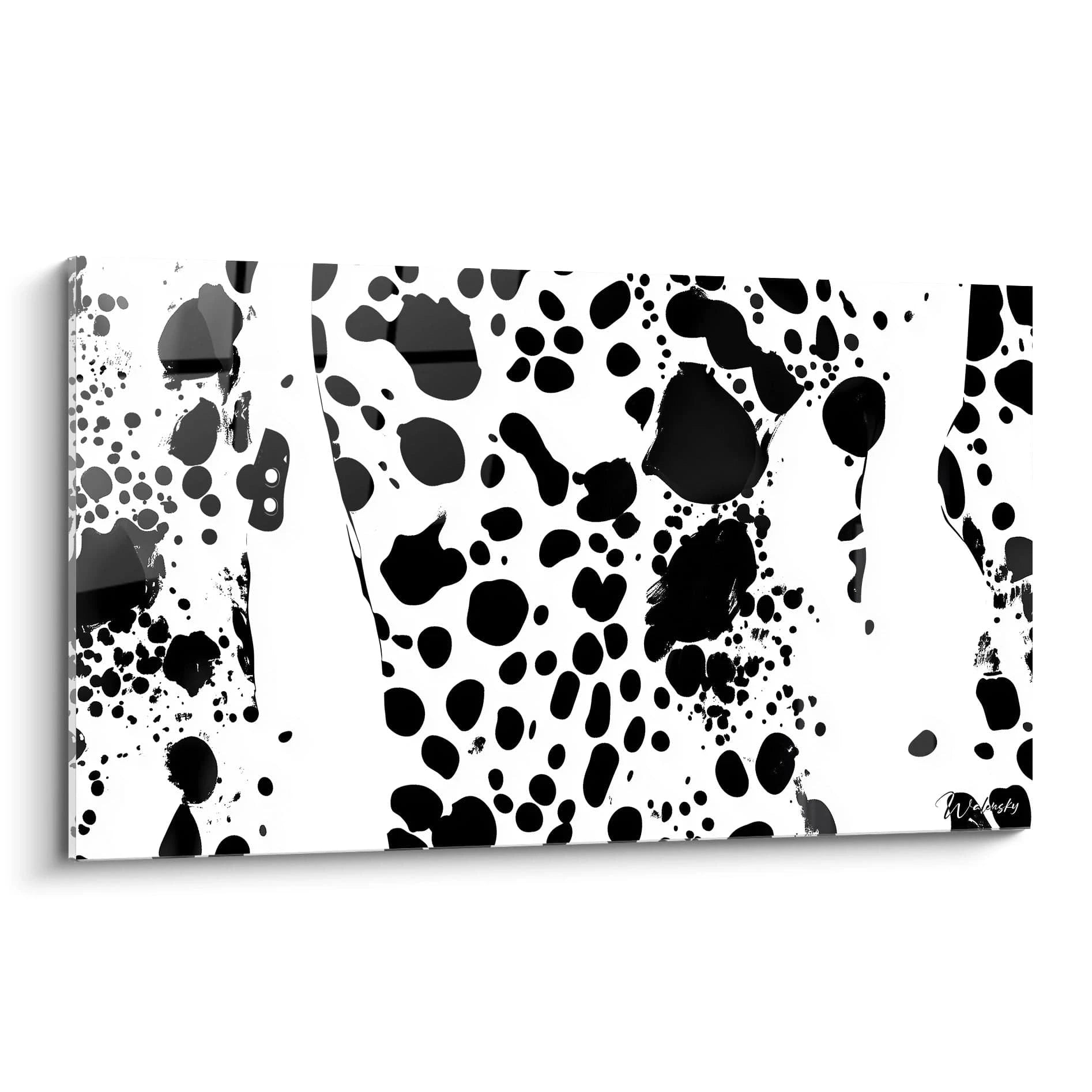






How Can Artwork Compensate for Cold and Impersonal School Architecture?
January 8, 2026 · 8 min read · by Walensky
I still remember that hallway at Jean Moulin middle school: one hundred meters of gray concrete, dim fluorescent lights, identical numbered doors. One fourth-grade student confided in me: "It's like a prison, not a place where you should want to learn." This sentence resonates differently when you have accompanied fifteen schools in their visual transformation. Educational spaces carry an invisible responsibility: that of nurturing or extinguishing curiosity.
Here’s what wall art brings to schools: it humanizes learning spaces, stimulates students' imaginations, and transforms passageways into opportunities for cultural awakening. Three measurable impacts that radically change the daily experience of hundreds of children.
You may feel this frustration with white walls that absorb energy rather than reflect it. This impression that the standardized architecture of the 70s-90s created factories of knowledge rather than gardens of curiosity. Rest assured: even without a colossal budget or structural renovation, a thoughtful selection of visual artworks can completely reinvent the atmosphere of an establishment. I will show you how to transform these spaces into true visual ecosystems that support learning.
The educational concrete syndrome: when architecture kills creativity
Architects of past decades designed schools according to a purely functional logic: fluid circulation, easy maintenance, minimized costs. The result? Structures that resemble administrative centers more than places of fulfillment. Neuroscience now teaches us what intuition suggested: the visual environment directly influences concentration and motivation.
I observed in a primary school in Lille that children systematically avoided certain hallways, preferring to take detours. Not out of superstition, but due to visual discomfort. These spaces lacking warm landmarks created a form of diffuse anxiety. Conversely, renovated classrooms with colorful paintings spontaneously became gathering places during recess.
This architectural coldness has measurable consequences: teachers get tired more quickly, students are less engaged, and a sense of anonymity undermines the feeling of belonging. The stakes go far beyond aesthetics: it touches on the heart of the educational mission.
Color as the first antidote to monotony
A well-chosen painting works like a visual window in a blind wall. In a college in Nantes, we installed a series of abstract paintings with warm tones along a particularly gloomy hallway. The impact was immediate: teachers spontaneously began using these artworks as improvised teaching aids, talking about composition, light, and emotions.
Bright colors – energizing oranges, soothing blues, regenerating greens – naturally counterbalance institutional grays and beiges. But beware: the goal is not to create a visual chaos. Chromatic consistency remains essential. I have learned to prioritize harmonious palettes that create visual pathways rather than disordered accumulations.
Wall art for schools that works best combines boldness and softness: present enough to mark the space, subtle enough not to overstimulate. An imaginary landscape watercolor can transform a stairwell into an invitation to mental travel.
Strategic areas to prioritize
Not all spaces are equal. Entrance halls deserve assertive works that set the tone upon arrival. Circulation corridors benefit from narrative series that accompany movement. Break areas – canteens, media centers, common rooms – call for soothing paintings that promote mental relaxation.
I saw a vocational high school transform its canteen with six large canvases depicting stylized scenes of everyday life. The noise level decreased noticeably: students took the time to observe, comment, creating a more relaxed atmosphere.

When art becomes an invisible educational tool
The real magic happens when paintings cease to be mere decorations and become integrated learning tools. A reproduction of Kandinsky in a hallway can serve as a starting point for a discussion about geometric shapes in mathematics. A photograph of a natural landscape becomes a pretext for discussing biodiversity in science.
In an elementary school in Bordeaux, teachers created a monthly ritual: each class chooses a painting exhibited in the establishment and prepares a short presentation. Students develop their observation skills, descriptive vocabulary, and public speaking confidence. Without realizing it, they learn to The most effective educational wall art is that which poses questions rather than imposing answers. An abstract composition intrigues, stimulates personal interpretation, legitimizes the diversity of perspectives. This is exactly what any modern education system should encourage. — Our selection


Visual identity as an antidote to anonymity
Schools often suffer from a subtle problem: lack of differentiation. Identical hallways, interchangeable classrooms, cloned buildings. This uniformity undermines the sense of belonging. Creating a unique visual identity through a consistent artistic selection radically changes this dynamic.
I worked with a rural middle school that chose a theme of "local nature": botanical illustrations of regional plants, landscapes of the four seasons, stylized local fauna. Within six months, students had integrated these visual references into their daily vocabulary. They no longer said "meet near the distributor," but "under the gray heron painting." The artworks had become emotional landmarks.
This collective appropriation is fascinating. When students participate in choosing paintings or create works themselves that are exhibited, engagement soars. The school ceases to be a place of submission and becomes a co-constructed space. The psychological difference is considerable.
Involve the school community
The most successful projects I have observed directly involved students, teachers and parents. Collective selection workshops, democratic votes on themes, temporary exhibitions that rotate. This participatory approach transforms the installation of paintings into a full-fledged educational project, teaching deliberation, compromise, respect for divergent tastes.

Beyond decoration: art as care for the environment
Let's be frank: ugly spaces make people sick. Not in a spectacular way, but through daily accumulation. This chronic visual fatigue, this lack of positive stimulation, this absence of free beauty – all of this weighs on collective morale. Introducing paintings into a school is a form of environmental care.
Schools I have worked with consistently report an improvement in the overall climate: less vandalism, more respect for the premises, better atmosphere between students. As if beauty called to beauty, care called to care. A wall displaying a thoughtful work implicitly says: "This place deserves attention and respect." Message received five out of five by the occupants.
Paintings for schools also act as emotional regulators. A soothing image near the exam room helps manage stress. A dynamic composition in the gym strengthens energy. This spatial intelligence, long neglected in educational design, is finally returning to the center of reflection.
— You may also like


Practical strategies for a successful transformation
Start modestly but intelligently. Identify the three most problematic areas of your establishment: those that generate the most discomfort, complaints, avoidance. These are your priorities. A single well-placed artwork is better than ten mediocre hangings.
Prioritize print quality and formats adapted to the scale of spaces. A small picture lost on a huge wall accentuates the feeling of emptiness. Conversely, an overly imposing work in a reduced space creates oppression. I generally apply the rule of thirds: the artwork should occupy about one-third of the available wall surface.
Think protection and durability: robust frames, secure fixings, protective varnishes if necessary. Educational establishments are places of intense life. Your choices must withstand time and use without requiring constant maintenance.
Budget and prioritization
Transformation does not require astronomical sums. A strategy spread over two or three years, with progressive acquisition, remains perfectly viable. Some establishments organize crowdfunding events, transforming the artistic project into a collective mobilization. Others negotiate partnerships with local galleries or art schools.
Transform your establishment into a true visual ecosystem
Discover our exclusive collection of wall art for School that bring warmth and inspiration to learning spaces.

The domino effect: when visual transformation inspires other changes
Something fascinating happens after the installation of thoughtful artworks: teaching teams spontaneously begin to rethink other aspects of the environment. We see the appearance of green plants, cushions in reading corners, warmer arrangements. Art acts as a catalyst for global transformation.
I followed a high school where the installation of about twenty paintings over two years triggered a real gentle revolution: reorganization of the library, creation of collaborative workspaces, greening of the courtyard. As if the first injection of beauty had awakened a collective desire for improvement.
This virtuous dynamic proves that aesthetics is never superficial in everyday living spaces. It profoundly influences our relationship with space, our desire to take care of it, and our ability to project ourselves positively into it. Wall art for school does not simply compensate for cold architecture: they initiate a reappropriation of the learning environment.
Imagine your students discovering every morning hallways that welcome them rather than intimidate them. Visualize those spontaneous conversations in front of an intriguing artwork, those lingering glances, that curiosity awakening.
The architecture may remain cold in its structure, but the atmosphere will have radically changed. And it is this atmosphere that shapes the educational experience on a daily basis.
Start with a space, a painting, a clear intention. Observe reactions, adjust, develop. The transformation of schools through art is not a project with a final destination; it is a living process that evolves with its community. Your school deserves to be a place where beauty and knowledge nourish each other.
FAQ
What types of paintings are best suited for schools?
Prioritize works that balance visual stimulation and tranquility. Colorful abstract compositions work remarkably well because they leave room for personal interpretation without imposing a single message. Natural landscapes, botanical or animal illustrations, and geometric artworks are also excellent choices. Avoid images that are too emotionally charged or representations that are too literal, which can quickly become tiresome. The goal is to create a visually rich but not oppressive environment that accompanies daily life without saturating attention. Also think about stylistic diversity: a balanced mix of figurative and abstract works, various techniques, creates a more stimulating visual journey than a uniform series.
How can students be involved in choosing paintings without creating conflicts?
The key lies in a structured democratic process. Start by collectively defining broad thematic orientations during participatory workshops: nature, cultures of the world, abstraction, sciences, etc. Then, present a preselection of artworks corresponding to these themes and organize votes by grade level or class for the spaces that concern them directly. This method teaches deliberation while guaranteeing overall aesthetic consistency. Students learn that their voices matter while understanding the constraints of the collective project. You can also create temporary exhibitions where student works coexist with professional reproductions, reinforcing a sense of belonging and collective pride. The essential thing is to transform the process itself into a pedagogical experience.
What budget should be allocated to visually transform a school?
It all depends on the scale of the project, but a significant transformation remains accessible with a reasonable budget. For an average school (500 students), expect between 2000 and 5000 euros for initial equipment that consistently covers strategic areas. Museum-quality reproductions have become affordable, and you can spread acquisitions over several years. Explore partnerships with local art schools, loans of works from FRAC (Regional Funds for Contemporary Art), or artist residencies that create specific works at a lower cost. Some institutions finance their artistic project through solidarity events or regional cultural subsidies. The investment, even modest to start, generates lasting benefits on the overall atmosphere and collective well-being, making it a particularly worthwhile expense in the long term.
Explore our collections


