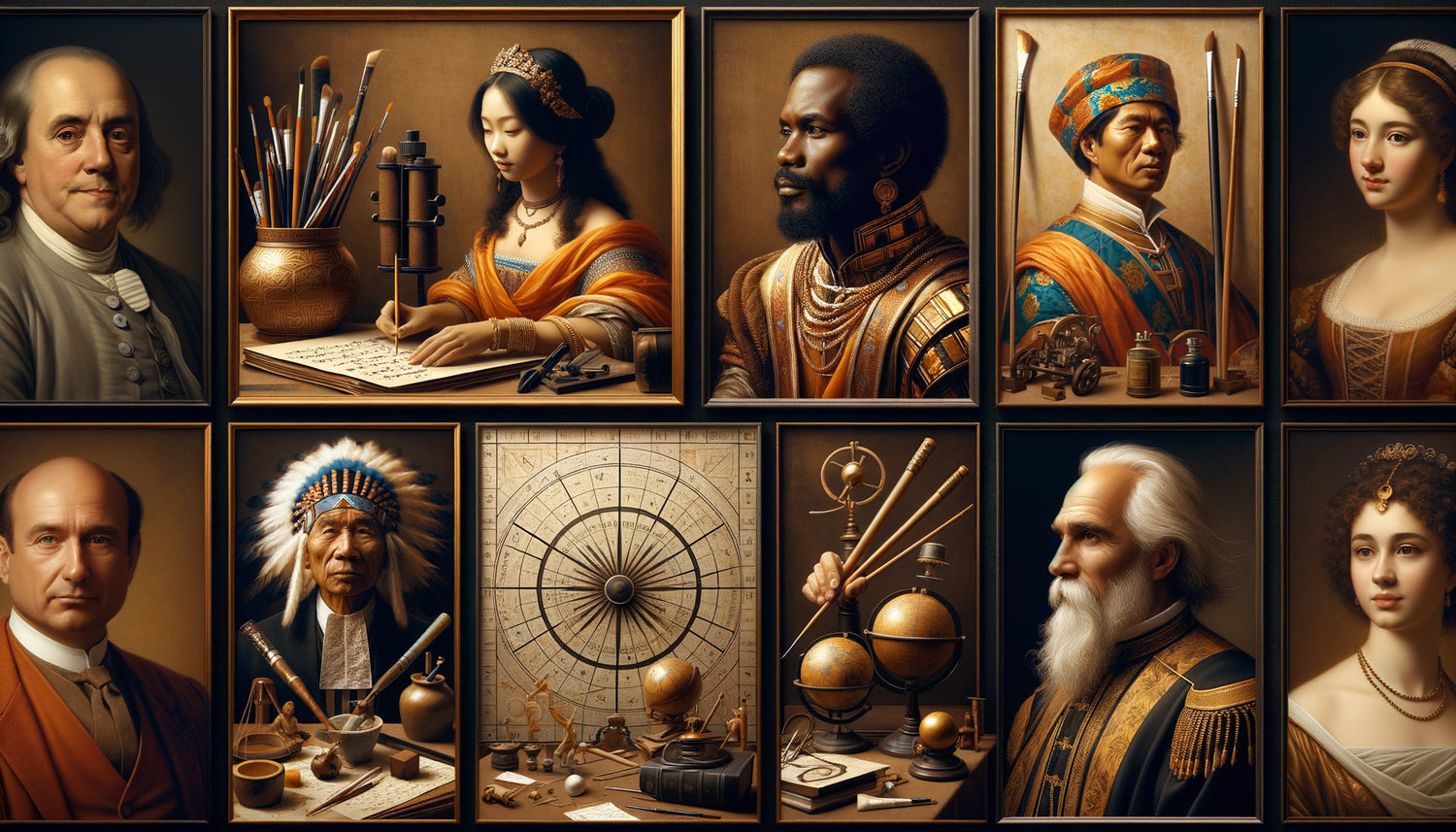
Last year, while exploring a renovated XVIIIth-century manor house turned boutique hotel, I was struck by a gallery of portraits that told a completely different story than traditional collections. Not just powdered wig-wearing white men, but female scholars, African explorers, Asian artists. The room breathed a narrative richness that transformed the entire atmosphere of the place.
Here's what portraits of diverse historical figures bring to your interior: they create a visual dialogue that celebrates the multitude of human journeys, they enrich your space with authentic cultural depth, and they invite your visitors to discover stories often forgotten.
Too often, our walls tell the same story. Portrait galleries are limited to conventional figures, creating a partial and repetitive representation of our collective heritage. This visual homogeneity impoverishes our spaces and perpetuates a truncated view of history.
Yet, incorporating portraits of diverse historical personalities requires neither expertise in art history nor decorative revolution. It takes only a conscious intention and a curiosity for the stories that have shaped our world beyond well-trodden paths.
I will show you how to build an inclusive portrait gallery that transforms your space into a place of discovery and reflection, while maintaining impeccable aesthetic consistency.
Why diversity in portraits redefines our spaces
A portrait is never simply decorative. It embodies a presence, tells an era, bears witness to a journey. When we consciously choose portraits of diverse historical figures, we perform both an aesthetic and political gesture: we decide which voices deserve to inhabit our walls.
In a recently renovated Parisian living room, I paired a portrait of Mary Seacole, a Jamaican pioneer in nursing, with that of an Ottoman scholar from the XVIth century and a Victorian explorer. This composition created an inclusive representation that invariably aroused the curiosity of guests. Each portrait became a pretext for conversation, each face opened a narrative door.
The power of an inclusive gallery lies in its ability to broaden our perception of historical excellence. It reminds us that genius, courage and innovation have never been the sole preserve of one gender, one origin or one culture.
Forgotten figures who deserve your walls
History is full of fascinating personalities whose portraits remain scandalously absent from our interiors. Female scientists like Émilie du Châtelet, an XVIIIth-century mathematician, or Wang Zhenyi, a Chinese astronomer who revolutionized our understanding of lunar eclipses.
Think of the precolonial African leaders: Queen Nzinga of Angola, a formidable military strategist of the XVIIth century, or Mansa Musa, emperor of Mali whose legendary wealth shook Mediterranean markets. Their portraits in ceremonial attire rival any European monarch in majesty.
Artists and Asian intellectuals also offer an extraordinary wealth of iconography. Hokusai was not alone: women such as Katsushika Ōi, his painter daughter, or Korean calligraphers from the Joseon dynasty deserve a place of honor in our wall compositions.
Beyond continents: cultural bridges
Some figures perfectly embody historical diversity through their ability to cross borders. Alexander Pushkin, a Russian poet of African descent. Alexandre Dumas, whose grandfather was a general in Napoleon's armies. These portraits tell stories of cultural blending that resonate particularly today.

How to compose an inclusive and coherent gallery
Inclusive representation does not mean a disordered accumulation. On the contrary, it requires particular attention to visual harmony. I use three fundamental principles to create historical portrait galleries that work aesthetically.
First principle: chromatic unity. Whether you opt for black and white reproductions, sepia tones or colors, maintain tonal consistency. A gallery of sepia portraits of Ada Lovelace, Cheikh Anta Diop and Ibn Khaldoun will create visual unity despite the diversity of origins.
Second principle: thematic dialogue. Group your portraits by theme rather than origin. A composition on pioneering scientists can bring together Marie Curie, George Washington Carver and Jagadish Chandra Bose. A gallery on exploration can associate Ibn Battûta, Alexandra David-Néel and Matthew Henson.
Third principle: balance of formats. Alternate sizes and orientations to create a dynamic visual rhythm. A large central portrait of Toussaint Louverture can be framed by smaller formats representing other emancipation figures.
Where to find quality portraits
The quest for portraits of diverse historical figures is an adventure in itself. National museums have digitized considerable treasures: the Smithsonian, the National Portrait Gallery in London, or the Rijksmuseum offer exploitable databases.
For exceptional reproductions, prioritize publishers specializing in historical iconography. Some platforms offer museum-quality prints on art paper that admirably restore the details of the originals.
Feel free to explore the photographic archives for figures from the 19th and 20th centuries. Portraits of Sojourner Truth, Rabindranath Tagore, or Josephine Baker possess an incomparable expressive force.
Framing as an act of recognition
The choice of frame amplifies the message. For a gallery of diverse historical figures, I favor antique gold frames that confer the solemnity traditionally given to official portraits. This aesthetic choice symbolically elevates these personalities to the rank they already deserved.

The transformative impact in educational spaces
If this approach enriches private interiors, it becomes truly powerful in collective spaces. In a school library where I was involved, we created a chronological gallery showcasing the diversity of intellectual contributions throughout the centuries.
Young people discovered Hypatia of Alexandria, 4th-century mathematician, alongside Al-Khwârizmî, father of algebra, and Sophie Germain, number theorist. This inclusive representation tangibly changed their perception of possibilities.
In professional spaces as well, these galleries send a message of openness. A law firm displaying portraits of Pauli Murray, B.R. Ambedkar, and Olympe de Gouges affirms its values without superfluous discourse.
Telling the stories behind the faces
A portrait truly comes to life when its story is accessible. For my own gallery, I had discreet plaques engraved mentioning the essential achievements of each figure. A few lines suffice: "Noor Inayat Khan, 1914-1944, British resistance fighter of Indian origin, secret agent during World War II."
This contextualization transforms passive contemplation into active discovery. Your guests no longer simply see a beautiful wall arrangement, but a mosaic of extraordinary destinies that have shaped our present.
Some collectors even create small booklets available near their galleries, delving deeper into the biographies and linking the figures together. This educational approach greatly enriches the experience.
Transform your walls into a celebration of universal human excellence
Discover our exclusive collection of wall art for School that inspires curiosity and celebrates the diversity of remarkable historical journeys.
From contemplation to inner transformation
Living daily surrounded by portraits of diverse historical figures operates a subtle but profound change. These faces become silent companions who remind us of the extent of human possibilities.
When I meet Harriet Tubman's gaze every morning in my hallway, I connect with a legacy of courage and determination. The portrait of Averroes in my office connects me to a millennial intellectual tradition that transcends borders.
This diverse presence enriches our collective imagination. It gets us out of the rut of repetitive representations to open us up to the magnificent complexity of the human adventure. Our spaces then become not only more beautiful, but infinitely richer in meaning.
Start modestly if you wish: a single portrait of a figure that fascinates you. Then let your curiosity guide you towards other discoveries. You will quickly see that this quest transforms your relationship to history and your own environment.
Your walls tell a story. Make sure it is worthy of the richness of our shared humanity.
FAQ: Creating an inclusive portrait gallery
How to choose the first historical figures for my gallery?
Start by identifying your areas of interest: science, arts, exploration, social justice? Then research diverse figures in these fields. For science, explore Ada Lovelace (computer science), George Washington Carver (agronomy), Mae Jemison (astronautics). The key is to choose personalities whose achievements touch you personally. This emotional connection will make your gallery authentic rather than simply representative. Also prioritize a balance between eras, geographical origins and genders to create a true inclusive representation. Don't hesitate to discover lesser-known figures: their story will all the more arouse the curiosity of your visitors.
Do diverse historical portraits work in all interior styles?
Absolutely. The key lies in adapting the visual treatment to your existing decor. In a clean, contemporary interior, opt for black and white prints with minimalist black or white frames. For a classic or Haussmannian style, prioritize color reproductions with traditional gold frames. An industrial interior will beautifully showcase large-scale portraits on canvas without a frame or with raw metal frames. Portraits of historical figures possess an iconic strength that transcends eras: a photograph taken in the 19th century dialogues perfectly with contemporary Scandinavian furniture if the visual treatment is consistent. The important thing is to maintain the stylistic unity of your ensemble rather than multiplying contradictory aesthetic approaches.
How to avoid making my gallery look artificial or forced?
Authenticity is born of passion and knowledge. Take the time to truly discover the figures you display: read their biographies, understand their historical context, identify what moves you in their journey. Your gallery should reflect your own discoveries rather than an obligation of representativeness. Avoid purely decorative assemblages where you would have chosen portraits only for their visual appearance. Create coherent thematic dialogues: pioneers of medicine, resisters against oppression, revolutionary artists. This narrative approach gives depth to your composition. Finally, don't hesitate to spontaneously share the stories behind these faces with your visitors: this living transmission is the best antidote to artificiality.