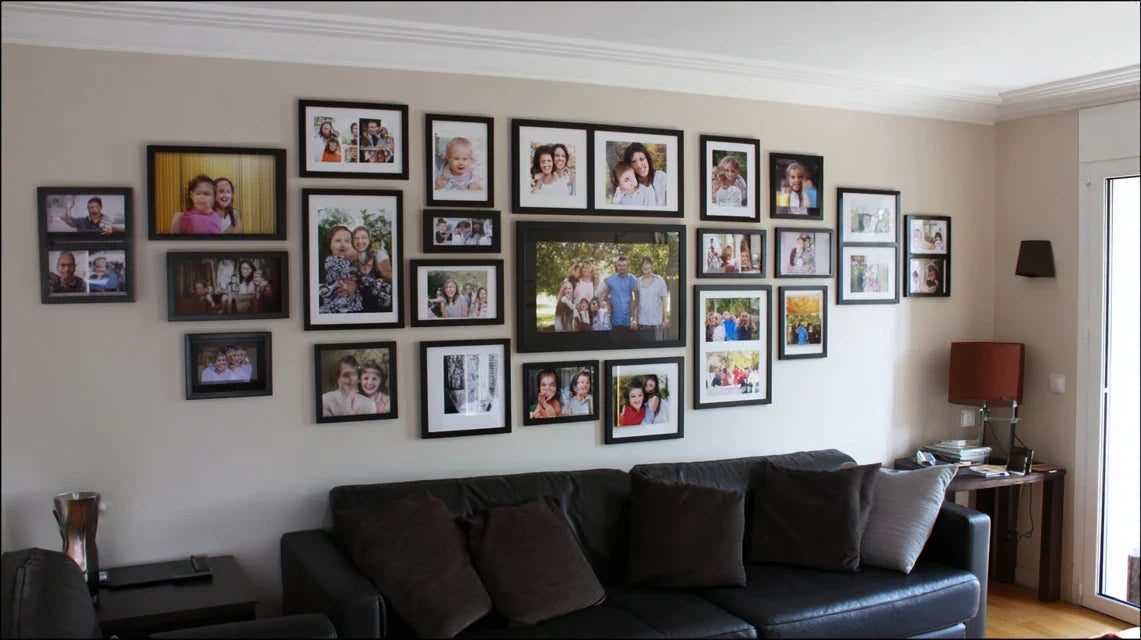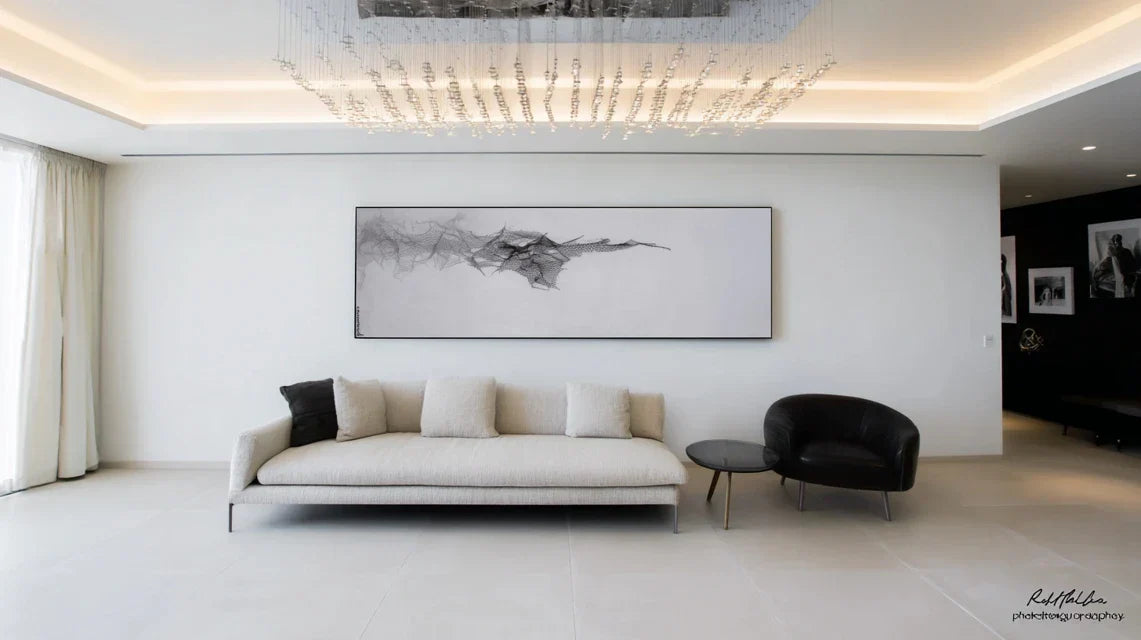
You're looking at your living room and feeling that sense of suffocation. Too many colors, too many patterns, too many objects competing for your attention. Your interior is overflowing with personality, but you can’t find any visual rest anywhere.
Each wall tells a different story: floral wallpaper here, overloaded shelves there, collection of trinkets on the fireplace, mismatched cushions on the sofa. Your gaze never manages to settle serenely.
You may have tried to declutter, putting some objects in boxes, but the effect remains the same: a feeling of visual chaos that tires you as soon as you walk through the door. Decor magazines make you feel like you should start all over again.
It's normal to feel overwhelmed. The problem isn’t the quantity of your possessions, but the lack of a unifying element that brings serenity. Your interior needs a visual anchor, not a large void.
By the end of this article, you will know how to choose the perfect minimalist artworks that will transform your eclectic interior into a soothing cocoon, without denying your decorative personality.
Why do your restless walls need a breath of simplicity now?
Waiting another six months will only worsen this visual fatigue that is insidiously settling in. Just as a musician who always plays fortissimo ends up losing their audience, a room without visual rest mentally exhausts its inhabitants. The longer you wait, the more this overstimulation becomes your new normal.
🏠 Revealing testimonial: Marie, an interior architect, says: "A client called me exhausted. Her vintage living room was beautiful, but she could no longer relax in it. By hanging three off-white abstract canvases above her Liberty sofa, we created an immediate visual breath. She told me: 'I didn't know you could feel so zen at home.'"
💬 Conversation with a decor expert
The decorator’s secret: the 70/30 rule: 70% visual richness, 30% soothing simplicity. Like musical pauses that give relief to notes, your minimalist artworks will reveal the beauty of your other decorative elements by creating contrast. Visible results in 24h.
What’s really happening in your brain when facing an overloaded decor
You may be feeling these three signals without identifying them: difficulty concentrating when you get home, a sensation of always being "in action" even in your living room, and this irresistible need to close your eyes to “visually switch off”.
Your brain is constantly processing all this visual information like background tasks on a computer. The problem isn't your sensitivity, but this constant cognitive stimulation that prevents true mental rest.
Imagine your gaze as a museum visitor: in a room crowded with artworks, it doesn’t know where to land. But add some neutral spaces between the canvases, and suddenly each artwork regains its strength and your eye can finally breathe.
The real cause: lack of visual hierarchy
Contrary to what one might think, the problem isn't “too many objects” but “not enough pauses”. Your eye needs resting zones to process and appreciate the richness of your decor, otherwise everything blends into visual noise.
It’s like trying to savor a gourmet feast in one bite: without breaks between courses, even the most refined dishes lose their flavor. Your beautiful objects cannibalize each other for lack of breathing space.
This revelation changes everything: you don't need to sacrifice your decorative personality, but orchestrate a dialogue between richness and simplicity. Your interior will regain its soul without losing its character.
🔍 Immediate test: Look at your room with your eyes squinted. If everything blends into a confused mass of colors and shapes, your brain is experiencing that constantly. Now imagine 2-3 soothing zones that would allow your gaze to “breathe”.
The trap of perfect coordination
Wanting everything to match perfectly paradoxically creates a tiring monotony. The human brain needs variations and contrasts to stay positively stimulated, but at a balanced pace.
Think of an exciting conversation: it’s the alternation between intense moments and reflective pauses that makes it memorable. A 100% coordinated decor is like a monologue without punctuation: technically correct but exhausting to follow.
That's why you sometimes get bored in “perfect” magazine interiors, and why introducing minimalist elements will energize your space instead of impoverishing it.
The unknown effect of emotional saturation
Each decorative object carries an emotional charge: memories, aesthetics, symbolism. Too many simultaneous visual emotions create a psychological fatigue similar to being in a conversation where everyone is talking at once.
You can easily detect it: that feeling of never truly being "at home" despite loving your objects, or that need to leave your home to really unwind. It's your psyche craving soothing neutrality.
Minimalist artworks act as spaces of silence in this emotional symphony, allowing each precious object to find its particular resonance within your heart.
3 signs that your decor needs breathing room:
- Your gaze never settles serenely: It flits constantly, searching for a resting point it cannot find, like a bird that can't find a stable branch
- You feel restless even at rest: Your living room no longer relaxes you; it keeps you in a permanent state of visual alert, preventing true mental disconnection
- Guests seem overwhelmed at first glance: They scan the room with eyes with an expression of bewildered surprise, a sign that the visual information is too dense to process
The trigger factor: the balance of visual masses
What truly transforms a space is the balanced distribution between dense and soothing zones. Like an orchestra conductor who doses crescendos and diminuendos, you must create a visual rhythm that naturally guides the eye and emotion. Minimalist paintings become your maestros of silence, creating those essential pauses that reveal the beauty of your decorative crescendos.
Golden rule of visual harmony: For every dense zone in your decor, provide an adjacent resting zone. This alternation creates a natural rhythm that the eye can follow without fatigue. Test by imagining your gaze as a melody that needs breaths.
| ❌ Classic saturated decor | ✅ Balance with minimalism | 💡 What changes | 🎯 Benefit felt |
|---|---|---|---|
| Each wall tells a different story | Visual pauses orchestrate the narrative | The eye finds a clear reading path | Immediate feeling of harmony and serenity |
| Need to look elsewhere to rest | Integrated resting zones in the decor | The brain can decompress on site | Your living room becomes your mental refuge again |
| Objects visually compete with each other | Each element finds its place in the whole | Clear and soothing visual hierarchy | Rediscovery of the beauty of your possessions |
| Permanent cognitive fatigue at home | Natural stimulation/relaxation alternation | Balanced and restorative visual rhythm | Mental energy preserved and increased well-being |
The gentle method to embrace minimalism in your rich universe
Don’t rush to revolutionize your interior overnight! This approach respects your decorative personality while bringing serenity to it. Like a gardener introducing zen areas into an English garden, you will create a harmonious dialogue between your existing assets and new spaces of calm. In three simple steps, your interior will regain its balance without losing any of its character.
🗺️ Your roadmap to harmony: Step 1 - Identify your natural anchor points (areas where the eye naturally rests), Step 2 - Select your minimalist allies (works that dialogue with your universe), Step 3 - Orchestrate the final balance (strategic placement for maximum impact). Each step brings you immediate and visible satisfaction.
Step 1: Mapping Your Natural Tranquility Oases
Before adding anything, you need to understand how your eye naturally navigates the space. Like an architect studying the terrain before building, this first step will reveal strategic locations where your future minimalist works will have the most soothing impact. You’ll discover that your interior already has areas of potential rest, you just need to reveal them.
What You Need for This Exploration
- Your smartphone or a camera: To capture your space from different angles and step back from your decor. The lens reveals what the accustomed eye no longer sees. Avoid close-up photos that don't show the whole picture.
- A notebook and a pencil: To note your feelings and observations without being influenced by the screen. The act of writing anchors discoveries better than pure memorization. A simple notebook is sufficient, no sophisticated tool needed.
- An hour of calm: Choose a time when you won't be disturbed, ideally in the late afternoon when natural light best reveals the volumes and contrasts of your space.
Now, let’s move on to active observation of your decorative territory
How to Reveal Strategic Points in Your Space
Photograph each wall from the entrance of the room: Stand where you naturally arrive and take a photo of each wall panel. This arrival perspective reveals the real visual impact that your guests and yourself experience. Look at these photos: does your eye settle somewhere or does it flutter everywhere?
⏱️ Time: 10 minutes | ✅ Success when: You have 4-6 photos showing the entire room from the arrival angle | ⚠️ Attention: Don't focus on details, keep a global vision - it’s the overall impression that counts
Identify your "organized chaos" zones: Observe your photos and mentally outline the very busy areas (shelves full of items, walls with multiple frames, corners with multiple objects). These aren't mistakes; they are valuable! They express your personality and should be preserved.
⏱️ Time: 15 minutes | ✅ Success when: You have identified 2-4 particularly visually dense zones | ⚠️ Attention: Resist the urge to criticize everything - you are trying to understand, not condemn your current decor
Spot your "candidates for visual rest": Now look for spaces that could accommodate simplicity: wall above the sofa, space between two windows, panel of wall facing a busy area. These locations will become your future oases of tranquility.
⏱️ Time: 20 minutes | ✅ Success when: You have noted 3-5 potential locations for soothing artworks | ⚠️ Attention: Avoid corners - prioritize well-visible areas that can truly rest the eye
✨ Validation of your mapping: You should now see your room as a musical score with its dense notes (busy zones) and its potential silences (free locations). If you already feel like calming certain areas, that's perfect! In case of doubt about a location, test it by temporarily hanging a light-colored plain fabric.
OUR RECOMMENDED PRODUCTS
Step 2: Selecting your serenity ambassadors
Now that you know your terrain, you need to choose artworks that will dialogue harmoniously with your existing universe. This step is crucial because it determines whether your minimalist additions will sublimate your decor or create an artificial rupture. You'll discover a palette of "warm minimalism" perfectly suited to interiors with character.
Your selection criteria for a minimalism that resembles you
- The color temperature rule: Identify whether your decor is more "warm" (beiges, ochres, reds) or "cold" (grays, blues, greens). Choose your minimalist artworks in the same temperature to create a natural continuity. A light beige for warm decors, a soft gray for cool decors. The textural echo principle: Observe the dominant materials in your home (wood, metal, textile, ceramic). Your minimalist artworks must echo at least one of these materials by their support or technique. Canvas to echo textiles, metal to echo industrial style. The emotional dimension: Your new artworks should carry the same emotional weight as your existing decor. If your interior is warm and welcoming, avoid cold and graphic minimalism. Prefer organic shapes and soft hues.
How to identify YOUR perfect minimalist works
Define your "character minimalism": Look at your favorite photo of your interior and ask yourself: "If this room were a person, what would it be like?" Extroverted and warm? Sophisticated and mysterious? Your minimalism should carry the same personality, just expressed more subtly.
⏱️ Time: 15 minutes | ✅ Successful when: You can describe your style in 3 precise adjectives | ⚠️ Attention: Avoid overly generic descriptions like "modern" - be specific about the emotion you are seeking
Test color harmony: Place a pure white sheet near your most loaded area. If it clashes violently, opt for off-whites or soft grays. The harmony must be immediate, not forced. The right shade will seem obvious at first glance.
⏱️ Time: 10 minutes per location | ✅ Successful when: A neutral color seems "obvious" for each location | ⚠️ Attention: If you hesitate between two shades for a long time, it's probably because neither is right - keep searching
Choose your format and quantity: For optimal calming impact, prioritize 2-3 medium-sized artworks rather than one large or multiple small ones. This proportion creates a natural visual rhythm without dominating your existing decor.
⏱️ Time: 20 minutes | ✅ Successful when: You can precisely visualize the size and number of artworks for each location | ⚠️ Attention: Avoid perfect symmetry which can appear rigid - prefer a natural balance
Step 3: Orchestrate your calmed visual symphony
The placement of your artworks determines 80% of their calming impact. This final step transforms your selection into a true anti-visual stress solution. You will learn how to strategically place your minimalist allies so that they create a natural dialogue with your existing decorative assets. Result: an interior that finally breathes, without losing its soul.
Placement technique for maximum calming
Apply the "visual counterweight" rule: Place each minimalist artwork facing or diagonally from a dense area. Like an acrobat adjusting his pole, your eye will naturally find its balance between the richness of one side and the simplicity of the other. This opposition creates a calming tension.
⏱️ Time: 30 minutes | ✅ Successful when: Each loaded area has its calming "counterweight" visible from the same viewing angle | ⚠️ Attention: Avoid placing all your minimalist works on the same side - distribute the calm throughout the space
Create "resting paths" for the eye: Your artworks should form a natural path that the eye can follow effortlessly. Imagine guiding a visitor through your room: calming areas should naturally mark this path, offering regular pauses.
⏱️ Time: 25 minutes | ✅ Successful when: You can "read" your room in a logical sense with natural pauses | ⚠️ Attention: If your eye zigzags chaotically, rethink the placement to create a smoother flow
Test the overall effect before final fixing: Hang temporarily (or simulate with tape) and live with this new visual rhythm for 48h. Your body will immediately tell you if the calming effect works: you should feel less tension when returning home.
⏱️ Time: 2 days of observation | ✅ Successful when: You feel a noticeable relaxation when looking at your interior | ⚠️ Attention: If the effect is not immediate, it means that the placement or choice of artworks needs to be adjusted