

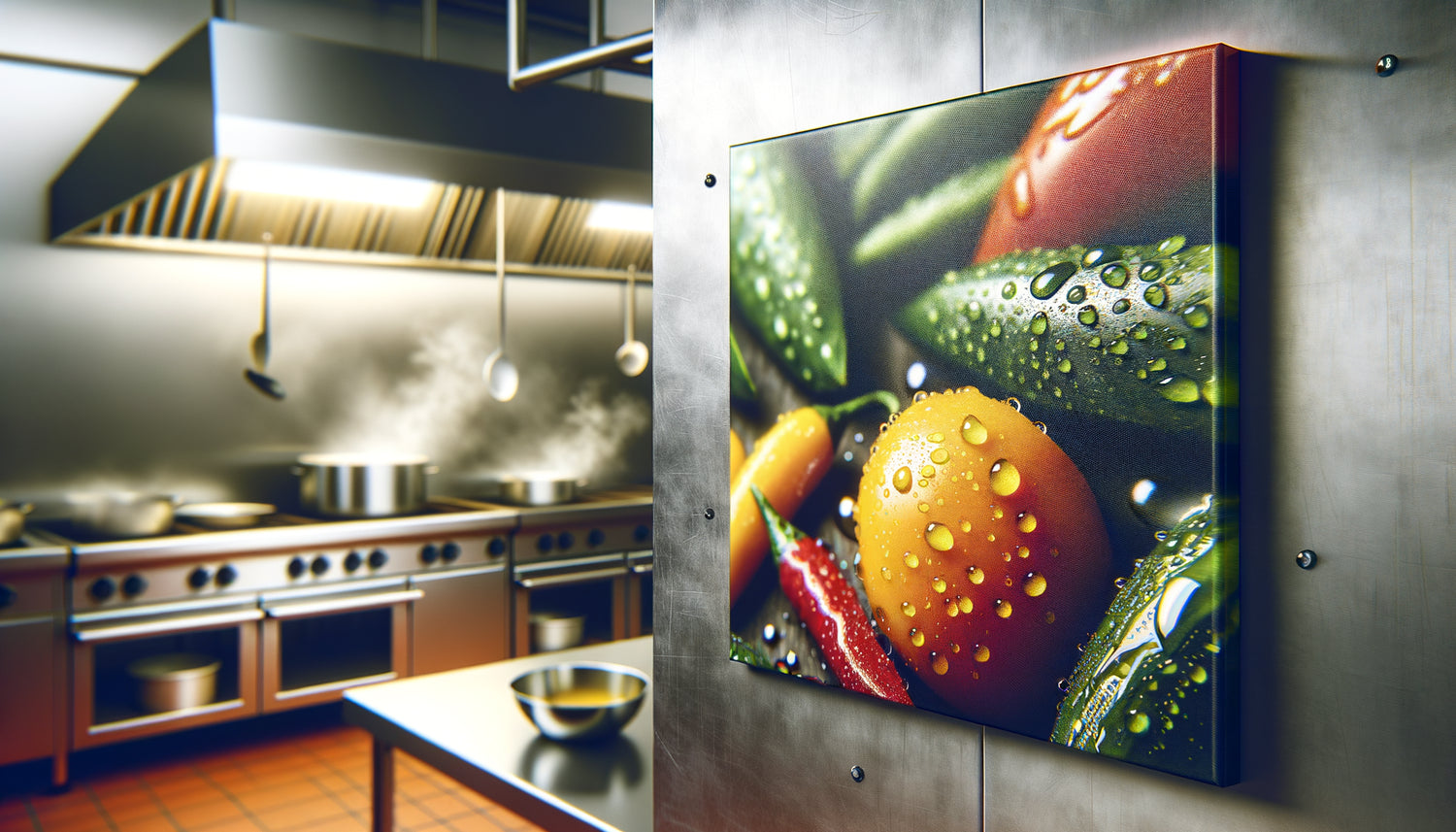
I still remember this magnificent canvas that a restaurateur had hung in his kitchen. A Tuscan landscape with warm colors, intended to inspire the creativity of his teams. Three months later, the work was unrecognizable: greasy halos, yellowish tint, peeling at the corners. A disaster costing 800 euros. Heat, humidity, splashes... professional kitchens are veritable battlefields for artistic supports.
Here's what a PVC-coated canvas brings to your professional kitchen: exceptional resistance to grease and moisture, remarkable ease of maintenance even in extreme conditions, and durability that transforms your decorative investment into a lasting element of your culinary identity.
You dream of humanizing your workspace, of creating the atmosphere that makes a brigade feel at home. Yet you hesitate. Too many disappointments, too many damaged works, too much money thrown away. How to decorate without fearing that everything will go up in smoke at the first burst of service? The solution exists, and it lies in a precise technical choice: the type of PVC-coated canvas.
Rest assured, you don't need to be a materials engineer to make the right choice. Once the criteria are clarified, you will transform your walls into a resistant art gallery, capable of withstanding the daily reality of an active kitchen. I will guide you through the specifications that really matter.
Grammage, invisible foundation of resistance
In the world of PVC-coated canvases, grammage is your first ally. This value expressed in grams per square meter determines the thickness and solidity of the support. For a professional kitchen, forget lightweight canvases of 280 or 340 g/m². These are fragile dancers in a world of boxers.
The threshold of credibility starts at 450 g/m². At this level, the PVC-coated canvas has a sufficiently dense structure to resist mechanical stresses: frequent handling during cleaning, vibrations from equipment, temperature variations. But for optimal resistance, experienced professionals prefer grammages between 510 and 680 g/m².
This superior density creates a formidable physical barrier. Airborne grease molecules, these invisible enemies that infiltrate everywhere, remain on the surface instead of penetrating the fibers. Moisture cannot pass through this textile wall. Result: your painting retains its brilliance despite the saturated atmosphere of a kitchen in full service.
The PVC coating: your shield against ambient hostility
The PVC coating transforms a simple canvas into a protective armor. But be careful, not all coatings are equal. For an ultra-resistant painting, look for a double-sided, integral coating that literally encapsulates every fiber of the fabric support.
This coating creates a totally impermeable surface. When grease-laden vapors settle, they slide on this polymer shield without sticking. Cleaning water beads up like on a lotus leaf. This hydrophobic and oleophobic characteristic is your best assurance against premature aging.
The chemical composition that changes everything
The PVC used must be food grade or compatible with professional hygiene standards. Some manufacturers add antibacterial agents in the coating, a considerable asset when hygiene is paramount. These coated canvases treated limit microbial proliferation, a criterion that health inspectors particularly appreciate.
Also prefer coatings without phthalates, more stable to high temperatures. A PVC coated canvas of superior quality resists up to 70-80°C without deformation or release of unpleasant odors. In a kitchen where the thermometer regularly rises, this thermal stability is not a luxury.

When textile weave meets performance
Under the PVC coating lies a backing fabric whose composition directly influences longevity. High tenacity polyester canvases far outperform cotton-polyester blends for demanding professional environments.
Pure polyester offers an intrinsic resistance to humidity. Unlike natural fibers which swell and shrink with hygrometric variations, polyester remains dimensionally stable. Your painting does not deform, does not warp, retains its perfect flatness even after months of exposure to a kitchen's saturated atmosphere.
The weave must be tight, with regular weaving. This weaving density prevents any micro-infiltration through the coating. Observe the canvas against the light: the less you see light passing through, the better. A compact weave guarantees that the PVC coating adheres uniformly, without weak areas.
The finishes that extend excellence
The final assembly of the painting determines its ability to survive in your professional environment. The edges of the coated canvas must be heat-sealed or double-folded, never simply sewn. Traditional seams create areas of moisture retention where mold and bacteria love to settle.
The fixing system deserves particular attention. Standard metal fasteners rust quickly in humid atmospheres. Prefer stainless steel or anodized aluminum. Some manufacturers offer ventilated suspension systems that create an air gap between the wall and the painting, limiting back condensation.
The anti-UV treatment, often overlooked protection
In a professional kitchen with powerful lighting operating 12 to 16 hours daily, artificial UV rays gradually degrade colors. A PVC coated canvas with anti-UV treatment retains its color saturation year after year. The slightly higher initial investment is offset by a multiplied lifespan.

The maintenance that reveals true resilience
Ease of cleaning distinguishes real professional canvases from imitations. Your ultra-resistant painting should withstand daily wiping with a damp microfiber cloth. Weekly, more vigorous cleaning with mild degreaser should leave no trace, no alteration.
The best PVC coated canvases can even handle occasional steam cleaning, the ultimate weapon against embedded grease. This ability to withstand intensive cleanings transforms your decoration into a functional element of your hygiene program.
Always test this resistance before final installation. Apply a few drops of oil to a corner, let it sit for 24 hours, and vigorously clean. If the surface returns flawless, without any residual halo, you have the right product.
The certifications that reassure and protect
In the food sector, standards are not optional. Your coated canvas should ideally possess certifications attesting to its compatibility with catering environments. The M1 or B1 standard guarantees an acceptable fire reaction, a criterion often checked during safety inspections.
Some manufacturers offer canvases compliant with REACH standards, guaranteeing the absence of problematic chemical substances. For your professional kitchen, these labels are not superfluous marketing, but concrete guarantees of durability and regulatory compliance.
Transform your kitchen into an inspiring space without compromise
Discover our exclusive collection of wall art for Kitchen that combines refined aesthetics and unparalleled professional resistance.
Visualize Your Kitchen Transformed
Imagine your brigade arriving each morning in a space where art meets technique. These resistant artworks reflect your culinary philosophy, your commitment to aesthetics, your refusal of compromise. Works that stand the test of time without faltering, silent witnesses to thousands of successful services.
The PVC coated canvas is not a technical esoteric detail. It's the difference between ephemeral decoration and a lasting investment in the identity of your establishment. Between a bare wall that depresses and an environment that inspires creativity and professional pride.
Start by identifying a supplier specializing in professional supports. Demand precise technical specifications: weight greater than 450 g/m², double-sided PVC coating, polyester backing. Request samples that you can actually test in your kitchen. And above all, never accept being told that a quality painting has no place in a professional kitchen. With the right support, everything is possible.
Frequently Asked Questions About PVC Coated Canvases for Professional Kitchens
How long does a painting on PVC coated canvas actually last in a professional kitchen?
With a professional quality PVC coated canvas and regular maintenance, you can expect 5 to 8 years of impeccable life, sometimes longer. The determining factors are the weight (minimum 450 g/m²), the quality of the coating and especially the frequency of cleaning. I have seen 10-year-old paintings still beautiful in pizzerias where the team wiped them with a sponge every evening. Conversely, medium-quality canvases abandoned without maintenance do not last 18 months. Durability is not only a matter of material, it is also a matter of care. Contrary to popular belief, regular cleaning prolongs the life of the canvas rather than wearing it out, as it prevents the accumulation of residues that eventually attack the coating.
Can you really clean a PVC coated canvas with professional degreasers?
Yes, absolutely, and it is even recommended! A true PVC coated canvas for professional use is designed to withstand commercial degreasers. Simply avoid aggressive solvents such as acetone or white spirit which can attack the polymer. Classic alkaline degreasers used in kitchens (such as diluted oven cleaner) work perfectly. Apply with a microfiber cloth, leave on for 30 seconds, rub in circular motions, rinse with clear water and dry. For significant build-up, you can even use a steam cleaner at a reasonable distance. This chemical resistance is precisely what distinguishes a professional canvas from a standard decorative support. If your supplier hesitates or discourages this type of cleaning, it's probably because the canvas is not suitable for a demanding professional environment.
Are there any special precautions to take when installing near cooking areas?
The location does affect the longevity of your artwork. Avoid immediate proximity to hobs, ovens and deep fryers where temperatures regularly exceed 80°C. A minimum distance of 1.50 meters from intense heat sources is prudent, even with high-performance canvases. Prioritize walls perpendicular to cooking areas rather than directly behind. Also be aware of direct splash zones: just behind the sink or preparation area, repeated splashes will eventually test the limits even of the best canvases. Ideal locations are back walls, cold storage or preparation areas, and passageways between the kitchen and dining room. Ensure proper ventilation as well: an efficient extractor system significantly reduces exposure to suspended grease, prolonging the beauty of your artworks. With thoughtful placement, your decorative investment remains spectacular for years.


