


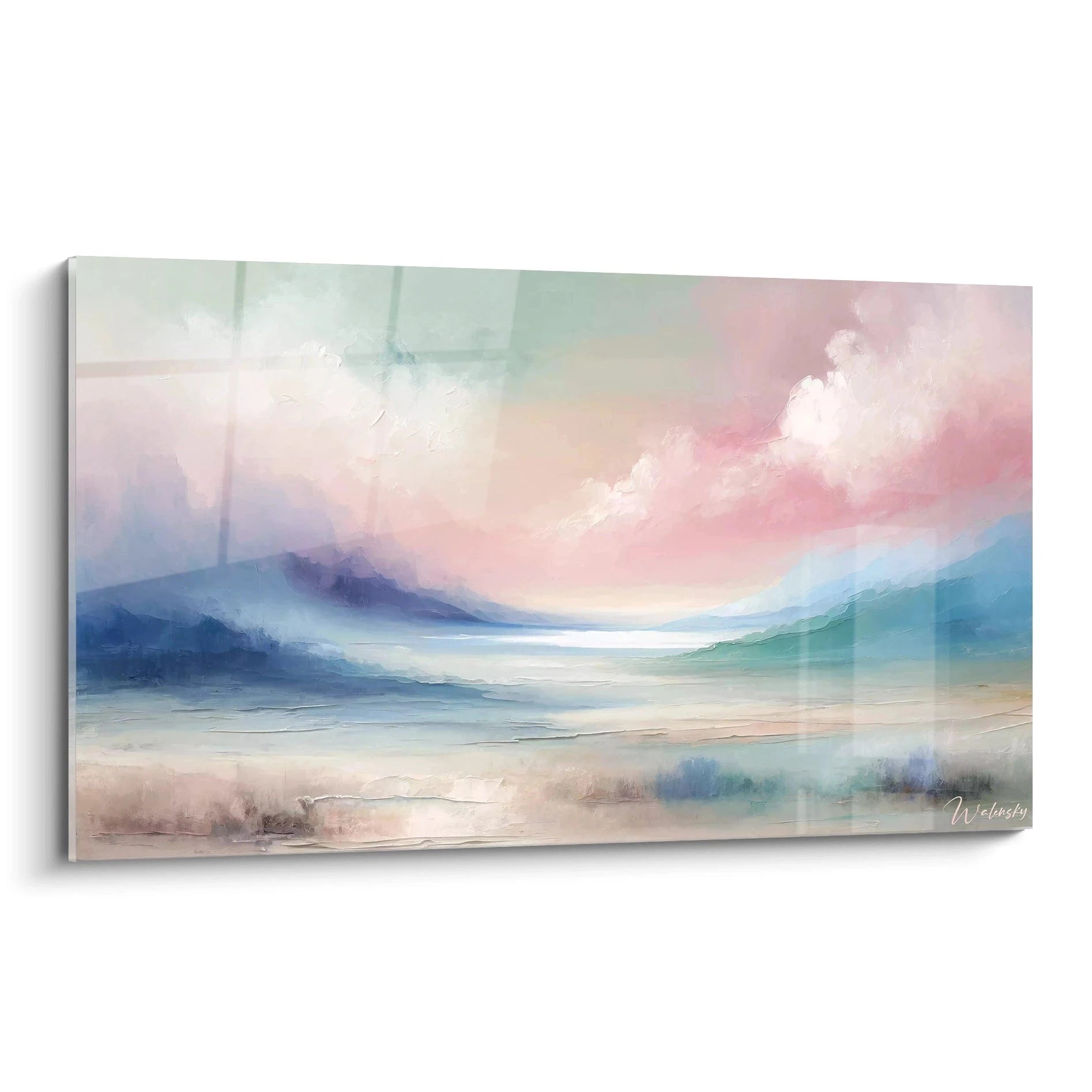

What size artwork for above a sideboard in a kitchen-dining room?
December 15, 2025 · 10 min read · by Walensky
This Saturday morning, while enjoying my coffee facing this blank wall above the sideboard, I felt that familiar sensation: something was missing. Not another piece of furniture, no. A soul. That visual presence which transforms a functional space into a vibrant living area. Yet, faced with the diversity of available formats, I hesitated: too small and the artwork disappears, too large and it overwhelms the composition. I have experienced this quest for perfect balance dozens of times.
Here's what the right dimensions for a painting above a sideboard bring: instant visual harmony, an assumed personality to your kitchen-dining room, and that daily satisfaction of contemplating a perfectly proportioned space.
You have this beautiful sideboard, perhaps found at an antique shop or carefully chosen to optimize your storage. The wall above seems empty, but how to choose the ideal size without risking bad taste? Too many owners abandon the idea, leaving their walls bare out of fear of making a mistake.
Rest assured: there are simple, proven principles that work in 90% of configurations. Proportion rules that transform uncertainty into creative certainty. I'm going to share exactly what works, without complicated jargon, just the essentials to sublimate your space.
Ready to discover how to transform this wall into a magnetic focal point of your kitchen-dining room? Follow me.
The rule of thirds: your dimensional compass
In the universe of wall decoration, one rule dominates all others by its simplicity and effectiveness: your painting should cover between 60% and 75% of the width of your sideboard. This proportion creates a natural visual balance that instinctively pleases the eye.
Specifically, if your sideboard is 150 cm wide, your ideal painting will be between 90 and 112 cm wide. For a 120 cm sideboard, aim for a format of 72 to 90 cm. This range offers you comfortable leeway while guaranteeing harmony.
Why does this proportion work so well? It avoids two common pitfalls: a painting too narrow that floats above the furniture like a lost postage stamp, and a work too wide that visually overflows and unbalances the composition. The sideboard and the painting then form a coherent ensemble, as if they had always been destined to coexist.
I have applied this rule in countless configurations, from contemporary kitchens to rustic dining rooms. It adapts to all styles, from Scandinavian minimalism to bohemian exuberance. This is your infallible starting point.
The multiple composition alternative
If you can't find a single painting of the perfect dimensions, consider a composition of several works. Two 60 cm paintings placed side by side with 10-15 cm of space between them create a visual ensemble of 130-135 cm, ideal for a 160 cm sideboard. This approach offers more flexibility and allows you to play with contrasts or chromatic harmonies.
The height that elevates: between 15 and 25 cm of breathing space
The width is set, let's talk about height. The space between the top of your buffet and the bottom of your artwork determines the elegance of the whole ensemble. Allow for a distance of between 15 and 25 centimeters – this is the optimal distance that creates a strong visual connection without sticking the work to the furniture.
Less than 15 cm and the painting seems precariously placed, ready to tilt at the slightest draft. More than 30 cm and the artwork detaches from the buffet, floating in emptiness without visual anchoring. This intermediate zone of 15-25 cm establishes a harmonious connection.
For low buffets (less than 80 cm high), prioritize 20-25 cm of spacing. For tall buffets or imposing cabinets, 15-20 cm will suffice. The goal: to have the eye naturally perceive the furniture and artwork as a unified decorative ensemble.
Note also that this placement height generally positions the center of the painting at eye level for a seated person – perfect for a dining room where the work is contemplated during meals.

Adapt the dimensions to your wall architecture
Your buffet doesn't live in isolation: it is part of an architectural context. A 4-meter wide wall offers different possibilities than a 2.50 meter wall. Consider the total available wall space above the buffet to refine your dimensional choices.
If your buffet is centered on a narrow wall, the rule of thirds applies perfectly. But imagine a 120 cm buffet placed against an immense 4-meter wall: an 80 cm painting respects the furniture-artwork proportion, but can seem lost in the overall wall space. In this case, dare a slightly more generous format, around 100-120 cm, which also dialogues with the architecture.
Architectural constraints also influence your choices. A side window, a nearby door, an exposed beam: these elements define natural boundaries. Your artwork must respect these visual borders to maintain the balance of the room.
Ceiling height as a decisive factor
In a kitchen-dining room with a standard height of 2.50 meters, an artwork 60-80 cm high is perfect above a classic buffet. But if you benefit from 3 meters or more, dare more imposing vertical formats (100-120 cm high) that enhance this exceptional volume. Conversely, under sloping ceilings with reduced height, prioritize compact horizontal formats that do not visually compress the space.
Panoramic vs. Square Formats: What Visual Impact?
Choosing between a horizontal panoramic format and a square format radically transforms the ambiance of your kitchen-dining room. This decision deserves careful consideration, as it influences the spatial perception of the entire room.
Panoramic artworks (with a 2:1 or 3:1 ratio, such as 47x19 inches or 59x24 inches) create a sense of visual widening. They naturally accompany the horizontal line of the sideboard, extending its structuring effect. Perfect for spaces that lack perceived width, they invite the eye to travel laterally, giving an impression of spaciousness.
Square or slightly rectangular formats (35x35 inches, 31x40 inches) offer more vertical presence. They capture attention, create a powerful focal point, excellent for large colorful compositions or detailed works that deserve contemplation. In a room with low ceilings, they add a welcome vertical dimension.
My personal advice? For a long and low sideboard (60 inches wide, 32 inches high), a panoramic artwork enhances the line. For a more compact and tall cabinet (40 inches wide, 40 inches high), a square format creates a harmonious and balanced ensemble.
— Our selection


The Simulation Technique Before Purchase: Never Make a Mistake
Before investing in your artwork, simulate the dimensions with kraft paper or cardboard. This decorator's trick avoids 99% of post-purchase disappointments. Cut out a rectangle to the intended dimensions, temporarily attach it to the wall with masking tape, then step back.
Observe the composition from several angles: facing the sideboard, from the entrance to the kitchen, from the dining table. Live with this simulation for 24-48 hours. You may find that the 39 inches you considered seem too imposing in the morning, or conversely too timid in the evening under artificial lighting.
This method allows you to adjust before ordering. You might discover that adding 4 inches in width radically transforms the impact, or that a slightly more vertical format better suits your aesthetic sensibility. It's an hour's investment for years of visual satisfaction.
Photograph the simulation: the camera often reveals imbalances that the accustomed eye no longer perceives. Compare several dimensional options by simply changing the size of your cardboard.
— You may also like


The Influence of Artwork Style on Ideal Dimensions
A vibrant abstract landscape doesn't scale like a delicate still life or a graphic black and white photograph. The style and content of the artwork influence ideal proportions, an often-neglected aspect.
Minimalist or monochromatic compositions support generous formats. A sleek abstract painting 120 cm wide above a 150 cm buffet will never overwhelm the space – on the contrary, it asserts a serene and contemporary presence. The visual simplicity of the work allows for this scale.
Conversely, a detailed scene, rich in elements (a complex still life, a bustling urban landscape), is best presented in a more modest format. A painting 80 cm wide for a 140 cm buffet allows the visual complexity to breathe, avoiding sensory saturation in an already functional space like a kitchen.
Vertical works, such as portraits or certain floral compositions, work beautifully above compact buffets. A 60x90 cm (vertical) painting above a 90 cm buffet creates a particularly successful vertical elegance in contemporary spaces.
Ready to transform your kitchen-dining room into a personal gallery?
Discover our exclusive collection of Kitchen paintings that will enhance your buffet with dimensions perfectly adapted to your space.
Visualize your transformed kitchen
Imagine yourself tomorrow morning, preparing your coffee in this kitchen-dining room metamorphosis. Your gaze naturally falls on this painting with perfect proportions, anchored above the buffet as if it had always belonged to that space. The dimensions respect the rule of thirds, the 20 cm breathing space creates this airy elegance, and the chosen format dialogues harmoniously with your architecture.
Your guests immediately notice this focal point that visually structures the room. More than just a piece of furniture and wall decoration, you have created a composition that tells your aesthetic sensitivity. Each meal becomes an opportunity to rediscover this work, under different lighting, different seasons.
The action to take today? Measure your buffet precisely, calculate the 60-75% range to determine your target dimensions, then simulate with cardboard. This half-day of exploration guarantees you years of daily satisfaction. Your kitchen-dining room deserves this attention, because it is where everyday family life is woven, between morning conversations and convivial dinners.
Good dimensions are not a rigid mathematical formula, but a sensitive balance between objective proportions and personal sensitivity. Trust the basic rules, then adjust according to your feeling. Your eye instinctively knows what works in your space – listen to it.

Frequently asked questions about painting dimensions above a buffetCan a painting be wider than the sideboard?This is a question I am often asked, and the short answer is: technically yes, aesthetically not recommended in most cases. A painting that extends more than 10-15 cm on each side of the sideboard creates a visual imbalance and gives the impression that the furniture is too small or poorly positioned. The overall effect loses its coherence. However, there is a creative exception: if you are composing a gallery wall with several works of varying sizes where the main painting intentionally extends beyond the sideboard while integrating into a larger wall composition, it can work. But for a single piece, stick to the 60-75% rule of the sideboard's width – this guarantees lasting harmony. If you find a favorite that is slightly wider, limit the overhang to a maximum of 5-10 cm on each side, ensuring that the wall space allows it.
What height of painting is suitable above a low sideboard of 70 cm?
Low sideboards (around 70-80 cm in height) are very common in contemporary kitchens-dining rooms, and they offer more freedom for the height of the painting. With a spacing of 20-25 cm between the top of the sideboard and the bottom of the painting (to create this essential visual connection), you can comfortably install a work of art from 80 to 120 cm in height depending on your ceiling height. For a standard room of 2.50 meters, an 80-100 cm painting works beautifully. If you benefit from 3 meters or more, dare to use 100-120 cm which will enhance this vertical volume. The goal is that the optical center of the painting is approximately at eye level when seated (about 110-120 cm from the floor), creating visual comfort during meals. Don't forget to also consider what is on your sideboard: a few decorative objects or a lamp influence the perception of the whole and may justify slightly adjusting the height of the painting.
Is it better to have one large painting or several small ones above a sideboard?
This question reveals two distinct decorative approaches, each with its advantages. A large single artwork (in the recommended proportions of 60-75% of the width of the sideboard) creates a powerful focal point, visually simplifies the space and is particularly suitable for contemporary or minimalist interiors. This is the safest option for beginners in decoration, as it limits the risk of compositional errors. On the other hand, a composition of several smaller artworks (two, three, or even four pieces) offers more creative flexibility and allows you to tell a richer visual story. This approach works wonderfully in bohemian, eclectic interiors or when you want to create a personalized gallery wall. The key to success with multiple artworks: consider the whole as a single work whose total dimensions (including the spaces between the frames) always respect the rule of thirds. For example, for a 150 cm sideboard, create an overall composition of 100-110 cm with two 45 cm artworks separated by 15-20 cm. My personal advice? If you love change and personalization, opt for the multiple composition. If you are looking for timeless elegance and visual simplicity, choose the single artwork.
This is a question I am often asked, and the short answer is: technically yes, aesthetically not recommended in most cases. A painting that extends more than 10-15 cm on each side of the sideboard creates a visual imbalance and gives the impression that the furniture is too small or poorly positioned. The overall effect loses its coherence. However, there is a creative exception: if you are composing a gallery wall with several works of varying sizes where the main painting intentionally extends beyond the sideboard while integrating into a larger wall composition, it can work. But for a single piece, stick to the 60-75% rule of the sideboard's width – this guarantees lasting harmony. If you find a favorite that is slightly wider, limit the overhang to a maximum of 5-10 cm on each side, ensuring that the wall space allows it.
What height of painting is suitable above a low sideboard of 70 cm?
Low sideboards (around 70-80 cm in height) are very common in contemporary kitchens-dining rooms, and they offer more freedom for the height of the painting. With a spacing of 20-25 cm between the top of the sideboard and the bottom of the painting (to create this essential visual connection), you can comfortably install a work of art from 80 to 120 cm in height depending on your ceiling height. For a standard room of 2.50 meters, an 80-100 cm painting works beautifully. If you benefit from 3 meters or more, dare to use 100-120 cm which will enhance this vertical volume. The goal is that the optical center of the painting is approximately at eye level when seated (about 110-120 cm from the floor), creating visual comfort during meals. Don't forget to also consider what is on your sideboard: a few decorative objects or a lamp influence the perception of the whole and may justify slightly adjusting the height of the painting.
Is it better to have one large painting or several small ones above a sideboard?
This question reveals two distinct decorative approaches, each with its advantages. A large single artwork (in the recommended proportions of 60-75% of the width of the sideboard) creates a powerful focal point, visually simplifies the space and is particularly suitable for contemporary or minimalist interiors. This is the safest option for beginners in decoration, as it limits the risk of compositional errors. On the other hand, a composition of several smaller artworks (two, three, or even four pieces) offers more creative flexibility and allows you to tell a richer visual story. This approach works wonderfully in bohemian, eclectic interiors or when you want to create a personalized gallery wall. The key to success with multiple artworks: consider the whole as a single work whose total dimensions (including the spaces between the frames) always respect the rule of thirds. For example, for a 150 cm sideboard, create an overall composition of 100-110 cm with two 45 cm artworks separated by 15-20 cm. My personal advice? If you love change and personalization, opt for the multiple composition. If you are looking for timeless elegance and visual simplicity, choose the single artwork.
Explore our collections


