I discovered this curious phenomenon one summer morning, while contemplating a still life of fruit in my workshop-gallery. An obstinate fly circled around the painting, seeming to seek to land on the painted grapes. This scene reminded me of the legendary anecdote of Zeuxis, that Greek painter whose grapes were so realistic that birds came to peck at them. But in our modern interiors, particularly in kitchens or dining rooms, this "success" becomes problematic.
Here's what a judicious choice of painting brings to your culinary space: an elegant decoration without sanitary drawbacks, a serene atmosphere without insect intrusions, and the freedom to display food art without compromise.
You love the aesthetics of still lifes and gastronomic representations, but you fear attracting flies, gnats, and other small flying visitors? This frustration is perfectly legitimate. No one wants to turn their kitchen into an entomological observation laboratory.
Rest assured: artistic solutions exist, tested in my own practice of exhibiting culinary works. By understanding what really attracts insects to certain paintings, you can make informed choices that preserve both your passion for food art and the cleanliness of your interior.
I will reveal the secrets of representations that remain purely decorative, without ever becoming involuntary insect traps.
The truth about insect attraction: beyond hyperrealism
Contrary to popular belief, it is not so much the realism of the painting that attracts insects, but a combination of more prosaic factors. Flies and gnats do not have sufficiently sophisticated vision to mistake a painting for real food.
What really attracts them? Organic residues in the environment near the painting, reflections of light creating illusions of wet surfaces, and above all odors lingering in food preparation areas. A painting depicting apples is no more attractive than an abstract landscape if the environment is clean.
However, certain types of representations pose more practical problems. Paintings with raised textured surfaces imitating juicy fruits can accumulate organic particles in their crevices. Works with glossy finishes create deceptive reflections. And creations using mixed media including organic elements (seeds, spices glued) actually become insect magnets.
The particular case of hyperrealistic still lifes
Modern hyperrealistic still lifes pose an interesting question. Their photographic quality can deceive the human eye, but rarely that of insects. The real problem occurs when these works are installed too close to preparation areas where cooking smells and vapors circulate.
I’ve noticed that paintings depicting decaying food, overripe fruits, or raw meats – sometimes chosen for their vanitas symbolism – create an unfortunate psychological association. Even if the painting itself isn't appealing, our brains establish an uncomfortable link with organic deterioration.
Smart Food Representations for Your Kitchen
After years of observing interactions between culinary art and domestic environments, I’ve identified the most suitable artistic approaches for living spaces exposed to insects.
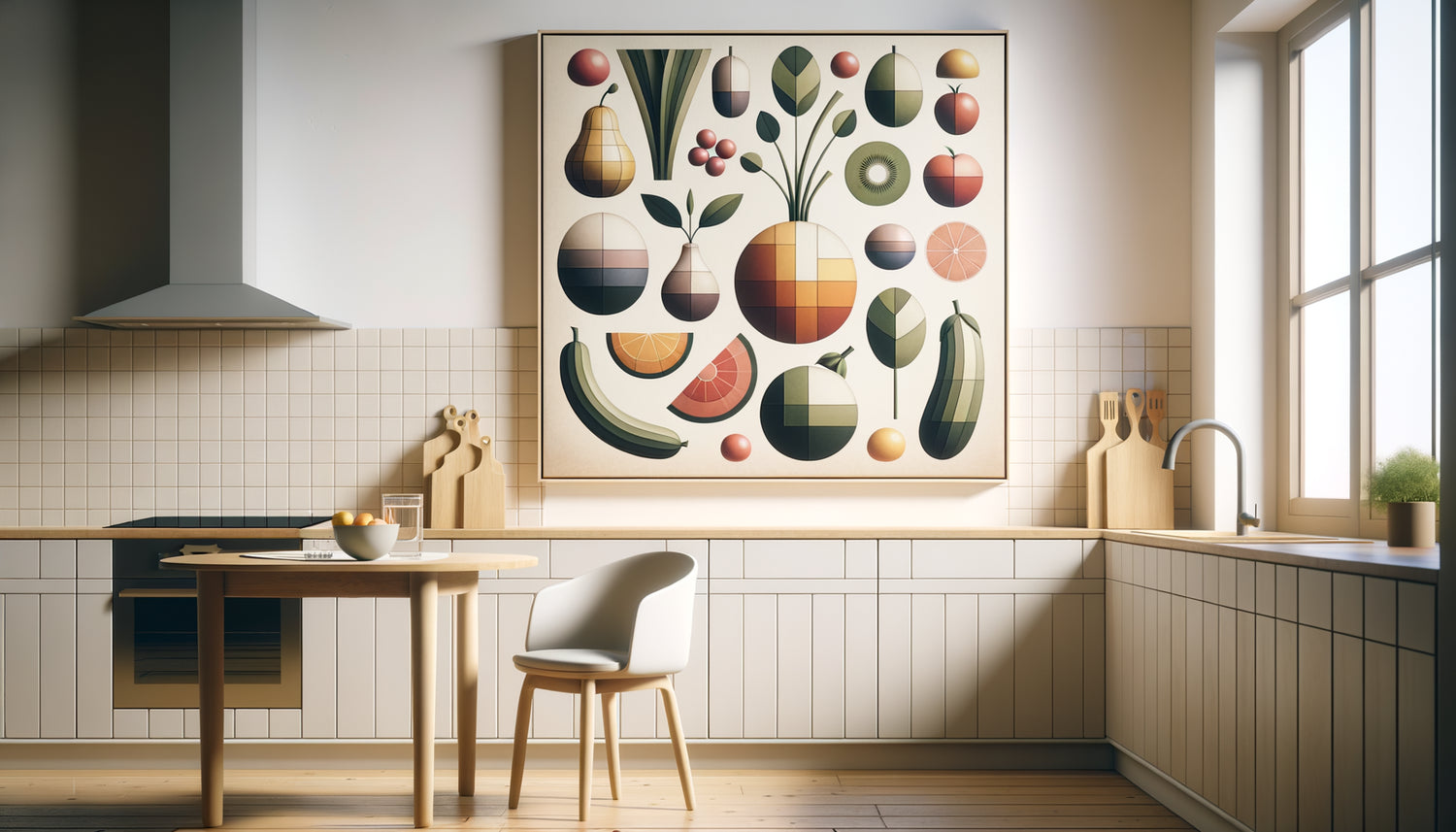
Stylized illustrations are a first sensible choice. These food representations use simplified shapes, blocks of color, and clean lines. Think vintage vegetable posters, sleek botanical drawings, or modern graphic compositions. Their clearly two-dimensional appearance eliminates any confusion, even for our human brains that no longer associate these images with real food.
Gastronomic abstractions offer a sophisticated alternative. These paintings evoke the culinary universe without literal representation: color compositions inspired by spices, organic shapes reminiscent of fruits without imitating them, textures suggesting food matter without reproducing it. It's the spirit of cooking without its direct appearance.
The Finishes That Make All the Difference
Beyond the subject matter, the painting’s finish plays a decisive role. Matte surfaces without pronounced texture remain neutral to insects. They don't accumulate particles and don't create deceptive reflections. Uniformly applied satin varnishes offer an elegant compromise.
Absolutely avoid paintings with thick layers of paint forming relief (impasto technique) to represent juicy foods. These hollows and bumps become veritable collectors of dust and organic particles suspended in the kitchen air.
Favor smooth, washable supports: varnished canvas, brushed aluminum, acrylic glass. A painting that you can clean with a simple damp sponge will never retain enough residue to interest even the smallest insect.

Conceptual Culinary Art: When Minimalism Protects
The move towards gastronomic minimalism in wall art offers an elegant response to our challenge. These works celebrate the culinary universe through refined visual codes: a simple fork in black silhouette, a stylized coffee cup in just a few lines, aromatic herbs sketched with pale watercolor.
This approach presents a double advantage. On the one hand, it creates an undeniable culinary atmosphere without ever evoking consumable food. On the other hand, it integrates perfectly into contemporary kitchens where pure lines and immaculate surfaces reign.
Gastronomic typographies are another fascinating avenue. Evocative words – 'Flavor', 'Basil', 'Market' – composed in elegant fonts on a solid background. Impossible for an insect to be interested, but the culinary evocation remains powerful for the human mind.
Black and white photographs: a surprising solution
Here's a counterintuitive discovery: black and white culinary photographs work remarkably well in kitchens. By eliminating color, we remove one of the main visual signals of food freshness.
A bright yellow lemon immediately evokes its acidity and juice. The same lemon in shades of gray becomes a formal study, an exploration of texture and light. Our brain perceives it differently, in a more artistic register than nutritional. And insects, devoid of these complex associations, find no particular interest in it.
Placement strategies: where to hang your food art
Even with the ideal artwork, placement determines your success. I have developed a simple but effective distance rule: never place a food representation within two meters of real food storage areas, fruit baskets or trash cans.
Insects follow olfactory corridors. They fly towards attractive odor sources, and anything on their trajectory can become an investigation stop. A cherry painting placed between the window and your compote dish becomes a likely stop, even if it emits no odor.
Prefer walls perpendicular to worktops rather than those located directly behind them. Create a visual and spatial separation between art and real food. In an open kitchen, the dining room wall is the optimal location for your gastronomic works.
Lighting: a factor often overlooked
Lighting dramatically influences insect attraction. A painting strongly lit by a spotlight creates a hot luminous point that naturally attracts flying insects, regardless of its representation.
Opt for diffused and uniform lighting in your culinary space. If you want to highlight a particular artwork, use indirect light or warm-temperature LEDs (2700-3000K) which attract fewer insects than cool lights.

The innovative materials that naturally repel
Innovation in artistic supports offers new solutions. Tableaux sur métal (aluminum, brushed steel) possess inherently repellent properties. Their smooth and cool surface offers no interest to insects seeking organic surfaces.
Impressions sur verre acrylique (plexiglass) offer similar advantages with controlled brilliance. Unlike traditional glass which can create deceptive reflections, anti-reflective acrylic diffuses light uniformly.
Some manufacturers now offer vernis répulsifs integrating natural compounds (citronella, eucalyptus extracts) in their formulation. These imperceptible finishes for humans create a subtle olfactory barrier deterring insects without using pesticides.
Transform your kitchen into an art gallery without compromise
Discover our exclusive collection of tableaux pour Cuisine that combine refined culinary aesthetics and absolute practicality, specifically designed for living spaces.
Preventive maintenance: maintaining harmony between art and hygiene
A suitable artwork does not dispense with entretien régulier. In a kitchen, even the most minimalist works accumulate micro-particles of suspended grease. Monthly cleaning with a slightly damp microfiber cloth is generally sufficient.
For artworks near the cooking area, install an protection invisible: a transparent antistatic film applied to the protective glass naturally repels particles. This barrier is cleaned with a simple gesture and replaced annually.
Pay particular attention to the angles et bordures du cadre where dust and residue accumulate. These areas become potential refuges for small insects. A handheld vacuum cleaner with a soft brush attachment, passed weekly, eliminates this risk.
Seasonal Rotation: A Professional Approach
In my gallery, I have adopted a seasonal rotation of culinary artworks. Representations of summer fruits find their place in winter, when these foods are absent from the real kitchen. This temporal dissociation eliminates any risk of olfactory confusion for insects.
In summer, a period of maximum activity for flies and gnats, prioritize abstractions and minimal compositions. Reserve your more elaborate still lifes for cooler months when entomological pressure naturally decreases.
Imagine your kitchen transformed: walls that tell your culinary passion without ever becoming insect magnets. Artwork that you clean as easily as your countertops. A perfect harmony between artistic expression and impeccable hygiene. This dream becomes a reality by consciously choosing your food representations according to the principles I have just shared.
Start modestly: replace this hyperrealistic still life with a stylized illustration in the same tones. Observe the difference for a few weeks. Then gradually develop your culinary gallery with adapted artworks, applying placement and maintenance rules. Your kitchen will become that space where art and daily life coexist without compromise.
Frequently Asked Questions
Do paintings of fruit really attract flies or is it a myth?
It's largely a myth, but based on an understandable confusion. Flies are not attracted to the image itself – they do not possess sufficiently sophisticated vision to confuse painting and real food. However, a painting hung near actual sources of food (fruit basket, trash can) finds itself on the natural path of insects and may give the impression of being the cause of their presence. The real problem occurs with textured paintings that accumulate organic particles suspended in the kitchen air, creating a true attraction. A smooth, well-maintained and properly placed painting poses no problem, whatever its representation.
Can I still hang a realistic still life in my kitchen?
Absolutely, with a few strategic precautions. Choose a work with a smooth and varnished finish, ideally protected under glass. Place it away from food preparation areas – at least two meters from the fruit basket, the main countertop, and the trash can. Favor a wall perpendicular to odor sources rather than parallel. Ensure monthly cleaning to eliminate micro-fat particles. Finally, avoid overly powerful direct lighting that creates hot spots attracting insects. With these adjustments, you can perfectly enjoy a beautiful classic still life without any drawbacks. Location and maintenance are more important than the subject itself.
What decorative alternatives offer the same aesthetic effect without any risk?
Stylized vegetable illustrations in a vintage or botanical style offer a charming culinary aesthetic with zero risk. Typographic compositions playing on the names of herbs, spices, or recipes create a very contemporary gourmet atmosphere. Black and white culinary photographs bring sophistication and gastronomic reference without the visual cues of freshness that could be problematic. Abstract works inspired by cooking – shapes evoking utensils, color compositions reminiscent of spices – offer a more conceptual approach. Finally, works on metals (aluminum, copper) with engraved or printed patterns combine resistance, ease of maintenance, and an industrial-chic aesthetic perfectly suited to modern kitchens.