

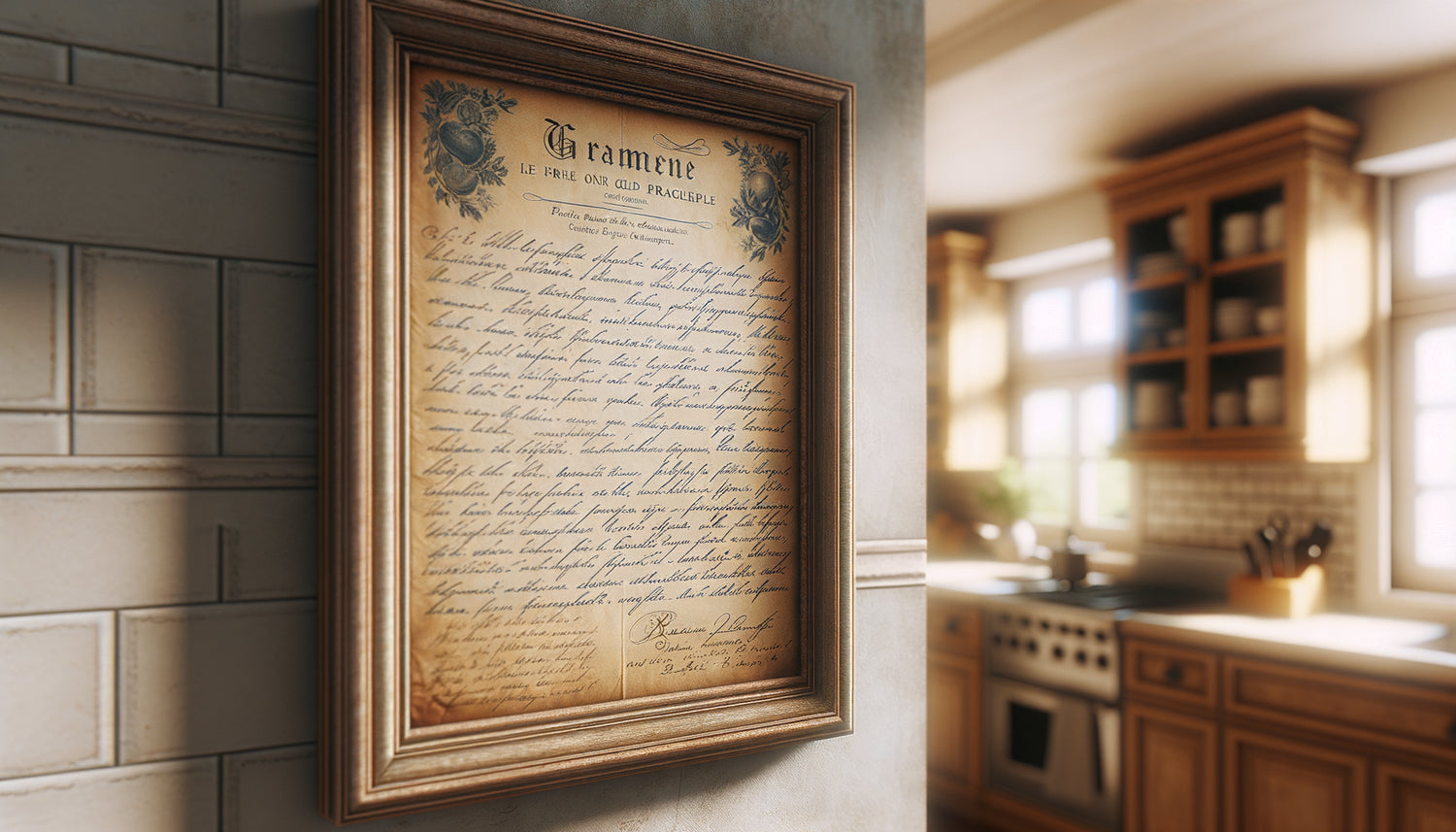
There's something infinitely touching about my grandmother’s shaky handwriting on a time-yellowed card. Her “firm but not dry” egg whites, her “generous pinches” of vanilla, her pencil annotations: “successful August 15, 1982.” These handwritten recipe artworks are not mere framed culinary instructions. They are fragments of soul, tactile testimonies of a transmission that escapes the digital.
Here's what a handwritten recipe artwork brings to your interior: a living memory that dialogues with the present, an aesthetic of imperfection that warms up sterile spaces, and a silent narration that transforms a kitchen into a family sanctuary. Three dimensions that industrial prints can never equal.
You’ve probably felt this frustration in front of your kitchen walls: perfect typographic posters leave you cold, reproductions of classic works seem out of place, and motivational quotes sound hollow. You're looking for something that truly represents you, that tells your story without having to explain it to every visitor.
Good news: this quest for authenticity finds its answer in framed handwritten recipes. Whether it’s an original heirloom or a careful reproduction, these graphic testimonies radically transform the atmosphere of a space. I invite you to discover why these particular objects instantly create that personal family touch that so many decorators vainly try to simulate with generic accessories.
Writing as an imprint: when handwriting tells more than words
Carefully observe an old handwritten recipe. Beyond the content, a whole personality is revealed in the tracing of the letters. The pressure of the pen reveals urgency or meditation, erasures betray the adjustments of a demanding cook, stains of flour or chocolate become proof of actual use, living experimentation.
This involuntary graphological dimension gives handwritten recipe artworks an emotional depth impossible to artificially reproduce. Unlike digital typefaces, however elegant they may be, handwriting carries within it the trace of a human gesture, a specific moment when a hand guided a tool on paper. This physical witness of a presence instantly creates a temporal bridge between the one who wrote and the one who looks today.
In a contemporary living room or a design kitchen, this assumed imperfection acts as a soothing counterpoint. Uneven letters, a line that descends slightly, a missed dot: all these micro-events humanize the space and remind us that before the era of digital perfection, beauty also resided in the singularity of gesture.
The power of marginal annotations
The true treasures of family handwritten recipes often lie in the margins. These little notes added over the years – “too sweet, reduce by half”, “excellent for Paul’s birthday”, “don’t forget the zest” – transform a simple instruction into an emotional palimpsest. Each addition is a testament to a lived experience, a memory crystallized around a dish.
Framed and displayed, these annotations become micro-stories that guests decipher with curiosity. They naturally create opportunities for sharing: “Whose handwriting is this?” becomes the prelude to a family story, an anecdote that brings back a loved one or a bygone era.
The materiality of time: patina, stains and assumed fragility
An authentic handwritten recipe painting bears the marks of time with a particular elegance. The yellowed paper, the folds that testify to years spent in a drawer, the halos of coffee or oil: each mark is a certification of authenticity, tangible proof that this document has been used, cherished, transmitted.
This aesthetic of patina radically opposes the instantaneity of digital images. Where an Instagram photo disappears into the incessant flow, the handwritten document anchored in its frame affirms a comforting permanence. It says: “I was there before you, I will be there after”, creating a temporal depth that considerably enriches the spatial experience.
For lovers of contemporary decoration who fear a dusty museum effect, these recipe paintings offer a perfect balance. Their generally modest format (a card, a notebook page) and their prosaic subject prevent them from tipping into pomposity. Framed with discretion – simple glass, light or matte black wood – they bring that touch of soul without weighing down the general aesthetic.
The sacralization of the everyday
Hanging a handwritten recipe on the wall performs a powerful symbolic gesture: transforming the utilitarian into the artistic, elevating the domestic to the rank of work. What was functional – instructions for making a cake – becomes contemplation. This transmutation values the daily gestures of our ancestors, recognizes their know-how as worthy of being preserved and celebrated.
In a society where “homemade” is regaining its nobility, these paintings act as silent manifestos. They affirm that cooking is an art, that family recipes constitute a valuable intangible heritage, that intergenerational transmission has value in the face of industrial food uniformity.

How handwritten recipes shape the identity of a home
I have repeatedly observed this fascinating phenomenon: in a carefully decorated but impersonal interior, the addition of even a single handwritten recipe painting instantly changes the perception of space. Suddenly, the kitchen is no longer a showroom, but the heart of a lived-in home.
Why this narrative effectiveness? Because recipes embody rituals. Unlike a family photo that freezes a moment, a recipe suggests repetition, a tradition that continues. It evokes childhood Sundays, collective preparations for special occasions, secrets passed down from hand to hand. This ritualistic dimension resonates deeply with our contemporary need for grounding and continuity.
Handwritten recipe paintings also create what anthropologists call "conversation pieces." Their presence in a semi-public space like the kitchen naturally generates exchanges. Guests approach them, decipher, question. These micro-interactions gradually weave the identity narrative of the home, more effectively than an explicit speech.
Composing a narrative gallery
A single framed recipe creates a focal point. But assembling several handwritten documents – recipes from different generations, varied writing styles, heterogeneous formats – allows you to build a true visual narrative. This wall of culinary memory then becomes the indirect portrait of a lineage, where each handwriting represents a voice, each dish evokes an era.
This domestic museum approach works particularly well in contemporary open-plan kitchens, where the wall adjacent to the dining area benefits from constant visibility. The heterogeneous assembly of handwritten paintings, far from creating disorder, produces a visual rhythm that harmoniously contrasts with the clean lines of modern furniture.
The creative alternative: recreating authenticity with intention
Not all homes have the chance to possess antique handwritten recipes. Some documents have been lost, others never existed in families where transmission was oral. This absence does not condemn one to give up that particular personal touch.
The solution lies in the intentional creation of new manuscripts. Transcribing by hand your favorite recipes, those you consistently prepare for special occasions, those that define your culinary identity, is an act of anticipated transmission. These documents that you create today will become the legacies of tomorrow, bearing your handwriting, your annotations, and your personal adjustments.
This approach has an unexpected advantage: it forces awareness and selection. What are really YOUR signature recipes? Those that deserve to be fixed, preserved, transmitted? This reflective process strengthens the link between your culinary practice and your identity, between your daily gestures and your future heritage.
The ritual of writing as meditation
Slowly copying a recipe by hand, taking care with the calligraphy, adding your personal comments, becomes a rare meditative act in our digital daily life. This moment of voluntary slowness, pen in hand, creates a deep connection with the content being transcribed. You are not mechanically copying: you mentally relive the preparations, anticipate the flavors, and recall the tasting contexts.
Once framed, these new handwritten recipes carry this contemplative energy. They testify to a deliberate choice against the ease of copy-paste, a valuation of manual gesture and time invested. In an interior, they discreetly but effectively signal a philosophy of life, a relationship with time and creation that resonates with current slow living values.
Ready to transform your kitchen into a living memory gallery?
Discover our exclusive collection of wall art for Kitchen that celebrates culinary art and instantly creates the authentic family atmosphere you are looking for.

Harmoniously integrating handwritten recipes into different decorative styles
One of the strengths of handwritten recipe artworks lies in their remarkable stylistic versatility. Contrary to popular belief that confines them to rustic or vintage interiors, these objects adapt easily to varied aesthetics, provided their staging is carefully considered.
In a minimalist interior, a single handwritten recipe artwork, framed in matte black and displayed on an immaculate white wall, creates a striking focal point. The emotional density of the document contrasts with the surrounding emptiness, creating a fertile visual tension. Minimalism is no longer cold but inhabited.
For industrial settings, opt for aged metal frames or industrial clip systems. The raw aspect of the support dialogues with the delicacy of the handwriting, creating that balance between strength and fragility that characterizes the best interiors in this style.
Scandinavian decorations naturally welcome handwritten recipes thanks to their hygge philosophy of authentic warmth. Pair them with light wood frames, arrange them in asymmetrical clusters, mix them with dried botanical elements to reinforce this atmosphere of a comforting cocoon.
Even in very graphic contemporary interiors, handwritten recipe artworks find their place as organic counterpoints. Their natural irregularity softens the aggressiveness of strict geometric lines, reintroducing humanity into spaces that might otherwise seem too conceptual.
Beyond the kitchen: deploying recipes throughout the home
While the kitchen is the obvious location for handwritten recipe artworks, other spaces benefit considerably from welcoming them. This relocation creates surprising effects that enrich the spatial experience of the home.
In the dining room, a large artwork presenting a recipe for a festive dish – Sunday roast, celebratory centerpiece – establishes an atmosphere of permanent celebration. It reminds you that this room is not just a functional place but the theater of important family rituals.
More unexpected: the hallway. This often-neglected transitional space transforms into a narrative gallery when a series of small handwritten recipes are deployed there. The physical journey becomes a temporal voyage, each step revealing a new fragment of culinary family history.
Some even dare to use the office or creative workshop. The idea? To recall that creativity is also nourished by everyday life, that inspiration can come from a list of ingredients as much as from a philosophical quote. Handwritten recipes act there as discreet muses, evoking the processes of transformation, experimentation and adjustment common to all creation.
This de-compartmentalized approach to framed handwritten recipes allows them to escape their status as thematic accessories and elevates them to become fully fledged decorative elements, carrying an emotional charge that transcends their literal content.
Conclusion: writing on the walls the story that constitutes us
Handwritten recipe artworks work this rare magic of transforming the invisible into the visible. They materialize intergenerational links, embody the transmission of know-how, anchor rituals that structure family identity in space. In a world where digital acceleration weakens our relationship with long time spans, these modest objects affirm the value of continuity, meaningful repetition, and living memory.
Start simply: find that handwritten recipe tucked away in a drawer, or transcribe that preparation which defines your family gatherings. Frame it carefully. Hang it where you will see it daily. And observe how this simple gesture gradually transforms your perception of space, how it creates opportunities for storytelling, how it silently weaves the link between past, present and future. Because ultimately, that's exactly what a personal family touch is: the visible trace of a story that continues, an identity that is built day after day, recipe after recipe.
Frequently Asked Questions
I don't have old handwritten recipes in my family, can I still create this atmosphere?
Absolutely, and it’s even a wonderful opportunity to start your own tradition! Two approaches are open to you: transcribe your favorite recipes by hand to create the future heritage of your lineage, or explore flea markets and garage sales where you will discover orphaned handwritten recipes waiting for a new family to cherish them. These anonymous documents carry the same emotional charge – a human writing, a preserved know-how – and fit perfectly into an interior seeking authenticity. What is not as important is biological ancestry as it is recognizing the value of these handwritten traces. By framing and displaying them, you offer them a second life and participate in this great intergenerational conversation around nurturing gestures. Over time, your own handwritten creations will take on the patina that makes their charm, and your children or loved ones will see in them the precious testimonies of your era and your sensitivity.
How to properly protect and frame an old and fragile handwritten recipe?
Preserving antique handwritten documents requires a few simple but essential precautions. Always choose a frame with UV-protective glass to protect the paper and ink from gradual fading caused by light, particularly aggressive in a kitchen. Absolutely avoid laminating the original document; this irreversible process can chemically damage the paper over time. If the recipe is extremely fragile or precious, have a high-quality photographic reproduction made by a professional – you will frame this copy while the original is stored flat in a stable environment. For mounting, use an acid-free cardboard mat that holds the document without direct contact with the glass, thus avoiding condensation and mold. Regarding placement, avoid proximity to heat sources (oven, stoves) and excessive humidity. A wall perpendicular to the cooking area generally represents the best compromise between visibility and preservation. These precautions will allow your handwritten recipe painting to last through the decades while remaining perfectly legible and moving for future generations.
Do handwritten recipes work in an ultra-modern and design kitchen?
Not only do they work, but they are often even more necessary and impactful! Very modern, design kitchens, with their smooth surfaces, clean lines, and high-tech aesthetics, sometimes risk feeling cold or impersonal, like showroom displays. It is precisely here that handwritten recipe paintings reveal their full potential by creating a saving emotional counterpoint. The contrast between the industrial perfection of modern materials and the organic irregularity of handwriting generates a fascinating visual tension that significantly enriches the space. To successfully integrate this, adopt a minimalist framing – matte black or pure white frame, simple square or rectangular format – that dialogues with the formal language of your kitchen. Limit the number of paintings to avoid overload: one or two carefully positioned elements are enough to humanize the whole without compromising aesthetic consistency. This approach proves that tradition and modernity do not oppose but sublimate each other, creating these inhabited contemporary interiors, technological but warm, which characterize the best of current design.


