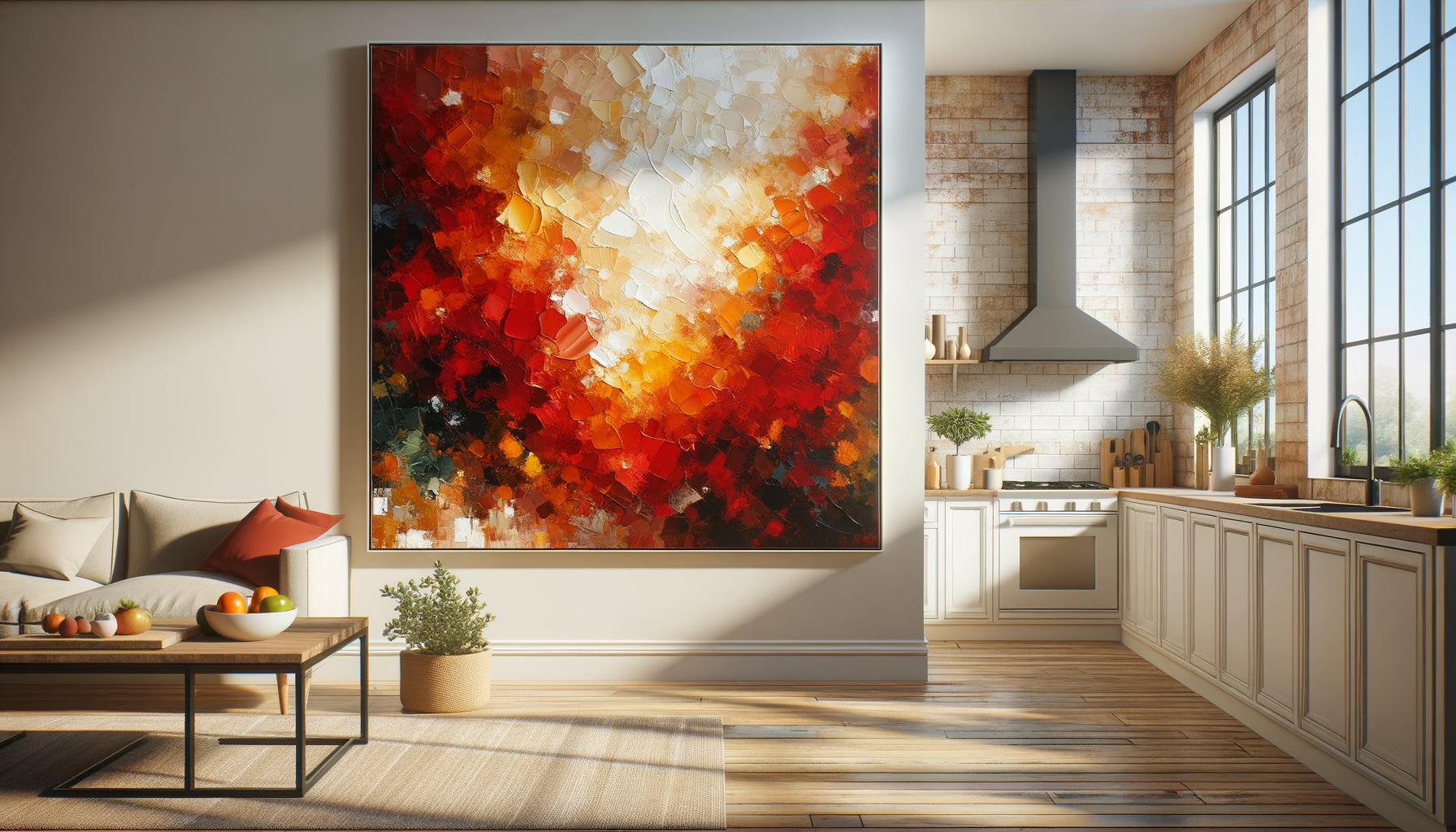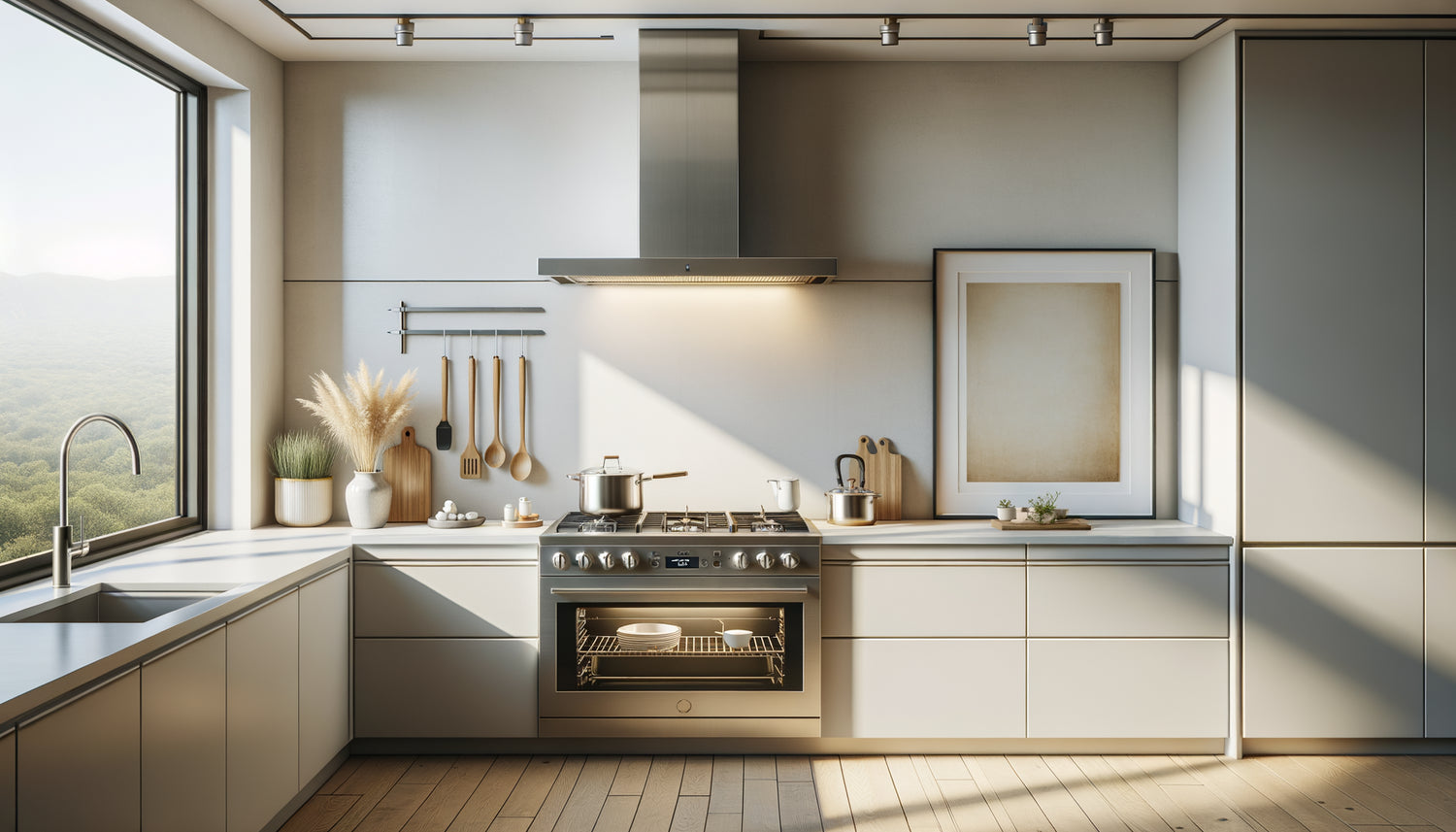
I've spent fifteen years advising homeowners who wanted to transform their kitchen into a living art gallery. And every time, the same story: a beautiful painting purchased with enthusiasm, carefully hung near the stove, then three months later, those greasy marks that gradually tarnish the artwork. I’ve seen this frustration in the eyes of dozens of clients passionate about culinary art.
Here's what a thoughtful placement of a painting near the stove brings: preserving your artistic investment, a kitchen that breathes sophistication without compromise, and harmony between culinary functionality and aesthetic pleasure. Because a painting deserves better than to become a collateral victim of your gastronomic talents.
The problem isn’t the desire to beautify this central area of your daily life. It's believing you have to choose between beauty and practicality. You’ve found the perfect artwork for your kitchen, the one that captures the Mediterranean spirit of your favorite recipes or the graphic elegance of your culinary universe. Then comes that paralyzing question: where do you hang it so it survives splashes of oil, tomato sauce splatters, cooking fumes?
Good news: positioning a painting near the stove without risk isn't a utopia. It’s a matter of intelligent geometry, strategic choices, and a few tricks professionals have been using for years. You will discover how to create that inspiring kitchen you dream of, where art dialogues with gastronomy without ever suffering.
The 90-centimeter golden rule: your artistic safety perimeter
Let's talk about the sacred geometry of the kitchen. When you cook, projections don’t follow a random trajectory. They obey predictable physical laws: oil sizzling in a pan can travel up to 80 centimeters laterally, fumes rise in a direct plume then disperse, splashes of boiling liquid follow precise angles.
My empirical rule after years of observation: 90 centimeters minimum between your stove and any painting. It's not an arbitrary number; it’s the result of countless consultations where I measured, observed, analyzed traces on walls. Below this distance, even with all due diligence, greasy particles will gradually colonize the surface of the artwork.
Concretely, if your stove is 60 centimeters wide, your protection zone extends to 150 centimeters on either side. This is the space you absolutely avoid hanging your painting. Think of it as an invisible but very real bubble around your cooking area.
Blind spots: your unsuspected allies
But this rule doesn’t mean banishing art from your culinary space. There are strategic angles that miraculously escape projections. The wall perpendicular to your stove, for example, offers natural protection. If your cooktop is oriented north, the wall becomes a privileged location, protected by the geometry of your setup.
I've also discovered that height plays a crucial role. A piece positioned 180 centimeters from the floor or higher escapes most direct splashes, which generally follow horizontal or slightly upward trajectories, rarely exceeding 160 centimeters. This elevation creates a zone of relative safety, even in reasonable proximity to the stove.
When ventilation becomes your best decoration ally
Let's talk about an element we often neglect in the equation: your ventilation system. A high-performance extractor fan doesn’t just remove odors; it radically changes the trajectory of greasy particles and vapors. It's your first line of defense to protect your artworks from splashes.
A quality extractor fan, correctly sized and positioned, captures up to 85% of suspended particles before they disperse in your kitchen. In my interventions, I’ve found that kitchens equipped with efficient extractor fans allow reducing the safety perimeter by 90 to 70 centimeters for lateral locations.
But be careful: not all extractor fans are created equal. A recirculation model offers less protection than an external extraction. The suction rate must be adapted to your kitchen volume and cooking frequency. If you cook daily, investing in premium ventilation becomes as important as choosing your artwork itself.
The invisible airflow that protects your artworks
Observe the behavior of steam when you cook with your extractor fan on. You will see aerial corridors, zones where the upward flow is powerful, others where it weakens. These observations tell you precisely where to position your artwork safely.
Walls located behind the extractor fan benefit from a suction effect that naturally pushes projections away. That's why we can sometimes hang a piece only 60 centimeters laterally if the extractor fan creates a protective flow. The art of positioning an artwork near the stove is also understanding the invisible dynamics of air in your kitchen.

Materials that defy splatters: choosing your artwork strategically
Not all artworks are equal when it comes to culinary attacks. If you absolutely want to decorate the area near your stove, the choice of support and finish becomes crucial. I have learned to guide my clients towards works whose resilience corresponds to their exposure to risks.
Tableaux sur aluminium ou métal are your best choice for at-risk areas. Their smooth, non-porous surface naturally repels greasy particles. A simple wipe with a damp sponge is usually sufficient to clean them, unlike a textile canvas which irrevocably absorbs projections.
Impressions sous verre acrylique also offer excellent protection. Glass or plexiglass creates a physical barrier between the artwork itself and external aggressions. Even a direct splash will never reach the image, and cleaning remains simple and risk-free for artistic integrity.
Absolutely avoid toiles non vernies, watercolors under simple frame, or works on paper in this area. Their porosity makes them vulnerable even to the finest airborne particles. If you already own such a work and want to position it near the stove, have it framed under glass with a mat that creates additional distance between the glass and the artwork.
The alternative of the gallery wall: relocating art without sacrificing beauty
Sometimes, the most elegant solution is to completely rethink the artistic distribution of your kitchen. Rather than concentrating a single painting near the stove, create a mur galerie on the opposite or perpendicular wall, out of any projection zone.
This approach has a double advantage: it protects your artworks while creating a powerful visual focal point that structures the space. Your gaze naturally crosses the kitchen from your cooking area to this artistic wall, creating remarkable spatial depth and dynamics.
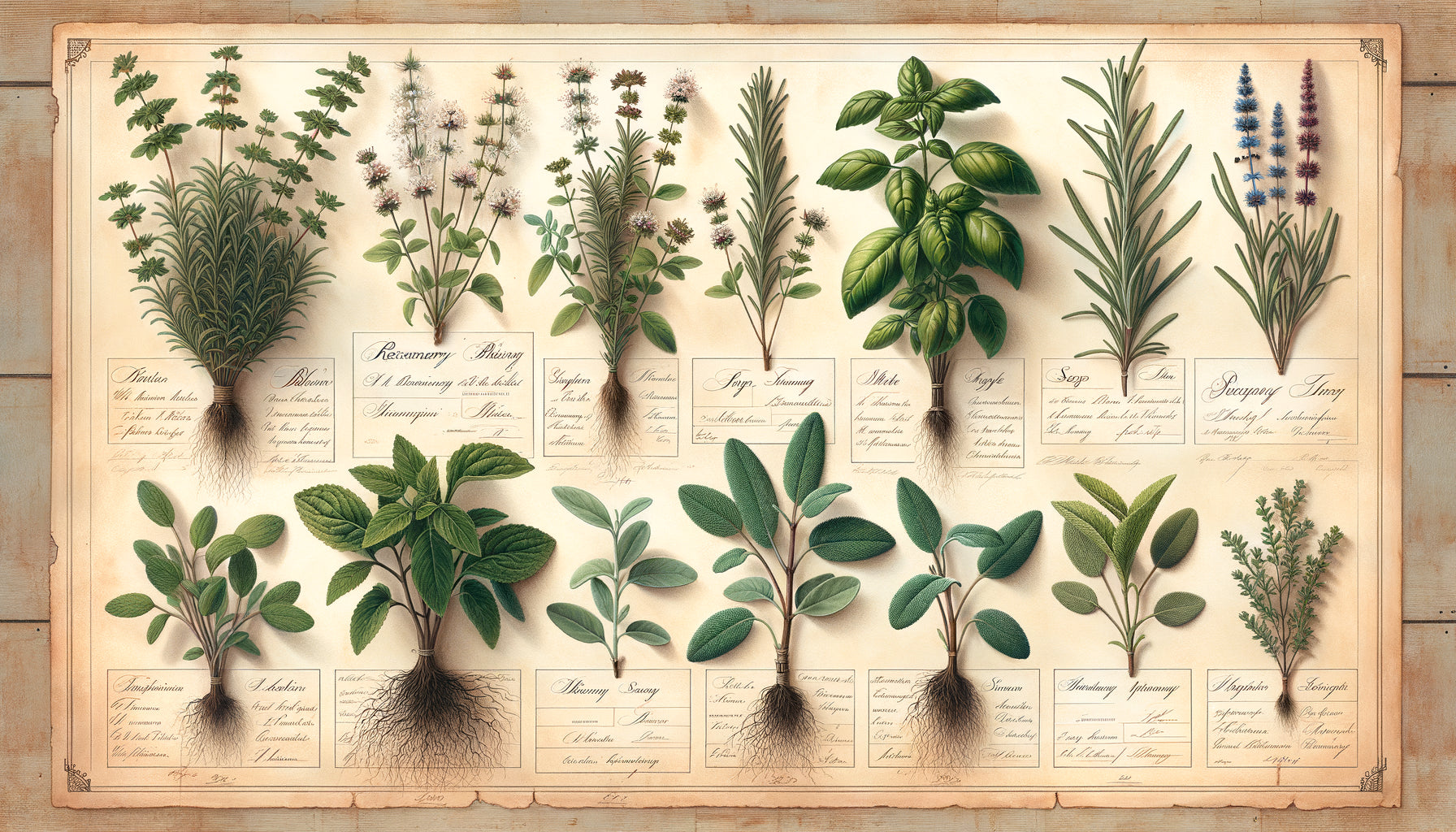
I recently advised a client who absolutely wanted to display her collection of botanical prints in her kitchen. Rather than scattering them, we created a vertical composition on the wall facing her stove, 3 meters away. Result: she fully enjoys her artworks while she cooks, with no risk of splashes, and her kitchen has gained a strong visual identity.
Unexpected Safe Havens in Your Kitchen
Explore opportunities you may be overlooking. The back wall of your kitchen, the one against which your table or island sits, is a premium location for a painting. Completely protected from splashes, it offers maximum visibility from the cooking area.
The space above a sideboard or side storage unit also represents a judicious choice. The presence of the furniture creates an additional physical barrier, and the natural height of this location keeps the artwork away from splatter trajectories.
Even the interior of a decorative niche or deep shelf can accommodate a small framed work. The recess created by the depth of the niche offers surprising protection while adding relief to your wall decoration.

Active Protection Solutions: When You Can't Give Up the Ideal Location
There are situations where placement near the stove is essential for aesthetic or structural reasons. In these cases, active protection solutions can make the difference between a preserved painting and a work gradually degraded.
The oversized protective glass remains the most effective solution. By framing your painting under an anti-reflective glass that generously extends beyond the edges of the artwork, you create a smooth surface that is easy to clean. Some framers even offer oleophobic treatments that actively repel greasy particles.
LED lighting integrated into the frame offers an unexpected benefit: the heat they generate creates a micro-updraft current that slightly repels suspended particles. It's not absolute protection, but an interesting addition to a global strategy.
Also consider wall surface treatments. A satin or glossy paint on the wall surrounding your painting cleans infinitely better than a matte finish. Even if the painting itself remains clean, a stained wall around it will diminish its visual impact.
Transform your kitchen into a gourmet gallery without compromise
Discover our exclusive collection of Kitchen Wall Art that resists the challenges of everyday cooking while enhancing your space.
Your kitchen deserves its gallery moment
Imagine yourself tomorrow morning, preparing your coffee, your gaze naturally falling on this perfectly positioned painting. No stains, no greasy marks, just the intact beauty of the work you have carefully chosen. This vision is not a luxury reserved for magazine kitchens, it is the direct result of a thoughtful placement.
You now know the geometric rules, the safe zones, the allied materials. You know that this 90-centimeter distance is not a constraint but a liberation: that of decorating your kitchen without this nagging worry about splashes.
So take your measurements this weekend. Identify your blind spots. Spot these perpendicular or distant walls waiting for their work. And finally give your kitchen that artistic dimension it deserves, the one that transforms every culinary moment into a complete aesthetic experience.
Because a well-positioned painting near the stove, is not just a matter of decoration. It's an affirmation that your kitchen is a living space in its own right, where beauty and functionality dance together without ever stepping on each other’s toes.
Frequently Asked Questions about Positioning Paintings Near the Stove
Can you really hang a painting in a kitchen where you cook every day?
Absolutely, and I highly recommend it! The key is to respect safety distances and choose the location carefully. I have clients who cook daily simmered dishes, fried foods, all kinds of preparations that generate splashes, and their paintings remain impeccable year after year. The secret? They are positioned more than 90 centimeters from the stove, on perpendicular or opposite walls, and protected by good ventilation. A painting in an active kitchen is not incompatible with its preservation, it is simply a question of strategic placement. Prioritize locations above a distant buffet, on the wall facing the stove, or in the dining area if there is one. And if you have any doubts, opt for a work under glass or on metal support, infinitely more resistant to daily aggressions.
How do you clean a painting that has already received grease splashes?
The answer depends entirely on the type of artwork. For a work under glass or on a metal support, you can use a microfiber cloth slightly damp with a drop of mild dish soap, then dry immediately with a dry cloth. The movement should be delicate, without excessive pressure. For a varnished wooden frame, the same approach works on the framing parts. On the other hand, for an unprotected textile canvas, the situation becomes delicate: absolutely avoid water which risks fixing the stain and damaging the paint. In this case, a soft-bristled brush can remove dry particles, but for embedded greasy stains, consult a professional restorer. It is precisely to avoid these complications that I always recommend positioning vulnerable paintings out of reach of splashes. Prevention remains infinitely more effective than curative treatment when it comes to preserving your works.
Are there paintings specifically designed to withstand the environment of a kitchen?
Yes, and it's an excellent question that too few people ask before buying! Aluminum dibond prints, for example, are specifically adapted to humid and greasy environments. Their smooth and waterproof surface naturally repels splashes, and they can be regularly cleaned without degradation. Tableaux sur plexiglas HD are also an excellent choice: the image is printed on the back of the transparent support, protecting it physically from any external contact. Some manufacturers even offer paintings with hydrophobic and oleophobic treatment, initially developed for professional kitchens. These works often combine wall-mounted remote fixings that allow air circulation behind the painting, avoiding moisture accumulation. If you are currently designing your culinary decor, prioritize these modern technical solutions that allow you to position your paintings with greater freedom, even in areas relatively close to the stove, while guaranteeing their longevity.