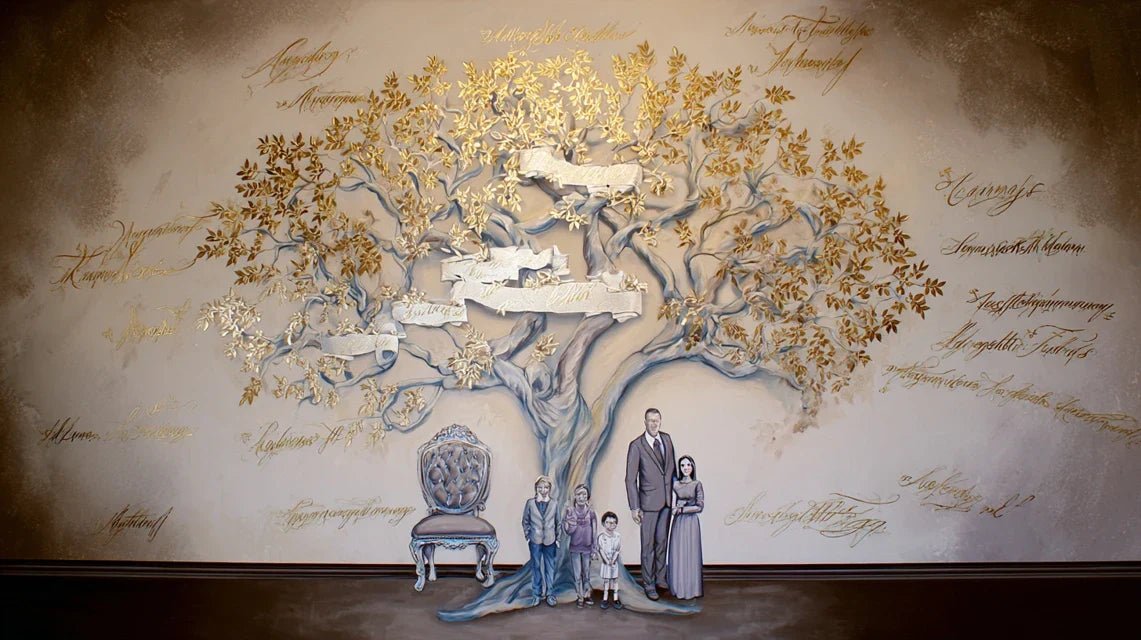
Family Tree Canvas: Your Family History in Wall Art
By Alexandre MARY
⏱️ Reading time: 8 minutes
You’re looking at your blank walls and feel that gnawing frustration: how to create a decoration that truly tells your story, makes sense, sparks conversation when your guests enter your living room?
That feeling of decorative emptiness haunts you. You’ve tried classic art reproductions, framed photos, even those trendy paintings found in stores. But nothing really resembles you, nothing reflects your deep identity and family heritage.
You've attempted family photo galleries on the wall, but the
This rule applies to accumulations of disparate objects, not to unified works of art. A well-designed family tree functions like an abstract painting: the eye first perceives visual harmony, then gradually discovers the details. It's the art of "organized complexity".
The golden rule of decorative storytelling: A well-crafted personal story becomes universally fascinating. Your family tree transformed into wall art will create spontaneous conversations and positively impact all your visitors from the first week of installation.
Do you recognize yourself in these situations?
Perhaps you hesitate when asked to talk about your origins, or that your children only vaguely know the history of their grandparents, or even that your walls lack that personal touch that would make your house a true family home.
What's really happening is that our era has accustomed us to instant and impersonal decorating. The problem isn't your family or your story - it's that you were never shown how to transform your roots into decorative art.
Think of your living room as an open book: currently, the pages are beautiful but empty of your story. A family tree is writing the first chapter of your family novel on your walls.
The first hidden cause: the myth of "neutral" decoration
Contrary to what you've been led to believe, neutral decoration isn't synonymous with elegance. In reality, the most memorable interiors tell a story. High-end designers know it: emotion trumps trend.
It's like choosing between a custom suit and off-the-rack clothing: even if both are beautiful, one resembles you and the other resembles everyone else.
This realization will revolutionize your approach to decorating: you'll no longer seek to copy magazines, but to express your identity. Your family tree will become the starting point of an authentically personal decoration.
🔍 Immediate test: Look at your living room right now and ask yourself: "Could a visitor guess who I really am by looking at this room?" If the answer is no, it means your decor lacks authentic personality.
The second hidden cause: fear of "too much"
Many think that displaying their genealogy is “doing too much”. In reality, it's the artistic execution that makes the difference between vulgar and refined. A well-designed family tree is as elegant as a contemporary work of art.
Imagine the difference between a photocopied restaurant menu and a calligraphed menu on beautiful paper: it's the same content, but the visual and emotional impact is incomparable.
Your family deserves this visual refinement. When your guests discover your artistic family tree, they won’t think “too much” but “touch of class”.
The third hidden cause: the illusion of complexity
You might think that creating an artistic family tree requires professional genealogy or graphic design skills. That's not true: you just need to know the right steps and have the right tools.
How to spot it? If you’ve been putting off this project for months, telling yourself "later, when I have time to do thorough research," then you're overestimating the complexity.
This illusion makes you procrastinate on a project that could be completed this weekend and would immediately transform the atmosphere of your interior.
3 signs that you’re ready to take the plunge:
You know at least 3 generations of your family: That's more than enough to create a strong visual impact - no need to go back to the crusades
You want deeper conversations at home: The family tree naturally generates authentic exchanges and moments of transmission
You’re looking for decor that will outlive you: Unlike fleeting trends, your family history is timeless and transmissible
The trigger: the "living legacy" effect
What really makes the difference is understanding that your family tree won’t just be decorative but generative. Like a catalyst, it will trigger conversations, awaken memories, and create new family bonds.
You'll recognize this by these signs: your children will start asking questions about the family, your guests will linger in your entrance hall, and you yourself will feel a peaceful pride each time you pass in front of your work.
The "decorative storytelling" rule: The more your decor tells your authentic story, the more magnetic it becomes to others. You can check this immediately by observing where visitors' eyes naturally go.
❌ Classic decor
✅ Artistic family tree
💡 Why it works
🎯 Immediate benefit
Scattered family photos
Unified and artistic history
Creates a strong visual coherence
Instant professional decor impact
Impersonal art reproduction
Unique work that resembles you
Generates emotion and conversation
Authentic connection with your guests
Temporary trendy decor
Timeless family heritage
Increasing emotional value
Sustainable decor investment
Walls that tell nothing
Support for family transmission
Activates memory and identity
Strengthening of family bonds
Your simple method to create your family masterpiece
Rassurez-vous, transforming your family tree into wall art isn't complex. It’s like arranging a bouquet: first you choose the right flowers (your family information), then arrange them harmoniously (the artistic layout), and finally present them in a beautiful setting (the high-end wall support).
The result? A unique work that impresses at first glance and reveals its subtleties over time.
🗺️ Your journey in 3 steps: First, you collect and organize your family information (satisfaction of rediscovering your history). Then, you design the artistic composition (creative pleasure of seeing your vision take shape). Finally, you create and install your artwork (pride in contemplating your finished creation).
Step 1: Laying the foundation for your story
Starting with this step is logical because it’s your raw material: without organized information, it's impossible to create a balanced composition. It's like drawing the foundations before building: invisible but essential.
Once this solid base is established, you will feel that deep satisfaction of seeing your heritage take shape and structure.
What you need to get started:
Family or family record book: Your official reference document containing exact dates and locations. Search through your important papers or request a copy from the town hall. Check that the information is legible - otherwise, prefer family testimonials to damaged documents because historical accuracy counts less than emotional impact.
Representative photos of each generation: One portrait photo per person is enough, even if it's old or black and white. The principle: each face tells a time and creates visual continuity. Avoid confusing group photos - prioritize individuality that allows for immediate identification.
Creative note-taking support: A large notebook or A3 sheets to sketch your tree visually. The large space releases creativity and allows you to visualize the whole thing. Small notebooks limit the overall view and stifle artistic inspiration.
Now, let's move on to practice with method
Building your family structure
Census of generations: First list yourself and your spouse, then your parents and in-laws, then your grandparents. This natural progression avoids omissions and creates a clear timeline. Note the first names, maiden names, and years of birth/death if known.
⏱️ Time: 30 minutes | ✅ Success when: You have at least 3 generations clearly identified with approximate dates | ⚠️ Attention: Don't get lost in the collateral branches at first - focus on the direct line to maintain visual clarity
Photo association: For each name on your list, try to associate a photo. If you don't have one, note "photo missing" and continue. The goal is to visualize your existing photographic heritage, not to have everything immediately.
⏱️ Time: 45 minutes | ✅ Success when: Each person has either a photo associated with them or a "to find" note | ⚠️ Attention: Don't get stuck on missing photos - a beautiful tree with 70% of the photos is more impactful than an abandoned project for 100% completeness
Visual organization sketch: On your large support, roughly draw your tree: you at the bottom, parents above, grandparents even higher. This primitive visualization reveals the balance or imbalance of your future composition.
⏱️ Time: 20 minutes | ✅ Success when: You clearly visualize the spatial distribution and family connections | ⚠️ Attention: Leave space between branches - a tree that is too tight becomes unreadable and loses its decorative impact
✅ Validation of your foundation: Your step 1 is successful when you can explain your tree in 2 minutes to someone, the structure is visually balanced on your sketch, and you feel excited about moving on to artistic creation. If you're still hesitating, that's normal - the important thing is to have an exploitable base, not a perfect one!
OUR RECOMMENDED PRODUCTS
Step 2: Designing your artistic composition
Now, you are moving from documentary to artistic. This step is more rewarding because you see your vision take shape aesthetically. This is where the magic happens: your story becomes art. The snowball effect begins: each aesthetic choice reinforces the overall impact of your work.
Your artistic design tools:
Simple creation software or creative paper: Canva, PowerPoint, or even quality sheets of paper with fine-tip markers. The tool is less important than your vision - some of the most beautiful family trees were born on a paper napkin! Avoid complex software that discourages spontaneous creativity.
Coherent color palette: Choose a maximum of 3 colors that harmonize with your existing interior decor. The principle: the tree should complement your decoration, not compete with it. A restricted palette creates more elegance than a family rainbow.
Unified graphic style: Decide if you want a vintage, modern, classic or artistic look. This stylistic consistency transforms a collection of information into a true wall artwork.
Create your family visual identity
Choosing an artistic style: Observe your interior and define the atmosphere: contemporary sleek, classic warm, or bohemian creative? Your tree should blend in naturally. A style consistent with your environment guarantees a harmonious and professional result.
⏱️ Time: 20 minutes | ✅ Success when: You can describe your style in 3 words and visualize it mentally | ⚠️ Attention: Avoid mixing too many different styles - elegant simplicity always surpasses confusing complexity
Composition and visual hierarchy: Place the most important elements (you, your children) in the most visible area, generally the lower center. Previous generations rise visually, creating a natural reading of your lineage. Test several layouts before validating.
⏱️ Time: 40 minutes | ✅ Success when: The eye naturally follows the family path without effort | ⚠️ Attention: A poor hierarchy makes the reading confusing - have someone else test your composition
Harmonious integration of photos: Uniformize your photos: same format, same treatment (black and white or color), same framing style. This consistency transforms a heterogeneous collection into a unified art gallery.
⏱️ Time: 35 minutes | ✅ Success when: All photos seem to belong to the same work | ⚠️ Attention: Don't keep a low-quality photo out of sentimentality - it would weaken the overall impact of your creation
🎨 Validation of your design: Your design is complete when someone can understand your family tree in less than 30 seconds, the whole is visually balanced, and you are proud to show your creation. The emotion you feel when looking at your composition is the best indicator of success!
Step 3: Creation and installation of your artwork
You are now reaching master level: transforming your design into a physical work of art. The difference between amateur and connoisseur lies here: choice of support, print quality, and professional installation. The final result you will be proud of? A centerpiece that dialogues with your interior architecture and impresses all your visitors.
High-end supports and finishes:
Canvas or aluminum dibond: Canvas brings warmth and tradition, aluminum offers modernity and durability. Avoid classic photo paper which looks "amateur". The quality of the support is immediately visible and determines the high-end perception of your work.
Secure mounting system: Wall fixings adapted to the weight and dimensions, spirit level for perfect alignment. A tilted or poorly fixed artwork spoils months of preparation. Invest in a professional hanging system to protect your work.
Optional accent lighting: A dedicated light transforms your tree into a true decorative attraction, especially in the evening. This creates a dramatic focal point that naturally attracts attention and enhances your creation.
Professional Finishing
Print file preparation: Check the resolution (minimum 300 DPI), the exact final dimensions, and safety margins. A poorly prepared file ruins the final rendering, even with the best support. This technical step determines the professional quality of your result.
⏱️ Time: 25 minutes | ✅ Success when: Your file meets your printer's specifications and displays clearly | ⚠️ Attention: Insufficient resolution cannot be corrected during printing - double-check rather than once
Choosing the optimal location: Test different walls with a cardboard cutout of your artwork's dimensions. The ideal location offers good visibility without creating visual clutter. Consider natural and artificial lighting, as well as traffic flow in the room.
⏱️ Time: 15 minutes | ✅ Success when: The location highlights your work without disrupting the harmony of the room | ⚠️ Attention: A poor location can make a beautiful artwork go unnoticed - take the time to make this decision
Installation and final staging: Hang your work with precision, then observe the overall effect in your room. Adjust lighting if necessary, and savor the moment of revelation when your vision becomes a tangible reality.
⏱️ Time: 30 minutes | ✅ Success when: Your artwork integrates perfectly and naturally attracts attention | ⚠️ Attention: Take the time for a critical step back - sometimes a slight adjustment makes all the difference
🏆 Consecration of your creation: Your project is perfectly accomplished when you feel a deep sense of pride contemplating your work, your loved ones are impressed by the result, and your family tree has naturally become a conversation starter in your home. Congratulations, you have created a lasting visual legacy!
The rule of progression for the accomplished creator: You can move on to the next step when you perfectly master the current step and want more sophistication. Ambition guides, but patience guarantees quality - better a beautiful simple tree than an unfinished complex project.
Congratulations! You now master the expert subtleties of wall-mounted genealogy art. This expertise distinguishes you from those who simply hang photos: you create true family works of art that cross generations and impress all who discover them.
🎯 Expert tip - The secret of accomplished creators: Discreetly add the creation date and your signature to the back or bottom of your artwork. In 20 years, this trace will become a valuable historical element for your descendants. This is how you transform your creation into a genuine authenticated family heritage.
💭 Frequent question from our readers
"I'm afraid of making mistakes with dates or names, and creating something false that will be seen by the whole family..."
This concern is very legitimate and shows your respect for family history. Rest assured: your painting represents your current state of knowledge, not an absolute truth carved in marble. The most beautiful family discoveries often come from these first "imperfect" trees that invite corrections and additions from the elders. Consider your creation as a catalyst for family memory rather than a definitive historical document.
✨ Serenity tip: Discreetly add the mention "Version 1.0 - [date]" at the bottom of your work with a smile. This defuses any criticism and invites future enrichments. You will discover that your "mistakes" become even more valuable opportunities for dialogue and transmission.
The pitfalls to avoid at all costs
Attention, some mistakes can turn your masterpiece into disappointment. I share these traps with you to avoid months of regrets and protect your emotional and financial investment in this very personal project.
⚠️ The "all or nothing" mistake: Wanting to absolutely include all family branches from the first version. It's tempting to be exhaustive, but the result becomes unreadable and discourages contemplation. Consequence: your work ends up in a closet instead of adorning your walls. Prioritize clarity and beauty - you can always create an extended version later.
📷 The "photographic mix" mistake: Mixing recent color photos, vintage black and white, and smartphone selfies without harmonization. Visual heterogeneity breaks the artistic unity and gives a "amateur collage" look. Uniformize the treatment of all your photos - same style, same format, same color ambiance.
💰 The "low-end support" trap: Saving on printing and the final support after weeks of meticulous preparation. A cheap support immediately betrays all your creative work and disappoints with every look. Your family history deserves a setting worthy of it - invest in the final quality.
📐 The "inadequate size" pitfall: Choosing dimensions that are too small for fear of being showy, or too large out of enthusiasm. A painting that is too small goes unnoticed, one that is too large overwhelms the room. Test with cardboard before printing - the location determines the ideal size, not your desires.
🎨 The drift of "too much style": Multiplying artistic effects, fonts, colors and decorations to "look better". The accumulation of effects creates visual confusion and impairs readability. The golden rule: elegance is born from restraint, not decorative abundance.
🛡️ Your quality control system: Before finalizing, show your project to 2-3 trusted people and ask them to describe what they see in 30 seconds. If they hesitate or are mistaken about family relationships, simplify. Watch out for these warning signs: visual fatigue when reading, need for explanation to understand, or a feeling that "it's too much" at first glance.
Because you took the time to inform yourself, enjoy 10% discount on your first order:
ART10
⏰ Valid 72h after reading • Applicable to all our products
FAQ: Your essential questions about wall genealogy art
⏰ How much time should you allow to create a professional quality family tree?
Allow 2 to 3 weekends for a satisfactory result: the first for gathering information and photos, the second for artistic design, and the third for finalization and installation. To optimize: prepare your family research during the week and reserve weekends for pure creation. Concrete example: Sophie created her 4-generation tree in 15 hours spread over 3 weeks, and the result proudly adorns her living room.
💰 What budget should you allow for a high-end family tree?
Between 150 and 400 euros depending on the dimensions and support chosen (canvas, aluminum, or plexiglass). This price includes assisted design, high quality printing, and professional hanging. Compared to the price of an original work of art with a similar decorative impact, it is a very worthwhile investment. Budget tip: start with an intermediate size (60x80cm) that you can always complement with a larger format later.
👨👩👧👦 How to handle blended families or complex family situations?
The beauty of modern genealogy art is its creative flexibility. Create several distinct "branches", use different color codes, or design multiple complementary artworks. The important thing is not conformity to a traditional model, but the authentic expression of YOUR family reality. Many of our customers have found in this approach an elegant way to celebrate the richness of their atypical family ties.
🏠 Where is the best place to position your family tree in the house?
The entrance or living room are the best locations: maximum visibility and impact on your guests. Avoid bedrooms (too intimate) or the kitchen (risk of humidity). Ideally: a wall facing the main entrance, at eye level, with indirect natural lighting. Test the location with a cardboard cutout to the correct dimensions before final installation.
🔧 Can I modify or enrich my artwork over the years?
Absolutely! It's even recommended. Keep your original source file and plan for expansion spaces from the initial design. Births, weddings, and new genealogical discoveries will naturally enrich your work. Some clients create a "version 2.0" every 5 years, transforming their artwork into a true evolving family chronicle. It's living genealogical art!
Your transformation: from spectator to creator of family heritage
In a few weeks, when your guests cross the threshold of your home, their eyes will be immediately captivated by this unique work of art that dominates your entrance. They will discover with fascination your family history highlighted, and you will feel that peaceful pride of one who has managed to transform their roots into visual heritage. Your children, for their part, will grow up knowing their origins, and your loved ones will congratulate you for this initiative that reveals your attachment to family values.
But beyond the decorative impact, you will have acquired a transferable creative skill: knowing how to transform personal content into visual art. This new creative confidence will accompany you in all your future decorating projects, and you will now look at your interior with the eye of a creator rather than a simple consumer of decoration.
The most beautiful thing about this approach? It was only a matter of method and self-confidence. Your first concrete action: this weekend, take out your family photos and notebook, and start by simply listing three generations. Your future self will thank you for having the courage to visually preserve this irreplaceable family heritage.
🌟 Your moment has arrived: You now have all the keys to create a family artwork that will mark future generations. Your story deserves this beauty, and you have the power to offer it to her. Start today, your visual heritage awaits you!
📚 Continue your creative inspiration
Discover our other guides on artistic personalization, high-end printing techniques, and the secrets of impactful wall decoration. Also explore our tips for creating coordinated series of artworks that will completely transform the atmosphere of your interior.