

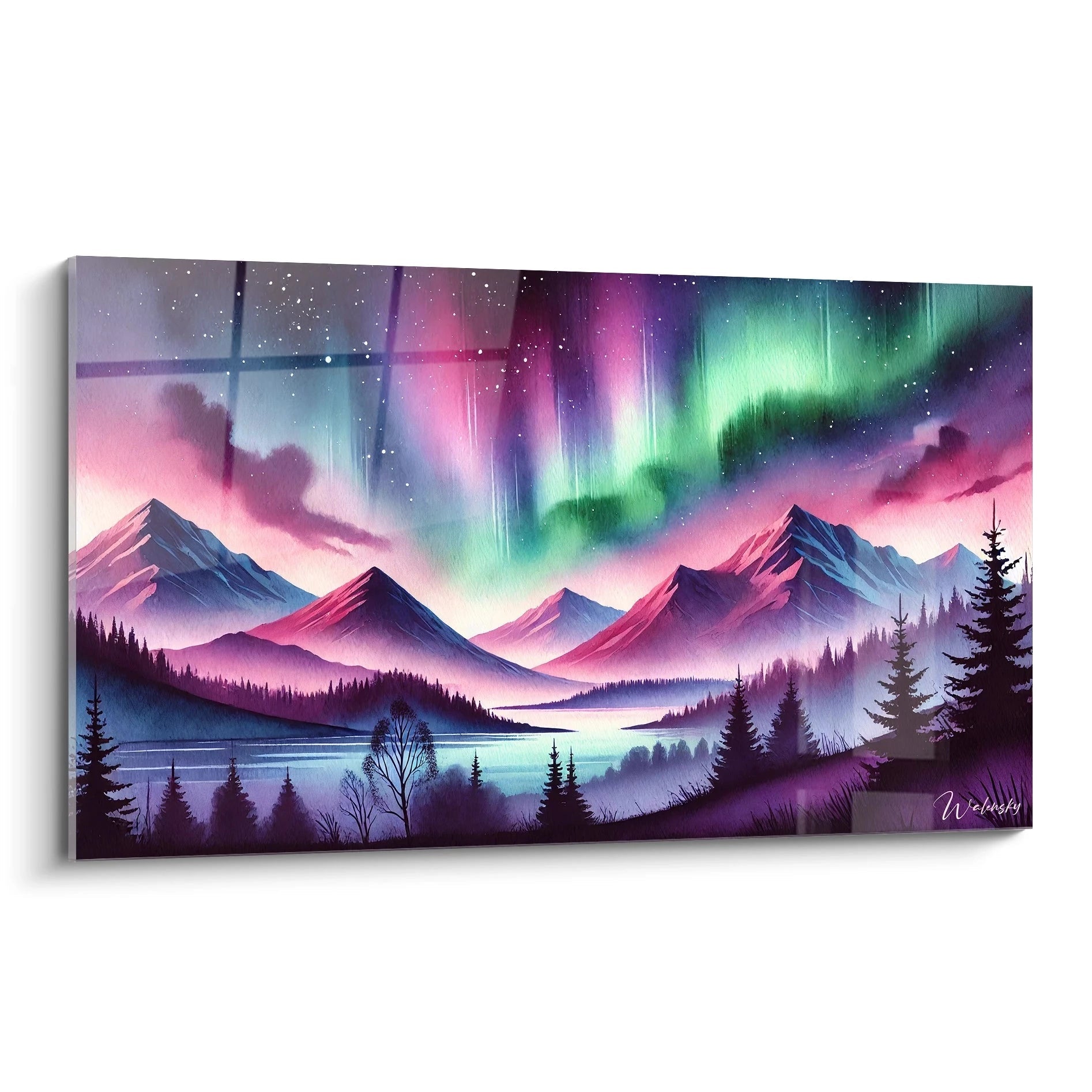






Why Do Abstract Wall Artworks Avoid Distractions in Professional Environments?
January 15, 2026 · 9 min read · by Walensky
In the open-space office on the fifth floor, I observe the same scene every day: gazes that wander, thoughts that escape, colleagues who stare at the white wall facing their desks as if it contained the answers to all their questions. Then, in some spaces that I have had the opportunity to transform, an abstract artwork changes everything. Eyes linger for a few seconds, the brain breathes, and concentration returns naturally.
Here's what an abstract wall art brings to your professional environment: cognitive stimulation without narrative overload, a visual breath that facilitates concentration, and a spatial anchor that mentally structures the workspace. Unlike figurative works or photographs loaded with details, abstraction offers this rare freedom: it exists without telling a story, without imposing an interpretation.
You probably already feel it: this mental fatigue that settles in these too neutral offices or, conversely, these spaces overloaded with visual information where every poster, every image, every message solicits your attention. Your brain navigates between the boredom of emptiness and the exhaustion of excess.
Rest assured: there is a balance, a point of harmony that I have discovered through my interventions in law firms, creative agencies, and coworking spaces. Abstract artworks occupy precisely this intermediate space, this zone of cognitive comfort.
In the lines that follow, I reveal to you why abstract art has become the silent ally of productivity, and how it subtly but profoundly transforms your relationship with the workspace.
When the brain gets tired of meaning: the cognitive load of narrative images
Let me tell you about the experience of a consulting firm where I intervened last year. The walls were covered in magnificent urban photographs: Paris in the rain, Tokyo at night, New York at dawn. Aesthetically impeccable. But employees complained of difficulty maintaining their attention during long meetings.
The problem? Each image told a story. Every photograph invited a mental journey. Our brain is programmed to seek meaning: in front of a figurative scene, it automatically activates its narrative areas, reconstructs a context, imagines a before and after. This process, as involuntary as exhausting, consumes valuable cognitive energy.
Abstract wall artworks short-circuit this mechanism. A composition of geometric shapes, a gradient of colors, lines that cross: your brain receives visual stimulation without being drawn into a narrative. It can rest while staying awake, like during a visual meditation.
In this professional space, I replaced three urban photographs with abstract works in muted tones: ochres, bluish grays, organic shapes. Within two weeks, the director called me back: meetings were more fluid, moments of reflection more comfortable. No one was looking elsewhere anymore.
Visual breathing: how abstraction structures attention
Imagine your gaze as a long-distance runner. It needs resting points, moments where it can settle without stopping completely. Abstract artworks offer exactly that: visual breathing stations.
Unlike an empty wall which creates frustrating absence, or a detailed image that captures attention for too long, an abstract artwork allows what ergonomists call an "active pause." Your gaze rests, your mind relaxes for a few seconds without drifting off into reverie, then your concentration naturally returns to your task.
I observed this phenomenon in a coworking space where freelancers sometimes worked ten hours a day. Before the installation of abstract wall art, many checked their phones every fifteen minutes, subconsciously seeking that visual break. After? Their gaze found refuge in the curves of an abstract composition for a few seconds, enough to reset their attention without breaking their workflow.
Optimal visual rhythm
Neuroscience confirms it: our attention works in cycles of 90 to 120 minutes, interspersed with natural micro-breaks. Abstract artworks accompany these micro-pauses without turning them into distractions. They create a visual rhythm in the space that respects your concentration's biological pace.

The absence of details: the anti-distraction secret
Have you ever worked facing a world map? Facing a reproduction of The Raft of the Medusa? Your gaze gets lost in the continents, follows the lines of currents, or counts the characters, identifies expressions. Each detail is an anchor point, an invitation to visual exploration.
Abstract wall art eliminates this temptation by its very nature. No details to decode, no figurative elements that solicit your memory or knowledge. A quality abstract composition offers a simple complexity: rich enough to interest the eye, clean enough not to hold it back.
In an architect’s office where I was involved, this difference was spectacular. Their previous decoration included historical plans of Paris, beautiful but terribly distracting. Collaborators would regularly stop to look for their street, their neighborhood, discuss urban transformations. After the installation of abstract paintings with architectural lines, the space remained visually stimulating, but these spontaneous conversations - friendly but time-consuming - naturally decreased.
The three-second rule
An abstract painting effective in a professional environment respects what I call the three-second rule: your gaze can rest on it for a maximum of three seconds before returning naturally to your work. No more, no less. This is the ideal time for a micro cognitive break without switching to distraction.
— Our selection


Abstract colors: soothe without putting to sleep
Color is a silent language that speaks directly to our nervous system. In my interventions in a professional environment, I learned that the chromatic choice of an abstract painting directly influences the concentration quality of a team.
Abstract compositions allow for sophisticated use of color, freed from the constraints of realism. You can choose an abstract wall painting with cool tones for a space where analytical concentration is paramount: deep blues, pearl grays, aquamarine greens. These shades activate the brain areas associated with calm and reflection without inducing drowsiness.
Conversely, for a creative space where you want to stimulate innovation, abstractions with touches of mustard yellow, terracotta or olive green bring a gentle energy. Unlike bright colors applied uniformly on a wall, which create constant and exhausting stimulation, these colored touches in an abstract composition offer intermittent stimulation.
In a digital communication agency, I installed three abstract paintings of different sizes: one dominated by blues for the strategic meeting room, another with warm ochres for the brainstorming space, and a third with neutral shades for the open space. Each space found its chromatic balance, and the team spontaneously adapted their uses to these visual atmospheres.

— You may also like


Spatial anchoring without visual noise
An effective professional environment should offer clear spatial landmarks without creating visual pollution. This is precisely the paradox that abstract wall art resolves with elegance.
Each abstract work becomes a visual anchor point that mentally structures space. You instinctively know that the area near the painting with geometric shapes is the concentration zone, that the wall adorned with the flowing composition marks the break area. These landmarks function at a subliminal level, without requiring conscious interpretation.
I experienced this approach in a 400 m² platform designed to accommodate around fifty employees. Without fixed partitions, the space risked becoming confusing and anxiety-inducing. The installation of six abstract paintings with consistent but distinct styles created an immediate visual map: everyone could orient themselves without signage, identify zones without panels, understand the function of spaces without explanations.
Productive visual silence
Abstraction creates what I call productive visual silence: a discreet presence that structures without invading, that marks without shouting. In a professional world saturated with information, notifications, and constant solicitations, this silence becomes a cognitive luxury.
Ready to transform your workspace into a sanctuary of concentration?
Discover our exclusive collection of wall art for coworking that combines contemporary aesthetics and cognitive ergonomics for professional spaces where productivity rhymes with serenity.

Your space, your concentration, your performance
Imagine your next Monday morning. You enter your office or coworking space. Your gaze rests for a few seconds on this abstract composition with soothing tones. Your brain breathes. Your attention focuses. The day begins with that mental clarity you were seeking.
Abstract wall art is not just decorative elements. They are discreet cognitive tools, silent allies of your professional performance. By eliminating narrative distractions, offering regenerating visual breaks, and structuring space without saturating it, they create that ideal professional environment where your mind can focus fully.
Start with a single abstract artwork facing your main workstation. Observe how your relationship to the space transforms. How your attention more easily finds its rhythm. How these few square meters become your territory of concentration.
Abstract art doesn't need to be understood. It simply asks to be present, like a discreet companion during your most productive hours.
FAQ : Your questions about abstract artworks in a professional environment
What size of abstract artwork should I choose for an individual office?
For an individual office, prioritize a format between 60x80 cm and 80x120 cm. This dimension offers sufficient visual presence to create an anchor point without dominating the space. Place your abstract artwork in your peripheral vision rather than directly facing you: at a 45-degree angle from your screen, on the side wall. Thus, your gaze can naturally rest on it during micro-breaks without diverting you from your main work. If your office is less than 10 m², opt for a maximum size of 50x70 cm to avoid a feeling of oppression. The goal is to bring visual breathing space, not to create a new focal point that would compete with your screen. For coworking spaces or open spaces, you can increase the dimensions up to 120x150 cm, because the viewing distance is generally greater.
Are colorful abstract artworks likely to distract as much as figurative images?
Excellent question that reveals an important nuance: it's not the color itself that distracts, but the density of information to decode. An abstract painting with bright colors but simple shapes is less distracting than a black and white photograph loaded with narrative details. The brain processes color more intuitively and emotionally than figurative elements that activate our recognition and memory areas. For an optimal professional environment, however, I recommend favoring sophisticated palettes over saturated primary colors: deep blues rather than electric blue, ochres rather than bright orange, sage greens rather than apple green. These nuances offer the necessary visual stimulation without creating cognitive overstimulation. Simply test: if after two minutes of looking, your eye continues to explore the work, it is probably too stimulating for a concentration space.
Can we really measure the impact of an abstract painting on productivity?
Measuring the direct impact remains complex as many factors influence productivity, but several indicators can guide you. First observe the frequency of your micro-distractions: if you check your phone or get up less often, it is a sign that your space offers the visual breaks you needed. Also note the duration of your concentration sessions: can you maintain your attention for 45 minutes without conscious effort? Finally, in a collective setting, the most revealing indicator is the reduction in verbal solicitations between colleagues. When a professional environment is visually balanced thanks to well-chosen abstract paintings, collaborators spontaneously interrupt their colleagues less because their brain finds the necessary micro-breaks autonomously. Several studies in cognitive ergonomics show that the presence of non-narrative visual elements in workplaces reduces cognitive stress by 15 to 20%. Start with a three-week test period: this is the time it takes for your brain to integrate the new visual environment.
</divExplore our collections


