1952. In the new Manhattan skyscrapers, a human resources director makes a disturbing discovery: his employees are avoiding certain workspaces. Not because of the lighting or furniture, but because the immaculate white walls provoke diffuse anxiety. It is by hanging a simple lithograph in a meeting room that he observes an astonishing phenomenon: conversations become more fluid, tensions ease. Unknowingly, he has just inaugurated a silent revolution in the design of shared offices.
The history of the first wall art in 20th-century offices tells much more than a decorative evolution: it reveals a radical transformation of our relationship to work, to shared space and to the humanity of productive places. These works have gradually transformed sterile work environments into spaces where the soul could breathe, where creativity found its visual fuel, where collective identity took shape.
You might think that paintings in offices are just an aesthetic detail, a superficial concession to employee well-being. Yet their appearance marks a major anthropological turning point: the moment when companies realized that the visual environment directly influenced productivity, engagement and even mental health of workers.
This little-known story deserves to be told, as it sheds light on our current choices in designing coworking spaces and modern offices. Let's discover together how these first wall murals shaped the visual codes of collective work that we know today.
Offices before paintings: the era of visual taylorism
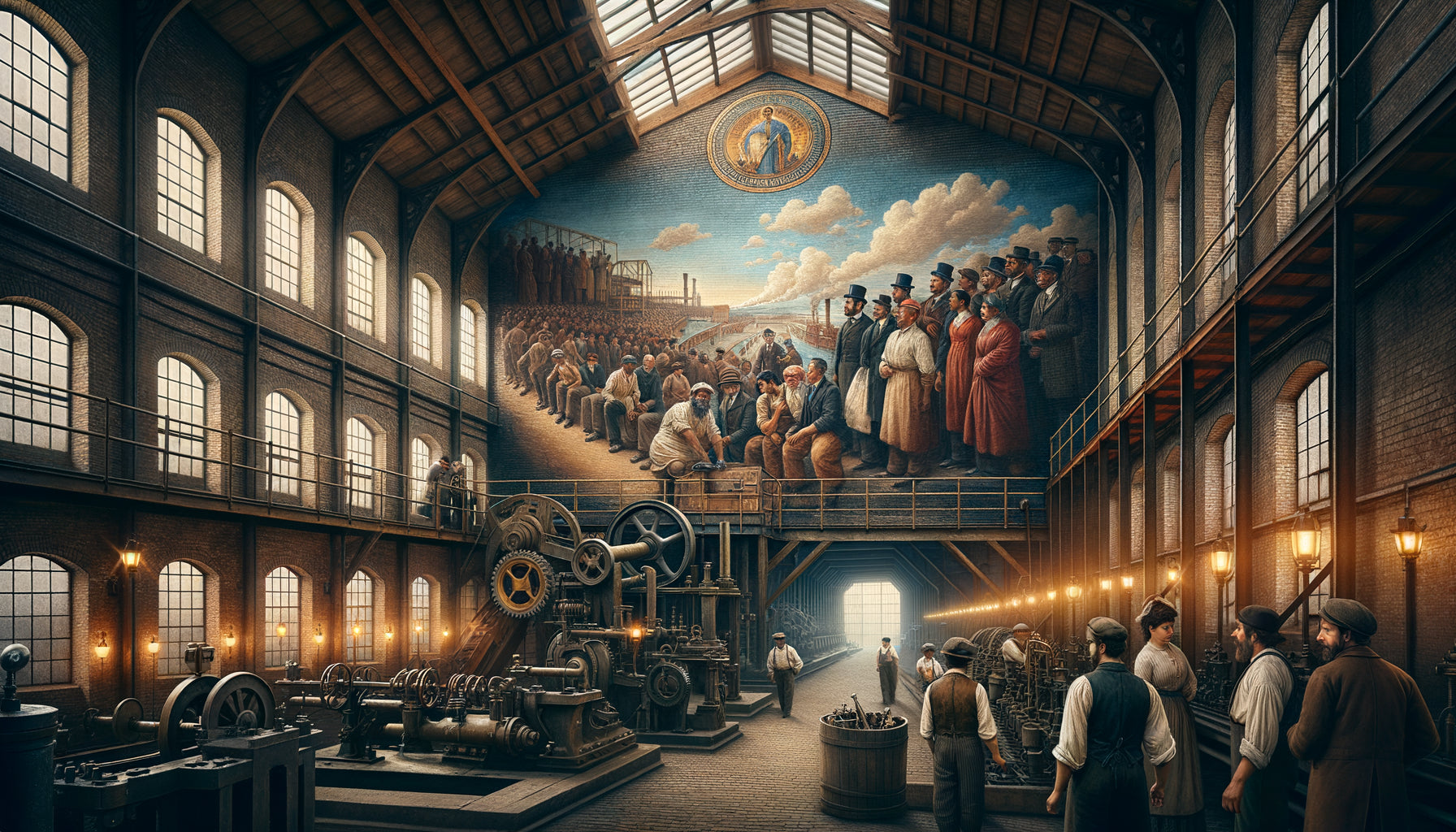
To understand the revolution represented by the first wall paintings, it is first necessary to visualize shared offices at the beginning of the 20th century. Between 1900 and 1940, Frederick Taylor's scientific organization of work dominated: office spaces resembled administrative factories. Rows of identical desks, bare walls painted beige or institutional green, no visual distractions tolerated.
This austerity is not accidental. It reflects a managerial philosophy: the employee must remain focused on his task, without his gaze wandering. The few wall elements are limited to clocks, regulatory display boards and, sometimes, a portrait of the company founder. The very idea that an image could improve work seems absurd to managers of the time.
Testimonials from the era are revealing. In large New York insurance companies or London administrations, employees describe a feeling of oppression, visual fatigue that adds to mental fatigue. White or gray walls create a dehumanizing environment where time seems suspended.
1945-1955: industrial psychology discovers the power of images
Everything shifts after World War II. Industrial psychologists, mobilized during the conflict to optimize soldiers' performance, apply their discoveries to the world of work. Their research reveals a disturbing truth: the visual environment directly affects cognition, mood and collaboration.
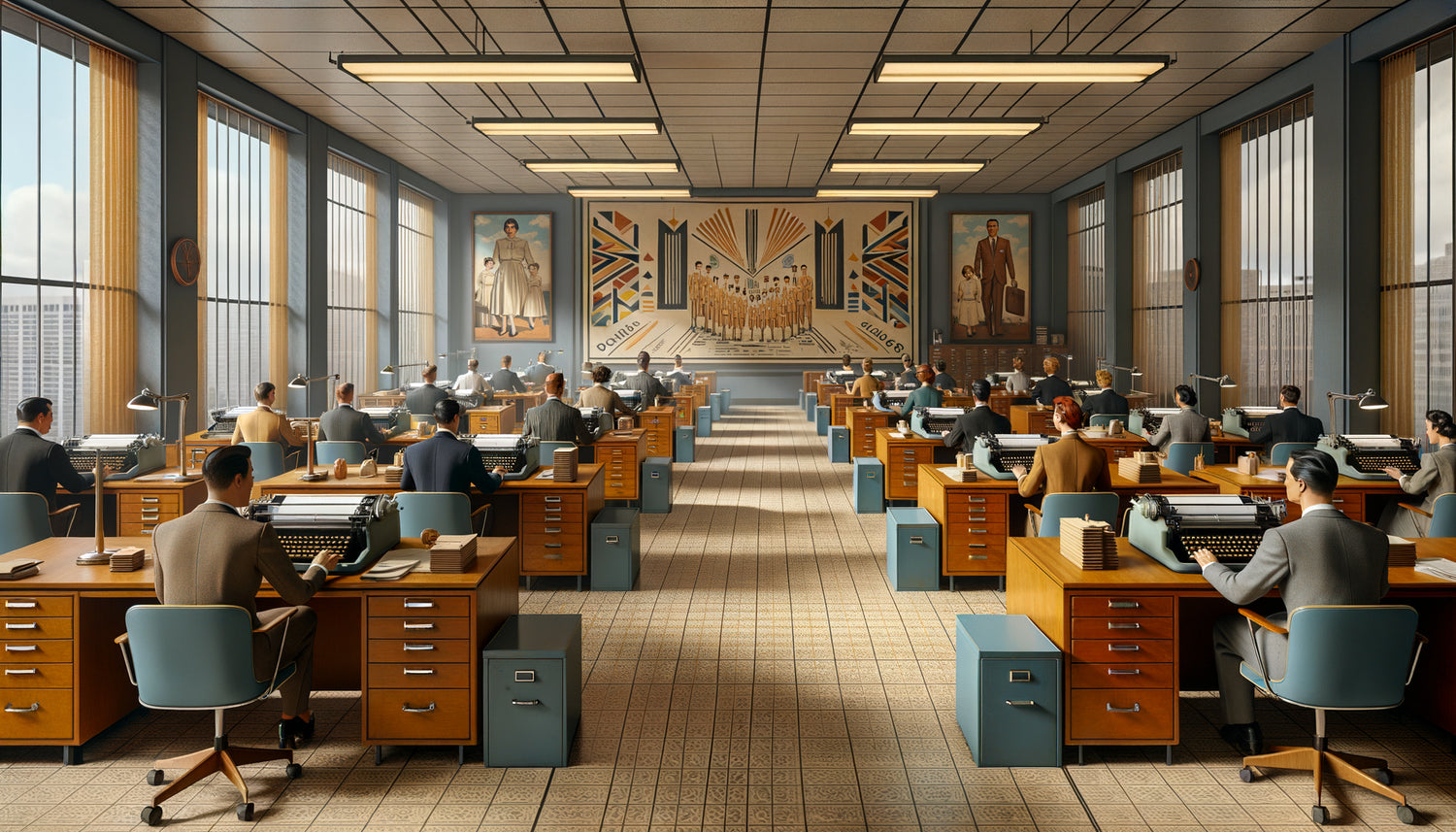
It is in this context that the first wall art appear in shared offices. Initially, these are cautious experiments: reproductions of soothing landscapes in break rooms, geometric abstractions in hallways. Pioneer companies like IBM or Pan Am test these arrangements with a quasi-scientific approach.
The results exceed expectations. Employees report improved well-being, reduced stress, and above all, better identification with their company. The wall art becomes a marker of collective identity: it signals that the company cares about creating a human environment, not just a productive one.
A fascinating fact: the first wall art in shared offices are often abstract works. Why? Because they avoid religious, political or cultural controversies. A Mondrian composition or an Impressionist landscape offers a neutral ground, acceptable to all, while providing the necessary visual stimulation.

The 1960s: when art becomes a corporate strategy
In the 1960s, the integration of wall art into shared offices experienced spectacular acceleration. The movement was led by a new generation of managers, influenced by ideas of intrinsic motivation and fulfillment at work. Wall art are no longer accessories, but strategic tools for interior design.
California technology companies, precursors to Silicon Valley, massively adopt this approach. Their shared offices fill with colorful works, often created by local artists. This approach meets several objectives: attract creative talents, stimulate innovation, and project a modern and progressive image.
An emblematic case: in 1964, Container Corporation of America launched a systematic program to acquire artworks for its offices. The company invests in original paintings by contemporary artists, transforming its workspaces into informal galleries. The impact is immediate: visitors comment on the creative atmosphere, employees develop a sense of pride.
This period also sees the emergence of consultants specializing in art for businesses. They advise management on choosing artworks, based on company culture, business activities, and even the lighting of spaces. The wall painting becomes a thoughtful element of interior architecture.
The evolution of styles: from reassuring realism to stimulating abstraction
The history of early wall paintings in shared offices reveals a fascinating evolution of tastes and visual strategies. In the 1950s, companies favored reassuring realism: bucolic landscapes, soothing still lifes, pastoral scenes. These choices reflect a desire to compensate for the rigidity of work with evocations of nature and serenity.
The 1960s-1970s mark a turning point towards abstraction. Geometric paintings, colorful compositions, and kinetic works invade the offices of creative and technology sectors. This evolution is not just aesthetic: it reflects a new conception of intellectual work, which values lateral thinking, creativity, and innovation.
At the same time, some companies adopt a more narrative approach. They commission wall paintings illustrating their history, values or vision. These works function as visual manifestos, constant reminders of collective identity. In banks and financial institutions, you will find works evoking stability and trust: classical architectures, symmetrical compositions, subdued palettes.
The dimensions of the paintings also evolve. The first works are modest, almost shy. Gradually, they gain presence: imposing formats that structure space, create visual landmarks, transform anonymous offices into memorable places.

The legacy of the pioneers: what these first paintings bequeathed to us
Today, when we enter a coworking space or a modern office and discover artworks on the walls, we are heirs to this story that began seven decades ago. The first wall paintings in shared offices of the 20th century established codes that we still follow, often without realizing it.
They taught us that art at work is not a superfluous luxury, but a psychological necessity. That images influence our emotions, our interactions, our creativity. That the visual environment shapes our daily experience of work as surely as the ergonomics of chairs or the quality of lighting.
These pioneers also demonstrated that the choice of wall art reflects and reinforces corporate culture. A tech startup doesn't hang the same artworks as a law firm, and this visual differentiation is not insignificant: it communicates values, attracts certain profiles, and creates a distinctive atmosphere.
The most valuable legacy from this story? The recognition that shared workspaces must nourish the soul as much as productivity. That we spend too much time in the office to accept visually sterile environments. That beauty, in all its forms, has a place in the places where we create, collaborate and build our professional lives.
Three inspiring lessons for our current workspaces
What can these early wall art pieces teach us about designing our contemporary offices and coworking spaces? Three principles emerge from this story, as relevant today as they were in the 1950s.
First lesson: emotional consistency. Pioneering companies didn't choose their artworks randomly. They thought about the emotion they wanted to create in each space. Area for concentration? Soothing works with cool tones. Brainstorming room? Dynamic and colorful compositions. This intentionality transforms a wall art piece from a simple decorative element into an emotional design tool.
Second lesson: art as conversation. The first wall art pieces in shared offices created talking points, informal moments of exchange in front of an intriguing work. They fostered spontaneous interactions, those hallway conversations that often generate the best ideas. A well-chosen artwork becomes a social catalyst.
Third lesson: constant evolution. Visionary companies didn't consider their artworks as permanent installations. They renewed them, rotated them between departments, organized temporary exhibitions. This dynamism maintained the visual freshness of the environment and signaled that the company itself was in constant motion.
Create your own visual legacy
Discover our exclusive collection of coworking art that will transform your workspace into a place of daily inspiration, in the footsteps of the pioneers who revolutionized shared offices.
Conclusion: the walls that watch us work
The history of the first wall art in shared office spaces during the 20th century is not just a design history anecdote. It's the story of a realization: our work environments shape who we are and what we create.
These pioneers who, in the 1950s, dared to hang a first piece of art in a stark meeting room opened a path that we continue to explore. They bequeathed us an essential question: what story do we want our walls to tell?
The next time you enter your office or coworking space, look at the walls. If they are empty, imagine the untapped potential. If they display artwork, take a moment to truly observe them. These wall art pieces carry the legacy of decades of reflection on human work, collective creativity, and the search for environments that elevate us.
Your workspace deserves this attention. Because the walls around us for eight hours a day should never be neutral: they should inspire us, bring us together, remind us why we create together.
FAQ : Your questions about wall art in shared workspaces
Why did companies start installing wall art in shared offices?
The turning point came after World War II, when industrial psychologists scientifically demonstrated the impact of the visual environment on employee well-being and productivity. The first wall art was installed as experiments, initially in break rooms, then gradually throughout all workspaces. The results exceeded expectations: reduced stress, improved identification with the company, stimulation of creativity. These discoveries transformed a simple aesthetic intuition into a recognized space planning strategy. Pioneering companies like IBM found that investing in wall art generated a measurable return in terms of employee engagement and brand image. Today, this practice has become standard, but it finds its roots in these bold experiments of the 1950s.
What type of wall art was preferred in the early shared offices?
The evolution of styles reflects a gradual transformation in work culture. **In the 1950s, companies mainly chose realistic landscapes and still lifes**, perceived as soothing and consensual. These works compensated for the rigidity of work with evocations of nature and serenity. The 1960s marked a turning point towards geometric abstraction and colorful compositions, particularly in technological and creative sectors. This change was not just aesthetic: it translated a new conception of intellectual work, valuing innovation and lateral thinking. More traditional institutions, such as banks, preferred works evoking stability: classical architectures, symmetrical compositions, subdued palettes. The choice of wall art thus directly reflected the identity and values of each organization, a practice that continues today in our coworking spaces and modern offices.
How to choose wall art for a modern collaborative workspace?
The history of the first paintings in offices teaches us three fundamental principles that remain relevant. **First, adapt the choice to the function of the space**: soothing works in concentration areas, dynamic compositions in brainstorming spaces. The pioneers of the 1960s had already understood this emotional coherence. Secondly, prioritize works that generate conversations and create informal meeting points, thus fostering spontaneous interactions that nourish collective creativity. Thirdly, do not hesitate to evolve your selection. Visionary companies regularly renewed their wall art, maintaining the visual freshness of the environment. For a contemporary coworking space, also consider the diversity of profiles who coexist: works universal enough to appeal to everyone, while being distinctive enough to create a memorable identity. The ideal wall art balances personal aesthetics and collective ambiance strategy.