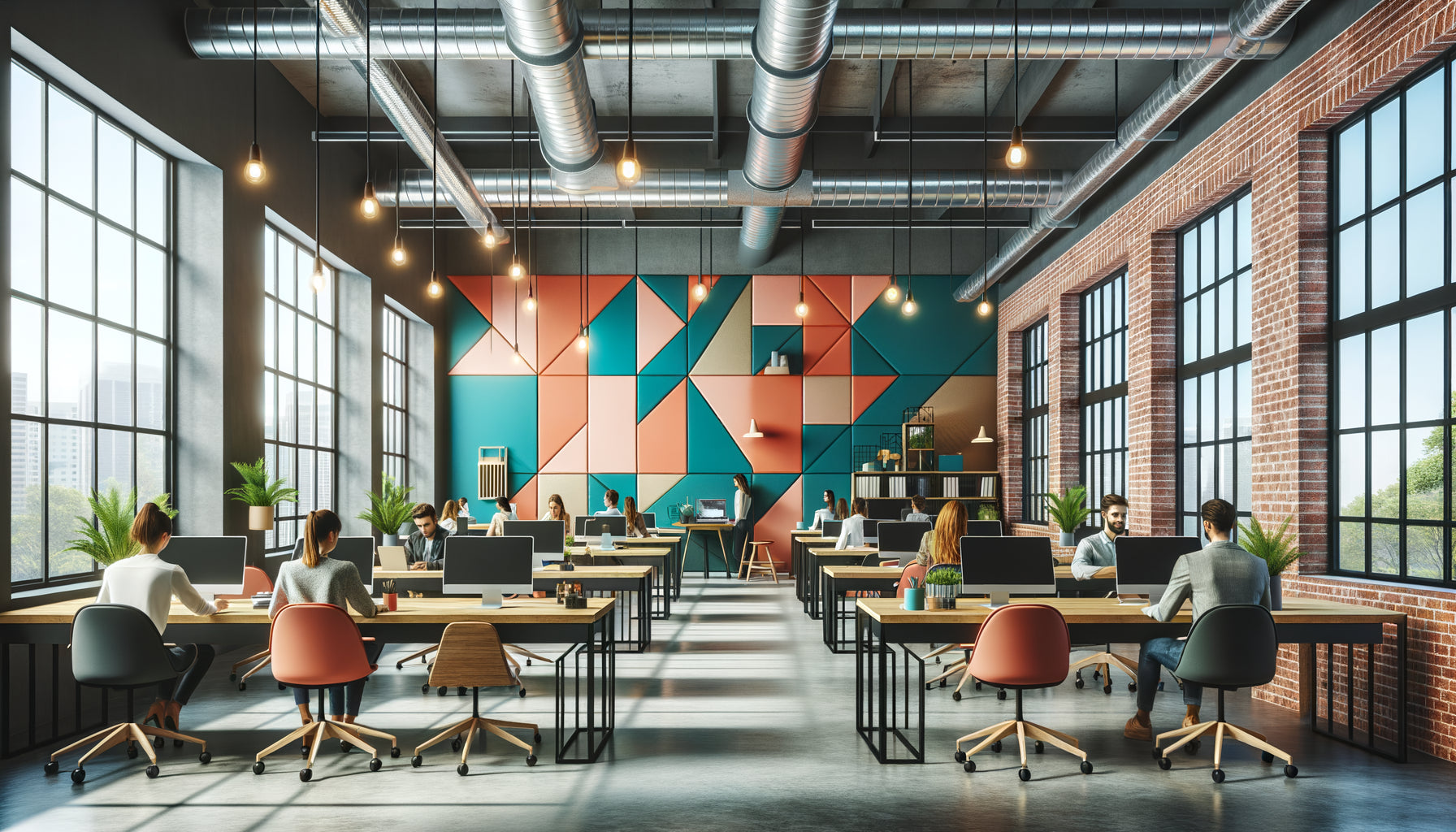
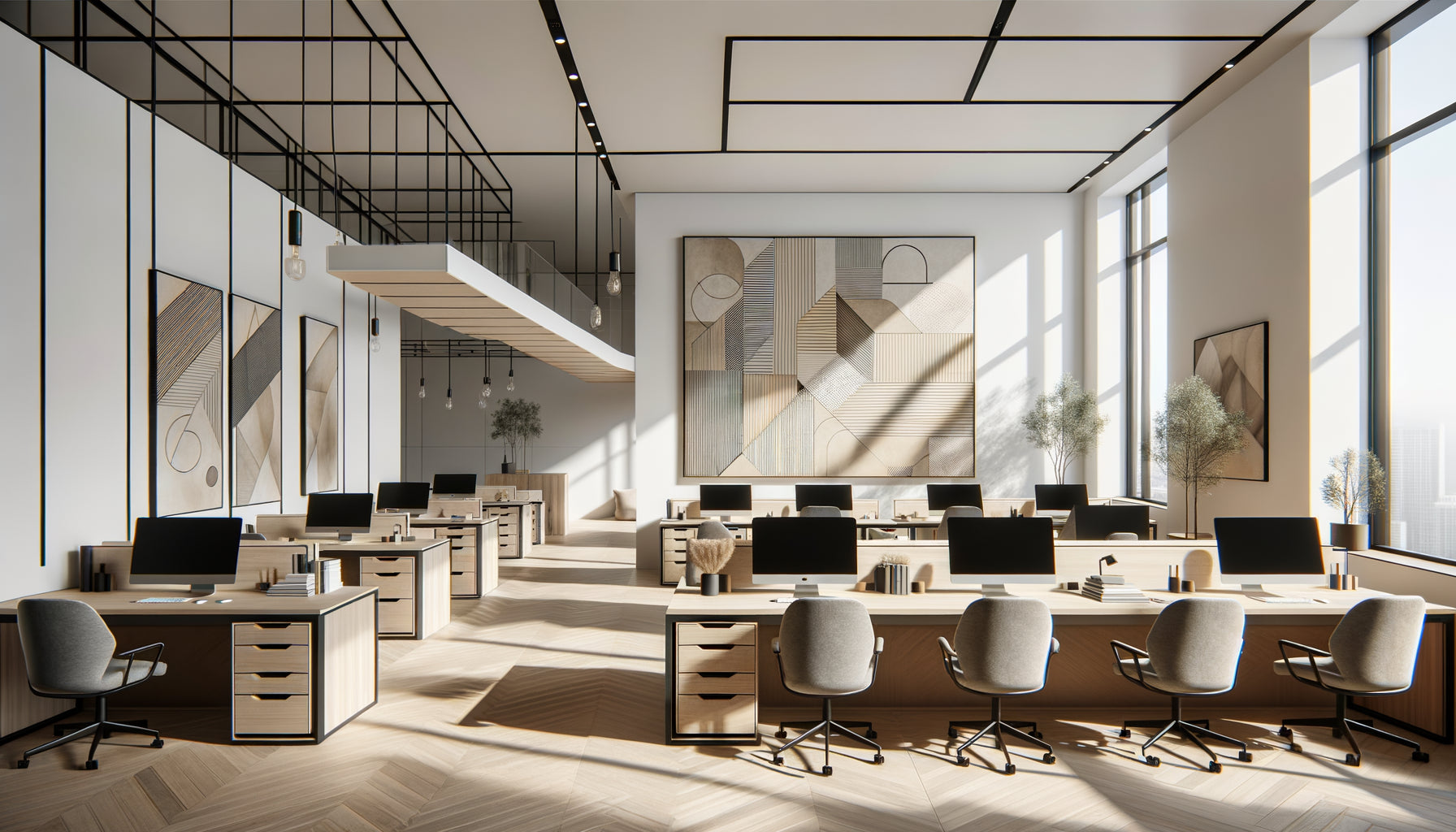
Last week, while visiting a new coworking space in the Marais district, I observed a revealing scene: two freelancers were discussing in front of the reception wall. One admired a large abstract canvas with coral tones, the other was scribbling notes on a magnetic whiteboard right next to it. Two wall artworks, two universes, two radically different intentions.
Here's what the distinction between decorative wall art and functional wall art brings to your coworking space: a clarification of spatial intentions, optimization of zones according to usage, and a consistent user experience that combines aesthetics and productivity. This difference is not just a matter of vocabulary; it defines the very soul of your place.
Many shared workspace managers invest heavily in wall decor without asking the essential question: should this artwork inspire or serve? Embellish or facilitate? This confusion generates visually saturated spaces where no one feels truly productive, or conversely, cold offices where inspiration evaporates.
Rest assured: understanding this distinction radically transforms your approach. Once you grasp the precise role of each type of wall art, you create zones that breathe, naturally support collaborative work, and paradoxically become more beautiful because they are more coherent.
I invite you on a journey through these two complementary universes, so you can compose the coworking space that truly makes a difference.
Decorative wall art: the visual soul of your coworking
The decorative wall art is that artwork you choose for its emotional impact. In a coworking space, it serves no immediate practical function: you cannot write on it or hang documents from it. Its mission? To create an atmosphere, affirm an identity, offer a point of contemplation.
I accompanied the design of a coworking space in Lyon where we installed a series of large-format black and white photographs in the lounge area. These decorative wall artworks depicted urban scenes of the city. Their presence instantly transformed the space: members took their coffee breaks there, naturally drawn to these images. Decorative artwork anchors the identity of the place.
In a coworking space, decorative wall art is strategically positioned in transition and relaxation areas: reception, hallways, cafes, reading corners. It dialogues with the architecture, softening or energizing as needed. Contrary to what one might think, it's not a superfluous luxury: it humanizes the professional space, breaks up the monotony, and becomes a conversation starter among members.
Characteristics of decorative wall art
The decorative wall art in a coworking space is recognizable by several distinctive features. Its surface is definitive: whether it's a painted canvas, an aluminum print, a framed photograph, or a textile composition, what you see is fixed. Its visual message does not change daily.
Its location responds to a logic of visual balance and ambiance. You position it facing a sofa to create a focal point, above a console in the entrance to impress upon arrival, or along a hallway to guide the eye. The decorative wall art doesn't need to be accessible: it can be installed high up, in a corner, without consideration for immediate practicality.
Finally, its aesthetic choice reflects the values of the coworking space. A space focused on technological innovation will opt for abstract and geometric wall art. A creative coworking space will favor colorful and bold works. A wellness venue will choose natural and soothing visuals. The decorative artwork is a silent manifesto.
The functional wall panel: the productivity tool
Let's change registers now. The functional wall panel exists only to be used. In a coworking space, it’s the tool that materializes collaboration: magnetic whiteboard, erasable glass surface, cork board, post-it wall, chalkboard.
Its beauty lies in its utility. I recently worked with a coworking space in Bordeaux where we transformed an entire wall of the meeting room into a functional panel: a white magnetic surface on which teams could project, write, organize. This functional wall panel became the heart of the place. Every day, new ideas are born there, erased, reborn.
The functional panel is always positioned in active work areas: meeting rooms, brainstorming spaces, project alcoves, co-creation zones. Its location is never arbitrary: it must be accessible at a comfortable writing height, large enough to accommodate multiple people simultaneously, and visible from the workstations.
What truly defines the functional wall panel
The first characteristic of the functional panel is its permanent evolutivity. Unlike decorative wall art which remains immutable, the functional panel changes constantly. Its content is ephemeral by nature: a diagram in the morning becomes a schedule in the afternoon, then a conceptual scheme the next day.
Its positioning responds to a strict ergonomic logic. The functional wall panel in a coworking space must be installed at a comfortable use height (generally between 80 cm and 180 cm from the floor), in a sufficiently lit area, with a distance allowing viewing of the whole. It also requires storage for accessories: markers, magnets, eraser, thumbtacks.
Ultimately, a functional artwork creates collaborative dynamism. It is never intended for isolated individual use. Its size, orientation, and spatial integration encourage teamwork. In a coworking space, it's the element that transforms independent workers into a creative community.

When the boundary blurs: captivating hybrids
The reality of contemporary coworking spaces has given rise to a fascinating third category: the hybrid wall art. I have been observing this trend for about two years now: solutions that combine the aesthetics of a decorative painting with the functionality of a utility board.
Imagine a large black chalkboard framed in a magnificent baroque gold frame. Visually, it's a sophisticated decorative object. Functionally, you can write on it with chalk. Or those magnetic boards printed with inspiring visuals onto which you can still hang documents. These hybrid wall artworks intelligently blur the boundaries.
In a coworking space in Nantes, we installed a series of dyed cork panels in terracotta and sage tones, arranged in a geometric composition. From afar, it's a decorative mural artwork. Up close, it's a functional board where everyone can pin inspirations and documents. This double reading considerably enriches the spatial experience.
Hybrid artworks find their ideal place in intermediate zones: flex workspaces that are neither totally relaxation nor totally productive, semi-private nooks, high-traffic areas. They allow for flexible use while maintaining a strong aesthetic consistency.
How to choose the right wall art for each zone
The key to a harmonious coworking space lies in the intentional mapping of your wall artworks. Each zone has a purpose, and each artwork should support it. This clarity of intention eliminates visual confusion and reinforces usage effectiveness.
For the reception and welcome area, always prioritize the decorative wall art. It's the first contact with your identity. A large impactful piece, a harmonious series, a local artwork that tells your territorial roots. Here, no practical function is necessary: you create the impression, the emotion, the memorability.
In meeting rooms and brainstorming spaces, a functional wall chart becomes essential. Opt for generous surfaces: a large magnetic whiteboard, a complete glass wipeable panel. Don't be afraid of size: it’s better to have a large chart used halfway than a small saturated and frustrating one.
For flex work areas and open spaces, adopt a mixed approach. Decorative charts creating ambiance on peripheral walls. Small individual functional charts or mobile solutions offer the possibility of quickly noting an idea. The balance between visual inspiration and practical tool makes all the difference.
Common mistakes to absolutely avoid
The most common mistake I observe? Installing decorative charts in areas that require functionality. You then create frustration: members are looking for a place to outline their project, they are surrounded by beautiful unusable works. The opposite is just as problematic: functional charts everywhere create an atmosphere of school or corporate office that kills inspiration.
Another classic trap: choosing wall charts without considering the scale. A small decorative chart lost on a large empty wall seems sad and cheap. An enormous functional chart in a small workspace becomes oppressive. Proportion is fundamental.
Finally, neglecting chromatic and stylistic consistency between decorative charts and functional charts visually fragments the space. Even if their functions differ, they must aesthetically dialogue. A decorative chart with pastel tones does not work well next to a functional chart with a raw industrial frame. Think visual family, not disparate collection.

The unsuspected psychological impact of this distinction
Beyond aesthetics and function, the difference between a decorative wall chart and a functional wall chart profoundly influences the mental state of coworking users. This psychological dimension is often neglected, yet it explains why some shared spaces become cult places while others remain deserted.
The decorative wall art activates the contemplative mode. Facing it, the brain allows itself a pause, a visual wandering. In a coworking space where productive pressure can be intense, these moments of visual breathing are essential. A beautiful piece of wall art becomes a mental refuge, an anchoring point of calm between periods of intense work.
The functional artwork, on the other hand, activates the productive and collaborative mode. Its mere presence signals: here, we make things happen, we structure, we share. It materializes abstract thought. I've noticed that coworking members spontaneously use functional artworks not only for their work but also as a social meeting point: they gather in front of the artwork to explain a concept, or leave messages for the community.
This psychological duality creates a valuable spatial balance: decorative artworks offer the serenity necessary for deep creativity, while functional artworks provide the tools for effective collaboration. A coworking space that masters this balance becomes a complete ecosystem where inspiration and action mutually nourish each other.
Your coworking space deserves artworks that tell your vision
Discover our exclusive collection of coworking artworks that combine professional aesthetics and daily inspiration to transform your shared spaces.
Compose your wall symphony
Now that you clearly distinguish between decorative and functional wall art, you can compose your coworking space like a coherent work of art. It's not about an unlimited budget, but about clarity of intention and strategic placement.
Visualize your ideal coworking space: upon entering, a powerful decorative artwork that captures the eye and affirms your identity. As you move towards the workspaces, a gradual transition where functional artworks appear, ready to welcome ideas. In the break areas, new decorative artworks that offer visual breaths. Each artwork in its place, each place with its artwork.
Start by mapping out your zones. Identify contemplative spaces that call for decoration, and active spaces that demand functionality. Don't try to fill every wall: emptiness also has its value. Then, gradually install the key pieces. Observe how your members use the space, adjust, experiment.
The difference between decorative and functional wall art is not a constraint, it’s a freedom: the freedom to create a coworking space where beauty and efficiency never oppose each other but constantly dialogue. It's this silent conversation between art and tool that makes up the soul of exceptional places.
Frequently Asked Questions
Can decorative and functional artworks be mixed on the same wall?
Yes, absolutely, provided a clear spatial logic is respected. The ideal approach is to create distinct zones: for example, a large decorative artwork centered with, at a sufficient distance on either side, smaller functional artworks. This composition works particularly well in large, multi-purpose coworking spaces. The mistake to avoid would be to juxtapose them without any breathing room, creating visual confusion. Think rhythm and balance: the decorative artwork anchors the aesthetics, while the functional artworks frame it without competing with it. Allow at least 50 to 80 cm of space between each element to allow the eye to clearly distinguish each function. This mixed approach is perfectly suited to flex coworking spaces where you want to maintain inspiration while offering practical tools.
How many decorative artworks are needed in a 200m² coworking space?
There is no strict mathematical rule, but a balanced approach is to provide one major decorative focal point per distinct functional zone. For a 200m² coworking space, this generally represents 4 to 7 significant wall artworks: a large format piece at reception, one or two in the lounge areas, perhaps a series in the hallways, one in the dining area. It's not about quantity but impact and consistency. A single high-quality large artwork creates more effect than five small ones poorly positioned. Always prioritize quality over quantity, and remember that blank wall space also has its value: it allows the eye to breathe and the artworks present to be truly seen. In a coworking space, each decorative artwork should be able to tell something about your identity, not simply fill a wall.
Are functional artworks mandatory in all coworkings?
Not mandatory in the strict sense, but strongly recommended if you want to encourage collaboration and collective creativity. A coworking space without functional wall artworks looks more like a classic shared office than a true collaborative space. These tools materialize the culture of exchange and teamwork. That said, their quantity and format depend on your positioning: a coworking focused on quiet individual work will need fewer functional artworks than a space dedicated to startups and brainstorming. At a minimum, provide at least one large functional artwork in each meeting room, and ideally some mobile or wall-mounted solutions in the common areas. Your members will thank you: the functional artwork is not a luxury, it's an innovation catalyst that transforms abstract ideas into concrete projects.