


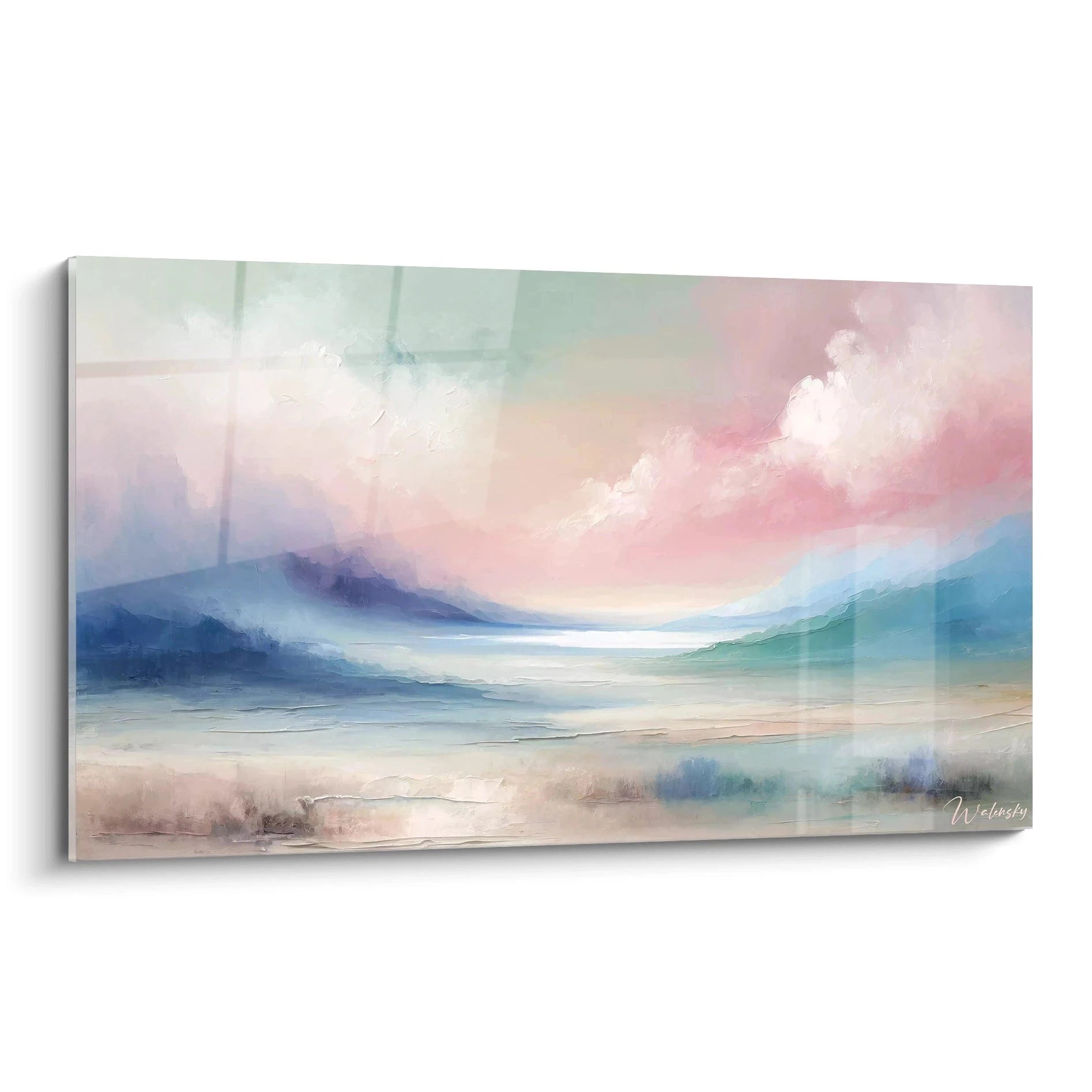

How Does Natural Light Affect the Perception of Wall Art in Coworking Spaces?
November 13, 2025 · 8 min read · by Walensky
This morning again, walking through this bright coworking space, I observed a fascinating scene: the same abstract painting that seemed to vibrate near the floor-to-ceiling windows, then gradually fade in the corner near the kitchen. As if the artwork changed identity depending on where it breathed. I have been studying this silent dance between natural light and wall art for eight years while setting up collaborative spaces, and it never ceases to surprise me.
Here's what natural lighting brings to your coworking wall paintings: it radically transforms colors and contrasts, modulates the work atmosphere according to the hours, and directly influences the concentration of your teams. Yet, how many shared workspaces install their artworks randomly, without understanding why some areas remain dull while others seem alive? This lack of knowledge is costly: an atmosphere that stifles creativity instead of stimulating it. The good news? Mastering this light-artwork interaction doesn't require a degree in optical physics or a disproportionate budget. Just a fine understanding of the principles governing visual perception in shared work environments. In the next few lines, I will reveal exactly how to orchestrate this alchemy so that each painting becomes a tangible asset in your coworking space.
The solar choreography: when natural light rewrites your decoration
Natural lighting is never static. It travels, evolves, transforms minute after minute. In a coworking space, this mobility creates micro-atmospheres that constantly redefine the visual experience of your wall paintings. I have measured variations in brightness reaching up to 10,000 lux near a south-facing window, against barely 200 lux in a corner four meters away. This spectacular inequality radically changes the perception of artworks.
Paintings with warm tones – ochres, reds, oranges – literally flourish under the morning light. The grazing rays of the rising sun amplify their chromatic intensity, creating a perfect energy sensation to start the day. Conversely, these same shades can appear aggressive under the brutal zenith at midday, especially near unprotected floor-to-ceiling windows. I have seen coworking spaces lose their softness simply because a blood-red painting, magnificent at 9 am, became stifling at 1 pm.
Works with cool tones – deep blues, emerald greens, violets – follow an inverse trajectory. They absorb the morning light without really illuminating, then come to life in the afternoon when the spectrum of light shifts. This particularity makes them valuable allies for concentration areas where tranquility is more important than stimulation.
Exposure, this invisible variable that changes everything
The orientation of your windows determines the very character of your coworking space. A north-facing exposure provides constant, almost cold light that preserves the chromatic integrity of wall paintings without creating violent contrasts. It is the natural lighting of the curator, one that never betrays the intentions of the artist. Creative spaces that prioritize visual stability love this orientation.
A south-facing exposure, on the other hand, generously but relentlessly floods with light. Brightness can reach peaks that literally wash out delicate colors. I advised a coworking space in Lille where a sublime pastel artwork became invisible at noon, completely drowned in the flow of light. The solution? Move the work two meters or install adjustable blinds. Intense natural lighting requires wall art with saturated pigments, capable of holding their own against the sun.
Exposures to the east and west create daily dramas. To the east, your artworks have their glorious morning hour before falling asleep in the afternoon. To the west, they slumber until 3 p.m., then explode in the golds of the evening. This temporal variation can become a narrative asset for your coworking space: imagine a series of wall art that visually tells the progression of the workday.

Reflections, glare and other light traps
Direct natural lighting often creates its worst enemy: the reflection. These blinding white areas that eat away at part of your artwork, turning a carefully crafted composition into an unreadable surface. In coworking spaces with large bay windows, this phenomenon reaches its peak between 11 a.m. and 2 p.m., precisely during peak hours.
Artwork under glass dramatically amplifies this problem. Their smooth surface becomes a mirror under direct sunlight. I have learned to proscribe them from exposed areas or to recommend treated anti-reflective glasses, even if their cost increases. For coworking spaces with a tight budget, preferring canvas prints or matte supports eliminates 80% of annoying reflections.
The hanging angle also plays its part. A wall artwork slightly inclined downwards – barely 5 degrees – deflects the zenith rays and preserves its readability. This simple trick transforms the visual experience without requiring costly work or sun protection.
— Our selection


Color temperature, this little-known magician
Natural lighting does not just illuminate: it colors. Its temperature varies from 2000 kelvins at sunrise to 6500 kelvins under a cloudy midday sky. This invisible variation nevertheless radically changes the perception of wall artworks in your coworking space.
Warm morning lights (3000-4000K) enrich yellows, intensify oranges, give body to browns. A painting depicting a desert or an autumnal scene will find its full expression under these conditions. However, blues appear dull, almost grayish. I repositioned dozens of wall art pieces simply by observing how their palette interacts with the dominant light temperature of their location.
Midday cool lights (5000-6500K) enhance blues, clarify greens, give depth to cold compositions. They also betray the slightest printing defects, revealing the true quality of the works. It is under this merciless natural lighting that the value of a painting in a professional coworking space is measured.

Light zoning: creating visual microclimates
Smart coworking orchestrates different intensities of natural lighting to create varied work atmospheres. This spatial strategy relies on the strategic placement of wall art as ambiance markers.
Energy zones – reception, brainstorming areas, kitchen – benefit from generous natural light (minimum 500-1000 lux). Wall art displays dynamic compositions, saturated colors, and marked contrasts. Their energized perception by the light reinforces the psychological function of the place. I have noticed that coworkers naturally gravitate towards these luminous zones in the morning.
Concentration zones – individual offices, phone booths – prefer moderate natural lighting (300-500 lux). Paintings with soothing compositions and medium tones without chromatic violence accompany the need for calm. The delicate balance between visual presence and discretion is played on a few dozen lux.
Transition zones – corridors, passages – tolerate significant variations. This is where experimental wall art can live, whose changing perception over time becomes an experience in itself. Some coworkings I support even make it a storytelling element: the work that reveals differently depending on the moment of passage.
— You may also like


Protection and preservation: loving without destroying
Natural light nourishes perception but can devour matter. The UV rays contained in sunlight inexorably degrade pigments and supports. A painting exposed daily to direct sun may lose 30% of its color saturation in eighteen months. This reality necessitates particular vigilance in coworking spaces where artworks represent an investment.
Window glazing UV films block up to 99% of ultraviolet rays while preserving 70% of brightness. Invisible once applied, they drastically extend the life of wall paintings without altering the lighting atmosphere. Their cost – approximately €40 per square meter installed – is quickly offset by premature replacement of damaged artworks.
Periodic rotation of paintings constitutes a simple but effective strategy. Alternating locations every six months distributes exposure and preserves visual interest. This practice, common in galleries, remains strangely rare in coworkings that fix their decoration. Yet, it transforms spatial perception while protecting artistic investments.
Ready to transform your workspace into a living gallery?
Discover our exclusive collection of coworking paintings that harmoniously interact with all types of natural lighting to create the perfect atmosphere.

Your workspace transformed by light
Imagine your coworking space in six months. The morning team naturally settles near these warm paintings that capture the first rays, coffee in hand. At noon, creatives take refuge in the alcove with soothing artworks where subdued natural lighting promotes concentration. In the late afternoon, collaborators spontaneously gather in front of this large abstract painting that ignites in the golden light, silently signaling that the productive day is coming to an end.
This silent choreography between natural light and wall paintings is not by chance. It stems from a fine understanding of lighting dynamics and thoughtful placement of artworks. Your first step? Observe for a week how light travels through your space. Note the areas that are illuminated, those that darken, moments of glory and eclipse. Then move just one painting taking these observations into account. You will see: the artwork will never be the same, nor will your space.
Frequently asked questions about natural light and paintings in coworking
Should direct sunlight on wall paintings be completely avoided?
No, but it needs to be managed intelligently. Direct sunlight is not an absolute enemy: it beautifully reveals certain works with robust pigments and contrasting compositions. The real danger lies in prolonged and daily exposure to UV rays. A work that receives two hours of morning sunlight will live perfectly if you install UV protection on the glazing or rotate it regularly. Pay attention to whether any annoying reflections appear: this is often more problematic for the immediate experience than long-term degradation. In my experience, a painting well chosen for its sunny location – saturated colors, matte support, energetic composition – becomes a major asset rather than a conservation concern. Direct natural lighting transforms some works into true luminous jewels impossible to reproduce artificially.
How to choose a painting for an area with little natural light?
Spaces with low natural light require wall paintings that create their own visual brightness. Favor compositions with light and bright colors – off-whites, pale yellows, sky blues – which reflect the little available light rather than absorb it. Works with soft contrasts work better than very contrasting compositions that become unreadable in the dimness. Also pay attention to details: in these areas, a painting that is too complex turns into a confused mass. I recommend simple geometric shapes, color blocks, clean compositions that remain readable even under 200-300 lux. Paradoxically, it's also the ideal place for works with metallic or reflective elements that capture and diffuse any light source. The goal isn't to fight darkness but to create visual points of interest that work with it.
Natural lighting changes according to the seasons: should I adapt my paintings?
The question reveals a fine understanding of the subject! Indeed, the solar angle varies by 60 degrees between June and December, radically changing the distribution of light in your coworking space. Rather than physically changing the wall paintings – tedious and costly – I recommend two complementary strategies. First, choose works versatile enough to withstand these variations: balanced palettes, compositions that work under different color temperatures. Second, adjust modular protections: blinds, sheer curtains, repositionable films. In winter, when light becomes scarce and flat, open completely to maximize natural lighting. In summer, filter the excess zenith. This dynamic approach simply requires observing how your paintings react to seasonal changes and gradually adjusting. Some coworkings even adopt a symbolic seasonal rotation – warm works in winter, cool works in summer – which renews the experience without technical complexity.


