In 1923, in the mural painting workshop of the Bauhaus in Weimar, something revolutionary was brewing. While European architects were still clinging to classical ornamentation, a group of visionary artists posed a radical question: what if the wall was no longer a decorative support, but a structuring element of space itself? This intuition would forever transform our way of living.
Here's what integrating mural art into the functional architecture of the Bauhaus brings us even today: a total harmony between form and function, an amplified spatial experience that alters our perception of volumes, and democratic beauty accessible in every modern interior. Yet, many think that wall art is limited to hanging a painting on a white wall. Others fear that mural painting will overload the space or quickly become dated. But the Bauhaus masters had already solved these dilemmas a century ago, by developing integration principles that remain astonishingly modern. I invite you to discover how their vision can radically transform your relationship with domestic space.
When the wall becomes architecture
To understand the Bauhaus revolution, you must first grasp what they rejected. In the 1920s, traditional architecture considered the wall as a neutral canvas to be decorated later. Wall art came last, like a superfluous jewel. Walter Gropius and his collaborators radically reversed this logic: in their work, the design of mural art began at the very moment the architect drew the first plans.
This integrative approach rested on a fundamental principle: the wall is not an obstacle but a creator of space. In the Bauhaus workshops, architects and painters worked side by side from the initial sketch. Oskar Schlemmer, director of the mural painting workshop, insisted on this organic collaboration. He designed his mural compositions in constant dialogue with windows, doors, angles, natural light.
Take the example of the staircase in the Bauhaus school in Weimar: Schlemmer deployed geometric shapes that visually extended the architecture itself. The verticals of the painted columns amplified the ceiling height. The colored horizontals created visual landings that guided the ascent. Wall art did not decorate the staircase: it became its spatial essence.
Color as a functional tool
Contrary to popular belief, Bauhaus artists did not use color to embellish but to structure perception. Johannes Itten, a color theorist, taught that each hue has a visual weight, a temperature, a direction. A bright yellow on a wall advances towards the observer; a deep blue recedes and expands the space.
In the functional architecture of the Bauhaus, this knowledge became spatial strategy. Weaving and carpentry workshops received wall treatments that modulated the perception of volumes according to use. A low ceiling appeared higher thanks to light vertical bands. A narrow corridor visually widened with cool tones on the side walls.
Geometry at the service of habitability
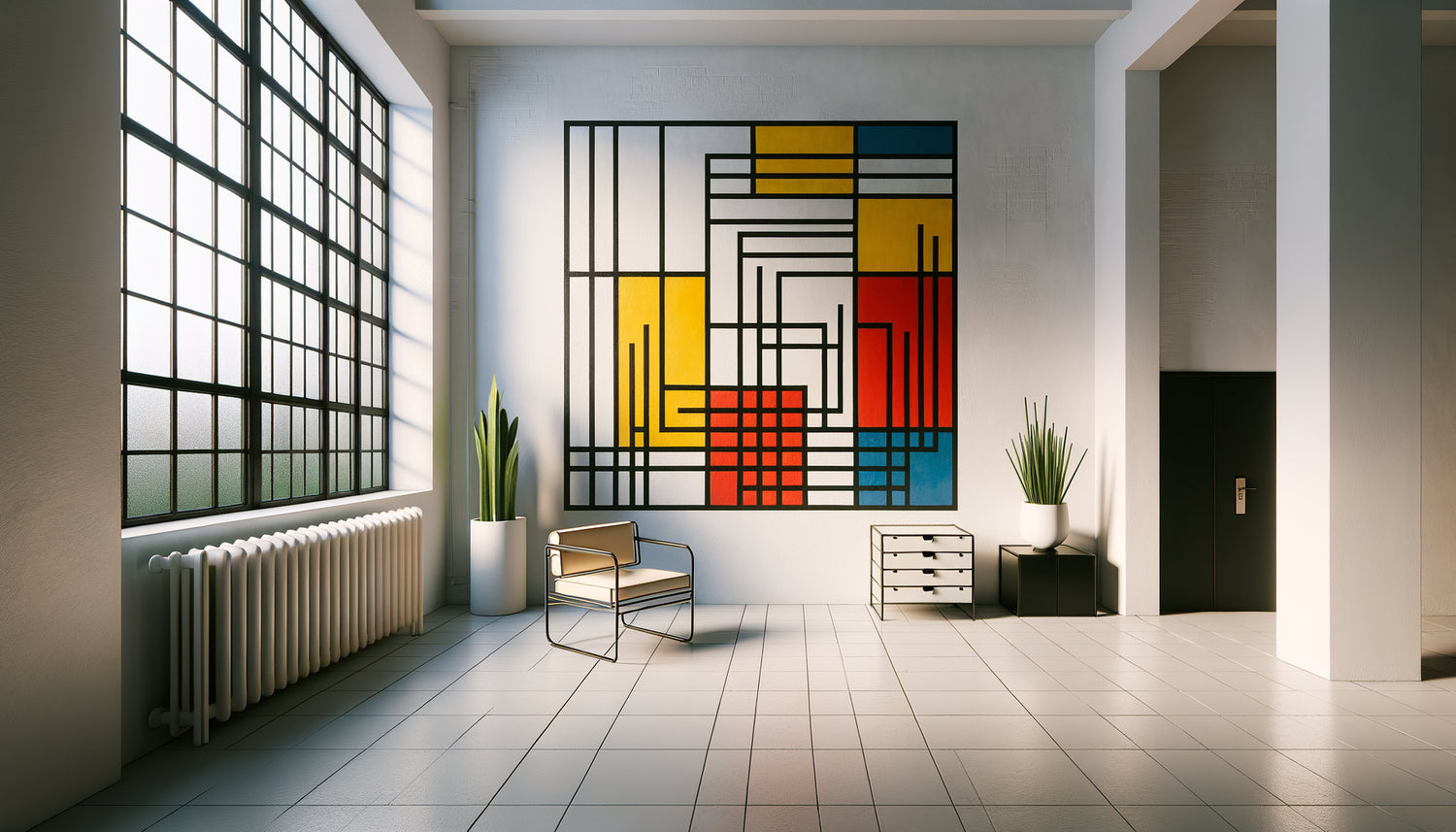
Bauhaus wall art is characterized by its radical geometric vocabulary: squares, circles, triangles, straight lines. This abstraction was not a gratuitous aesthetic choice but a functional necessity. Geometric shapes naturally dialogue with modern architecture, which itself favors pure volumes and right angles.
Wassily Kandinsky, master of form at the Bauhaus, demonstrated to his students that each geometric shape produces a specific spatial emotion. The circle creates a focal point that gathers attention. The triangle dynamizes and puts in motion. The square stabilizes and soothes. In composing their mural paintings, the artists of the Bauhaus were literally orchestrating the emotional experience of space.
In the social housing designed by the Bauhaus, this geometric mastery served very concrete purposes. A wall painted with superimposed horizontal rectangles created an impression of storage and order in a small apartment. Colored circles above living areas defined functional territories without physical partitions.
The balance between repetition and singularity
Another central principle: wall art had to be reproducible. The Bauhaus dreamed of a democratic beauty, accessible to all. Artists developed techniques that allowed their compositions to be reproduced identically in different buildings. Geometric stencils, proportion grids, standardized color charts: everything was designed so that the integration of wall art remained affordable.
Yet, each creation remained unique. How? Through precise adaptation to the specific architectural context. The same geometric composition unfolded differently depending on the height of the walls, the orientation of the light, the function of the room. Wall art functioned like a musical score: a fixed structure that each space interpreted in its own way.

Three integration principles to adopt today
How to translate this vision into our contemporary interiors? I have identified three founding principles that you can apply immediately, whether you live in an industrial loft or a classic apartment.
First principle: design wall art before furniture. Reverse your usual process. Before choosing your sofa, think about the wall articulation that will give character to the room. A large colored rectangle behind the seating area creates an architectural backdrop. Vertical stripes on the entrance wall visually sculpt the passage. This Bauhaus logic guarantees spatial coherence impossible to achieve otherwise.
Second principle: use color to correct architectural flaws. Is your ceiling too low? Light verticals on the walls create a visual elevation. Does your hallway seem endless? A warm hue in perspective brings the wall closer and optically shortens the space. Wall art thus becomes a functional tool for spatial repair.
Third principle: prioritize timeless geometric shapes. Bauhaus artists understood this: abstract geometric compositions age much better than figurative or decorative motifs. A wall punctuated by colored rectangles remains modern after thirty years. This longevity makes wall art a true architecture, not a fleeting trend.
From Bauhaus to contemporary design: a living lineage
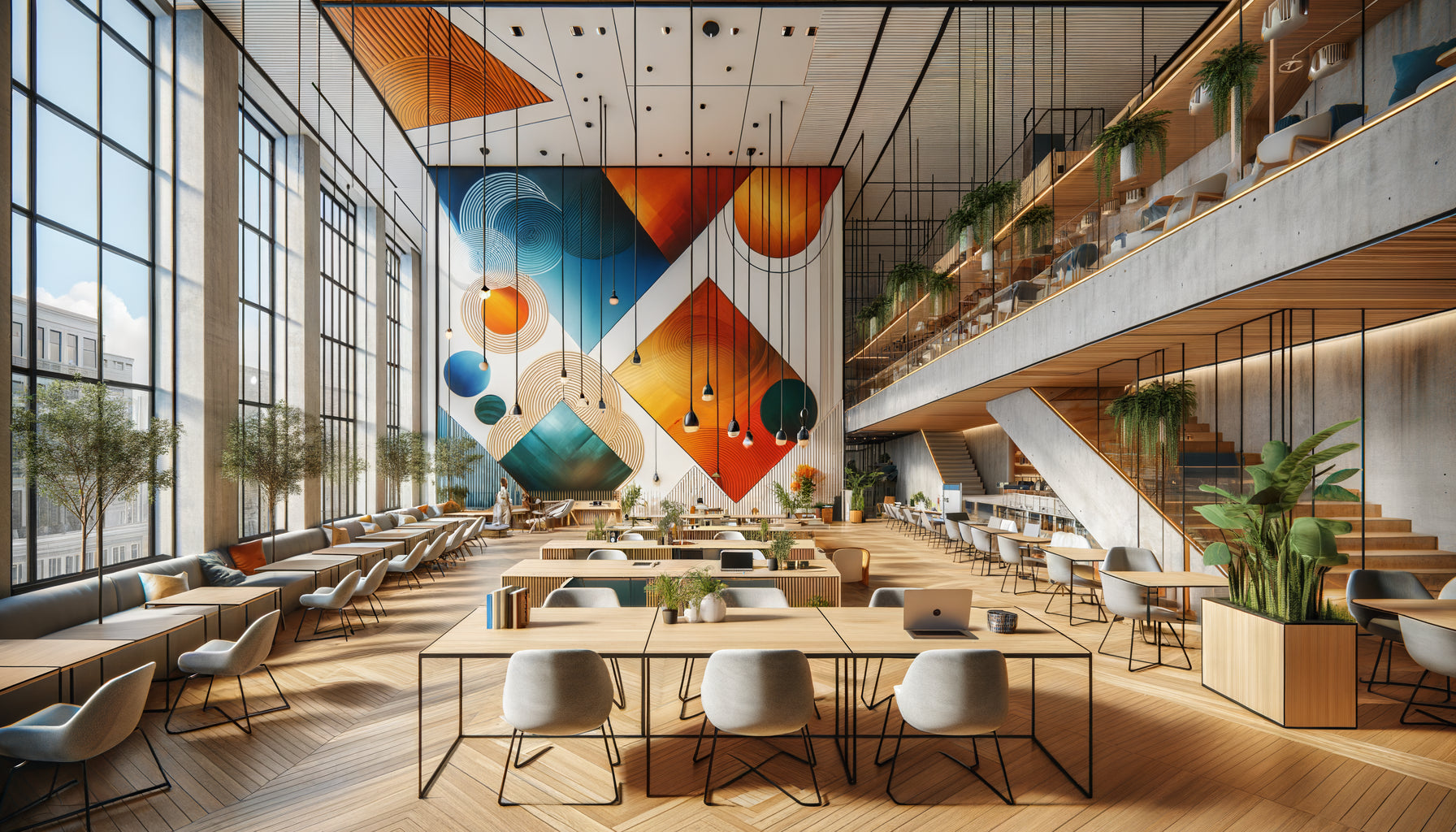
The legacy of this architectural integration of wall art still irrigates current design. Scandinavian minimalist interiors, with their large swathes of structuring color, are direct descendants. Coworking spaces that use geometric murals to define functional areas apply the principles of the Bauhaus exactly.
Even techniques have evolved while remaining faithful to the original spirit. Where Schlemmer used casein paint, we now have durable acrylic paints, repositionable geometric wallpapers, digital projections. Technology changes, the principle remains: make the wall an active architectural element, not a passive support.
This continuity is not nostalgic. It testifies to the visionary accuracy of the Bauhaus. By designing wall art as intrinsically linked to functional architecture, these artists discovered universal spatial laws, as relevant in a Berlin loft in 2024 as in an experimental house in Dessau in 1926.
Transform your space with the spirit of Bauhaus
Discover our exclusive collection of wall art for coworking that integrates functional geometry and spatial harmony to sublimate your professional walls.

Your wall is waiting for intention
What the Bauhaus ultimately teaches us is that every wall possesses untapped architectural potential. This surface you see as a simple neutral background is, in fact, a powerful spatial tool, capable of radically transforming your daily experience of space.
Imagine: you return home tonight and, instead of seeing anonymous walls, you perceive active surfaces that structure your gaze, guide your movements, modulate your emotions. This transformation requires neither heavy work nor a colossal budget. It simply requires looking at your walls with the eyes of Bauhaus masters: as architectural elements in their own right.
Start modestly. Choose one wall, the one that seems most problematic to you. Too narrow? Too dark? Without character? Apply a principle of functional integration to it: a geometric composition that corrects the spatial defect. You are not decorating. You are architecting. And that distinction changes everything.
FAQ: Integrating wall art in the Bauhaus manner
Does geometric wall art risk making my interior too austere?
It is precisely the opposite that happens, and I understand this common apprehension. Bauhaus geometric compositions actually create a structured warmth very different from minimalist coldness. When you use simple but colorful shapes, you bring life without creating visual clutter. The secret lies in the choice of colors: Bauhaus artists favored frank but never garish colors, often derived from natural pigments. An ochre rectangle on a white wall immediately brings warmth. A deep blue circle creates a meditative depth. Austerity is born of total stripping, not of colored geometry. In the interiors I have studied, residents testify to a feeling of peace and clarity: the space becomes readable, visually organized, therefore deeply welcoming. Bauhaus never sought spectacular effects but functional harmony, which is the most durable form of beauty.
Can Bauhaus wall art really be integrated into an old apartment with moldings?
It’s not only possible, but often spectacular! The mistake would be to think that Bauhaus requires modern architecture to work. The principles of functional integration adapt to all contexts, precisely because they start from the existing architectural framework. In a Haussmannian apartment with moldings, you can create a fascinating dialogue between classical ornamentation and modern geometry. For example, a large colored rectangle positioned within the moldings creates a frame within a frame, an elegant mise en abyme. Or horizontal bands that run under the cornice, highlighting the original structure. Contemporary designers excel at these marriages: the old defines the territory, the modern activates it. I’ve seen Parisian interiors where this mix created a sophistication impossible to achieve otherwise. The essential thing is to respect the Bauhaus rule: that wall art dialogues with existing architecture rather than ignoring it. Measure your moldings and ceiling heights precisely, then compose accordingly. This constraint becomes creativity.
Do you need painting skills to create a Bauhaus wall art yourself?
Absolutely not, and that was precisely one of the democratic goals of the movement. Bauhaus artists developed techniques reproducible by anyone: stencils, masking tape, simple proportion grids. To create a perfect colored rectangle, you need painter’s tape, a spirit level and a roller. That's all. Simple geometric shapes forgive small imperfections, unlike figurative patterns that require an expert brushstroke. Start with ultra-simple compositions: two rectangles of different sizes, in two complementary tones. Use a projector to trace the outlines if you lack confidence. Or opt for contemporary solutions: repositionable geometric wallpaper offers the same effects without any risk. The Bauhaus spirit valued spatial intention more than technical virtuosity. What matters is that your composition serves the space, not that it demonstrates your painting talent. This accessibility explains why these principles have crossed a century: they are universally applicable.