That day, while visiting a typical Parisian apartment from the 1930s, I observed a customer hesitating in front of her narrow hallway. "I love this lithograph, but I don't want to bump into things," she confided in me. This sentence perfectly summarizes the dilemma of circulation spaces: how to dress walls without creating an obstacle?
Here's what a shallow frame brings to your hallway: an artistic presence without a dangerous projection, an elegant finish that enhances the artwork, and that precious peace of mind when moving with your arms full. Forget the anxiety of a frame protruding 5 or 6 centimeters, creating a permanent snag for clothes, bags, or shoulders of guests.
Have you already given up on hanging that engraving that makes you dream so much? Have you measured twenty times the available space before concluding that "it would protrude too much"? This frustration touches thousands of art lovers confronted with the realities of hallways, narrow entrances, or those transitional spaces where every centimeter counts. The traditional frame, with its 4 to 6 cm thickness, unfortunately turns these areas into obstacle courses.
Fortunately, the 2cm shallow frame revolutionizes the layout of constrained spaces. This technical solution, long reserved for galleries and professionals, is now accessible to transform your hallway into a real domestic gallery, without compromising safety or elegance.
The silent revolution of the ultra-flat frame
When I discovered the first shallow frames in a London framing workshop, I immediately understood their potential for restricted spaces. At only 2 cm thick overall, these structures completely redefine the relationship between the artwork and the wall. Unlike the traditional frame which creates a visible “bump” on the wall, the 2cm frame almost hugs the wall surface.
The secret lies in the construction itself. These frames use low-section wooden stiles, generally between 15 and 20 mm, associated with perfect canvas tension. This minimalist design does not detract from the solidity: the structure remains rigid thanks to carefully studied assemblies and the quality of materials. I have seen shallow frames support canvases of 80 x 120 cm without flinching in Parisian entrances where every millimeter counts.
The visual advantage goes beyond the simple question of projection. This proximity to the wall creates a striking “window” effect, as if the artwork were directly printed on your architecture. The eye naturally glides over the image without being interrupted by a frame thickness. In a hallway, this effect literally transforms the perception of space: instead of visually narrowing the passage, the 2cm frame dresses it without encumbering it.
Which formats to prioritize for a shallow frame?
Not all formats lend themselves equally well to a shallow frame. After testing different configurations in dozens of hallways, I identified the ideal proportions. Horizontal elongated formats work beautifully: a 60 x 30 cm or an 80 x 40 cm naturally follows the perspective of the hallway while maintaining perfect stability with only 2 cm of depth.
Vertical formats deserve special attention. A 2 cm frame will easily support a 40 x 60 cm or even a 50 x 70 cm, but beyond that, it is necessary to evaluate the weight of the canvas and the quality of the tension. I have seen artists use lightweight canvases on shallow frames up to 60 x 90 cm with impeccable results. The rule: the larger the format, the more critical the manufacturing quality of the shallow frame becomes.
The importance of canvas and tension
The reduced depth of the frame imposes specific requirements on the canvas. A canvas that is too thick or rigid will create uneven tensions on a mount only 2 cm deep. Medium weight cotton canvases (280-320 g/m²) offer the best compromise: robust enough to remain stretched, flexible enough to conform to the structure without forcing.
The tension itself requires precise know-how. On a shallow frame, it is impossible to cheat with poorly positioned staples or an insufficiently stretched canvas. Each fixing point must distribute force evenly to avoid deformations. This technical rigor ensures that your work remains perfectly flat, even after years hanging in your hallway where variations in temperature and humidity can affect the materials.

The different types of 2 cm frames available
The market now offers several variants of shallow frames, each with its own specific characteristics. The standard 2 cm primed frame remains the most accessible: pine or spruce structure, pre-stretched cotton canvas, ready to paint or receive a print. This is the solution I recommend for beginners, especially if you want to create a personal gallery in your hallway with several coordinated works.
Professional, low-profile frames are upgraded with beech or poplar wood, mortise-and-tenon joints, and superior quality canvas. The difference is immediately noticeable: perfectly square corners, impeccably flat surface, increased durability. For a hallway that represents the first impression of your interior, this investment is fully justified. I have clients whose 2 cm professional frames last for years without any deformation.
More recently, low-profile aluminum frames are appearing. With as little as 18 mm thickness, these ultra-light structures are particularly suitable for photographic or digital prints. The metal eliminates the risk of wood warping and offers a resolutely contemporary finish. In a modern hallway with clean lines, this type of low-profile frame creates a striking contemporary art gallery effect.
Installation and fixing: the secrets of a secure hanging
A 2 cm frame requires thoughtful fixing. Its shallow depth changes the center of gravity of the whole, creating a different lever effect than a traditional frame. I systematically use specific flat hooks for low-profile frames, which distribute the weight over a wider surface of the wall. These fixings, screwed directly into the rear frame, keep the artwork less than 3 cm from the wall in total.
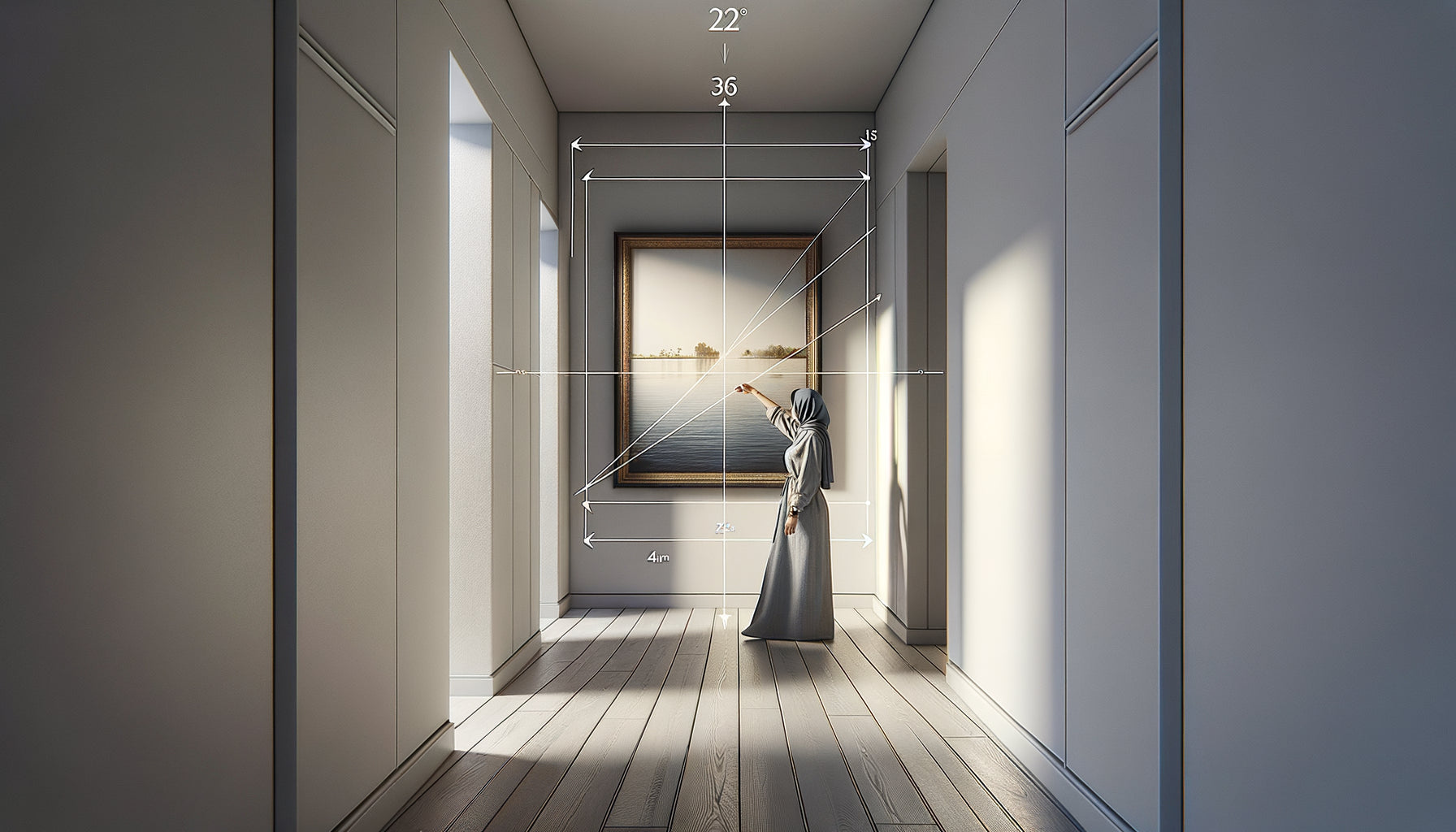
Positioning deserves particular attention in a hallway. Unlike a living room where you admire the work head-on, in a passageway, you discover it in perspective laterally. I generally install my low-profile frames slightly lower than the traditional eye level height (140-145 cm rather than 150-160 cm), which improves visibility when walking. This height also reduces the risk of accidental contact with the shoulder or arm.
Solid walls vs. lightweight partitions
On a solid brick or concrete wall, fixing a low-profile frame is not a problem. Two suitable anchors are sufficient for formats up to 80 cm. On a plasterboard partition, which is more common in modern hallways, I use Molly anchors or special drywall fixings that distribute the load. A 2 cm frame in standard format (60 x 80 cm with canvas) rarely weighs more than 800 grams to 1 kg, which remains well within the capabilities of these fixings.
The real trick for hallways? Create a wall composition with several low-profile frames rather than a single large piece. Three 40 x 30 cm formats spaced 8 to 10 cm apart create a captivating visual rhythm while distributing the weight over several hanging points. This gallery approach transforms your hallway into a true artistic journey, each work dialoging with the next without ever creating a physical obstacle.

Styles and aesthetics suited to the ultra-thin frame
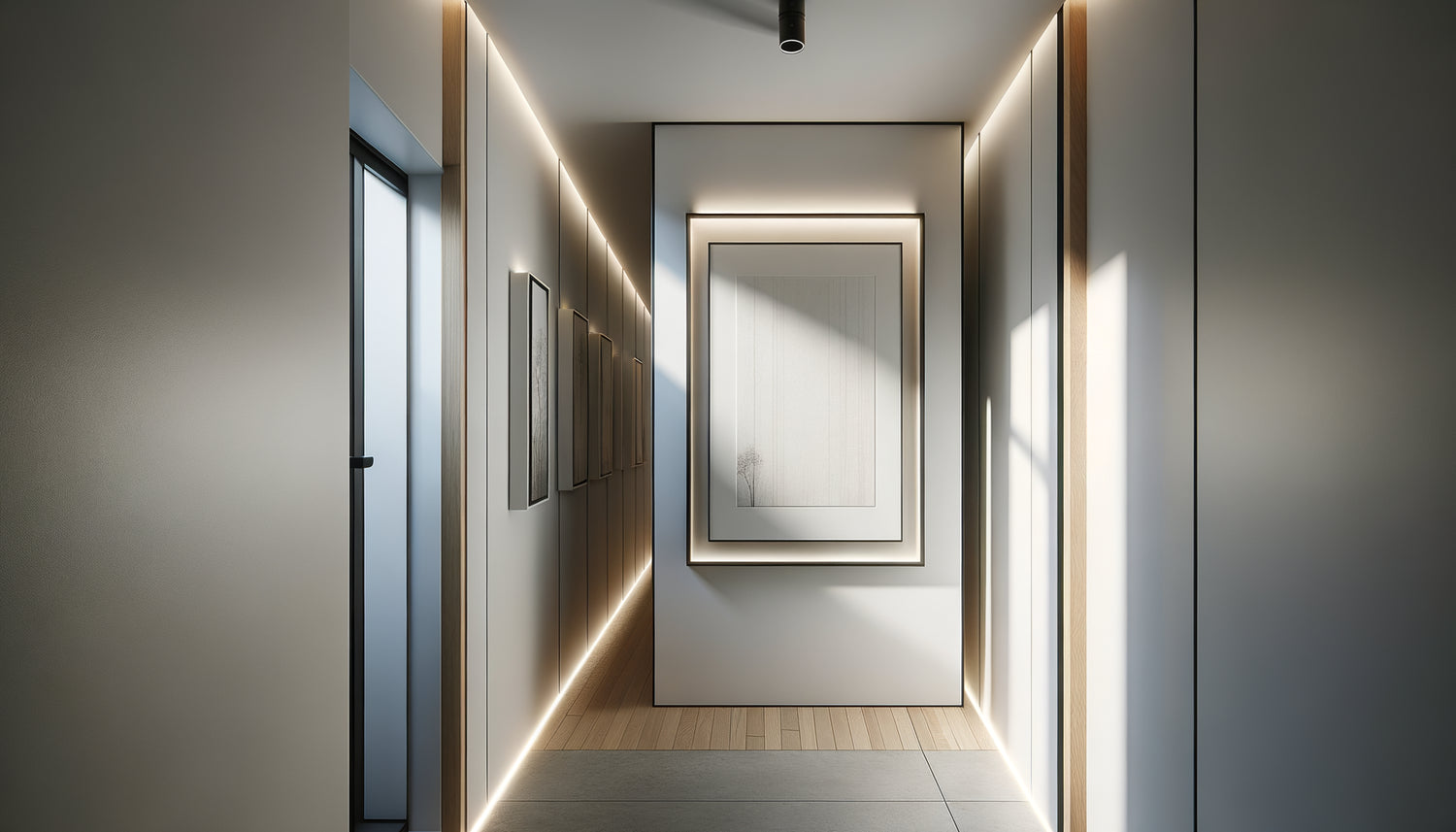
Certain visual universes particularly enhance shallow frames. Art photography, for example, gains impact with this streamlined presentation. Without the thickness of a traditional frame, the image seems to float just centimeters from the wall, creating a remarkable presence even in a small space. I furnished a hallway only 95 cm wide with five black and white photographs on 2 cm frames: the gallery effect is spectacular without ever giving the impression of clutter.
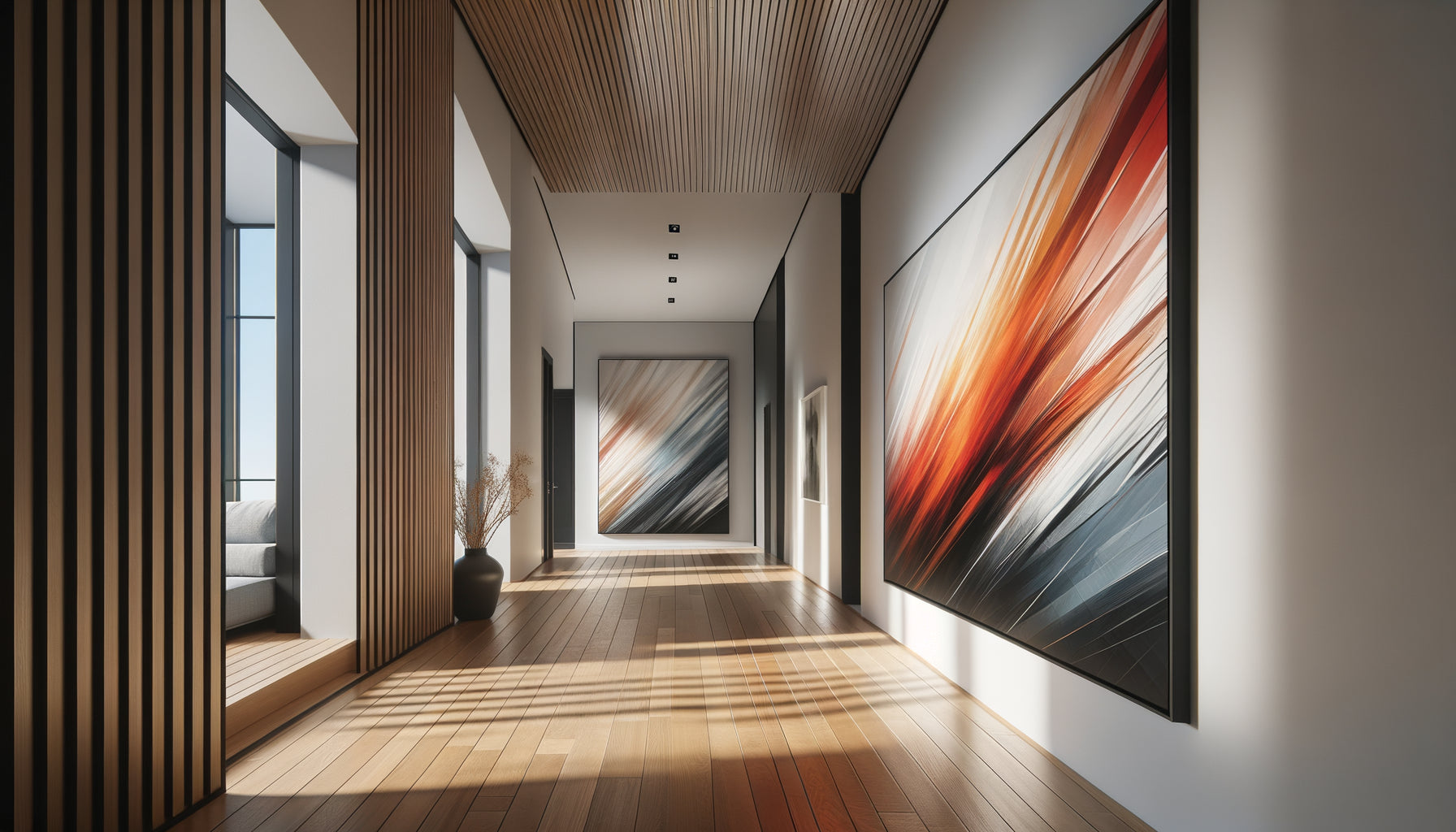
Contemporary abstract works naturally lend themselves to this minimalist format. Blocks of color, geometric compositions, monochrome textures find in the shallow frame a setting that does not distract attention. The discreet border, often left raw or painted in a neutral shade, visually extends the work rather than framing it. In a hallway with white walls, this visual continuity perceptibly enlarges the space.
Even more classic styles adapt remarkably well. I recently mounted reproductions of vintage botanical engravings on 2 cm frames for a Haussmannian hallway. The contrast between the classic subject and the ultra-modern presentation creates a fascinating aesthetic tension. The shallow frame modernizes the work without betraying it, a valuable quality for lovers of eclecticism.
Maintenance and durability: your investment in time
A well-designed 2 cm frame lasts decades. The key lies in the initial quality of the wood and assembly. Stabilized woods, dried to less than 12% humidity, resist the climatic variations of a hallway, an area often less heated and more subject to drafts than main rooms. I have shallow frames installed for fifteen years which retain perfect tension and impeccable angles.
Maintenance is limited to regular dusting with a soft, slightly damp cloth. Avoid chemical products that could migrate onto the canvas. If you notice slight slackening of the tension after several years, some high-end shallow frames incorporate tension keys in the corners, allowing the canvas to be retightened without disassembling the entire assembly. This feature, borrowed from traditional frames, guarantees exceptional longevity.
The real threat to a 2cm frame remains excessive humidity. In a hallway leading to a bathroom or near an entrance exposed to the elements, monitor the ambient humidity level. Beyond 65% for extended periods, the wood can warp and the canvas relax. A discreet dehumidifier or simply better ventilation will preserve your artistic investment for years to come.
Transform your hallway into an art gallery without sacrificing a single inch
Discover our exclusive collection of hallway art that will enhance your walls without creating any annoying protrusions.
Your hallway reinvented, inch by inch
Imagine coming home tonight and rediscovering your hallway. No longer just a functional passage, but a space inhabited by works that reflect you, hung just 2cm from the wall. This lithograph waiting in its box, this photograph that finally deserves to be seen, this abstract composition that dialogues with natural light: all find their place without you having to fear any accidental bumps.
The shallow frame is not just a technical solution; it's an interior design philosophy for our era where square footage is precious. It reconciles the legitimate desire for beauty with the real constraints of space. Start modestly if you are hesitant: a single 2cm frame with a work that really speaks to you. Observe how it transforms the atmosphere of your hallway, how it creates a focal point without ever hindering circulation.
In a few weeks, you may consider adding a second piece, then a third. Your hallway will gradually become that intimate gallery you dreamed of, that visual journey that welcomes your guests and greets you every day. All thanks to these 2 small centimeters that change everything.
Frequently Asked Questions
Is a 2cm frame really sturdy for a hallway where people often pass?
Absolutely, and it’s something I regularly debunk. The sturdiness of a shallow frame doesn't depend on its thickness but on the quality of its assemblies and the tension of the canvas. A well-constructed 2 cm frame, with reinforced corners and properly stretched canvas, perfectly resists vibrations and minor impacts. I have clients with children and pets whose shallow frames last for years without damage. The key is to choose a quality construction and suitable wall mounting. Moreover, unlike a thick frame that can be hit head-on, the 2 cm frame presents such a reduced surface area that it is naturally less exposed to accidental contacts. Your shoulder will slide rather than impact.
Can a traditional frame be converted into a shallow frame?
Unfortunately not, and I understand the temptation to try in order to save on an existing artwork. The structure of a traditional frame and a 2 cm frame differs fundamentally from conception. The stiles of a classic frame generally measure 4 to 6 cm in section, making simple reduction impossible. Restretching a canvas onto a new shallow frame is technically feasible, but it involves completely relaxing the work, which risks damaging it, especially if it has been painted. My recommendation: keep your artworks on traditional frames for large living rooms, and invest in new shallow frames specifically for your hallway. This approach allows you to create an aesthetic consistency adapted to each space in your interior, each zone having its own constraints and decorative opportunities.
What is the best height to hang a shallow frame in a hallway?
The hanging height in a hallway follows different rules than those of a living room, and it’s crucial to maximize the impact of your shallow frame. In a room where you admire the artwork from face on, the classic rule places the center of the image at 160 cm (average eye level). In a hallway, you generally discover the artwork in perspective laterally, while walking. I recommend lowering the center of the 2 cm frame to around 140-145 cm, which considerably improves visibility during circulation. This height has another advantage: it moves the artwork away from the passage area of shoulders and arms, reducing the risk of contact. If your hallway is particularly narrow (less than one meter), don't hesitate to lower it a few more centimeters. Test with masking tape before drilling: walk several times in the hallway observing at what point your gaze naturally catches the artwork. This intuitive height is often the best, as it corresponds to your actual use of the space.