


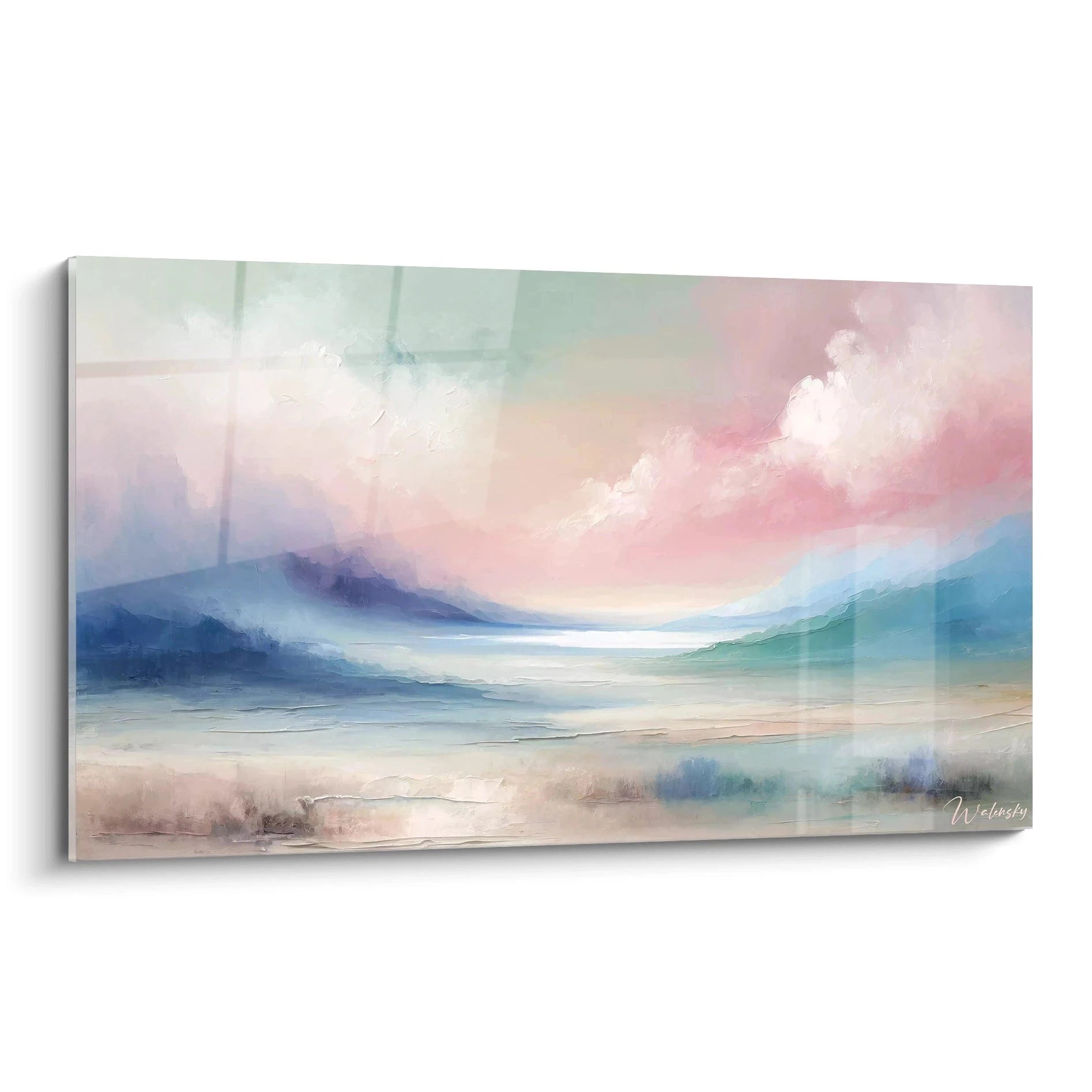

Painting with UV varnish: is it necessary in a hallway with a skylight?
December 8, 2025 · 11 min read · by Walensky
The zenith skylight illuminates your hallway with a dazzling clarity, transforming what was once a dark passage into a sun-drenched gallery. Every morning, this natural light caresses your walls, reveals textures, and magnifies the architecture. But this same luminosity that enhances your interior hides an invisible danger for your works of art: ultraviolet rays, these silent aggressors that inexorably degrade pigments and supports.
Here's what a UV varnish brings to your paintings under zenith light: an invisible protective barrier that preserves the brilliance of colors for decades, peace of mind facing direct sun exposure, and the guarantee that your artistic investment will retain its emotional and financial value. The frustration of seeing a painting gradually lose its vibrancy, its nuances fade, its warm tones turn dull after just a few seasons of exposure – this is what too many skylight owners experience. Rest assured: this degradation is not inevitable. With the right protections, your hallway can become the perfect setting for your favorite works, even under the most intense light.
Zenith light: that friend who can become an enemy
A skylight radically transforms the atmosphere of a hallway. This opening to the sky creates descending natural light that sculpts the space, eliminates the feeling of confinement and instantly enhances everything it touches. Unlike side windows, zenith light offers continuous and direct exposure, particularly intense during central hours of the day.
This architectural configuration however presents a crucial particularity: the angle of incidence of solar rays. Where a north-facing window diffuses soft and indirect light, the skylight receives sunlight at its zenith, the moment when UV rays reach their maximum concentration. Between 10 am and 4 pm, especially during summer months, your hallway becomes a veritable chamber of light where UV intensity far exceeds that of traditional wall exposure.
Owners of these bright spaces often find that their textiles, floors and wallpapers fade more quickly than in the rest of the house. This phenomenon applies with even greater severity to paintings exposed directly under the zenith beam. Organic pigments – particularly reds, yellows and purples – react chemically to ultraviolet rays, gradually losing their saturation. A delicate watercolor can lose 30% of its chromatic intensity in just two years of unprotected exposure.
Understanding the invisible enemy: UV radiation in your hallway
Ultraviolet rays represent about 5% of the solar light spectrum, but cause 40% of damage to works of art. These short and energetic waves – mainly UV-A and UV-B – penetrate traditional glazings and attack the molecular bonds of pigments and binders.
The Triple Degradation Mechanism
In a hallway with skylights, three phenomena combine to accelerate deterioration: photo-oxidation which decomposes organic pigments, yellowing of traditional varnishes which alters color perception, and fragility of supports – canvas, paper or wood – which become brittle and friable. A painting exposed to zenithal light suffers in one year what it would have endured in five years in a dimly lit space.
The situation is worsened with certain types of paintings. Contemporary acrylics, despite their reputation for solidity, sometimes contain synthetic pigments particularly sensitive to UV rays. Watercolors and gouaches, with their water-based binders and lack of protective layer, prove extremely vulnerable. Even traditional oils, known for their resistance, see their varnish yellow and crack under the combined effect of UV rays and thermal variations created by solar heating of glazing.

Our favourite
Sunset Spiral Painting - Golden Light Vortex - Abstract Spiral Edition
233,90€
Discover this artworkThe UV protective varnish: a sophisticated molecular barrier
Modern UV protective varnishes incorporate specific absorbing molecules – benzotriazoles or benzophenones – which capture ultraviolet rays before they reach the pictorial layer. These transparent formulations create a selective filter: they block 95 to 99% of harmful UV rays while allowing the entire visible spectrum to pass through, thus preserving the natural appearance of the work.
Contrary to popular belief, a protective varnish does not yellow and does not alter the tones – contemporary formulations based on UVLS (UV Light Stabilizers) resins remain perfectly stable for several decades. Their application creates a sacrificial layer that absorbs light aggression, protecting not only the pigments but also the binders, the support and the underlying layers.
Two complementary protection technologies
Spray varnishes offer a uniform application ideal for textured surfaces and large dimensions. Their matte, satin or gloss finish allows you to adapt the visual appearance according to your aesthetic preferences. Liquid varnishes applied with a brush are perfect for small-format works and allow precise control of the treated areas, particularly useful for paintings with mixed media where some areas require differentiated protection.
For a hallway with a zenithal skylight, the choice of UV protection level becomes crucial. Standard varnishes filtering 80% of UVs are sufficient for moderate exposure, but a hallway bathed in direct light justifies ample use of high-protection varnish filtering 97-99% of ultraviolet rays. This 15-20% difference in filtration rate practically doubles the chromatic lifespan of your painting.
— Our selection


Assess your exposure: not all skylights are equal
Before investing in UV protection, carefully analyze the characteristics of your installation. A skylight equipped with filtering glazing already blocks a significant portion of ultraviolet rays – some modern glazings eliminate up to 70% of UVs. Check the technical specifications of your installation: recent double glazing often incorporates a Low-E treatment that naturally reduces UV transmission.
The orientation and size of the skylight directly influence the intensity of exposure. A small Velux window facing northwest generates moderate and indirect brightness, while a large central skylight of 2m² creates a luminous intensity comparable to an outdoor shaded space. Observe your hallway at different times: if a direct beam of light hits the wall where you want to hang your painting between 11 am and 3 pm, UV protection becomes essential.
The presence of trees or surrounding structures also modulates exposure. A skylight partially shaded by dense foliage naturally reduces UV intensity, especially in summer when the sun is at its highest. On the other hand, an unobstructed rooftop terrace facing full south maximizes exposure all year round – a configuration that systematically justifies the application of a protective varnish to any exposed artwork.

— You may also like


Complementary solutions: multiply the protections
The anti-UV varnish is just one layer of a global conservation strategy. Filters blinds or curtains installed on the skylight soften direct light intensity while preserving the overall brightness of the space. Transparent adhesive UV films applied to glazing block ultraviolet rays at the source without obscuring – a particularly relevant solution if you display multiple paintings in the hallway.
Strategic placement of your artworks
Even with a protective varnish, smart placement significantly extends the lifespan of your paintings. Favor the side areas of the hallway where light arrives at an oblique angle rather than directly under the zenithal beam. A 50 centimeter offset can reduce UV exposure by 30%. If your hallway allows it, create an alternating gallery where the most valuable or sensitive works occupy the least exposed locations.
For collectors owning valuable artworks, seasonal rotation is a wise practice: display your most vulnerable paintings during autumn and winter when light intensity decreases, and replace them with protected or less sensitive works during summer months. This museum-inspired approach adapted to private homes preserves your investments while regularly renewing the ambiance of your hallway.
Transform your bright hallway into a timeless art gallery
Discover our exclusive collection of hallway paintings that beautifully resist natural light while enhancing your passageway.

In the same vein
Modern Muse Canvas - Contemporary Abstract Painting Edition
233,90€
Discover this artwork →When varnish becomes non-negotiable
Certain situations make UV protection absolutely essential. Art photographs, particularly inkjet prints and pigment prints, inevitably degrade under unprotected UV exposure – their inks fade in just a few months under direct zenithal light. Original watercolors, true jewels of fragility, require an anti-UV glass in addition to a surface varnish if their technique allows.
Contemporary artworks with fluorescent or neon pigments are extremely vulnerable – these vibrant colors lose up to 50% of their intensity in a single summer season of direct exposure. If your hallway houses this type of creation, high-protection anti-UV varnish becomes as crucial as the artwork itself. For masterpieces or collector's pieces whose value exceeds several thousand euros, the question does not even arise: maximum protection is an economic and heritage imperative.
Conversely, some creations tolerate exposure better. Vintage oil paintings already patinated, abstract works with stable mineral pigments, or recent digital prints on lightfast certified paper may suffice with moderate protection. Decorative reproductions without particular sentimental or financial value may not justify the investment of a high-end varnish – their eventual replacement remains economically reasonable.

More selected pieces
The Invisible Bonds Wall Art - Contemporary Abstract Painting Edition
233,90€
Discover this artwork →Application and maintenance: preserving protection
Applying an anti-UV varnish requires careful preparation to ensure its effectiveness. The surface of the painting must be perfectly clean, dry and degreased. For recent paintings, strictly respect the drying time – six months minimum for oil, three weeks for acrylic – before any varnish application. A prematurely applied coat traps residual solvents and causes blistering and clouding.
The application technique directly influences the uniformity of protection. Work in thin successive layers rather than a single thick layer that may run or create uneven bright spots. For spray varnish, maintain a constant distance of 30-40 centimeters, perform horizontal then vertical passes, and repeat the operation 2 to 3 times spacing each coat by 30 minutes. This method guarantees even coverage and optimal protection over the entire surface.
Maintaining a varnished painting is simple: a gentle dusting with a duster or dry microfiber cloth is sufficient for regular maintenance. Absolutely avoid conventional cleaning products that can alter the protective varnish. If a stain appears, use only a slightly damp cloth of distilled water, blotting gently without rubbing. The anti-UV varnish retains its filtering properties for 10 to 15 years under normal exposure conditions – a remarkable longevity which largely amortizes the initial investment.
Imagine your hallway in ten years: the same vibrant colors, the same striking contrasts, the same emotion intact facing your favorite paintings. This vision is not a dream but an accessible reality thanks to adapted UV protection. Your skylight will continue to majestically illuminate your passage, but this time as an ally rather than a threat. The decision to apply an anti-UV varnish represents more than a technical gesture: it is an act of preservation that honors your works, respects your investment and guarantees the transmission of your artistic heritage to future generations. Today, make an appointment with a professional framer or consult the technical specifications of your paintings – this first concrete action marks the beginning of conscious and sustainable conservation.
Frequently asked questions about UV protection for hallway paintings
Is anti-UV glass enough or should there also be a varnish on the painting itself?
The UV-resistant glass and surface varnish play complementary but distinct roles in preservation. The filtering glass creates a first, particularly effective barrier for works on paper – watercolors, engravings, photographs – which cannot receive direct varnishing without alteration. It blocks 97-99% of UV rays before they even reach the artwork, while also providing mechanical protection against dust and humidity. However, glass has limitations: its high cost, its considerable weight, and its reflections that can hinder perception in a very bright hallway. Directly applied anti-UV varnish is ideally suited for paintings on canvas or wood where a glazed frame would be inappropriate. It offers protection in immediate contact with the pictorial layer, eliminating any space where UV rays could penetrate. For maximum protection of a valuable artwork under a zenith skylight, the combination of both – UV filtering museum glass plus surface varnish if the technique allows – represents the optimal solution, one adopted by museums for their permanent collections exposed to natural light.
Do complementary lighting LEDs also emit dangerous UV rays?
Excellent news for hallway owners with mixed lighting: contemporary LEDs emit virtually no ultraviolet radiation. Unlike older halogen bulbs or fluorescent tubes which generated significant UV, LED technology produces light by electroluminescence in the visible spectrum only. Spectrometric measurements show that quality LEDs emit less than 0.1% of UV, a negligible amount that causes no damage to artworks even after thousands of hours of exposure. This characteristic makes LEDs the preferred choice for accent lighting of your hallway paintings: you can install adjustable spotlights to create dramatic lighting in the evening without worrying about adding an additional source of degradation. The only precaution concerns the color temperature: prefer warm white LEDs (2700-3000K) rather than cool white to avoid a bluish tint that alters the perception of your paintings' warm tones. On the other hand, the natural light from your zenith skylight remains the main source of UV to control, as only a protective varnish or filtering glazing can effectively neutralize it.
Can you apply anti-UV varnish yourself or do you need a professional?
Applying an anti-UV varnish yourself is perfectly feasible for decorative works or those of moderate value, provided you strictly adhere to the protocol. Aerosol varnishes available to the general public now offer accessible professional formulations, with detailed instructions that allow for a satisfactory result. The key to success lies in preparation: work in a well-ventilated area but without drafts that would deposit dust, at a stable ambient temperature (18-22°C), and generously protect the environment of the painting with tarpaulins and cardboard. Always test the varnish on a sample or discreet area before full application – some mediums react unpredictably to the solvent in the varnish. Liquid varnishes applied with a brush require more technical skill: the gesture must be fluid, without going over an already varnished area, otherwise marks will be created or the underlying layer dissolved. For works of significant value – signed originals, heritage family paintings, gallery acquisitions – the intervention of a professional restorer is strongly recommended. Their expertise allows them to adapt the type of varnish to the specific pictorial technique, identify any potential adhesion problems, and above all guarantee an even and durable result. An investment of 80 to 200 euros depending on the size is amply justified in the face of the risk of permanently compromising an irreplaceable work with a risky amateur application.


