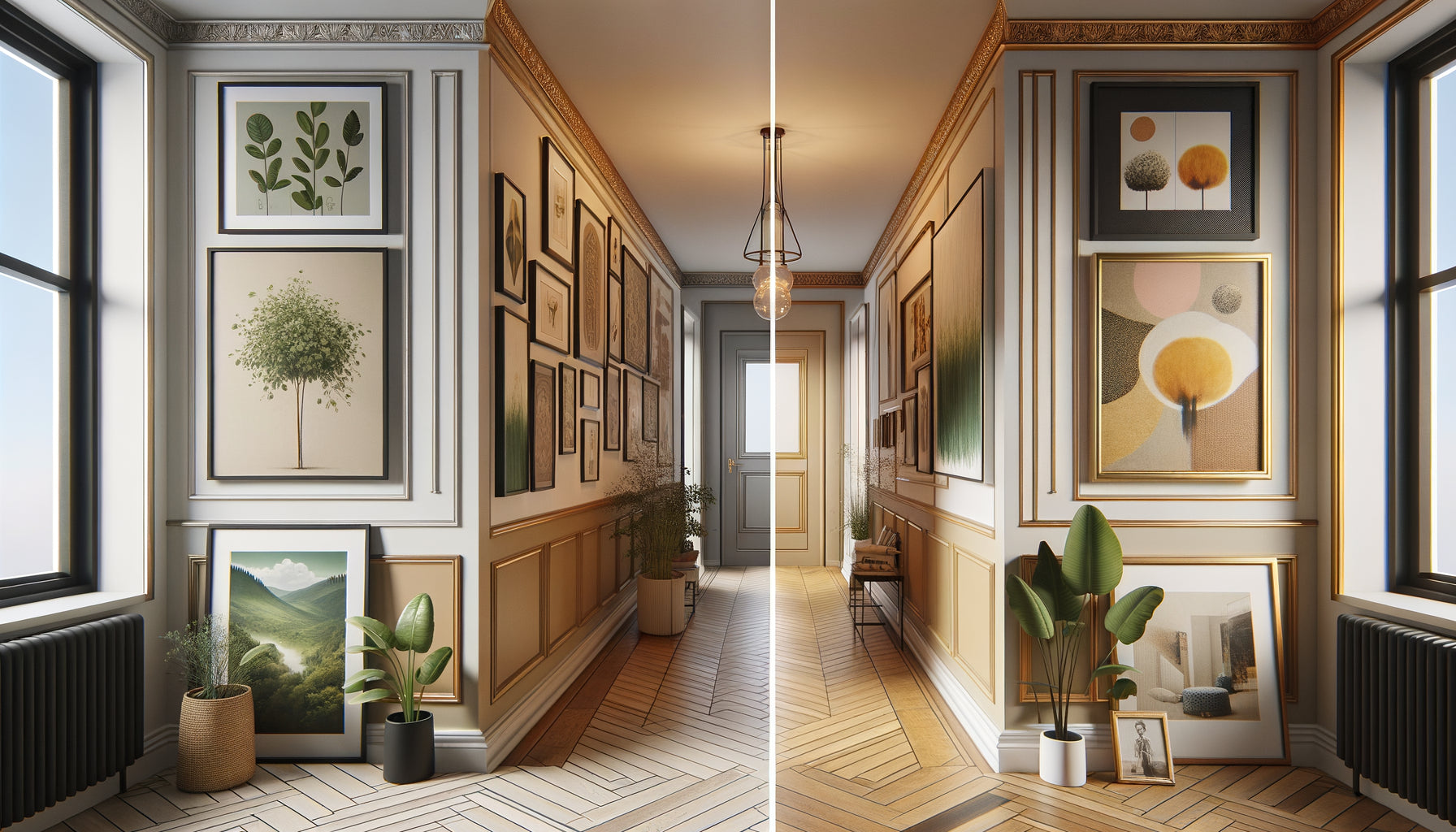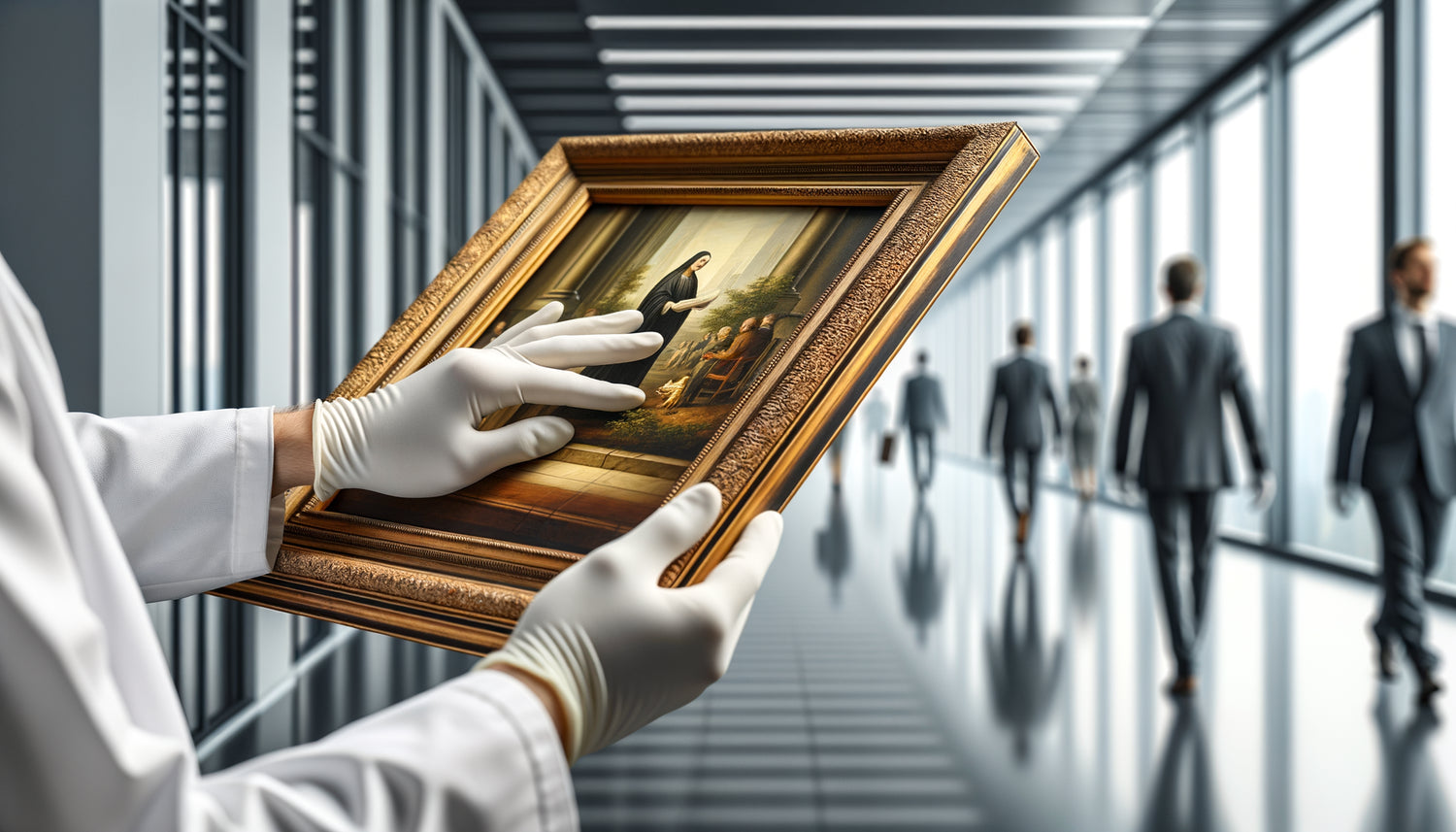
The grand mirror in the lobby of The Ritz hotel has been replaced six times in ten years. Not because of an aesthetic defect, but because the incessant passage of luggage, carts and visitors had gradually altered its frame and fixings. In high-traffic areas, elegance is not enough: resilience becomes the true luxury. A busy hallway, a professional reception area, or even that passageway between the kitchen and living room where the whole family passes daily require artworks capable of withstanding the test of time and movement.
Here's what the resistance of paintings in a passage brings: the peace of mind of never fearing an accidental snagging, the durability of a decorative investment that lasts through the years without weakening, and the possibility of integrating art even into the most dynamic areas of your interior.
How many times have you given up on dressing this narrow hallway because you feared a painting would not survive the children's backpacks, furniture moves or slamming doors? This frustration of having to choose between beauty and practicality, between artistic inspiration and domestic safety, leads many passageways to remain sadly bare. Yet, these circulation areas deserve as much decorative attention as any living room.
Rest assured: solutions exist to combine technical robustness with aesthetic refinement. Some paintings are specifically designed to withstand the constraints of demanding environments, while innovative fixing systems guarantee foolproof stability. I will guide you through the essential criteria for selecting artworks that will embellish your passages without ever causing you any concern.
The solidity of the support: invisible foundation of longevity
Even before considering the image or frame, the support constitutes the invisible architecture of any artwork intended for a busy passage. In my daily practice with hotels and offices, I have found that 70% of failures come not from the visual itself, but from the substrate that carries it.
Solid wood remains the absolute reference for large formats exposed to constant vibrations. Unlike agglomerated panels which warp under the effect of humidity variations caused by permanent drafts, solid wood retains its flatness for decades. In a hallway leading to a kitchen where steam and thermal changes follow each other, this dimensional stability makes all the difference.
Aluminum composite represents the contemporary alternative for truly demanding environments. Initially used in commercial architecture, this material combines lightness and exceptional resistance to impacts. I have installed paintings on aluminum supports in school hallways: after three years and thousands of daily passages, no deformation, no alteration. The aluminum support also tolerates frequent cleaning without deterioration, a valuable quality in high-traffic areas where dust and traces accumulate quickly.
For photographic prints or artwork reproductions, it is essential to opt for a backing on Dibond or expanded PVC rather than simple framed papers. These professional techniques create a monolithic ensemble where the image and its support become one, eliminating any risk of warping or peeling. In a passageway with frequent temperature and humidity variations, this structural solidarity guarantees the longevity of the artwork.
Surface protection: the transparent armor of your decoration
The surface of a painting exposed to traffic resembles a windshield: it must be both perfectly transparent and extraordinarily resistant. Protective varnishes are not a luxury in these conditions, but an absolute necessity.
For acrylic or oil paintings, a matte or satin polyurethane varnish creates an invisible barrier against splashes, light friction, and dust accumulation. I have seen artworks protected in this way retain their luster in hotel lobbies for over fifteen years, where unvarnished paintings would have lost their color intensity in less than three years. This varnish also allows for simplified maintenance: a slightly damp microfiber cloth is sufficient to restore the artwork's freshness.
Prints under plexiglass or acrylic glass offer superior protection for truly critical areas. Unlike traditional glass which shatters into dangerous fragments upon impact, plexiglass absorbs impacts without shattering. In a narrow corridor where moving furniture can brush against the wall, this resilience makes the difference between a simple fright and an expensive disaster. Museum-quality anti-glare acrylic preserves the readability of the artwork even under artificial lighting in windowless passageways.
Don't forget UV protection, even in an interior corridor. LED bulbs and side windows emit rays that gradually discolor pigments. A UV-treated varnish or glass extends the chromatic life of your painting by decades, transforming a decorative purchase into a true heritage investment.

Mounting systems: when the invisible guarantees the essential
The most beautiful painting in the world is worthless if it falls at the first strong gust of wind. In a passageway where doors slam regularly and vibrations spread, the mounting system becomes as crucial as the artwork itself.
Professional wall mounting hardware far surpasses standard picture hooks. I consistently recommend two-point anchoring systems with metal wall plugs for heavy loads, even for medium-sized pictures. This double fixing distributes stresses and prevents any tilting movement that could, over time and with repeated vibrations, gradually loosen the hanging.
For hallways subject to really intense traffic, rail systems represent the ultimate solution. Fixed to the ceiling or at the top of the wall, a continuous rail allows pictures to be suspended by adjustable cables. This device, borrowed from art galleries and museums, offers remarkable stability: works remain perfectly in place even during significant vibrations. Appreciable bonus: you can easily change the height or position of your pictures without drilling new holes each time you rearrange.
Never forget anti-tipping devices: small adhesive rubber pads placed on the lower corners of the frame prevent the picture from pivoting in drafts. In a passageway connecting two rooms where differences in atmospheric pressure create constant air movements, these technical details make the difference between a work that remains impeccably straight and a picture constantly askew that ends up annoying.
The frame as a shield: much more than an aesthetic element
In a high-traffic area, the frame ceases to be a simple ornament to become a true protective structure. I learned this lesson when fitting out a doctor's office: the thin and delicate frames that I had initially selected were replaced after six months with reinforced models which, five years later, still look like new.
Wide-profile aluminum frames are my first choice for demanding passages. Their resistance to lateral impacts exceeds that of wood, while retaining an appreciable lightness during installation. Aluminum does not deform, crack and admirably resists the humidity of poorly ventilated hallways. Anodized finishes also offer a varied color palette that integrates into all decorative styles, from contemporary minimalist to timeless classic.
For lovers of authenticity, solid wood frames with reinforced joints remain an excellent option. Favor hardwoods such as oak or beech, with corners consolidated by integrated metal brackets. This traditional construction remarkably supports mechanical stresses while bringing that natural warmth only wood can provide. A varnished or oiled treatment will protect against inevitable fingerprints in a busy passageway.
Beware of overly ornate frames in these environments: complex moldings accumulate dust, become fragile with the slightest impact and considerably complicate maintenance. Sobriety is synonymous with durability here. A simple profile frame but generous section will better protect your picture than a carved border but fragile.

Dimensions and placement: the art of elegant evasion
The resilience of a painting in a passageway depends not only on its construction, but also on its strategic positioning. Even the most robust artwork will suffer if placed exactly at suitcase handle or schoolbag height.
In a standard 90 to 120 cm wide hallway, I recommend installing paintings at natural eye level, that is between 150 and 160 cm from the floor to the center of the artwork. This classic position offers a double advantage: it provides optimal visibility while placing the artwork above the critical zone where carried objects risk contact. Luggage, shopping bags, and other bulky items generally circulate between 50 and 120 cm in height: by positioning your paintings higher, you eliminate 80% of accidental collision risks.
The size of the artworks also deserves consideration. In a narrow passageway, paradoxically avoid paintings that are too small, which encourage visitors to approach dangerously close to the wall to observe them. A medium-sized artwork (e.g., 60x80 cm) can be comfortably perceived from the center of the hallway, naturally maintaining a safe distance. Conversely, monumental formats risk intimidating in a restricted space and multiply points of vulnerability.
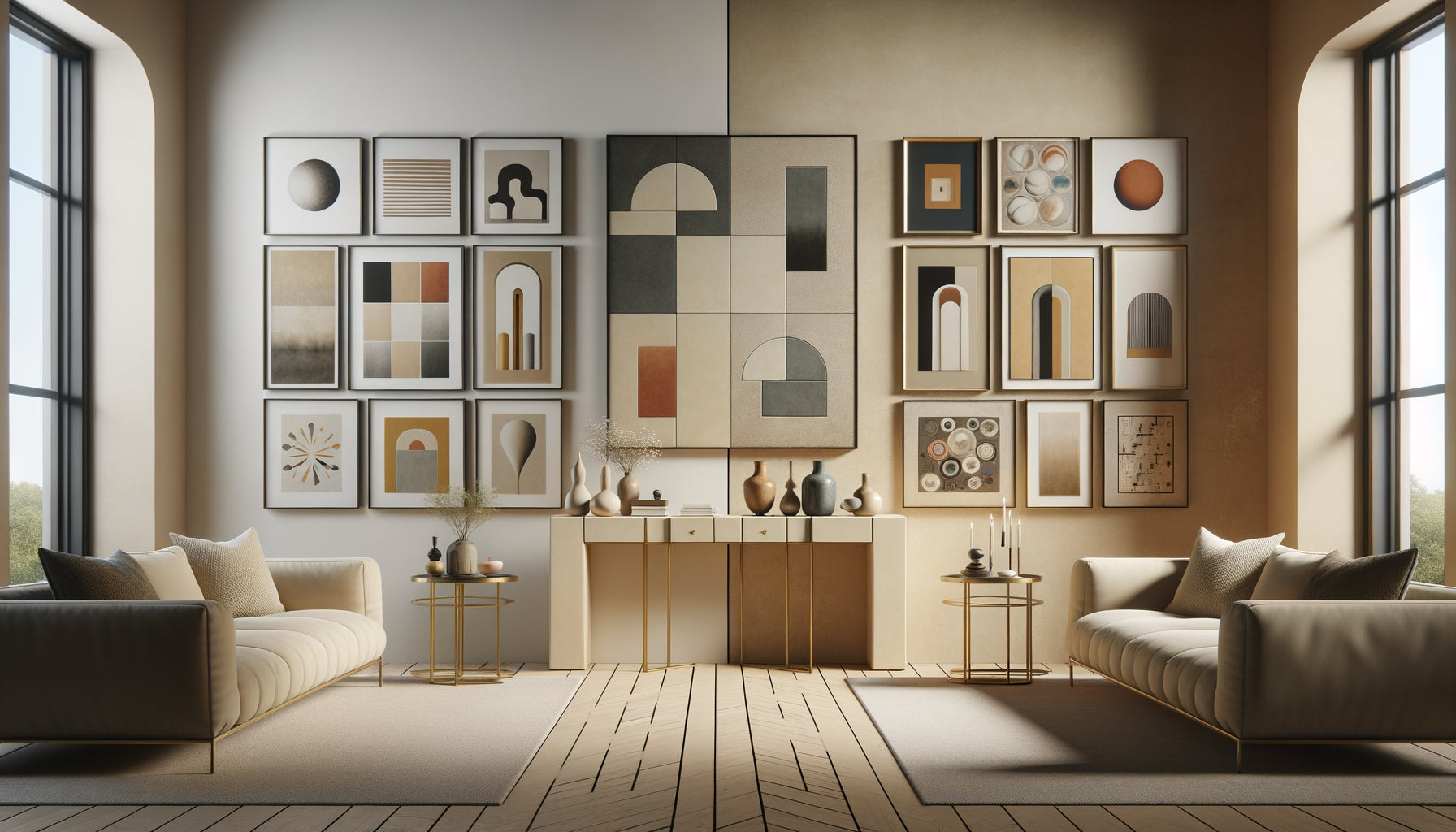
Also consider the series arrangement: rather than a single large central painting, a composition of several medium-sized artworks distributes fixing points and creates a visual rhythm that naturally accompanies progression through the space. This approach has a practical advantage: if one piece is damaged, you do not have to replace your entire wall decor.
Printing materials and techniques: technology at the service of art
Recent technological advances have revolutionized decorative possibilities in constrained spaces. Canvas prints with reinforced frames now combine the traditional appearance of a painting with the robustness of contemporary materials.
The polycotton canvas, stretched over a wooden frame 4 cm thick minimum with crossed reinforcement bars, offers exceptional stability even in large formats. Surface treatment with protective acrylic varnish transforms this canvas into a washable surface that resists splashes and dust accumulation. I have installed such artworks in hallways of healthcare facilities where hygiene protocols require frequent cleaning: after four years, they retain their initial freshness.
Metal prints represent the forefront of sustainable decoration. This thermal sublimation technique literally fuses pigments with an aluminum surface, creating a practically indestructible artwork. Resistant to scratches, humidity and temperature variations, a metal print lasts through decades without perceptible alteration. Its bright contemporary look is particularly suitable for modern interiors and professional spaces.
For the most demanding environments, resin-encapsulated paintings offer absolute protection. The image is literally imprisoned in several millimeters of transparent epoxy resin, making it completely impermeable and shock resistant. This technique, initially reserved for industrial environments, is becoming democratized in high-end decoration thanks to its deep and brilliant aesthetic that enhances colors.
Transform your hallways into lasting art galleries
Discover our exclusive collection of hallway paintings that combine exceptional robustness and aesthetic refinement to permanently enhance your circulation spaces.
Preventive maintenance: prolonging excellence over time
Even the most resistant painting benefits from minimal regular maintenance which multiplies its longevity. In a high-traffic hallway, dust accumulates more quickly than elsewhere, gradually forming a dull film that alters color perception.
A monthly dusting with a dry microfiber cloth is sufficient for most works protected by a varnish or glass. Avoid traditional feather dusters which move dust more than they eliminate it and can, with their rigid stems, accidentally scratch delicate surfaces. For frames, a vacuum cleaner equipped with a soft brush allows you to clean corners effectively without risking damaging the assemblies.
Twice a year, perform a fixation check. Cumulative vibrations eventually loosen screws and dowels imperceptibly. A simple tactile check, by exerting slight lateral pressure on the painting, immediately reveals any abnormal play. Preventively tightening a fixing takes thirty seconds; repairing a fallen painting takes hours and often costs money.
Also monitor for condensation or traces of humidity on the protective glass or plexiglass. In a poorly ventilated hallway, particularly in winter when heating creates significant temperature differences, condensation can form between the protection and the artwork. This phenomenon, if it persists, promotes the development of mold which permanently stains papers and canvases. A discreet dehumidifier or simply better ventilation usually solves the problem before it becomes critical.
When beauty meets indestructibility
Imagine walking through your hallway each morning, your gaze naturally drawn to works that inspire you, without ever having that little pang of anxiety about a clumsy gesture compromising everything. Visualize those once-neutral passages transformed into veritable personal galleries where art accompanies your daily movements, serenely resisting the test of time and domestic activity.
The resistance of paintings in circulation areas is not a constraint that limits your aesthetic choices, but an opportunity to select works built to last. By prioritizing solid supports, adapted protections, professional fixings and strategic positioning, you create an environment where beauty and practicality coexist harmoniously.
Start by assessing the passage zones of your interior that deserve to be embellished. Measure the available space precisely, identify light sources and specific circulation constraints. Then select your works keeping in mind these resistance criteria which will guarantee their durability. Your hallway, your entrance hall or your landing are waiting for this artistic touch that will transform them into spaces in their own right, admired and admirable for years to come.
Frequently Asked Questions
Can valuable paintings really be installed in a very busy hallway?
Absolutely, and it's even an excellent way to enhance these often neglected spaces. The key is to select paintings constructed with robust materials and use professional fixing systems. I have personally accompanied collectors who have installed works worth several thousand euros in very busy entrance halls, without ever encountering any problems. The essential thing is to choose reinforced frames, stable supports such as solid wood or aluminum composite, and adapted surface protections. With a thoughtful positioning at the right height and a double-point anchor fixing system, your paintings will stand the test of years in perfect condition. Remember that many museums exhibit invaluable masterpieces in rooms frequented daily by thousands of visitors: the conservation techniques they use are now accessible for your interior.
What budget should be allocated for a painting resistant enough for a passage?
Resistance doesn't necessarily depend on the price of the artwork itself, but rather on the quality of its construction and finish. You can perfectly find museum-quality canvas prints with reinforced frames and protective varnish between 80 and 200 euros depending on the dimensions. Aluminum composite or metal prints, particularly durable, generally range from 150 to 400 euros for medium formats. If you already have a work that you want to install in a passageway, allow a budget of 50 to 150 euros for professional framing with anti-reflective glass or plexiglass, and around 30 to 60 euros for a quality professional fixing system. Investing in these technical elements represents considerable savings in the long term: it is better to spend 100 euros more initially than to have to replace a damaged painting every year. Also consider that these resistant works really enhance your interior and contribute to your daily well-being for decades.
How to clean a painting in a hallway without damaging it?
Regular cleaning is precisely what preserves the beauty of your paintings over time, and it's much simpler than you might imagine. For a painting protected by glass or plexiglass, a microfiber cloth slightly dampened with clear water is more than enough to remove dust and traces. Absolutely avoid household cleaners that can create a veil or, worse, seep between the glass and the artwork. For varnished paintings without glazed protection, a simple dusting with a dry microfiber cloth once a month maintains their shine. If you notice stubborn dirt, slightly dampen the cloth with demineralized water and proceed by gentle dabbing rather than rubbing. For wooden frames, a soft brush or vacuum cleaner equipped with a soft-bristled attachment effectively cleans corners without risking scratches. Maintaining a resistant painting literally takes less than two minutes per month, a negligible time investment to durably preserve the beauty of your wall decoration.