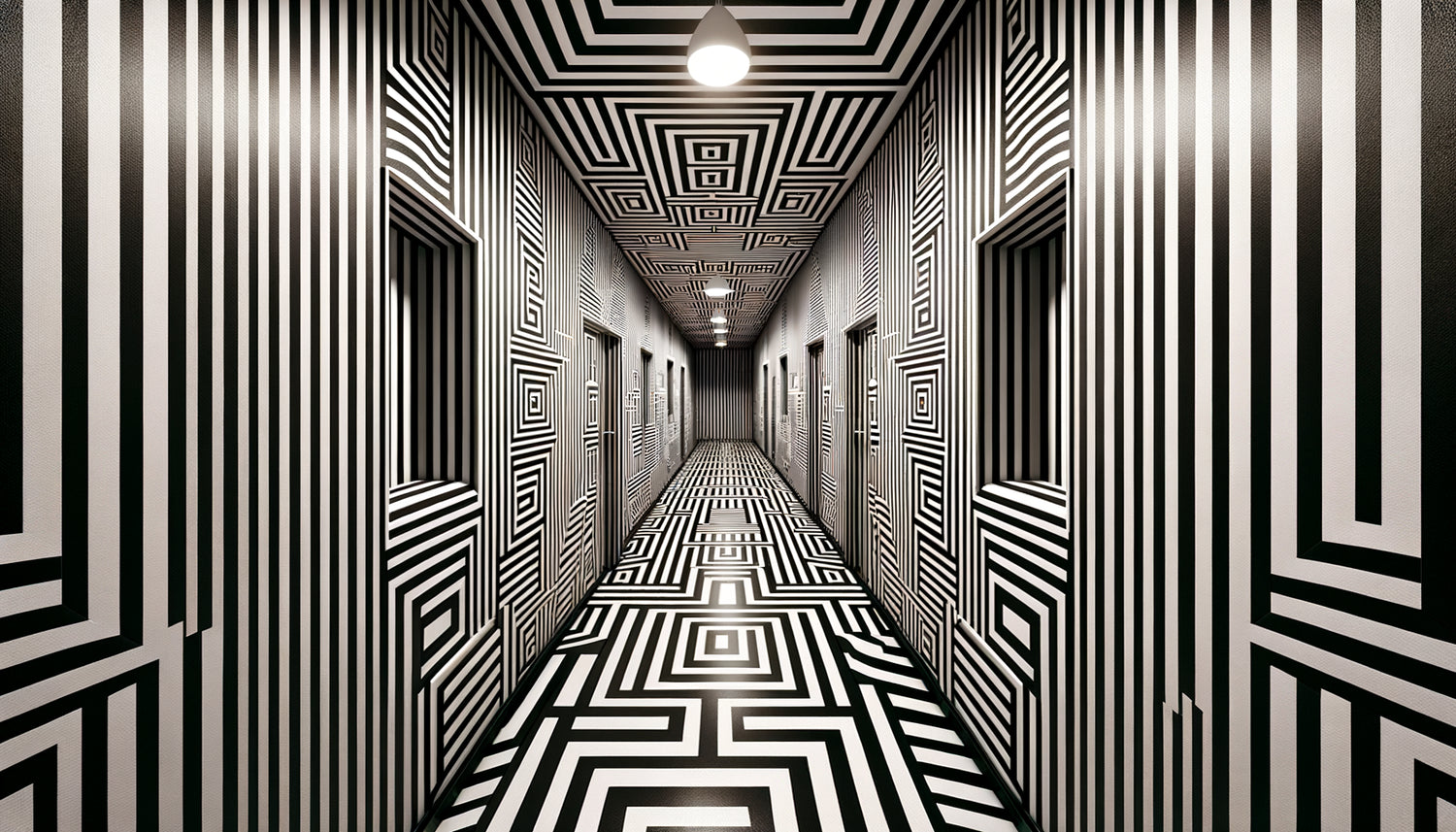
I still remember that endless hallway in an apartment in the 16th arrondissement. My client had tried to brighten up the space with a geometric wallpaper pattern. The result? A real visual ordeal every time you passed through it. Guests literally avoided using this corridor, which had become a source of discomfort. This experience taught me a fundamental lesson: in a linear space, the choice of patterns can transform an elegant passage into an oppressive tunnel.
Here's what the right pattern choices bring to a linear space: a smooth and soothing flow, a sense of natural light that visually expands the space, and timeless elegance that enhances every square foot of your interior.
You have probably already felt this dizziness when crossing certain hallways, these narrow passages where the walls seem to press in on you from all sides. This discomfort is not by chance: it is the result of decorative choices that amplify the structural flaws of these spaces. Rest assured, this problem has concrete and elegant solutions.
In this article, I will reveal the patterns to absolutely avoid in order to preserve the visual harmony of your linear spaces, and how to create a serene atmosphere that transforms each passage into an enjoyable experience.
Horizontal stripes, false friends of narrow hallways
Contrary to popular belief that horizontal stripes would widen a space, these patterns create a visual crushing effect in linear passages. I have observed this phenomenon in about ten projects: horizontal stripes fragment the perspective and transform a hallway into a succession of bands that tire the eye.
The problem lies in the repetition of the pattern over an extended distance. Your gaze naturally tries to follow the lines, creating a visual movement contradictory to your physical displacement. This dissonance generates a subtle but persistent feeling of discomfort.
High-contrast black and white stripes are particularly dizzying. They create a optical vibration that your brain struggles to process, especially in motion. This visual fatigue intensifies when natural lighting is limited, a frequent situation in linear spaces.
The problematic case of repetitive vertical stripes
While vertical stripes may seem theoretically more appropriate to enhance height, their multiplication along the length of a hallway produces an effect of bars that is oppressive. The linear space becomes a visual cage where each vertical band accentuates narrowness rather than attenuates it.
Complex geometries and op art patterns: sensory overload
Complex geometric patterns represent the most dangerous trap for a linear space. Intersecting chevrons, interlocking hexagons, perspective diamonds: these sophisticated compositions overwhelm the gaze in a hallway where the eye is constantly searching for a point of rest.
I've noticed that op art-inspired patterns, with their illusions of depth and perspective tricks, dramatically amplify the dizzying sensation. These designs intended to disrupt perception work remarkably well... perhaps too well in a passageway where you circulate daily.
The pattern density plays a crucial role. Wallpaper covered in small repeating triangles creates an aggressive visual texture that transforms your walls into a vibrant surface. This constant agitation mentally exhausts, even if you don't immediately realize it.
Trompe-l'oeil patterns simulating 3D effects are another source of visual confusion. Your brain constantly strives to interpret the illusory depth, generating an unnecessary cognitive load during a simple movement around your home.

Checkerboards and tiles: when regularity becomes a trap
The checkerboard pattern paradoxically embodies classic elegance and visual nightmare in a linear space. This strict alternation of contrasting squares creates a stroboscopic rhythm that assaults the retina, especially when moving quickly.
Small tile sizes amplify this phenomenon. The smaller the motif, the more your eye works to distinguish details, creating an insidious eye fatigue. This multiplication of contrasts transforms your hallway into a hypnotic grid where the gaze finds no rest.
I particularly noticed this problem with checkerboard floors in narrow hallways. Perspective accentuates the undulating effect of the pattern, giving the impression that the floor is moving beneath your feet. This sensation can even cause slight dizziness in sensitive individuals.
The tunnel effect of perspective tiles
When tiles are laid creating forced perspective towards a vanishing point, the linear space transforms into an accelerated tunnel. This illusion, seductive on paper, generates a visual suction sensation that can destabilize during repeated passages.
Dense florals and saturated organic patterns
Wallpaper with dense floral compositions, with their profusion of flowers, foliage, and ornaments, creates a visual jungle in linear spaces. This abundance of organic shapes prevents the eye from circulating freely, keeping it prisoner of an oppressive decorative clutter.
The problem intensifies with jungle or lush forest-like patterns. These dense compositions, beautiful in a spacious living room, transform a hallway into overwhelming vegetation that psychologically reduces the available space.
High-contrast floral motifs, especially those combining dark flowers on light backgrounds or vice versa, create a constant visual tension. Each element of the pattern attracts attention, fragmenting your field of vision into multiple competing focal points.
I've noticed that a dense floral motif can visually reduce the perceived width of a hallway by 20 to 30%. This impression of narrowing comes from the saturation of the visual field which leaves no room for your gaze to breathe.

Repetitive ethnic motifs and tribal patterns
Ethnic motifs, with their repeated symbols and ritual geometries, possess a captivating cultural intensity. However, this richness becomes overwhelming in a linear space where the repetition of the pattern unfolds over several meters without interruption.
African, Aztec or Maori tribal motifs often feature angular elements and marked contrasts that create an aggressive dynamism. This visual energy, perfect for a single accent wall, becomes dizzying when it accompanies your entire movement.
Ikat patterns, with their blurred outlines and offset repetitions, generate a particular visual instability. Your brain constantly tries to find the perfect alignment that does not exist in this type of motif, creating a subtle but exhausting perceptual frustration.
The symbolic overload of multi-layered motifs
Some ethnic motifs superimpose multiple layers of symbols, creating a narrative density that overwhelms the linear space. This semantic complexity adds to the visual complexity, doubling the dizzying impact of the pattern.
Transform your hallway into an elegant and soothing gallery
Discover our exclusive collection of wall art for Hallway that create refined focal points without visually weighing down your linear space.
Towards Visual Harmony in Your Linear Spaces
Imagine walking through your hallway tomorrow morning, in that soft early light. Your walls breathe, your gaze naturally glides along soothing surfaces. No tension, no dizziness, simply an elegant fluidity that transforms this utilitarian passage into a harmonious transition between your living spaces.
This transformation begins with a conscious choice: to prioritize serenity over decorative overload. Opt for spaced motifs, nuanced tones, and light vertical compositions that guide the eye upwards rather than trapping it in a dizzying horizontal repetition.
Start by observing your linear space with a fresh eye. Identify patterns that create visual fatigue, then consider gentler alternatives. Your hallway deserves to become that serene gallery you walk through with pleasure, not that grueling tunnel you unconsciously avoid. True beauty lies in balance, not excess.
Frequently Asked Questions About Patterns in Linear Spaces
Can I use polka dots in a narrow hallway?
Polka dots can work in a linear space, but their size and density are crucial. Large polka dots, generously spaced on a neutral background, create a gentle visual rhythm that doesn't overwhelm. Conversely, small, tightly packed dots generate a vibrating texture similar to the problematic patterns mentioned earlier. Opt for polka dots 8 to 15 centimeters in diameter, with spacing at least equal to their size. Contrast also plays a role: tone-on-tone polka dots are infinitely more restful than black polka dots on a white background. The trick is to create a subtle visual rhythm rather than an aggressive repetition. If you're unsure, test a sample over several meters before committing.
Are stylized plant motifs acceptable in a linear space?
Absolutely, provided they are clean and airy. Stylized plant motifs, with spaced graphic leaves or elegant stems on a neutral background, offer a decorative solution that avoids the dizzying effect. The key is to simplify the design and the space between the elements. A stylized monstera leaf motif, for example, creates an elegant vertical rhythm without saturating the visual field. Avoid compositions where elements overlap or create a dense mass. Prioritize motifs where the background occupies at least 60% of the total surface area, allowing your gaze to breathe. Monochromatic or two-tone shades work better than multicolored compositions in these spaces.
How can I tell if a pattern will create a dizzying effect before installing it?
Here is a simple method that I consistently use: request a large sample of the pattern (at least 50x50 cm) and position it in your linear space. Step back several meters and walk towards it at normal speed. If your gaze is uncomfortably drawn or if you feel visual tension, the pattern is too intense. Photograph the sample with your phone and observe the photo: contrast and repetition problems often become more obvious through the lens. Also test with different lighting conditions, as natural and artificial light significantly alter the perception of patterns. Finally, ask for the opinion of an outside person: we sometimes develop visual habituation that prevents us from objectively perceiving the impact of a pattern.