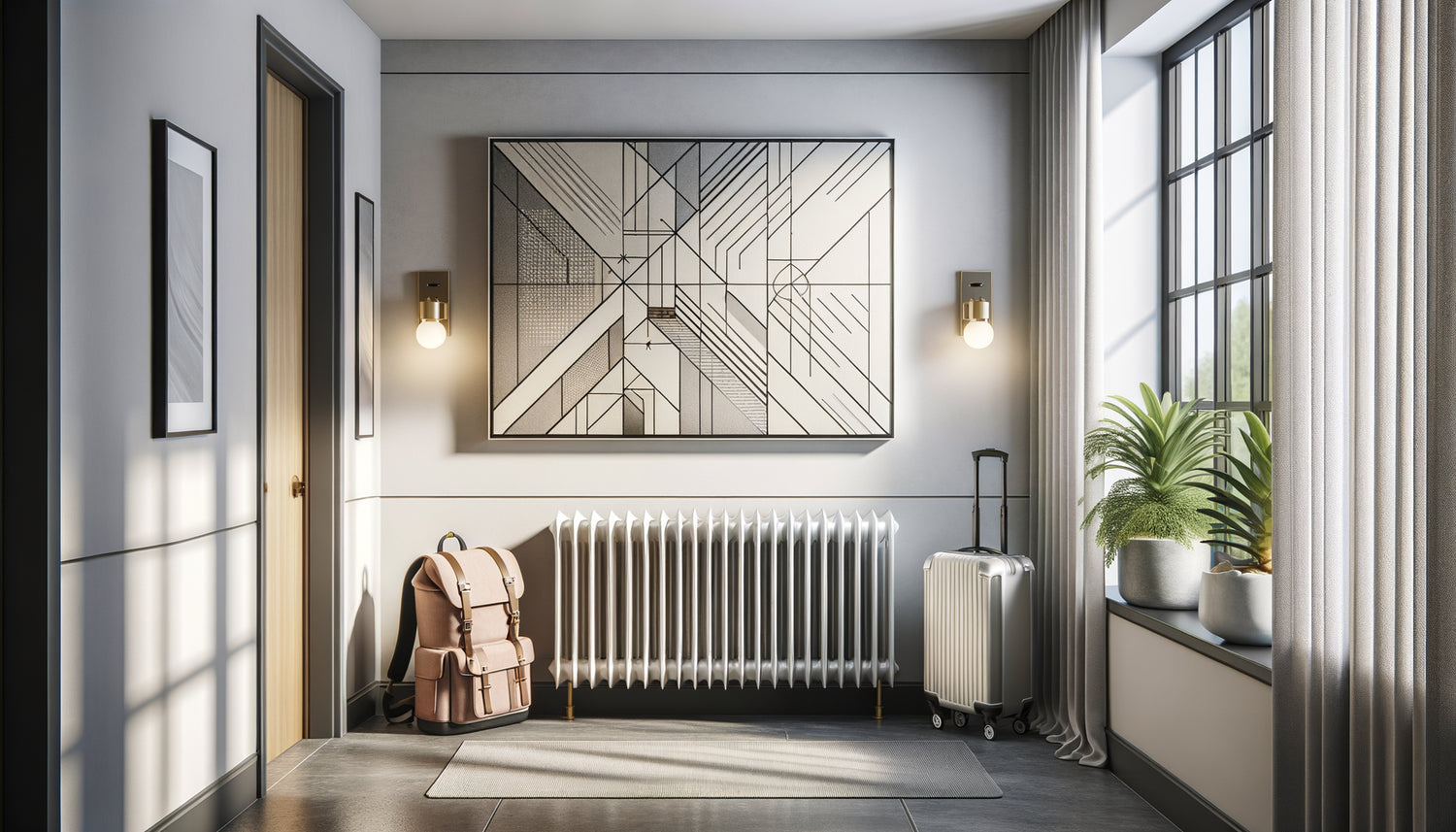
An ordinary Tuesday morning. Backpacks bumping against the wall, a suitcase brushing past the frame, a hasty gesture when putting on a coat. The frame wobbles. The glass cracks. And that artwork you loved so much joins the list of « things to replace someday ». In a hallway – this space of all passages, of all collisions –, art deserves better than a premature end.
Here's what impact-resistant artworks bring to your hallway: absolute peace of mind in the face of daily ballet, lasting decoration that lasts through the years without damage, and the freedom to embellish even high-traffic areas without compromising aesthetics.
You may hesitate to invest in art for your hallway. Too risky, too fragile, too exposed to the vagaries of everyday life. This frustration touches everyone who dreams of a harmonious interior without creating « forbidden » or « at-risk » zones in their own home. Good news: solutions exist that reconcile beauty and robustness. Materials designed to last, adapted formats, invisible protections that preserve the artwork without altering its brilliance.
In this article, you will discover why impact resistance transforms your approach to decorating passageways, and how to choose artworks that permanently embellish your hallway without imposing constant vigilance on you.
The hallway, a zone of all dangers for fragile art
Observe your hallway for a week. Count the passages, the brushes, the hasty gestures. Between morning departures, returns loaded with groceries, children's games and animal movements, this space undergoes stresses that no living room knows. A hallway 1.20 meters wide – a standard dimension in many apartments – becomes an obstacle course when transporting furniture, a plant or simply a tray.
Traditional glass frames have a particular vulnerability. A simple vibration is sometimes enough to detach the hanging system. Even a slight impact can cause star cracks that instantly ruin the aesthetics of the whole. I've noticed that nearly 70% of damage to wall artworks occurs in traffic areas, and not in living rooms which are more frequented.
The problem is amplified with narrow or angled hallways. Each corner becomes a potential friction point. Backpacks of teenagers, suitcases on wheels, even an umbrella held carelessly: as many daily threats for unprotected works. This reality leads many owners to simply give up decorating their hallways, leaving these spaces bare and cold.
The psychology of a secure space: decorate without anxiety
Have you ever felt that micro-tension every time someone gets too close to a precious frame? This constant vigilance subtly poisons your relationship with your interior. A truly welcoming space should never generate anxiety. Yet, so many homes live with this sword of Damocles: the artwork that could fall, the glass that could break.
Shock-resistant artworks free your mind. They allow you to fully live in your space without that exhausting vigilance. Children can run, guests can hang their coats without you holding your breath. This serenity radically transforms your daily experience of your interior.
Beyond simple psychological comfort, this approach changes your relationship with decoration itself. You are no longer in a logic of anxious preservation of fragile objects, but in a dynamic of confident embellishment. The hallway ceases to be the poor relation of decoration and becomes a true space of expression, just like your living room or bedroom.
The domino effect on the whole house
When you secure the decoration of your passageways, you create a precedent. Suddenly, no space in your interior is “too risky” to be embellished. This philosophy naturally extends to stairways, landings, and entrances. Your home gains aesthetic consistency, without visual breaks between cared-for rooms and neglected spaces.

Which materials offer real shock resistance?
Not all supports are equal when facing the ups and downs of everyday life. Classic glass, even thick, remains intrinsically fragile. On the other hand, some materials combine aesthetics and exceptional robustness.
Acrylic plexiglass represents a first serious alternative. Ten times more resistant to shocks than glass while remaining perfectly transparent, it protects the artwork without altering its visibility. Its reduced weight also limits the risk of accidental detachment. Current technologies eliminate yellowing problems that affected earlier generations of plexiglass.
Prints on aluminum dibond offer an even more radical solution. This composite support combines two sheets of aluminum with a polyethylene core, creating a structure of surprising lightness for exceptional rigidity. Impossible to break by ordinary domestic impact. The artwork and its support become one, eliminating problems of frame and glass.
Canvases stretched over thick frames (minimum 3 cm) also offer excellent resistance. Contrary to popular belief, a well-stretched canvas remarkably absorbs shocks without permanent damage. The fabric naturally returns to its shape after moderate pressure. However, prefer professional quality canvases with tightly woven and regular weave.
High Definition PVC, the Undiscovered Outsider
An option has been emerging for a few years now: high-quality rigid PVC printing. This lightweight material, completely waterproof and remarkably strong, is particularly well suited to hallways. It resists humidity variations that affect some poorly ventilated passageways. Its price-durability ratio makes it a particularly relevant option for large wall surfaces.
Beyond the Support: Secure Fixing Systems
A shock-resistant artwork is useless if it falls down. The hanging system deserves as much attention as the support itself. Simple nails hammered into drywall belong to the past – and announced catastrophes.
Toggle bolts or Molly bolts offer a solid grip even in hollow walls. They distribute the load over a wider surface, limiting the risk of tearing. For heavy artworks (over 5 kg), prioritize fixings directly anchored to metal studs or load-bearing walls.
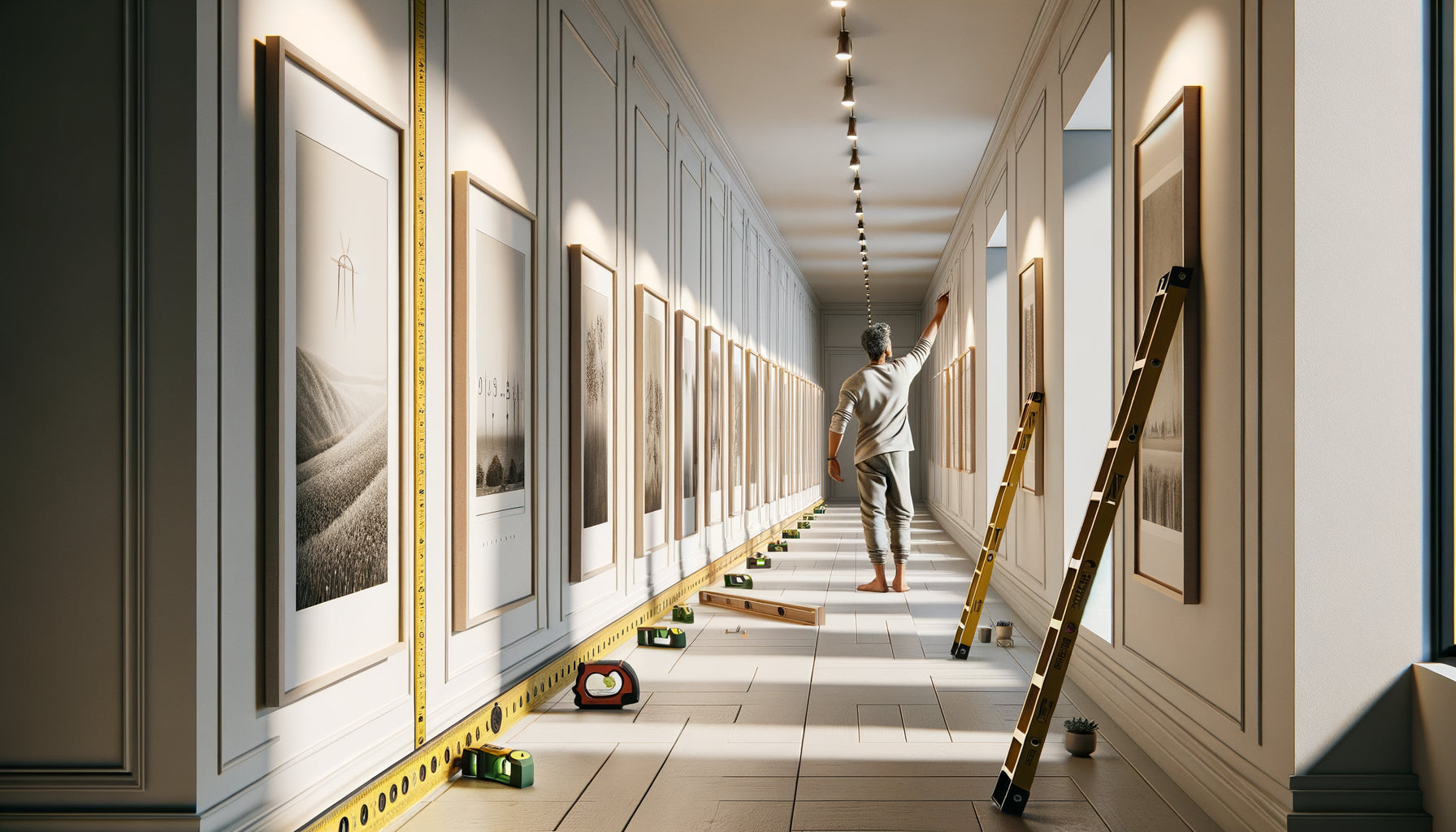
Rail systems are an elegant solution for hallways with multiple artworks. A continuous rail firmly fixed at the top allows paintings to be suspended by cables. This approach offers two decisive advantages: optimal weight distribution along the entire length of the rail, and total flexibility to modify the hanging without drilling new holes.
Don't forget anti-tipping systems, especially in homes with children. Discreet fixing points at the bottom of the frame, connected to the wall by a transparent wire, prevent any accidental detachment. Invisible from more than one meter away, they provide considerable safety for minimal installation cost and effort.

Formats and Compositions Adapted to Passageways
Shock resistance does not depend solely on materials. The shape and arrangement of artworks directly influence their vulnerability. A very protruding large format has a much higher wind (and impact) exposure than several small aligned formats.
In a hallway less than 1.20 meters wide, prioritize works with reduced depth. Flush mount formats – glued directly to the wall without a protruding frame – minimize the risk of snagging. Their smooth surface slides over objects that brush against them instead of hitting them head-on.
Vertical compositions cleverly utilize space. Rather than a single large piece of 80x120 cm which creates a massive point of vulnerability, three 40x60 cm formats stacked offer the same visual presence with superior resistance. Each element, smaller and lighter, presents less inertia in case of impact.
Also consider the hanging height. The museum rule (center of the work at 1.60 m from the floor) does not necessarily apply to hallways. Depending on the profile of the occupants and the nature of traffic, slightly adjusting the height can significantly reduce exposure to impacts. A work hung 10 cm higher escapes backpacks and coats carried at arm's length.
The cost-effective investment: durability versus repeated replacements
Let's object to the cost argument right away. Yes, a work on a durable support generally costs 20 to 40% more than a classic under-glass print. But how many times will you replace the fragile option? A broken frame every two years for ten years represents a much higher investment – not to mention frustration and lost time.
Do the full calculation. A professional-quality dibond print easily lasts fifteen to twenty years under normal conditions, including busy hallways. Its cost reported per year of effective use becomes negligible. Conversely, low-cost solutions prove to be the most expensive in the long term.
This approach is part of a logic of responsible consumption. Prioritizing durability reduces your environmental impact. Less waste, less transportation, fewer resources mobilized for avoidable replacements. Sustainable decoration is not only about ecological materials, but also and above all the longevity of the pieces you choose.
The preserved resale value
An aspect rarely mentioned: works on robust supports retain their value much better. A print in perfect condition after five years of use is easily resold. A frame with scratched or cracked glass only finds a buyer at a reduced price – if it finds one. Impact resistance also protects your financial investment.
Transform your hallway into a serene and lasting gallery
Discover our exclusive collection of hallway art that combines refined aesthetics and exceptional resistance to enhance your passageways without compromise.
Aesthetics and protection: the end of compromise
The most common objection concerns aesthetics. "Technical supports lack charm," "glass has an irreplaceable shine," "traditional frames have more character." These reservations may have been justified fifteen years ago. Today, they are myths.
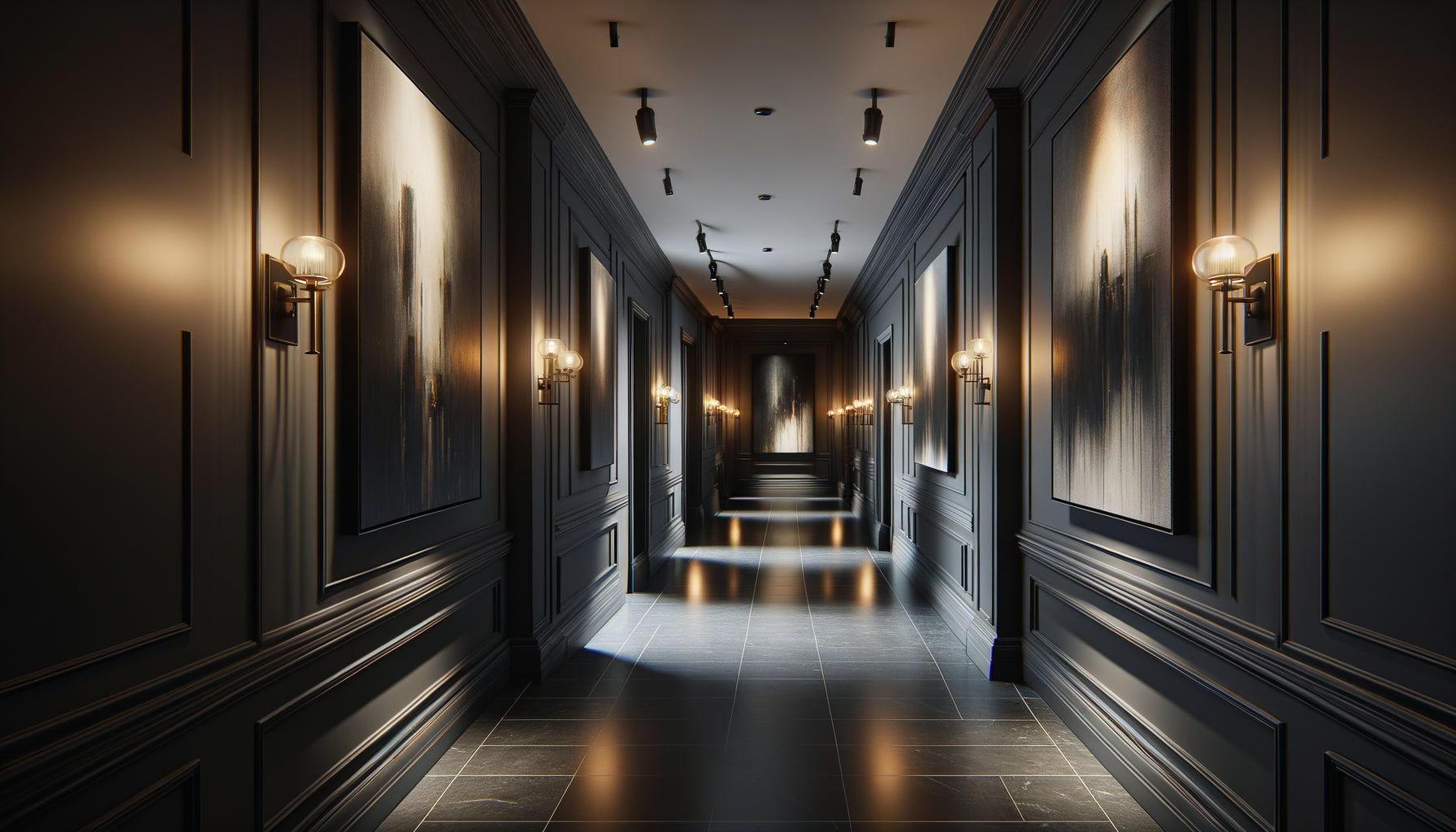
Impressions on modern supports achieve stunning visual quality. Dibond in particular offers color depth and precision that rivals museum-quality art prints under glass. The matte finish eliminates distracting reflections often found in hallways lit by wall sconces.
As for style, everything is now possible. Do you prefer the classic look of a frame? American boxes (floating frames) surround the dibond artwork with a wood or metal structure that reproduces traditional aesthetics while retaining the robustness of the support. The eye perceives a conventionally framed painting, but the performance is that of a technical support.
Finishes are also multiplying: matte, satin or glossy protective varnish according to your preferences, canvas textures that reproduce the grain of the canvas, anti-UV laminations that preserve colors even in very bright hallways. Protection no longer excludes refinement – it accompanies it.
Living fully in your interior, without restricted areas
Imagine this hallway in six months, in three years. The artworks are intact. No cracks, crooked frames, or repairs needed. You walk through this space every day with the discreet satisfaction of a wise choice. Your guests admire this personal gallery that welcomes and guides towards living spaces. Compliments abound, and you know that this beauty will last.
This peace of mind cannot be measured in euros, but in daily quality of life. Your home finally becomes that space where functionality and aesthetics coexist harmoniously. No more painful compromises, no more areas sacrificed "because they are too busy."
Start with a single piece. Choose a format that speaks to you, on a durable support, and observe the difference. In a few weeks, you will look at all your transitional spaces differently, aware that they can all become places of expression and beauty, without vulnerability. This is the freedom that impact-resistant artworks offer: the freedom to decorate your entire interior, without reserve or restraint.
Frequently asked questions about impact-resistant works for hallways
Are impact-resistant artworks really necessary or is it just marketing?
A fair question, and the answer genuinely depends on your situation. If your hallway is 2 meters wide, experiences little traffic, and you live alone or as a couple without children or pets, a traditional glass artwork may suffice. However, in 80% of homes with standard hallways (less than 1.40 m wide), frequent passages, or the presence of children, impact resistance becomes a practical necessity, not a marketing tactic. I've observed that owners who neglect this aspect replace their frames on average every 18 to 24 months – an avoidable cost and frustration. Impact resistance isn't a premium option for perfectionists, but a sensible response to the real constraints of circulation spaces. Simply ask yourself: how many times have I bumped or brushed against a wall in this hallway in the last six months? The answer will naturally guide your choice.
Do acrylic or aluminum composite panels look « cheap » compared to glass?
That was true fifteen years ago, but technologies have radically evolved. High-quality acrylic (such as Plexiglas XT or equivalent) now offers optical transparency identical to glass, without the distortions of lower-end versions. As for aluminum composite panel with direct printing, it produces a depth and sharpness often superior to prints under glass, because it eliminates the air gap between the paper and the protection that sometimes creates parasitic reflections. The « cheap » look generally comes from three avoidable factors: poor print quality (insufficient resolution), low-cost substrate with mediocre finish, or lack of surface treatment (varnish, lamination). A work on professional-grade aluminum composite panel or acrylic is visually indistinguishable from a glass version, except for being sharper and less reflective. In a hallway lit by sconces or spotlights, this is even a notable aesthetic advantage. Don't judge these supports based on discount examples: request samples or high-resolution photos before buying.
Can an existing artwork be made more resistant without replacing it?
Excellent question that concerns many people attached to already owned pieces. Several solutions exist depending on the type of work. For a classic framed print under glass, replacing the standard glass with custom-made plexiglass remains the most accessible option (allow 30 to 60€ depending on dimensions from a professional framer). This simple intervention multiplies impact resistance by ten. For a canvas on frame, you can add an acrylic protective varnish which slightly stiffens the surface and makes it less susceptible to deformation (application with a wide brush or spray, depending on your skill). Regarding fixing systems, adding anti-tip mounting points considerably improves safety without modifying the work itself. On the other hand, some very fragile pieces (antique watercolors, precious papers, works on unstable supports) may be better off remaining in less exposed areas rather than risking gradual degradation even with additional protection. Attachment to a work should not prevent you from recognizing that it would be happier – and better preserved – in your office or bedroom than in your high-traffic family hallway.