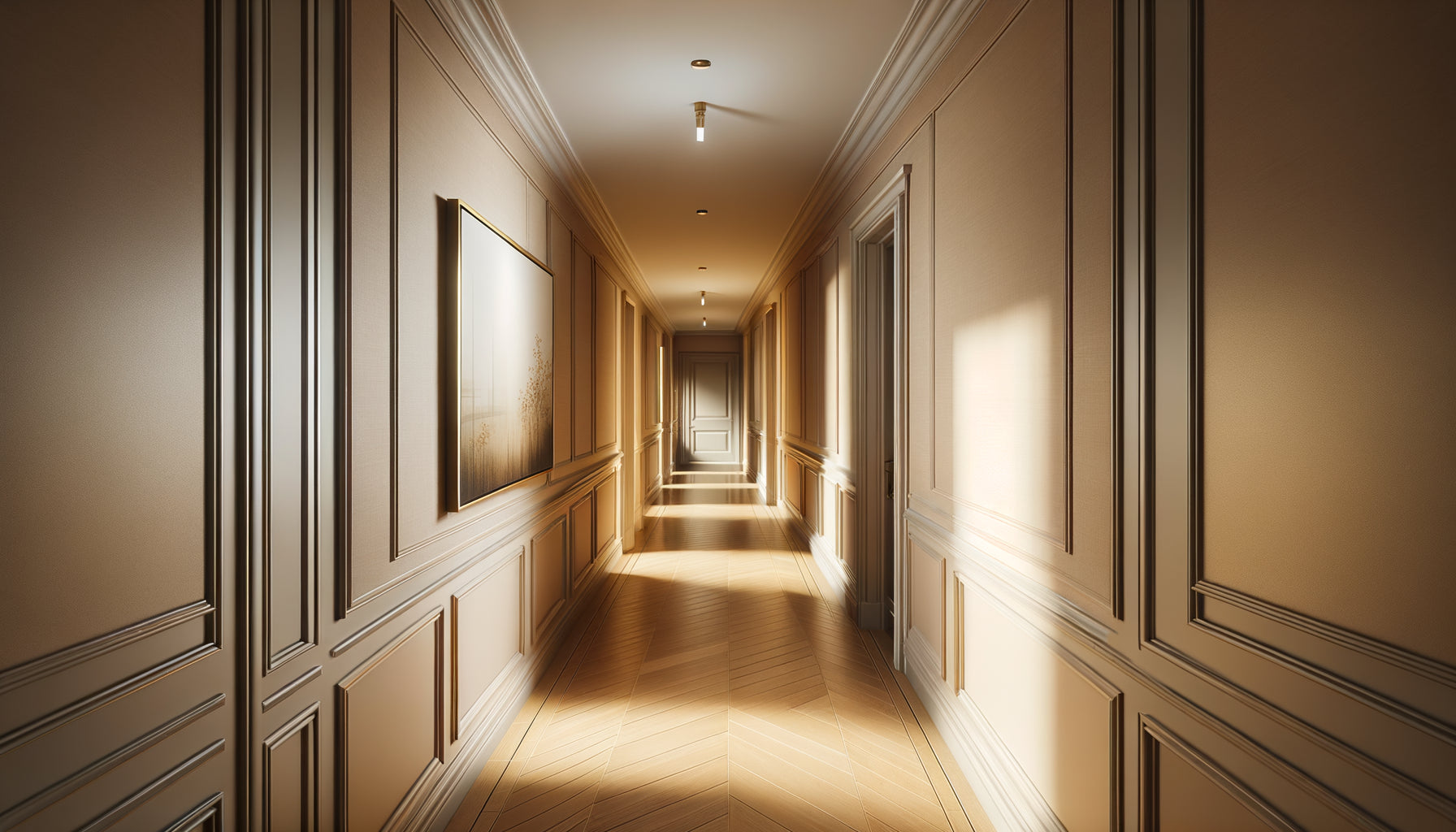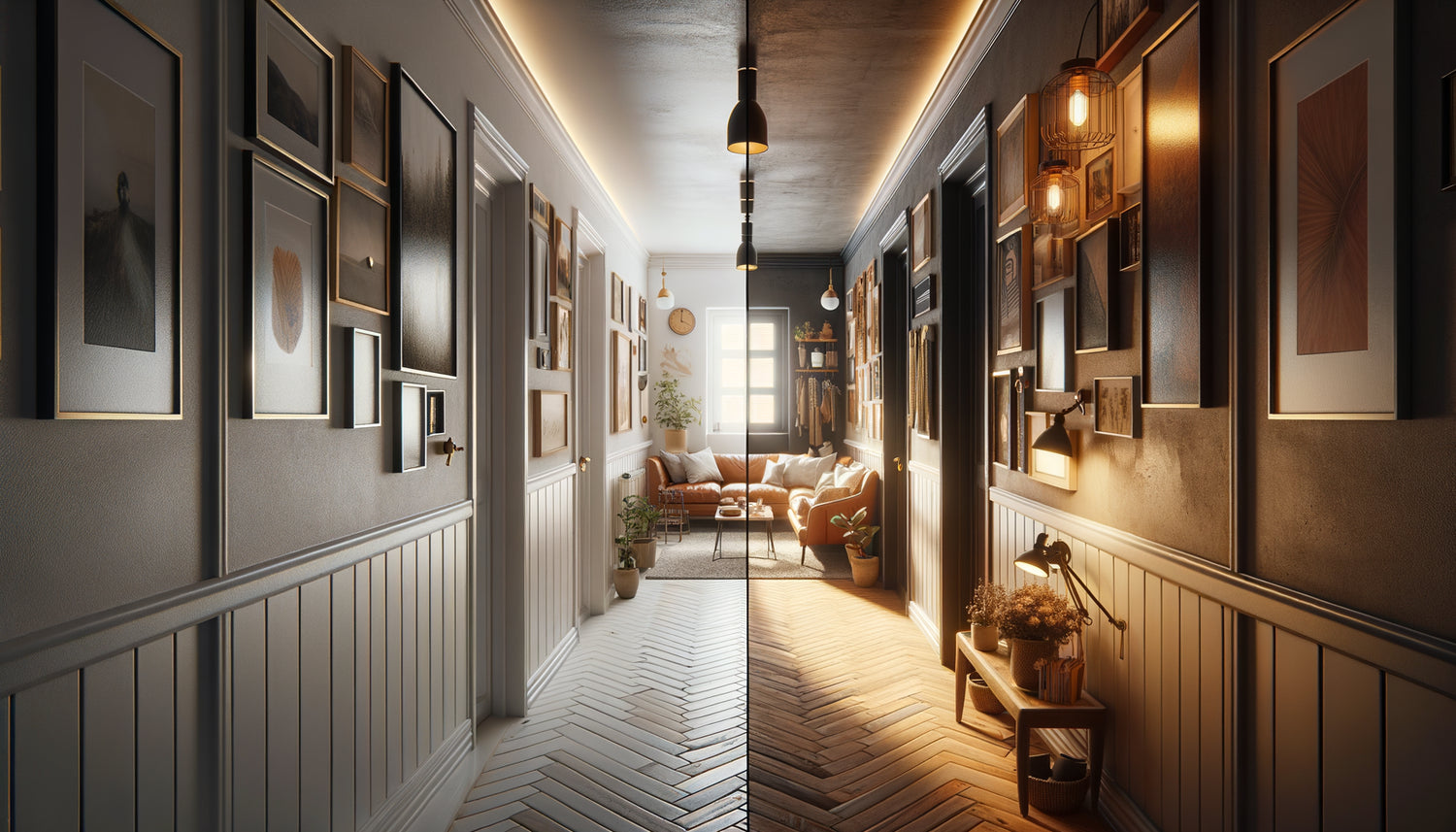
I remember this visit to a client in Paris, the owner of a magnificent apartment in the Marais. Each room was an ode to refinement: a light-filled living room, a cozy bedroom, an impeccable open kitchen. Then we walked down the hallway. A long narrow passage, bare white walls, cold lighting, a feeling of absolute emptiness. “I never know what to do with it,” she confided in me with an embarrassed smile. I’ve heard that sentence hundreds of times. Hallways are the forgotten spaces in our interiors, these transitional areas we walk through without noticing them, when they possess extraordinary decorative potential.
Here's what wall decor for hallways brings: it transforms a functional passage into a personal gallery, creates visual continuity between your rooms, and reveals square meters of character that were previously invisible.
Perhaps you too have this hallway that you consciously ignore. These few square meters of walls that remain desperately empty while you multiply the decorating projects in the living room. The feeling of waste when you realize that this surface could tell a story, but you don't know which one or how. You are not alone. The neglect of hallways in decoration is almost universal, and the reasons are deeper than they appear.
Good news: understanding why we abandon these spaces is the first step towards their metamorphosis. And believe me, a well-decorated hallway radically changes the perception of an interior. Ready to discover what lies behind this collective neglect?
The invisibility of transitional spaces
Hallways suffer from a fundamental problem: they do not exist in our decorative consciousness. When we imagine “decorating our home,” we immediately visualize the living room, the bedroom, perhaps the bathroom. Hallways? They are absent from this mental map. They are non-places, neutral airlocks whose sole function is to take us from one room to another.
This psychological invisibility is reinforced by our relationship with time. A hallway, we walk through it in a few seconds. Why invest time and money in a space where you don't “live”? This seemingly rational logic ignores a crucial reality: we walk through our hallways dozens of times a day. Added together, these micro-exposures represent a considerable amount of time spent in this neglected space.
I timed it: in a standard apartment, we accumulate between 15 and 30 minutes daily in the hallways. Over a year, that's more than 150 hours spent facing white walls. The missed opportunity is dizzying. Yet, this awareness is slow to come. Hallways remain those blind spots of our attention, these spaces that our brain automatically categorizes as “transient” and therefore “non-priority.”
The tyranny of architectural constraints
Let's be honest: hallways are objectively complicated to decorate. Unlike a spacious living room where you can play with volumes, hallways impose strict architectural constraints. Their narrowness is the first obstacle. How do you hang paintings in a passageway where you can’t even step back to appreciate the composition?
Natural lighting often lacks. Most hallways are blind, without windows, lit by sconces or spotlights that create shadows. This artificial light makes it difficult to appreciate colors and nuances. You hesitate: will this frame look the same under this pale lighting? Uncertainty paralyzes the decision.
The question of circulation
There's also this practical anxiety: not cluttering the passage. A hallway is narrow by definition. You carry boxes during a move, you pass with suitcases, children run through it. Installing wall decor seems risky. What if a frame fell? What if someone bumped into a relief painting? This fear of domestic accidents, even irrational, is enough to keep the walls bare.
Unusual proportions add another layer of complexity. Hallways are long and narrow, creating tunnel perspectives. What size painting should you choose? Should you align several or opt for a large piece? The rules that work in other rooms seem not to apply. Faced with these complex visual equations, many give up out of caution.

The hierarchy of decoration syndrome
Our budgets are not expandable. When it comes to investing in wall decor, an implicit hierarchy is imposed: we decorate the "noble" rooms first. The living room, where you receive guests and spend most of your time. The bedroom, a sanctuary of intimacy. Perhaps the dining room if you like to entertain.
Hallways come last on this mental list. After all, who will see them? Guests only pass through them, too busy discovering the main rooms. This logic of external gaze dominates our decorative choices. We decorate to show off, to impress, to create a social atmosphere. The hallway, an area of privacy par excellence, escapes these motivations.
I also observe a phenomenon of perpetual postponement. "I'll decorate the living room first, then I'll take care of the hallway." Except that “then” never really arrives. There’s always another priority: changing the sofa, remodeling the kitchen, arranging the balcony. Hallways wait indefinitely in a queue that never ends.
The lack of inspiring models
Open a decorating magazine. Browse through a furniture catalog. Scroll through Instagram or Pinterest. How many beautifully decorated hallways do you see? The answer is: very few. This absence of visual references perpetuates the vicious cycle of neglect.
Without inspiring models, it's difficult to project what a hallway could become. Our decorative imagination needs concrete examples, tangible proof that a space can be transformed. Specialized media focus their attention on large rooms, spectacular spaces, impressive volumes. Hallways, too ordinary, too modest, are rarely highlighted.
This media invisibility reinforces the idea that “there’s nothing to do” with a hallway. That it is an area definitively condemned to banality. Yet, some interior designers create absolutely exceptional gallery hallways. But these achievements remain confidential, confined to professional portfolios, rarely disseminated in mainstream channels.

The fear of a final choice
There is a specific anxiety associated with decorating hallways: the fear of making a mistake in a permanent space. In a living room, you can easily move a frame, rearrange a wall. The arrangement remains flexible. But a hallway, with its linear configuration and constraints, seems to require a definitive solution, carved in stone.
This perception amplifies the anxiety of choice. What style to adopt? Classic, contemporary, eclectic? And if the result doesn't please you? It’s impossible to easily “test” different options. The hallway then becomes the scene of decision-making paralysis. Rather than risking a visible mistake on a daily basis, it is preferable to maintain the safe status quo of the white wall.
The inhibiting perfectionism
I also observe what I call inhibiting perfectionism. Some clients have very specific ideas for their hallways: a gallery of family photos, a collection of antique engravings, a series of abstract works. But the idea must be « perfect », the composition « impeccable », the frames « perfectly matched ». This quest for the ideal prevents action. While waiting for the perfect configuration that never arrives, the walls remain empty.
Hallway wall decor also suffers from a lack of conceptual coherence with the rest of the interior. Should you extend the style of the living room or create a break? Opt for chromatic continuity or, conversely, mark a transition? These legitimate questions become obstacles when they do not find an obvious answer.
When the hallway becomes a personal gallery
Yet, hallways offer a unique opportunity: that of creating a true personal art gallery. Their linear configuration is ideal for visual storytelling, for telling a story that unfolds with each step. Imagine: a chronology of family photographs, a thematic collection that evolves gradually, a series of works that dialogue with each other.
Hallways are also the most intimate spaces in our homes. Unlike the living room exposed to outside views, they truly belong to us. We can display our passions without filter, our most personal memories, our most affirmed tastes. This is where decoration becomes authentically personal, freed from social conventions.
I have seen spectacular transformations: this hallway becoming a vertical library with narrow shelves and interspersed frames. This gallery of black and white portraits creating an English manor ambiance. This passage transformed into a cabinet of curiosities with botanical reproductions. Each time, the effect is striking: the neglected space becomes the most characteristic, the most memorable place in the apartment.
Ready to awaken your sleeping hallways?
Discover our exclusive collection of wall art for Hallway that transforms your passageways into true personal art galleries.
Start small, see big
The key to escaping the neglect of hallways? Start modestly without waiting for the perfect solution. A single frame can be enough to break the curse of the white wall. A small composition of three paintings already creates a visual dynamic. The important thing is to start the movement, to prove to your brain that this space deserves attention.
Embrace the initial imperfection. Your first attempt may not be definitive, and that is perfectly acceptable. Decoration is a living process, which evolves with you. This triptych that you hang today can be moved, completed, replaced tomorrow. The essential thing is to break away from inertia, to finally consider these wall square meters as a territory of expression.
Observe your hallway with a new eye. Measure its length, note its peculiarities, imagine its potential. What kind of atmosphere do you want to create? What message do you want to convey to yourself each time you walk through it? These simple questions open up unsuspected doors. Your hallway is waiting for your attention to reveal its hidden personality.
Transition spaces are also transformation spaces. By decorating your hallways, you are not only changing walls: you are modifying your perception of your home, creating a harmonious continuity, fully inhabiting every square meter. Neglect is not a fatality, it is simply a habit that it is time to break.