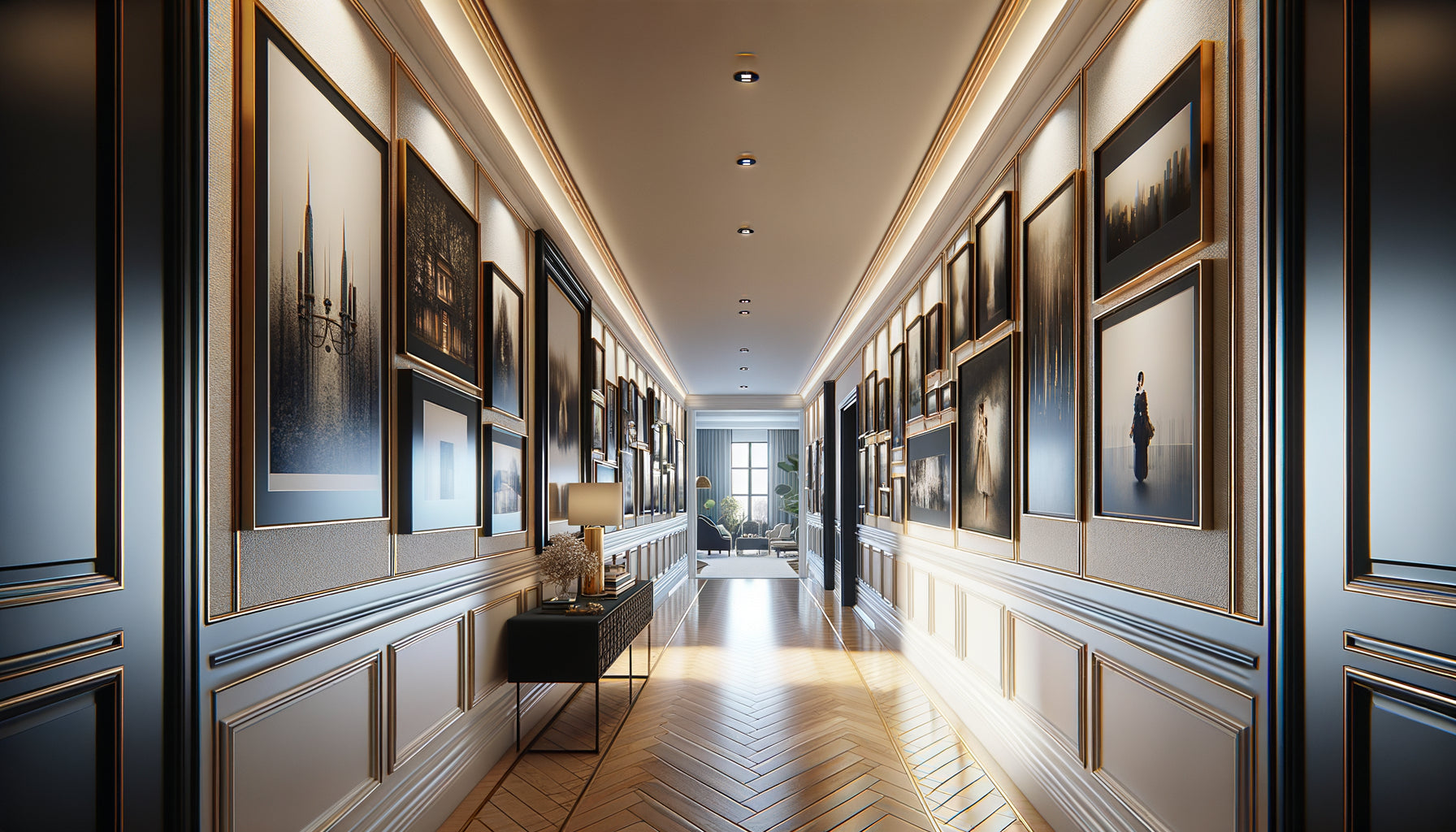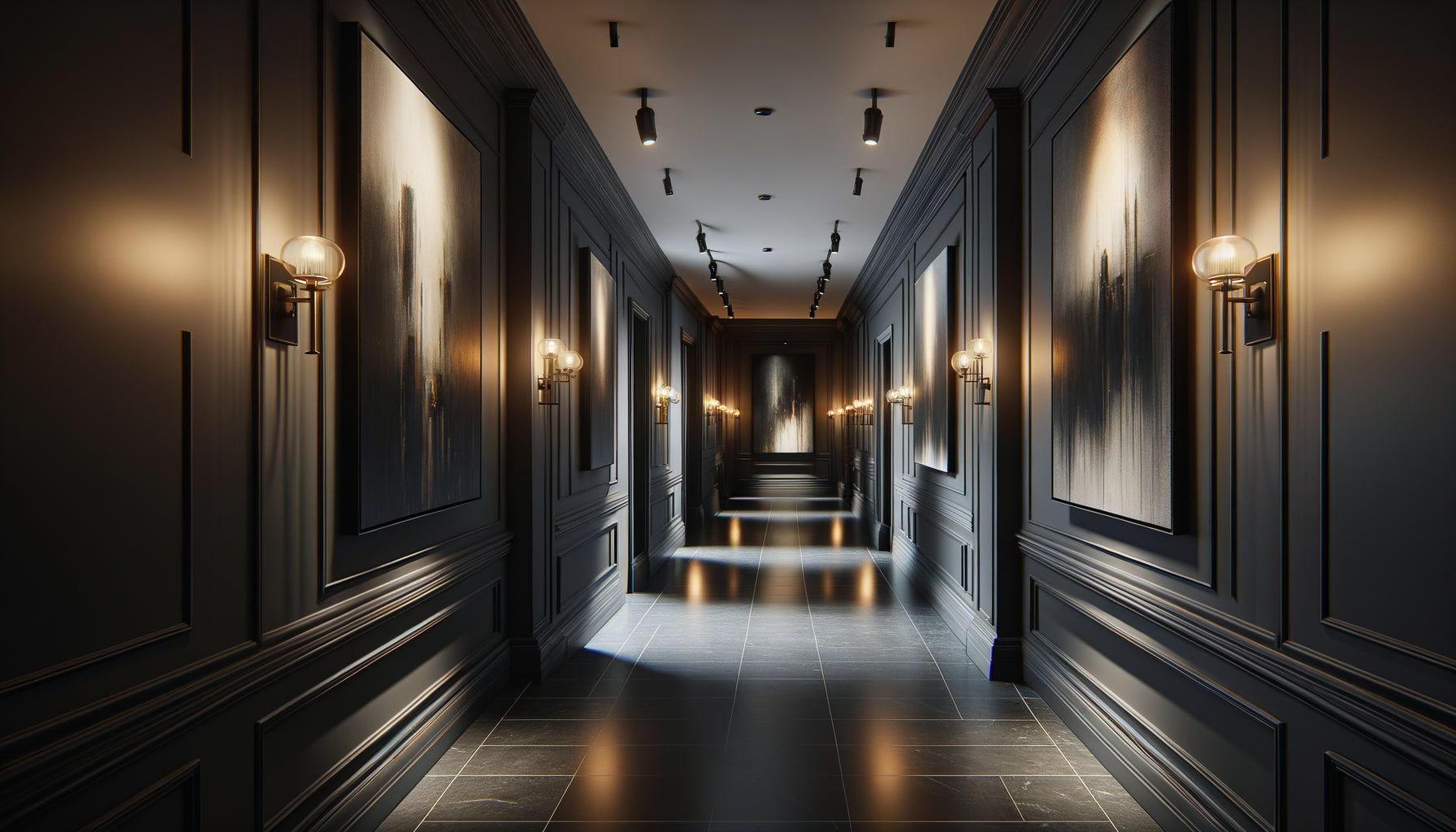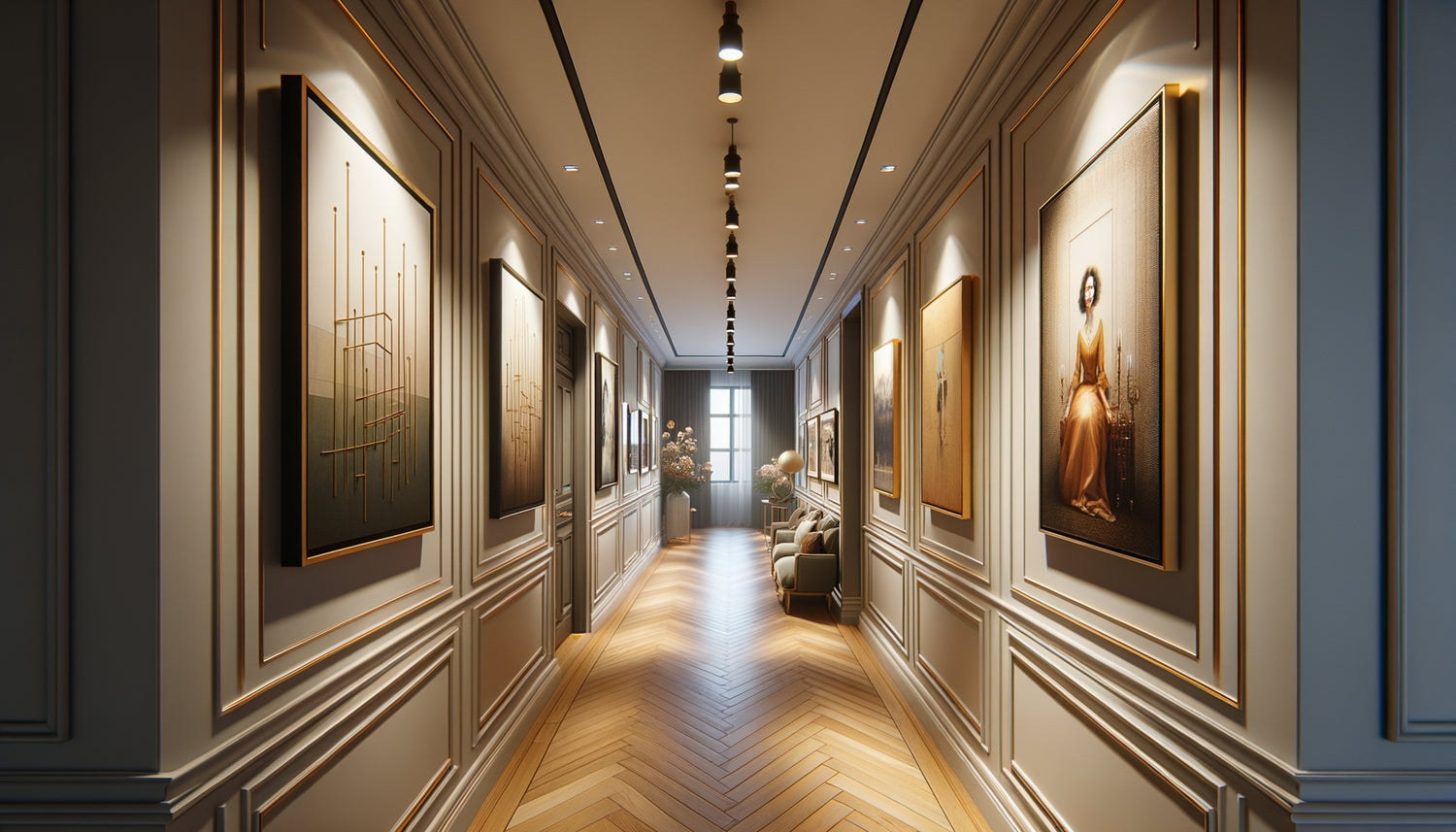
I’ve always thought hallways were the most ungrateful spaces in a home. Long, narrow, often dark, they served only as obligatory passages between living rooms. Until the day I realized that a hallway could become a true narrative gallery, a space where each step reveals a new chapter of a visual story. Creating a succession of paintings that tell a story along a hallway transforms an unplace into an immersive experience. Here’s what this narrative approach brings: it guides the gaze and movement, it creates emotional continuity between spaces, and it reveals the deep personality of an interior. Many hesitate in front of their empty hallway, not knowing where to start, fearing to overload or conversely to create a disordered effect. Rest assured: with a clear narrative structure and a few compositional principles, your hallway can become the most captivating space in your home. I’ll show you how to orchestrate this succession of paintings so that it tells your own story.
The first rule: design your hallway like a cinematic narrative
Before even choosing your paintings, think of your hallway as a film for which you are the screenwriter. A story along a hallway requires a beginning, a development and a resolution. The entrance to the hallway is your opening: it must immediately capture attention. Choose for this first location a strong painting, perhaps larger than the others, which establishes the general theme. If your story is a journey through the seasons, start with a vibrant spring. If it's an evolution of colors, start with a pure and intense hue.
The central area of the hallway represents the body of your narration. This is where you develop your visual message with a succession of paintings that dialogue with each other. They can vary in size, but must maintain consistency – whether chromatic, stylistic or thematic. I like to create a rhythm by alternating formats: a large painting, two small ones side by side, then a medium one. This variation avoids monotony while keeping the eye engaged.
The end of the hallway, your narrative resolution, deserves special attention. It can either conclude the story with a powerful final painting or create an opening to the next room. Think about what you want the visitor to feel when they finish this visual journey. Peace? Wonder? Curiosity?
Narrative architectures that always work
After organizing dozens of narrative displays, I have identified several structures of visual stories particularly effective. The chronological narration remains the most intuitive: follow a clear temporal progression. Old family photographs evolving towards the present, landscapes traversing the seasons, or even a day told from sunrise to sunset. This linearity reassures the eye and facilitates reading of the space.
The chromatic narrative offers a poetic alternative: create a color story that evolves gradually. Start with cool tones – deep blues, aquatic greens – and slowly glide towards warm hues – oranges, reds, golds. This sequence of paintings creates an almost synesthetic experience where color becomes language. I have seen hallways transformed into veritable chromatic gradients where each work is one step further in the transition.
The thematic narrative allows for more creative freedom. Choose a guiding thread – water, birds, urban architecture, faces – and explore its multiple facets. A hallway can tell the story of the ocean: first calm on the surface, then the mysterious depths, marine creatures, and finally the storm. Each painting becomes a chapter in this thematic exploration.
The emotional narrative: from subtle to powerful
An approach I particularly like is to create an emotional story. Start with soft, contemplative, almost meditative works. Gradually intensify the visual energy: more dynamic compositions, sharper contrasts, more expressive subjects. This increase in intensity transforms the crossing of the hallway into a real dramatic curve. The visitor feels this progression emotionally without even being fully aware of it.

The art of spacing: rhythm tells the story
The distance between your paintings profoundly influences the narrative. Works that are too far apart create disconnected chapters; too close together, they cannibalize each other. For a harmonious succession, I recommend a spacing of 10 to 15 centimeters between frames. This proximity suggests narrative continuity while leaving each work its breathing space.
But this rhythm can be intentionally modulated. Create pauses in your story by leaving larger spaces between some paintings. These visual silences act as narrative ellipses, moments when the eye rests before embarking on a new chapter. I particularly like to create diptychs or triptychs within a wider succession – two or three paintings very close together that form a tight sequence, then a more generous space before the next group.
Hanging height also plays a narrative role. The classic rule places the center of artworks at 1.60 meters from the floor, at eye level. But to tell a dynamic story, dare to vary these heights slightly. A slight progressive ascent of paintings can suggest an elevation, while a gradual descent evokes depth, introspection. These subtle variations enrich the narrative dimension without disturbing the overall harmony.
When I look at an empty hallway, I see an open book
Light radically transforms the reading of your visual story. A dark hallway requires luminous works, clear subjects, perhaps even the addition of discreet spotlights that reveal each chapter. Conversely, a hallway bathed in natural light allows for more contrasting works, deep blacks that will not be absorbed by the darkness. Observe how the light evolves throughout the day: your story can literally change atmosphere between morning and evening.
I have learned to play with reflections and shadows. A glass frame captures and reflects light differently depending on the viewing angle. By strategically arranging your paintings along the hallway, you create games of reflection that enrich the experience. Sometimes, the reflection of a painting in the glass of another creates an unexpected dialogue, a mise en abyme that deepens the narrative.
Frames: discreet servants of narrative coherence
Frames unify or fragment your story. For a consistent succession, prioritize similar frames – the same style, the same color, variations possible only in dimensions. This formal unity allows the images themselves to carry the narration without distraction. Black frames create an elegant contemporary gallery, light wood frames bring warmth and naturalness, while gold frames infuse a patrimonial, almost museum-like dimension.
But a frame break can also serve the narrative. If your story has a dramatic turning point, mark it with a change of frame. Imagine: a series of white minimalist frames telling a serene journey, then suddenly, a thick black frame for the artwork representing the storm, before gradually returning to clear frames for the peaceful resolution.

The mistakes that break the narrative magic
The most dangerous temptation is to simply hang your favorite paintings without reflection. A random succession creates visual cacophony, even if each work is individually magnificent. The eye naturally seeks logic, a common thread. Deprived of this structure, it feels a subtle discomfort, a sense of disorder that spoils the experience.
Another pitfall: wanting to say too much. A hallway is not an exhaustive inventory of your travels, passions and favorite artistic periods. An effective story remains focused. It's better to tell one story remarkably than to clumsily sketch out ten simultaneous narratives. Coherence always prevails over exhaustiveness.
Neglecting proportions is also a frequent mistake. A tiny 20x20 cm painting lost on a large hallway wall disappears, regardless of its quality. Conversely, works that are too imposing in a narrow hallway create a feeling of oppression. To tell a visually engaging story, paintings should occupy about one third of the height of the wall – neither too discreet nor overwhelming.
Your hallway deserves its own visual epic
Discover our exclusive collection of hallway paintings that will transform your passage into a captivating narrative gallery.
Composing your story: practical methodology
Start by spreading all your candidate paintings on the floor, in your living room or a large room. This overview immediately reveals natural affinities: which works spontaneously dialogue? Which colors call to each other? What subjects form a logical progression? Photograph different combinations with your phone. This composition step avoids holes in the walls and regrets.
Next, measure your hallway precisely: total length, ceiling height, locations of doors and switches. Transfer these dimensions to paper or use a planning application. Draw the location of each painting while respecting your spacing. This two-dimensional visualization allows you to refine your visual narration before physical implementation.
For the actual hanging, I always proceed from the center outwards or from the entrance to the end, depending on the narrative logic. Use a laser level if possible – nothing more effectively ruins a beautiful story than a shaky hanging line. The works suddenly seem to slide, creating a visual instability that disrupts the narrative reading.
Tools to facilitate storytelling
Invest in a professional hanging system, especially for a succession of multiple artworks. Rail systems with cables offer valuable flexibility: you can easily adjust the position of each piece without multiplying holes. This adaptability is essential as your story will likely evolve over time, new works will be added, and others will leave.
Prepare dedicated lighting if your hallway lacks natural light. Adjustable LED spotlights allow you to create points of interest, highlighting key moments in your narrative. A particularly significant artwork, the climax of your story, may deserve slightly more intense lighting that naturally attracts the eye.
Evolving Your Story Through the Seasons
A fascinating dimension of wall storytelling lies in its mutability. Your hallway is not a frozen museum. I recommend designing your story as a flexible structure where some artworks remain – the narrative pillars – while others can be replaced seasonally. Winter works give way to spring compositions, creating a living narrative that breathes with the calendar.
This dynamic approach keeps your gaze engaged. Even a hallway you walk through daily retains its ability to surprise when the story is partially renewed. Keep a reserve of rotating artworks: those temporarily removed can decorate other spaces before returning to enrich the hallway's narrative at another season.
Photographically document each version of your narrative succession. These visual archives become a fascinating meta-narrative: the history of your stories, the chronicle of your hallway's transformations. You will see how your aesthetic sensibility evolves, how the themes that touch you move and renew themselves.
Conclusion: Your Hallway, Your Personal Epic
Imagine: every morning, you walk through your hallway transformed into a narrative gallery. Your gaze glides from one artwork to another, following the thread of a story that deeply resembles you. It's no longer just a functional passage, but a space of emotion and contemplation. Creating a succession of artworks that tell a story, is offering your home a visual backbone, a narrative that unifies and enriches the living experience. Start modestly: three or four artworks are enough to sketch out an initial narrative. Observe how they dialogue, how your gaze runs through them. Then, let your story grow, become more complex, surprise you. Your hallway awaits its narrative – and you are its legitimate author.
FAQ: Your Questions About Creating Wall Stories
How many artworks do you need to tell a coherent story in a hallway?
A visual story truly begins with three artworks – it’s the minimum number to establish a beginning, development and conclusion. With three well-chosen pieces, you already create a readable narrative progression. However, the ideal length depends on your hallway: for a 3-meter space, four to five artworks create a comfortable rhythm. A long hallway of 6 meters or more can accommodate eight to twelve works without saturation, provided consistent spacing is maintained. Don't feel obligated to fill all the space immediately: it’s better to have a short but impactful story than a diluted narrative. Start with a few key artworks and let your narrative collection grow organically over time, as you make discoveries and fall in love.
Can I mix different artistic styles while maintaining narrative consistency?
Absolutely, and it's often what creates the richest stories! The key lies in identifying a common thread that transcends stylistic differences. This narrative bridge can be chromatic: abstract, photographic and figurative works sharing the same palette of blues and greens tell a consistent story despite their divergent styles. The thread can also be thematic: a journey told through a watercolor, a photograph, an engraving and an oil painting maintains its narrative consistency thanks to the unifying subject. Think of your succession as a literary anthology: different authors, different voices, but a common theme that ties everything together. The essential thing is to avoid abrupt breaks – introduce changes in style gradually, like smooth transitions rather than cuts.
My hallway is very narrow, can I still create a visual story without creating an oppressive effect?
A narrow hallway sometimes becomes even more conducive to storytelling than a wide passage, because the proximity to the artworks creates a particular intimacy. The trick is to adapt the size of your artworks: prioritize medium formats (maximum 40x50 cm) rather than large compositions that would overwhelm the space. Opt for one-sided hanging if the width is really limited – a single narrative wall is quite sufficient. In terms of subjects, favor works with depth of field, perspectives that visually open up the space: landscapes, seascapes, paths that recede into the distance. Light shades – whites, beiges, pale blues – visually enlarge the hallway. Finally, well-thought-out lighting radically transforms perception: discreet LED spotlights directed at the artworks create luminous points that structure the space without weighing it down. Your story will be even more intense, experienced in this contemplative proximity.