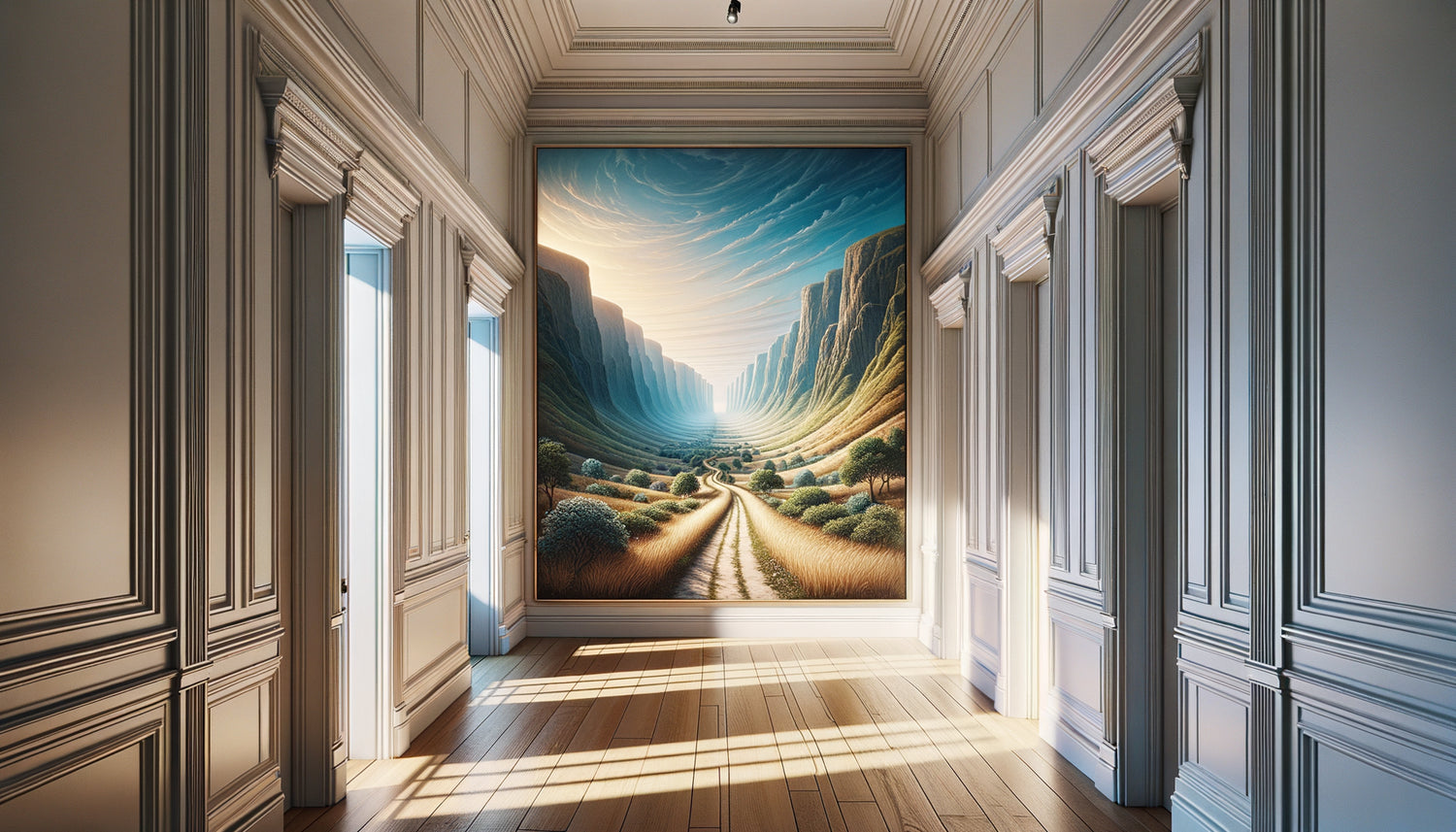
I’ve spent fifteen years transforming confined spaces into bright and airy passageways. And among all the tricks I’ve tried, only one consistently provokes that moment of astonishment in my clients: installing a perspective landscape painting in their hallway. This wall that seemed to compress the space suddenly opens up like a window onto infinity. The hallway breathes, lengthens, transforms.
Here's what perspective landscape paintings bring to a short hallway: they create an illusion of depth that visually pushes back the walls, transform a narrow passage into an elegant gallery, and offer a visual escape that radically changes the perception of space.
You know that unpleasant sensation in your hallway? That feeling of suffocation, as if the walls were getting closer with each passing. You’ve tried mirrors, light colors, sophisticated lighting. Result? The space stubbornly remains short, compact, almost claustrophobic.
Rest assured: this is not an architectural fatality. The solution doesn't lie in costly renovations, but in understanding a fascinating principle that Renaissance painters perfected five centuries ago. I’m going to show you how a simple painting can literally push back the limits of your hallway.
The magic of perspective: when the eye is deceived
When you place a perspective landscape painting at the end of a short hallway, your brain can’t help but follow the vanishing lines of the painting. This forest path that winds towards the horizon, this tree-lined road that gradually narrows, this row of Tuscan cypresses that converge on a distant point: all visual invitations that encourage your gaze to travel far beyond the physical wall.
Linear perspective works according to a simple but remarkably effective mathematical principle. The parallel lines of the landscape seem to meet at a single vanishing point, creating a dizzying sense of depth. Your eye naturally follows these guidelines and, through an astonishing perceptual sleight of hand, your brain mentally extends the space of the hallway.
I installed a painting depicting a mountain path in a hallway only 2.30 meters long. The owner confided to me that she no longer feels that daily oppression. Her gaze plunges into the landscape before even perceiving the limit of the wall. The short hallway has visually gained several meters of perceived depth.
The three types of perspectives that lengthen space
Not all landscapes are equal in creating this lengthening effect. The most effective landscape paintings feature a marked central perspective: a path, a road, a river, an avenue of trees. These elements naturally create those famous vanishing lines that guide the eye to the horizon.
Atmospheric perspective adds an extra dimension. Landscapes that incorporate successive planes - a sharp foreground, intermediate planes gradually veiled, a hazy background - multiply the sense of distance. This subtle gradation of sharpness and tone reinforces the impression that the eye traverses multiple layers of space.
Finally, chromatic perspective plays on color temperature. Warm hues (ochres, reds, oranges) in the foreground and cool tones (blues, grays, mauves) in the background naturally accentuate the sense of depth. A landscape painting in perspective mastering these three dimensions transforms a hallway of just a few meters into an apparently infinite corridor.
Strategic placement: where to hang to maximize the effect
The classic mistake is to place the painting on a side wall of the hallway. A serious error. For a landscape painting to visually lengthen the space, it must imperatively be positioned at the back of the hallway, in the natural line of sight. As soon as you step into the hallway, your gaze should immediately plunge into the perspective of the landscape.
The hanging height deserves special attention. Position the center of the painting at eye level of a standing person, approximately 1.60 meters from the floor. This height ensures that the horizon line of the landscape naturally sits within your central field of vision, facilitating immersion in the perspective.
If your short hallway does not have an available back wall - because a door is located there - opt for the side wall furthest from the entrance. Then choose a landscape with oblique perspective that directs the gaze towards the depth of the hallway rather than perpendicularly.
The crucial question of dimension
A painting that is too small gets lost and does not sufficiently impact the spatial perception. A painting that is too imposing crushes the hallway and produces the opposite effect sought. For a hallway 2 to 3 meters long, aim for a format of at least 70x100 cm or 80x120 cm. The painting should occupy a significant surface area of the wall without completely saturating it.
The orientation of the format also counts. A horizontal format accentuates the impression of lateral width, perfect for short hallways that are narrow. A vertical format draws the eye upwards, creating a feeling of elevation that compensates for the horizontal compression. A square or panoramic format is suitable for hallways of medium width seeking a harmonious balance.

Landscapes that work: paths, roads and infinite perspectives
After dozens of installations, certain motifs have proven particularly effective. Forest trails winding between trees create a spectacular elongated depth. The alternation of light and shadow along the path creates successive focal points that draw the eye ever further.
Roads lined with trees, especially the famous avenues of plane trees or cypresses, work remarkably well. Repeated vertical trunks act as rhythmic markers that mark the progression towards the horizon. These parallel vertical lines naturally converge towards the vanishing point, amplifying the sense of distance.
Marine landscapes with a beach in perspective offer a clean and bright version particularly suitable for dark hallways. The perfectly straight maritime horizon creates visual stability while the sand or waves draw converging lines towards the open sea. The impression of openness is immediate and soothing.
Mountain valleys viewed from above, with their slopes gradually approaching each other, create a fascinating tunnel effect. This type of perspective landscape is particularly suitable for descending hallways or configurations where the eye can naturally follow a downward diagonal.
The most impactful pictorial styles
Photorealistic realism impresses with its ability to completely deceive the eye. An hyperrealistic landscape painting depicting a country path can literally give the impression of a real opening in the wall. The illusion is striking, almost unsettling.
Impressionism offers a softer alternative, where touches of color and diffused light create poetic depth. The slight imprecision of the contours adds a dreamy dimension that works wonderfully in intimate spaces.
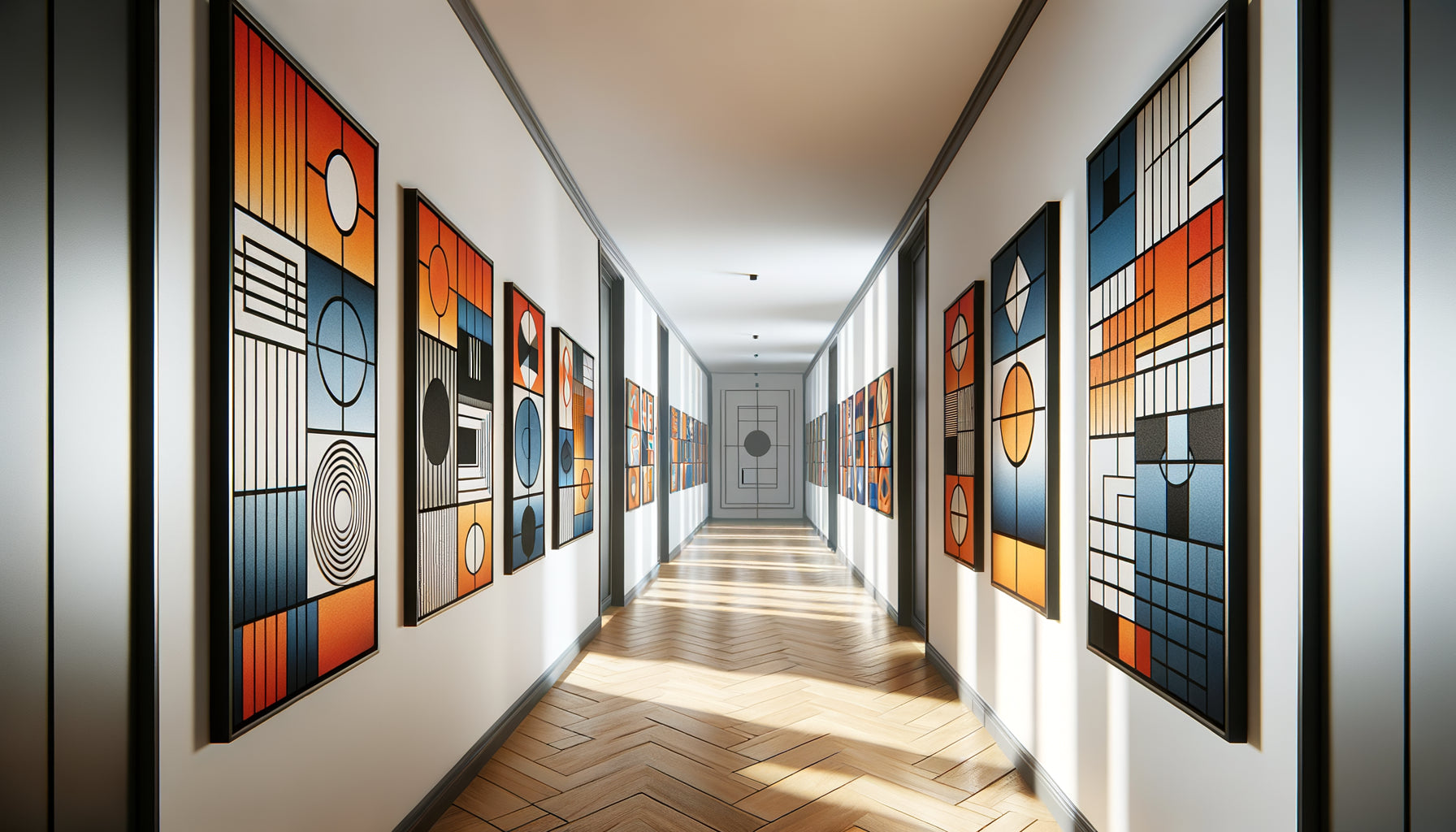
Contemporary abstract landscapes with geometric perspective are suitable for modern interiors. Clean lines, progressive color gradients, shapes that taper towards the background create a sense of conceptual depth, less literal but equally effective to visually lengthen a hallway.
Lighting: an indispensable ally of perspective
A landscape painting in perspective with poor lighting loses 70% of its effectiveness. Lighting does more than just make the work visible: it dramatically amplifies the illusion of depth. An adjustable spotlight directed at the painting from the hallway ceiling creates a highlighting that irresistibly attracts the eye.
Sidelighting, with a wall sconce positioned above the frame, accentuates the relief and texture of the canvas. This sculpting light reinforces the perception of the different planes of the landscape, increasing the sense of three-dimensionality.
For particularly dark hallways, consider a subtle LED backlighting behind the frame. This luminous halo visually detaches the artwork from the wall, creating the impression of an open window rather than a flat surface. The effect of enlarging the short hallway is amplified.
The light temperature that enhances perspective
Opt for a slightly warm light (2700-3000K) for forest or countryside landscapes. This golden hue enriches the greens and ochres, creating a welcoming atmosphere that compensates for the hallway's compression.
For marine or mountain landscapes, a neutral light (4000K) preserves the coolness of the blues and the clarity of the skies. This temperature avoids distorting the cool tones essential to atmospheric perspective.

The frame: discreet but decisive
The frame of a landscape artwork intended to lengthen a hallway should be thought of as a window, not as decoration. Dark frames (black, dark brown, graphite) create a sharp contrast that detaches the landscape from the wall and accentuates the impression of openness. It's as if you are looking through an embrasure.
Thin and streamlined frames are particularly suitable for contemporary interiors. They do not interrupt the visual continuity between the real hallway and the represented landscape. The eye naturally glides from the wall to the artwork without interruption, reinforcing the illusion of spatial continuity.
For hallways with light walls, a white or cream frame can create a soft transition, particularly effective with bright landscapes. The artwork then seems to be an integral part of the architecture rather than a decorative addition.
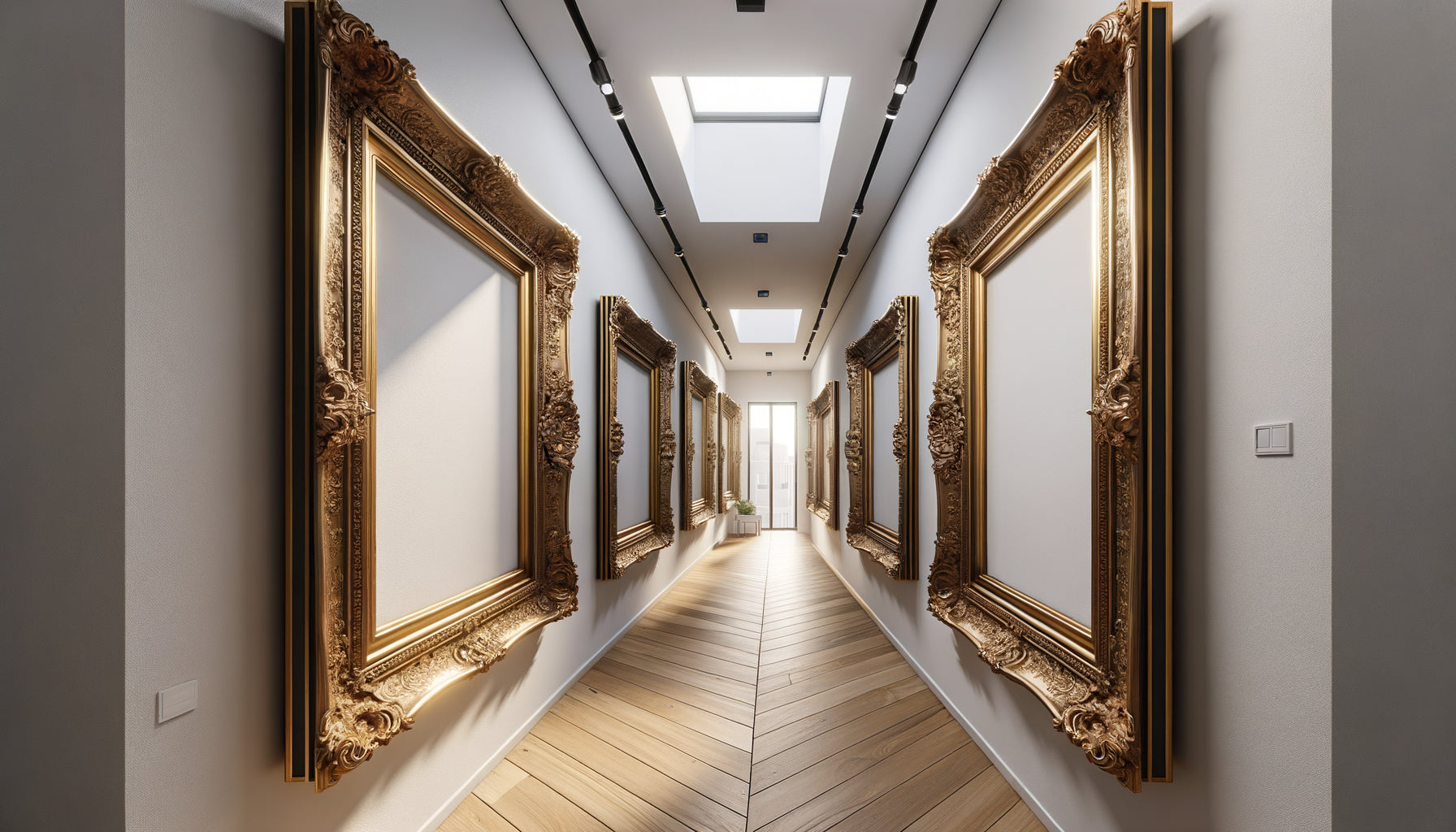
Absolutely avoid overly ornate or gilded frames that draw attention to themselves rather than to the landscape's perspective. Every decorative element of the frame that captures the eye is an obstacle to the sensation of lengthening the short hallway.
Ready to transform your hallway into a gallery of depth?
Discover our exclusive collection of hallway art that pushes the boundaries of your spaces and creates those precious illusions of depth.
Transform Your Hallway: Visualize the Change
Imagine walking through your front door tomorrow morning. Your gaze no longer immediately hits the back wall. It naturally glides towards that mountain path winding towards distant peaks, towards that endless beach where sand meets a blue horizon, towards that avenue of centuries-old plane trees disappearing into an unsuspected depth.
The hallway hasn't physically changed. Its dimensions remain the same. Yet you no longer feel that daily compression. The space breathes, opens up, invites you to travel rather than rush out. Your guests now stop in this passage they used to cross without seeing, captivated by this unexpected window onto elsewhere.
A perspective landscape painting is not just a decorative element. It's an architectural tool that transcends the physical constraints of your interior. Choose it carefully, install it strategically, illuminate it intelligently: your short hallway will become that elegant gallery you never suspected it could be.
Start by precisely measuring your space. Identify the back wall or the optimal position. Then let yourself be guided by your feelings towards the different landscapes: the one that captures your gaze and refuses to let go, the one in which your imagination naturally plunges, that's the one that will transform your hallway.
Frequently Asked Questions About Landscape Paintings for Hallways
Will a landscape painting work in a very short hallway, less than 2 meters?
Absolutely, and it's even in particularly constrained spaces that the effect is most spectacular. For a hallway of less than 2 meters, prioritize a painting with a very marked perspective - a path that quickly recedes into the depth, a road with pronounced vanishing lines. The format should be proportionate: approximately 60x80 cm minimum to create sufficient visual impact without saturating the space. The trick is to choose a bright landscape with a clearly visible vanishing point that immediately captures the gaze. I have transformed hallways of 1.80 meters with a simple painting depicting a cypress avenue: the feeling of suffocation has completely disappeared. The key lies in the intensity of the perspective rather than the size of the hallway itself.
Should I prefer a natural landscape or an urban landscape to lengthen a hallway?
Both work remarkably well, but cater to different moods. Natural landscapes – forests, beaches, mountains – create a sense of escape and tranquility particularly appreciated in urban interiors. They visually soften the confined space of a hallway by opening a mental window onto nature. Urban landscapes with perspective – a Haussmannian street stretching out, a bridge crossing a river, a square with arcades in succession – bring an architectural dimension consistent with modern interiors. They create stylistic continuity while producing the same illusion of depth. My advice: choose according to the overall atmosphere of your interior. Contemporary urban apartment? Opt for an architectural perspective. Softer, more natural decor? The countryside landscape will naturally impose itself. The essential thing remains the presence of clearly identifiable vanishing lines.
Can multiple landscape paintings be combined in a short hallway?
This is a delicate question. In a short hallway, multiplying the paintings risks fragmenting attention and diluting the lengthening effect. The strength of a single perspective landscape painting lies in its ability to completely capture the gaze and guide it towards a single vanishing point. If you install multiple paintings, the eye flits between different competing depths, canceling out the spatial illusion. Interesting exception: a series of three paintings depicting the same landscape according to a logical progression – foreground, midground, background – can work if arranged in sequence along the hallway. This composition creates a visual narrative that accompanies physical progress through space. But honestly, to maximize the lengthening effect, a single masterful painting at the end of the hallway remains the most effective solution. Focus your budget and reflection on this unique piece which will radically transform the perception of your space.