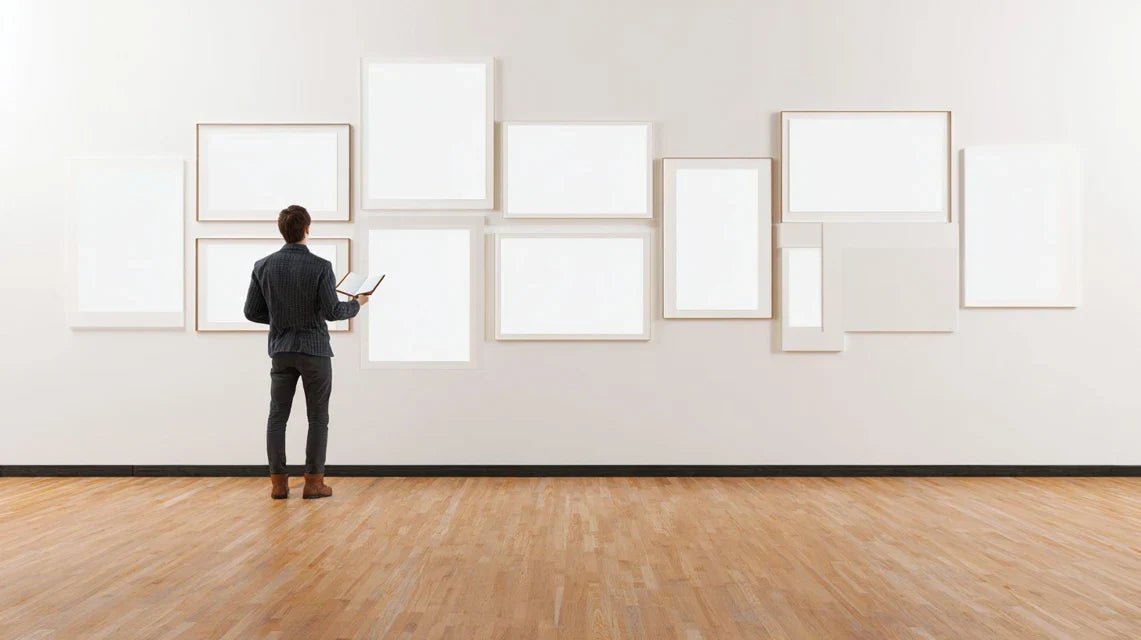
How to Start a Contemporary Wall Art Collection at Home?
By Alexandre MARY
⏱️ Reading time : 8 minutes
You’ve been staring at that blank wall for months, dreaming of hanging something beautiful, personal, and truly reflective of you. But as soon as you walk into a gallery or browse art websites, that familiar feeling washes over you: everything seems inaccessible, coded, reserved for those who “know.”
You already imagine the critical looks of your guests at your choice, that little voice whispering "what if I’m wrong?" Contemporary art attracts you, but this invisible barrier between you and these works discourages you before you even begin.
You may have tried a few impulsive purchases - a soulless reproduction from a big-box store, or that canvas quickly chosen to “look nice.” The result? Walls that tell nothing of your story, a decoration that leaves you wanting more.
This frustration is perfectly normal and doesn’t reveal any lack of taste on your part. The world of contemporary art simply suffers from a translation problem: no one has yet explained the simple codes to navigate this exciting universe with confidence.
By the end of this article, you will know exactly how to build your first collection of contemporary wall art, confidently and enjoyably, transforming your interior into a true personal gallery that reflects who you are.
Why does your interior deserve more than just decoration?
Contemporary wall art radically transforms the atmosphere of a space - and the longer you wait, the more you deprive your daily life of that creative energy that makes the difference between a house and a truly inspiring cocoon. Imagine coming home and immediately feeling that particular vibration, that personality emanating from your walls. That’s exactly what you miss every day of waiting.
💡 Revelation from a decor consultant: "My client Sarah transformed her living room by hanging three carefully chosen contemporary artworks. Six months later, she confided to me: 'My friends are now asking me for decorating advice, whereas before they found my interior 'nice but without soul.' These paintings revealed my personality.'"
💬 Conversation with a decor expert
“I’m afraid that contemporary art will seem too 'pretentious' in my living room... People might think I’m showing off?”
Not at all! Well-chosen contemporary art creates exactly the opposite effect. Think of a beautiful melody in a room: it doesn't shout “look at me,” it simply enriches the atmosphere. Your guests will feel this harmony without necessarily analyzing why your interior soothes or inspires them.
“I’ve always been told that you need huge walls and high ceilings to exhibit contemporary art..."
This rule dates back to the 80s! Today, artists create formats adapted to all spaces. A small format well placed can have more impact than a large canvas poorly positioned. It's the harmony with your space that counts, not the size.
The magic happens from the first carefully chosen artwork: Like a delicate fragrance that transforms a room, a contemporary work of art instantly reveals the personality of your interior. You will observe this change from the first week, when you realize that you spend more time in this room, simply.
What really prevents you from taking the plunge
You may feel this paralysis of choice facing the thousands of works available, this fear of an expensive mistake, or even this impression that "it's not for you". Behind these symptoms lies a much simpler reality: no one has given you the right keys to understanding.
The problem is neither your taste nor your budget, but a system that presents art as a secret code to decipher. In reality, choosing a contemporary work of art follows an accessible logic, almost intuitive once you know the basic principles.
It's like learning to drive: intimidating at first, then natural as soon as you master the automatisms. Your aesthetic instinct already exists, just trust it with the right methods.
The illusion of universal "good taste"
Contrary to popular belief, there is no absolute "good taste" in contemporary art. What works is the consistency between your personality, your space and the emotion you want to feel at home. The "rules" that you think you know often come from magazines that promote a formatted style.
Imagine choosing your music playlist according to the tastes of a stranger: absurd, isn't it? It’s the same for art. Your collection should speak to you, not impress an imaginary expert.
This revelation changes everything: instead of looking for "the perfect artwork", you will learn to identify "the perfect artwork for you". The pressure disappears, the pleasure of discovery takes over.
🔍 Immediate verification test: Look at the images you have saved on your phone in recent months. Observe the colors, the atmospheres that come back. Here's already some valuable clues about your natural artistic sensitivity!
The myth of inaccessible budget
Many imagine that a "real" art collection requires thousands of euros per artwork. This belief comes from a confusion between speculation art and decorative art. You are not buying to resell, but to live with and enjoy looking at every day.
Think about the books in your library: their value does not lie in their resale price, but in the emotions they give you. For contemporary art, it’s exactly the same logic.
This understanding completely frees your approach: you can start with affordable artworks and gradually develop your collection based on your preferences and available budget.
The fear of other people's opinions
This anxiety often hides a lack of knowledge about current codes of contemporary art. You might imagine having to justify your choices with complex technical vocabulary, while today’s collectors prioritize emotion and authenticity.
Observe how people talk about their favorite movies or books: they share their feelings, not an academic analysis. The approach is the same for art and much more natural than you think.
When you embrace your artistic choices, you gain credibility. Your guests respect someone who says "I like this artwork because it soothes me" more than someone who repeats a memorized speech.
3 signals that reveal you are ready to take the plunge:
You stop in front of certain gallery windows: Your eye is already drawn to particular styles, even if you don't dare to enter
You scroll through Instagram saving images of interiors: You are unconsciously developing your visual culture and refining your preferences
You feel frustrated with your current walls: This dissatisfaction indicates that you are ready for a more authentic aesthetic change
The turning point that changes everything
The real breakthrough occurs when you realize that collecting contemporary art is not a privilege reserved for an elite, but a pleasure accessible to anyone who wants to enrich their daily life. Like learning a new cuisine or discovering a new neighborhood, it simply requires curiosity and method. Once this realization happens, you will observe your surroundings with a new look, more confident and creative.
The golden rule for beginner collectors: Always start with what spontaneously moves you, without trying to intellectualize it. If a work makes you smile or dream for more than 30 seconds, that's already an excellent indicator of compatibility.
❌ Limiting belief
✅ Kind reality
💡 Why it works
🎯 Immediate benefit
"I don't know enough about it"
Your sensitivity is enough to start
Art speaks to emotions before intellect
Confidence in your intuitive choices
"It’s too expensive for me"
Every budget allows you to begin
Emotional value is more important than price
Accessible and evolving collection
"Others will judge my tastes"
Authenticity impresses more than conformity
Your choices reveal your unique personality
Respect and admiration from those around you
"You need a large space"
Every wall can accommodate art
Impact depends on the choice, not the size
Immediate transformation of your interior
Your simple method for creating a collection that reflects you
Rassurez-vous : constituer votre première collection d'art contemporain ne nécessite ni diplôme en histoire de l'art ni fortune personnelle. Cette méthode progressive vous guide pas à pas, comme un architecte qui pose d'abord les fondations avant d'élever les murs. En trois étapes logiques, vous allez transformer vos murs en une galerie personnelle qui raconte votre histoire et nourrit votre inspiration quotidienne.
🗺️ Overview of your journey: Étape 1 - Découvrir votre style naturel (immediate satisfaction), Étape 2 - Choisir vos premières œuvres avec confiance (visible transformation), Étape 3 - Composer une collection harmonieuse (pride and recognition). Chaque niveau consolide le précédent, comme apprendre un instrument : gammes, premiers morceaux, puis compositions personnelles.
Avant de regarder la moindre œuvre, vous devez d'abord cartographier vos goûts spontanés. Cette étape fondamentale évite les achats impulsifs que vous regretterez. Comme un jardinier qui analyse d'abord son terrain avant de planter, vous allez identifier les couleurs, textures et ambiances qui vous parlent naturellement. Cette découverte de soi procure une satisfaction immédiate et guide tous vos choix futurs.
Vos outils de découverte personnelle
Un carnet visuel physique ou numérique : Pas un simple bloc-notes, mais un espace dédié où compiler vos inspirations visuelles. Choisissez un format que vous prendrez plaisir à consulter régulièrement. Les applications comme Pinterest fonctionnent parfaitement, mais un joli carnet papier crée une relation plus intime avec vos découvertes. Évitez les simples screenshots éparpillés qui finissent oubliés.
Une méthode de classification intuitive : Organisez vos inspirations par ressentis plutôt que par catégories techniques - "énergisant", "apaisant", "mystérieux". Cette approche émotionnelle révèle vos besoins esthétiques profonds et facilite vos futurs achats. Le système fonctionne mieux que les classifications académiques car il reste connecté à vos vraies motivations.
Du temps d'observation sans pression : Accordez-vous des moments de flânerie visuelle sans objectif d'achat. Cette liberté permet à votre goût naturel de s'exprimer sans les parasites du "il faut que" ou "je dois". L'impact sur votre clarté de vision est immédiat et durable.
Now, let's move on to concrete practice
Actions pour révéler vos préférences authentiques
Faites l'inventaire de vos choix esthétiques actuels : Photographiez les objets de votre intérieur qui vous procurent du plaisir visuel - un coussin, une vaisselle, un livre. Analysez les points communs : couleurs récurrentes, matières privilégiées, formes qui reviennent. Cette méthode révèle votre palette esthétique inconsciente, bien plus fiable que vos suppositions sur vos goûts.
⏱️ Time: 30 minutes | ✅ Successful when: You identify 3-4 visual constants in your choices | ⚠️ Attention: Don’t judge your discoveries, just observe - judgment biases analysis
Explore without buying for 2 weeks: Visit galleries, art sites, artist Instagram accounts, noting only your spontaneous reactions. In front of each artwork, ask yourself "would I like to see this every morning?" This simple question bypasses the intellect to access your true sensitivity.
⏱️ Time: 15 minutes per day | ✅ Successful when: You spot artworks that “speak” to you immediately | ⚠️ Attention: Resist the urge to buy during this exploration phase, it’s crucial for your learning
Test your emotional reactions: For each artwork that attracts you, note the precise emotion it evokes - joy, serenity, energy, nostalgia. This emotional mapping becomes your compass for all future purchases. It also reveals the atmospheres you are subconsciously seeking to create in your home.
⏱️ Time: 2 minutes per artwork observed | ✅ Successful when: You easily connect emotions and visual styles | ⚠️ Attention: Use simple, personal words rather than technical artistic vocabulary
✨ Validation of your artistic profile: After these 2 weeks, you should be able to describe your aesthetic universe in a few words ("soft colors and organic shapes" or "marked contrasts and geometry”). If it’s blurry, extend the observation for a few days. Otherwise, congratulations: you now know your “visual DNA” which will guide all your future choices!
OUR RECOMMENDED PRODUCTS
Step 2: Choosing your first artworks with confidence
Now that you know your visual language, choosing your first artworks becomes an exciting game rather than a puzzle. This more rewarding step allows you to realize your vision and see your interior transform before your eyes. The snowball effect begins: each successful purchase reinforces your confidence for the next.
Your practical selection criteria
Defined and evolving budget: Set a comfortable allowance for your first 3 artworks, without putting yourself in financial difficulty. Allow for progression: first artwork to test, second to confirm, third to indulge yourself. This approach eliminates the financial stress that disrupts aesthetic decisions.
Dimensions adapted to your spaces: Measure your available walls and keep these dimensions on your phone. An artwork that is too small disappears, too large overwhelms. The rule of thumb: the artwork should occupy 60-75% of the width of the wall or furniture it overlooks. This proportion creates a visually harmonious balance.
Emotional validation technique: Before any purchase, keep the image of the artwork on your screen for 3 days. If it continues to please you after this "digestion" period, it's generally a good sign of lasting compatibility. This technique avoids 90% of regretted impulse purchases.
Solidifying your initial choices
Start with your main living space: Choose the space where you spend most of your waking time - living room, open kitchen, office. This room will benefit most from your artistic investment and allow you to observe the daily impact of your choice. Starting there maximizes your immediate satisfaction.
⏱️ Time: Immediate identification | ✅ Successful when: You precisely visualize the location of your first artwork | ⚠️ Attention: Don't spread your efforts across multiple rooms simultaneously at the beginning
Use the "confirmed crush" rule: Select 5 artworks that attract you within your budget, then let it settle for 48 hours. The one that continues to inhabit your mind is usually the right one. This method appeals to your deep intuition rather than your analytical mind, which is often less reliable in art.
⏱️ Time: 2 days of reflection | ✅ Successful when: An artwork naturally stands out | ⚠️ Attention: Don't rationalize this step too much - your first impression is often the best
Prepare the hanging before purchasing: Check the lighting of the chosen location, the solidity of the wall, and visualize the artwork with a cardboard box in the correct dimensions. This preparation avoids unpleasant surprises and confirms that the artwork will be highlighted. A good hanging makes the difference between a successful and disappointing purchase.
⏱️ Time: 20 minutes | ✅ Successful when: The location is technically and aesthetically validated | ⚠️ Attention: Direct lighting on the artwork creates reflections, prioritize indirect lighting
🎯 Confirmation of your first purchase: Your choice is validated when you feel a mixture of excitement and serenity at the idea of living with this artwork. If you still hesitate or feel anxiety, take more time. The right choice provides a peaceful certainty, not stress.
Step 3: Harmonizing your nascent collection
With 2-3 well-chosen artworks, you access the connoisseur level: create visual dialogues between your pieces. This step reveals the difference between accumulating decorative objects and a true collection. You develop a trained eye that will naturally impress your visitors, and above all, you create an environment that nourishes your daily inspiration.
Principles of harmonious composition
Chromatic consistency without monotony: Identify 2-3 dominant colors in your existing artworks and enrich this palette rather than contradicting it. This approach creates a recognizable visual signature without falling into repetition. Harmony arises from variation on a theme, not uniformity.
Balance of formats and techniques: Alternate large and small works, paintings and photographs, smooth textures and reliefs. This diversity maintains visual interest while maintaining stylistic consistency. Your collection becomes richer and avoids the "catalog" effect.
Spacing and eye movement: Organize your artworks to create a natural visual path through the room. The eye should be able to travel from piece to piece effortlessly, creating a fluid contemplative experience. This mastery distinguishes a thoughtful collection from a haphazard arrangement.
Orchestrating your artistic environment
Create thematic "families": Group your artworks according to their affinities - same technique, similar palette, or shared emotion. This organization reveals the internal logic of your collection and guides your next purchases. You develop a recognizable personal signature.
⏱️ Time: 1 hour of reflection | ✅ Successful when: Your artworks "talk" to each other visually | ⚠️ Attention: Don't force connections - some works prefer solitude
Experiment with temporary hangings: Before permanently drilling, test different layouts with removable adhesive. This playful phase reveals unexpected compositions and refines your sensitivity to space. You often discover that your initial hanging ideas weren't the best.
⏱️ Time: 30 minutes per test | ✅ Successful when: The composition satisfies you for several days | ⚠️ Attention: Photograph each test to objectively compare options
Plan your evolution over 6 months: Identify the "gaps" you feel in your current collection - color area to reinforce, missing format, complementary technique. This forward-looking vision avoids scattered purchases and builds a consistent collection over time.
⏱️ Time: 20 minutes of projection | ✅ Successful when: You have 2-3 specific goals for your next purchases | ⚠️ Attention: Stay flexible - your tastes may still evolve with experience
🏆 Recognition of your emerging expertise: You master this step when your guests spontaneously ask you for advice on their own decor choices. Your interior exudes an obvious harmony that testifies to a real aesthetic reflection. You feel a legitimate pride in contemplating your work.
The rule of progression for the discerning collector: Add a maximum of one work per month to allow each new piece time to find its place in the collection. This patience avoids visual saturation and maintains the pleasure of discovery. It is better to have a collection of 5 perfectly chosen works than 15 hesitant purchases.
You now master the fundamentals, but some expert subtleties can transform your enlightened beginner approach into a true intimate knowledge of contemporary art. These nuances give you an advantage over 90% of occasional buyers and allow you to unearth hidden gems.
🎓 Secret of experienced collector: Follow 3-4 emerging artists rather than buying "safe bets". Their artistic evolution enriches your perspective, their prices remain accessible, and you develop an eye for spotting talent before others. This approach transforms the collection into a fascinating human adventure.
💬 "What if I'm wrong and the artwork bores me after a few months?"
"I'm afraid of making a bad choice and ending up with a work that I no longer like..."
This concern is totally understandable and even healthy - it shows that you are taking this approach seriously! In reality, "mistakes" are part of the learning process and teach more than immediate successes. A work that no longer pleases you after 6 months reveals the evolution of your taste, valuable information for your future choices. Plus, you can always move it to another room where it will find a second life. Consider your first purchases as an exploration, not a definitive commitment.
💡 Anti-regret test: Before buying, ask yourself "could this artwork be pleasing in the guest bedroom if it doesn't suit the living room?". This simple question assesses the versatility of your choice and reassures about the investment.
The traps to absolutely avoid (to protect your budget and your pleasure)
Some classic mistakes can turn your beautiful artistic adventure into a source of frustration and financial regrets. These pitfalls are predictable and totally avoidable when you know them. I prefer to warn you now rather than you discover them at your expense.
🛑 Buying on impulse: This artwork makes you vibrate? Perfect, but allow yourself a minimum of 48 hours before taking out your credit card. The enthusiasm of the moment can mask an incompatibility with your interior or your budget. True gems withstand this period of reflection, fleeting impulses fade. This rule avoids 80% of regretted purchases.
🛑 Following trends instead of your tastes: Art that is "fashionable" often ages badly and may not reflect you. Your collection should reflect your personality, not that of an influencer or a magazine. Trends come and go, but your daily enjoyment should last. Invest in what truly moves you, not what supposedly impresses.
🛑 Neglecting lighting and hanging: A beautiful work poorly lit or hung loses 50% of its impact. Contemporary art requires a minimum of staging to reveal its beauty. Budget for lighting and professional framing if necessary - it's an investment that enhances your entire collection.
🛑 Wanting to buy everything at once: Patience is part of the collector's pleasure. Buying 5 works in the same week creates a visual and financial indigestion. Your eye needs time to get used to each new piece before welcoming the next. This progressive approach refines your taste and avoids regrets.
🛑 Ignoring dimensions and proportions: Measuring is not enough, you need to visualize the work in its context. A perfect piece in a gallery may seem overwhelming or lost at home. Use augmented reality apps or cut out a cardboard to the right size to test the effect before buying.
🛡️ Safety checklist before any purchase:
1) Do I still like the work after 2 days of reflection?
2) Have I checked its dimensions in my space?
3) Does my budget remain comfortable?
4) Does this piece enrich my collection without unbalancing it?
If one answer is no, postpone the purchase. Warning signs: pressure from the salesperson, "exceptional" price limited in time, purchase to please someone else.
Because you took the time to inform yourself, enjoy 10% discount on your first order:
ART10
⏰ Valid 72h after reading • Applicable to all our products
🤔 Your beginner questions (we answer without judgment)
💰 "How much should I budget to start a real collection?"
Allow 300-800€ for your first 3 quality works, spread over 6 months. Start with 150-200€ to test your tastes, then gradually increase according to your satisfaction. This evolutionary approach respects your budget while allowing you to acquire authentic pieces that retain their emotional value.
⏰ "How long does it take to develop a real artistic taste?"
Your natural sensitivity already exists - 3 months of active observation is enough to refine it and gain confidence. The first 6 months of purchases develops your practical expertise. After one year, you will have a recognizable aesthetic signature and the assurance of your choices.
🏠 "My apartment is small, can I still collect?"
Absolutely! Small spaces even create more intimacy with artworks. Prioritize formats from 30x40cm to 50x70cm, and don't hesitate to use hallways and corners. A single well-chosen artwork transforms a space more effectively than three that are poorly proportioned.
🎯 "How do I know if an artist has potential?"
Observe the consistency of their work over 2-3 years, their presence in serious galleries (not just online), and above all your constant emotional reaction to their artworks. A good emerging artist evolves without losing their visual identity. Your lasting pleasure remains the best indicator.
🖼️ "Original artwork or high-quality reproduction: what is the concrete difference?"
The original has a physical presence, a texture, a unique history that you feel on a daily basis. This "aura" justifies the investment for your main pieces. High-end reproductions are suitable for testing a style or temporarily completing your collection, but do not provide the same lasting satisfaction.
🌟 Your new life as an enlightened art lover
In 6 months, you contemplate your walls with a deep satisfaction that you have never felt before. Your interior finally tells your story, nourishes your daily inspiration, and naturally impresses your guests. This transformation goes far beyond simple decoration: you have developed a trained eye, an aesthetic confidence that shines through all your life choices.
This new artistic expertise enriches your relationship with the world - you observe public spaces differently, appreciate creativity in all its forms, join this exciting community of contemporary art lovers. Your conversations become richer, your travels take on a new cultural dimension, and your general sensitivity is refined.
The most beautiful thing about this adventure? You realize that the intimidating barrier was an illusion. Collecting contemporary art wasn't more complicated than learning a new recipe - you just needed to start with the right basics. Your first step? Choose today the piece you want to transform first, and begin your visual exploration with curiosity and confidence.
🚀 Your artistic adventure begins now: You have all the tools to transform your walls into a personal gallery. More than a collection of artworks, you are building an environment that inspires you every day and reveals your unique personality to the world.
📚 To deepen your artistic expertise
Discover our other practical guides on choosing frames, optimal lighting for your artworks, and conservation techniques. Become the contemporary art expert that you already admire in others.