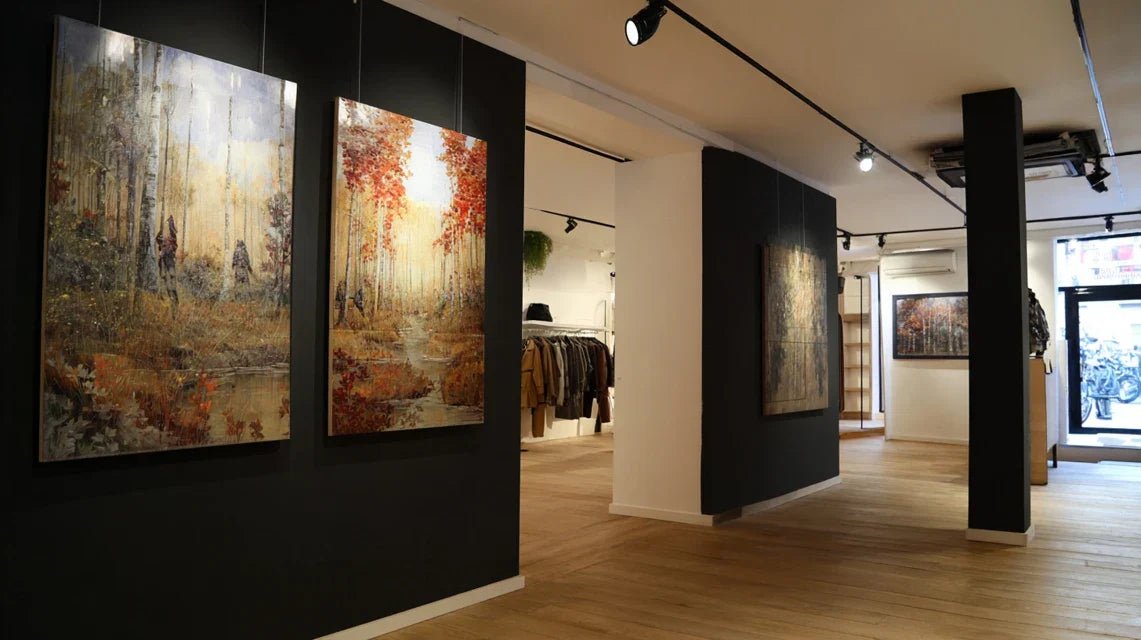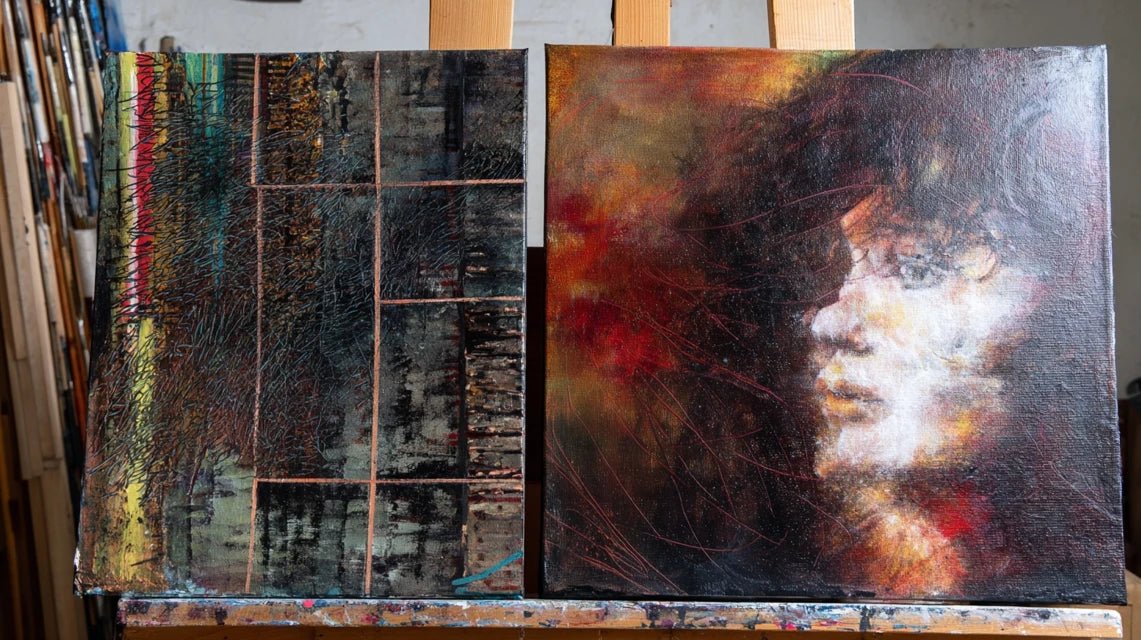
You're facing this wall that has been waiting for months to be adorned, but every time you visit a gallery or browse an art website, you feel completely lost. Oil, acrylic, watercolor, pastel... How do you choose when everything seems beautiful but nothing seems to fit together in your head?
You imagine that harmonious living room you dream of, but faced with the diversity of artistic techniques, you wonder if this oil painting will go well with that delicate watercolor, or if those vibrant pastels won't clash with your modern acrylics.
You may have already tried a few impulse purchases, but the final result lacks visual coherence. Your works seem to compete for attention rather than dialogue harmoniously.
This is perfectly normal: you've never been told that building a coherent collection doesn’t depend on chance or an innate “artistic eye,” but on a methodical approach that respects the characteristics of each medium.
By the end of this article, you will master the art of composing a collection of paintings by artistic medium that will transform your interior into a refined and coherent personal gallery.
Why Your Current Approach Doesn't Work?
Building a collection by artistic medium is not just about aesthetics: it’s creating a visual ecosystem that evolves with you. Each painting technique has its own personality, nuances, and language. Waiting for “the right moment” or “the right inspiration” means missing the opportunity to create a true personal artistic legacy.
🎨 Customer testimonial: "Sarah had been collecting for 5 years without a method. Result: 12 beautiful paintings individually, but her living room looked like an artistic hodgepodge. By reorganizing her collection by mediums and adding 3 strategic pieces, she created three distinct spaces that complement each other perfectly.”
💬 Conversation with a Decor Expert
The expert collectors’ golden rule: A successful collection tells a coherent story where each medium reveals a facet of your personality, creating an ensemble that gains both aesthetic and emotional value over time.
Assess your current situation
Do you recognize yourself in these situations? Do you hesitate for 20 minutes in front of a painting because you don’t know if it will integrate into your existing collection. Your guests compliment your works individually but never the ensemble. You feel that something is wrong without being able to identify what.
What's really happening is that you are collecting isolated favorites instead of building an artistic narrative. The problem isn’t your taste - it’s excellent - but the lack of a collection strategy.
Think about your wardrobe: you don't buy a jacket, pants and shoes without thinking about how they go together. Your art collection deserves the same strategic attention.
First hidden cause: The "everything goes together" illusion
Contrary to what decoration magazines suggest, not all artistic mediums naturally harmonize. A thick oil painting with pronounced impasto and a watercolor create visual tension, not harmony.
It’s like serving a grand cru of Bordeaux with sushi: individually excellent, but the combination detracts from both. Each art technique has its own codes, its history, its visual language.
Understanding this reality frees you from the pressure to "make everything coexist" and allows you to create targeted collections that reveal their full expressive power.
🔍 Quick test: Look at your current paintings and identify their mediums. Note whether you feel a natural harmony between the works of the same medium versus those of different mediums.
Second hidden cause: Confusion between style and medium
Many think that buying "modern" or "classic" is enough to create consistency. But an artistic medium profoundly influences the atmosphere of a work, regardless of its style.
It’s the difference between the melody (the style) and the instrument (the medium). A jazz tune played on piano or saxophone tells two different stories, even with the same score.
This confusion makes you collect "on the surface" without grasping the deep dynamics that create the visual harmony of your interior.
Third hidden cause: Ignorance of “visual families”
Each medium creates a “visual family” with its own codes of light, texture and presence. Pastels share a powdery softness, oils a sensual richness, watercolors a poetic transparency.
You can verify this by observing your emotional reaction: your eye and your feeling change whether you are looking at an oil collection or watercolors.
Ignoring these families is like missing out on the amplifying power of a cohesive collection that reinforces the impact of each individual artwork.
3 signs your collection lacks coherence:
- The "museum" effect: Your living room resembles a guided tour where each work individually demands attention
- Constant hesitation: You never know where to place a new acquisition without upsetting the whole
- Visual fatigue: Your eye finds no rest, constantly solicited by contradictory visual languages
The trigger: The power of specialization
What really transforms a collection is becoming a specialist in one or two mediums. Like a sommelier who develops pointed expertise, you begin to perceive subtle nuances, anticipate harmonies, create sophisticated visual dialogues that only connoisseurs notice.
The seasoned collector's rule: It’s better to have a collection of 5 watercolors that reveal themselves to each other than an assemblage of 15 works from different mediums that neutralize each other.
| ❌ Random collection | ✅ Collection by medium | 💡 Why it works | 🎯 Visible benefit |
|---|---|---|---|
| I buy what I like | I develop targeted expertise | Natural visual coherence | Interior that tells a story |
| Each work fights for attention | The works reveal themselves to each other | Collective amplifying effect | Increased emotional impact |
| Difficult to integrate new purchases | Each addition enriches the whole | Clear selection criteria | Evolving and lasting collection |
| Sentimental value only | Artistic and heritage value | Recognized collector expertise | Investment that appreciates |
The method for building your collection by medium
Rassurez-vous : construire une cohesive collection by medium follows a logical progression, like cultivating a garden. First identify the terrain (your space and your tastes), then plant the first seeds (founding works), finally develop and refine your artistic ecosystem. The result? An interior that breathes harmony and reveals your artistic sophistication.
🗺️ Your roadmap in 3 steps: Step 1 - Choose your preferred medium (the heart of your collection). Step 2 - Acquire your first foundational works that will define the style. Step 3 - Develop and enrich your collection with pieces that dialogue and complement each other.
Step 1: Choose your signature medium
Starting by defining your preferred medium is essential as it will determine the overall atmosphere of your collection. It's like choosing the language in which you will write your artistic story. This decision will bring you immediate clarity and direction for all your future purchases.
The 4 most suitable mediums for collectors
- Oil on canvas: The quintessential noble medium, offering unparalleled chromatic richness and a tangible presence. Look for the quality of impasto and the depth of glazes. Favor specialized galleries over reproductions because originality determines value and emotional impact.
- Watercolor: The poetry of transparency, perfect for creating a delicate and luminous atmosphere. The principle lies in mastering water and pigment. Check the authenticity of the paper grain and the fluidity of the colors. Watercolor transforms a space into a contemplative refuge.
- Contemporary acrylic: Expressive modernity that adapts to all current interiors. Its versatility allows for surprising textural effects. Look for the quality of pigments which guarantees the longevity of colors. Acrylic brings an undeniable contemporary energy.
Now, let's move on to selecting your personal medium
How to identify your natural medium
Analyze your emotional reaction: Visit a gallery or browse online collections, and note down in front of which mediums you feel a spontaneous emotion. Your intuition often reveals your natural affinity. This emotional connection will be the foundation of an authentic collection.
⏱️ Time: 1-2 hours of visiting | ✅ Successful when: You identify 1-2 mediums that "speak" to you naturally | ⚠️ Attention: Do not let yourself be influenced by prices - follow your deep feeling
Evaluate your living space: Observe your interior under different lighting (natural/artificial, morning/evening). Some mediums like watercolor enhance natural light, while oils create their own internal luminosity. Choose in harmony with your daily environment.
⏱️ Time: One week of observation | ✅ Successful when: You clearly visualize which medium would naturally inhabit your walls | ⚠️ Attention: Avoid choosing a medium that is too imposing for a small space
Define your budget and goals: A collection of original watercolors starts differently from a collection of oils. Set an initial realistic budget and project yourself over 2-3 years. This long-term vision will orient your choices towards works that increase in value.
⏱️ Time: 30 minutes of reflection | ✅ Successful when: You have a clear budget and defined goals | ⚠️ Attention: Do not underestimate the costs of framing and lighting
✨ Validation of your choice: You should feel a particular excitement at the idea of developing this expertise. You find yourself noticing this medium everywhere and spontaneously researching it. If that's the case, you've found your artistic path!
OUR RECOMMENDED PRODUCTS
Step 2: Acquiring your foundational works
This step marks the transition from dream to reality. Your first strategic acquisitions will define the DNA of your collection and guide all your future choices. It's the most rewarding stage because you see your vision take shape concretely and your interior transform.
Criteria for selecting a foundational work
- The technical signature of the medium: Look for a work that perfectly illustrates the specific characteristics of your chosen medium. For watercolor, prioritize transparency and fluidity. For oil, the richness of impasto. This piece will serve as a quality reference for your entire collection. Size and presence: Your first work should have enough presence to structure the space, but without overwhelming it. It becomes the visual anchor around which the rest of your collection will revolve. Think proportion and balance with your furniture. Thematic versatility: Choose a subject open enough to allow for future variations. A landscape, an abstraction, or a still life offer more possibilities for evolution than a very specific portrait.
Progressive acquisition strategy
Identify your sources of supply: Establish a list of galleries, artists' studios, and platforms specializing in your medium. Develop a relationship of trust with 2-3 preferred sources who will understand your vision and alert you to relevant opportunities.
⏱️ Time: 2-3 weeks of prospecting | ✅ Success when: You have identified your trusted sources | ⚠️ Attention: Avoid impulsive purchases during your first visits
Create your "hunting board": Create a digital folder with your favorites, their prices, and their characteristics. This documentation helps you refine your criteria and seize the right opportunity. Let your desires mature to avoid compulsive purchases.
⏱️ Time: Ongoing process | ✅ Success when: You have 5-10 documented works | ⚠️ Attention: Don't become emotionally attached to a single piece
You are now entering the phase of expertise and refinement. Your eye is educated, you develop a true discernment, and each new acquisition enriches the whole rather than simply adding to it. It is at this level that your collection becomes truly personal and takes on artistic and heritage value.
The art of overall composition
Create visual dialogues: Arrange your works so they "respond" to each other: variations in size, color games, contrasts in brightness. In a watercolor collection, alternate dense and airy subjects, warm and cool tones. This orchestration reveals your mastery as a collector.
⏱️ Time: Several attempts over a few days | ✅ Successful when: The whole breathes and each work is revealed | ⚠️ Attention: Avoid perfect symmetry that freezes the whole
Anticipate the evolution of your collection: Leave free spaces for future acquisitions. Your collection must be able to grow organically. Identify the "missing links": formats, themes, or styles that would enrich your existing set.
⏱️ Time: Continuous reflection | ✅ Successful when: You visualize the future evolution | ⚠️ Attention: Do not saturate the space too quickly
Rule of progression for collectors: Move on to the next acquisition when the previous one is perfectly integrated visually and emotionally into your daily life. Patience builds better collections than haste.
You now master the fundamentals, but knowing these subtleties of an expert will distinguish you from occasional collectors and multiply the impact of your collection.
🎯 Pro technique - Signature lighting: Each medium reveals its beauty under specific lighting. Watercolors are enhanced by diffused natural light, oils by directed warm lighting. Adapting the lighting to your medium literally transforms the experience of your works.
🤔 Frequent question from our readers
"I'm tempted by a magnificent painting but it’s not in the medium I chose... Should I resist or make an exception?"
This hesitation is perfectly natural and reveals that your artistic sensitivity is refining! The exception can be interesting if it truly enriches your universe, but beware of reproducing the initial scattering. An elegant solution: create a "transition space" (hallway, office) where this exceptional piece can live its own life without disrupting the coherence of your main collection.
💡 Compatibility test: Temporarily place the work near your existing collection and observe your feelings for a few days. If it enriches the whole without unbalancing it, it may be a sign of a natural evolution of your taste.
The pitfalls to absolutely avoid
After having accompanied hundreds of collectors, I know the recurring mistakes that compromise a beautiful collection. These pitfalls are predictable and totally avoidable with the right reflexes.
- 🚫 Buying "because it's a deal" : An attractive price never justifies acquiring a work that does not fit your vision. These opportunistic purchases become "filler pieces" that weaken your collection. Remember: it is better to wait for the right piece than to collect compromises. 🚫 The race to quantity : Wanting to "fill" your walls quickly leads to scattering. A quality collection is built over time. Three exceptional works create more impact than ten average pieces. Patience is the ally of the savvy collector. 🚫 Ignoring format harmony : Mixing large and small formats anarchically creates a visual cacophony. Establish a "grammar" of sizes that structures your presentation. This very common mistake is immediately recognizable in beginners. 🚫 Neglecting consistent framing : Disparate frames sabotage the most beautiful collection. Define a signature framing style (natural wood, black metal, pure white) that unifies the whole. Framing is the discreet signature of the refined collector. 🚫 The "living room wall only" effect : Confining your collection to a single space limits its impact. Dare to intelligently scatter your works throughout the house to create an artistic journey that reveals your sophistication to your guests.
🔍 Checklist before each acquisition : Does this work dialogue with my existing collection? Does it respect my medium consistency? Do I have the space and lighting adapted? Does my budget allow for quality framing? If one answer is no, postpone the purchase.
🎁 Special readers offer
Because you took the time to inform yourself, enjoy 10% discount on your first order :
Your frequently asked questions about collection by medium
Count 800-1500€ for your first 3 foundational works, including professional framing. Prioritize quality over quantity: it is better an excellent watercolor at €400 than a mediocre oil painting at the same price. The initial investment determines the future value of your collection.
A collection of 8-10 pieces generally takes shape over 18-24 months. This timeframe allows you to mature your choices and refine your eye. The most beautiful collections are built over 5-10 years, evolving with the personality of their owner.