Every morning, you wake up with this feeling of floating, this impression of starting the day without a clear direction, as if your thoughts scatter before you've even fully opened your eyes.
You instinctively reach for your phone, then rush into your morning routine on autopilot, never really connecting with your intention for the day ahead.
You may have tried meditation, positive affirmations, or even gratitude rituals, but nothing seems to truly ground this energy you're so seeking upon waking.
This is perfectly normal: these practices often require a mental effort that your still-sleepy brain isn't ready to provide. What you need is something visual and immediate that speaks directly to your senses.
By the end of this article, you'll know exactly how to transform a simple glance at a work of art into a powerful morning ritual that grounds your energy and positively directs your entire day.
Why does your morning routine determine your whole day?
The minutes after waking up constitute what neuroscientists call the "altered state window": your brain slowly transitions from "sleep" mode to "wakefulness." It's exactly like the potter’s clay: malleable at first, then gradually hardens. Missing this opportunity is letting your mind wander and losing this unique chance to direct your energy from the start.
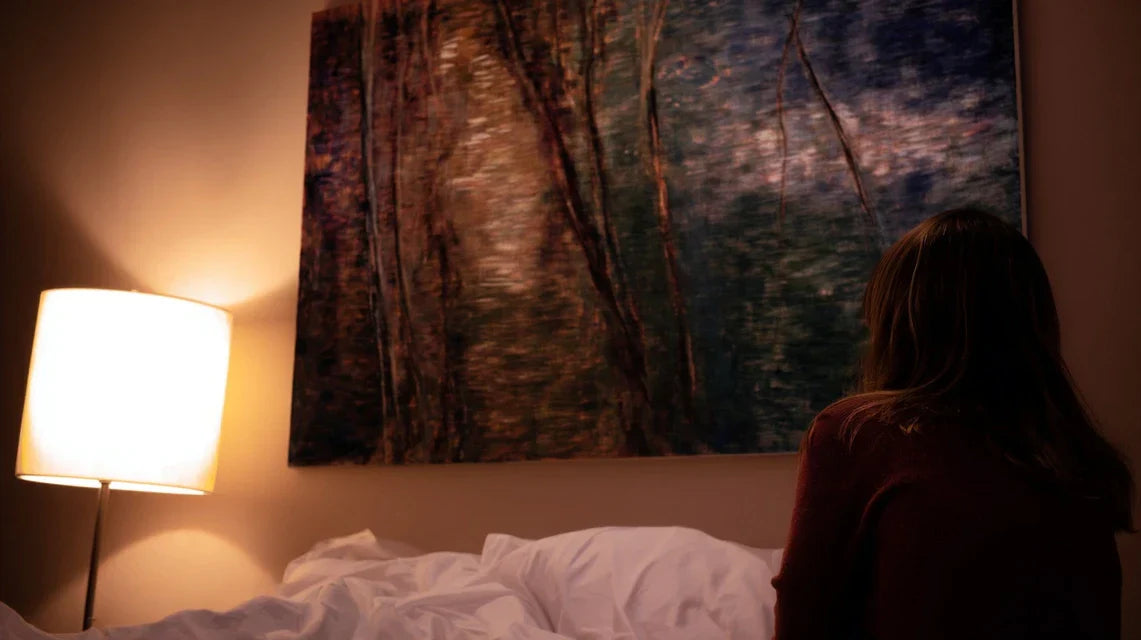
🎨 Revelatory testimonial: Sarah, an interior architect, recounts that before installing this abstract painting with orange tones facing her bed, she used to start every morning stressed by her task list. Today, these fluid shapes and warm colors instantly remind her of her natural creativity and help her approach projects with serenity rather than anxiety.
💬 Conversation with a decor expert
The principle of the morning visual anchor: Your brain automatically associates the first images perceived with your emotional state at that moment. By consciously choosing this first image, you literally program your mood for the following hours. The effects are felt from the first week, with a feeling of calm and clear direction that persists throughout the day.
What's really behind your difficult mornings
Do you recognize these situations? You wake up already mentally occupied by your to-do list, you feel this inexplicable urgency as soon as you open your eyes, or you feel like experiencing your day rather than directing it.
What's really happening is that your brain desperately seeks familiar visual cues to orient itself in space and emotion. Without intentional anchoring, it clings to the first stimuli available: often your phone, aggressive light, or your worries.
Imagine your mind like a GPS starting up: without a programmed destination, it remains in "searching for signal" mode and wastes your energy unnecessarily.
The first hidden cause: morning visual chaos
Contrary to what we imagine, it's not lack of sleep that makes your mornings difficult, but the absence of visual continuity between your resting state and your waking state. Your eye naturally seeks a reassuring anchor point.
It’s exactly like entering an unfamiliar house in the dark: even well-rested, you feel disoriented. Your brain needs to recognize something familiar and soothing to smoothly transition from sleep to wakefulness.
This discovery changes everything: instead of fighting morning disorientation, you can intentionally create this visual cue that naturally guides your transition to awakening.
🔍 Quick test: Tomorrow morning, before looking at anything else, observe where your gaze naturally goes when you wake up. That's exactly where your anchor artwork will have the most impact on your emotional state.
Many people think that you need to "motivate yourself" in the morning, but in reality, your brain when you wake up functions like a processor with reduced capacity.
Each micro-decision (what to wear, what to eat, where to start) depletes your mental energy before even starting.
Think of your morning mind as your phone's battery at 20%: each additional app drains it faster. A single visual focus point saves this precious decision-making energy.
Result: instead of wasting your mental clarity on superficial choices, you preserve it for what really matters in your day. The effect is immediately felt with a sensation of fluidity and purpose.
The third hidden cause: emotional mismatch
Here's what almost nobody notices: there’s a 15-20 minute gap between your physical wake-up and your emotional wake-up. Pending this period, your nervous system actively seeks signals to calibrate your state.
You can easily spot it: it's that time when you’re “awake” but not really “present,” where you function on autopilot. See if you remember precisely your first 20 minutes of waking up.
This window directly influences your energy level, patience, and creativity for the entire day that follows.
3 signals that your morning grounding is working:
- Gentler, progressive wake-up: You exit sleep naturally, without that feeling of “violence” from the alarm. This is a sign that your nervous system recognizes the environment as safe.
- Immediate mental clarity: Your first thoughts are oriented towards your intentions rather than your obligations. Your mind spontaneously connects to what inspires you.
- Prolonged emotional stability: You maintain this feeling of centeredness even when facing the unexpected events of the day. This is an indication that grounding has created a solid foundation.
The trigger element: visual emotional resonance
What really makes the difference is what therapists call "emotional resonance”: this ability of an image to instantly awaken a positive internal state. It’s like a tuning fork that vibrates your energy at the right frequency. You will easily recognize it: when faced with the right artwork, you feel an expansion in the chest, a deeper breath, an immediate feeling of alignment.
Rule of optimal grounding: The perfect artwork for your morning ritual is one that makes you feel both calm AND energy, as if it reflected your best version. Simply test it: observing it should make you want to breathe more deeply.
| ❌ Wake-up without grounding | ✅ Wake-up with intention artwork | 💡 Mechanism | 🎯 Benefit obtained |
|---|---|---|---|
| Feeling of mental dispersion as soon as you open your eyes | Immediate focus on a positive and soothing intention | The brain instantly finds a familiar visual reference point | Day oriented towards your real priorities |
| Stress and inexplicable urgency upon waking up | Gentle transition between sleep and conscious awakening | The nervous system calibrates to chosen stimuli | Stable energy and preserved creativity |
| Difficulty connecting with your deepest motivations | Automatic visual reminder of what inspires you | Neurological association between image and desired state | Natural alignment with your values |
| Day endured rather than consciously directed | Immediate feeling of mastery and clear intention | Activation of the "creation" mode rather than "reaction" mode | Confidence and proactivity strengthened |
The simple method for creating your morning grounding ritual
Rassurez-vous : contrairement aux rituels complexes qui demandent du temps et de la discipline, the visual art anchoring works automatically once set up. It's like planting a seed that grows naturally: you prepare the ground once, then nature does the rest. In 3 progressive steps, you build an anchoring system that will transform your mornings without extra effort on your part.
🌱 Overview of your transformation: First you choose your anchoring artwork (the intention), then you install it strategically (the environment), finally you personalize the contemplation ritual (the integration). Each step naturally reinforces the next, creating a self-sustaining system that generates more and more benefits.
Step 1: Identify your energetic anchoring artwork
This first step is crucial as it determines the quality of your future experience. Like choosing the foundations of a house, it's better to take the time to do it right now than to have to start all over later. The satisfaction you will feel once this selection is complete will naturally motivate you for the next step.
Criteria for selecting your intention artwork
- Immediate emotional resonance: The work should create a physical feeling of well-being at first glance. You will know it because your breathing changes spontaneously, like in front of a beautiful landscape. Avoid works that "intellectually please" but do not generate this positive bodily reaction.
- Energizing yet soothing color palette: Look for tones that evoke your ideal energy: deep blues for serenity, greens for balance, soft oranges for vitality. The secret is to choose colors that make you feel both calm and dynamic, never agitated or sleepy.
- Format and style suitable for contemplation: Favor compositions that invite the eye to travel without fatigue: flowing abstracts, harmonious landscapes, or balanced geometric shapes. The work should be able to be "read" visually in 30 seconds without creating eye strain.
Now, let's move on to the practical selection of your artwork:
How to identify your perfect artwork
First reaction test: Stand in front of several potential artworks and observe your instant bodily reaction. The right work causes a micro-relaxation of the shoulders and a slight involuntary smile. If you have to "think" to appreciate it, it's not the right one for morning anchoring.
⏱️ Time: 2-3 minutes per artwork | ✅ Success when: Immediate physical feeling of well-being | ⚠️ Attention: Do not confuse "I intellectually like it" with "it feels good to my body"
Morning projection test: Imagine waking up, still a little sleepy, and looking at this artwork. Do you feel a sense of welcome and gentleness? The artwork should make you want to take a deep breath, not wake you up abruptly.
⏱️ Time: 1 minute of visualization | ✅ Successful when: The mental image generates calmness | ⚠️ Attention: Be wary of artworks that are too stimulating or complex in the morning
Emotional resilience test: Look at the artwork several days in a row at different emotional moments. A good anchoring artwork stabilizes your mood rather than reinforcing it: it calms you down when you are tense and energizes you when you are apathetic.
⏱️ Time: 1 week of observation | ✅ Successful when: The artwork balances you regardless of your state | ⚠️ Attention: Avoid artworks that amplify your negative emotions
✨ Validation of your choice: Your anchoring artwork is perfect when you feel both a soothing familiarity and a slight inspiration with each glance. Test by closing your eyes and visualizing the artwork: if the mental image alone makes you feel good, you've got it! If you are hesitating between several artworks, choose the one that best evokes the person you want to be on a daily basis.
OUR RECOMMENDED PRODUCTS
Step 2: Strategic Installation for Maximum Impact
Now that you have your anchoring artwork, it's time to position it to maximize its transformative power. This step is more strategic: the location determines the effectiveness of your entire ritual. It’s like installing an antenna: even the best technology only works if it’s properly oriented and positioned.
Professional Installation Elements
- Secure, discreet fixing system: Use wall fixings suitable for the weight and support of your artwork. Modern invisible hook or discreet rail systems offer security and aesthetics. Always check compatibility with your wall type to avoid any risk of falling.
- Soft accent lighting: An indirect light source reveals colors without creating annoying reflections. Adjustable spotlights or integrated LED lighting literally transform the visual impact of the artwork. The goal is to sublimate without dazzling, especially in the morning.
- Visual breathing space: The artwork should have enough space around it to “breathe” visually. This amplifies its energetic impact and avoids a feeling of clutter that would counteract the desired calming effect.
Optimal Positioning for Morning Anchoring
Identifying the natural viewpoint: Lie in your bed in your usual waking position and note where your gaze spontaneously goes. That's exactly where your artwork will have the maximum subconscious impact. Mark this point with a post-it so you don’t forget it.
⏱️ Time: 5 minutes | ✅ Successful when: Viewpoint identified and marked | ⚠️ Attention: Don't choose a "logical" location but where your eye naturally goes
Adjusting height and angle: The artwork should be comfortably visible from your waking position, without effort or neck strain. The golden rule: the center of the artwork at eye level when you are lying slightly upright.
⏱️ Time: 10 minutes of adjustments | ✅ Successful when: Comfortable vision without physical exertion | ⚠️ Attention: Test from different sleeping positions if you move around a lot
Testing morning lighting: Check the appearance of your artwork at different times when you wake up: nascent natural light, artificial lighting, twilight. The artwork must remain visible and inspiring in all these lighting conditions.
⏱️ Time: 3 days of observation | ✅ Successful when: Artwork remains attractive at any time | ⚠️ Attention: Provide supplementary lighting if necessary
Now comes the most rewarding part: creating your personal protocol for morning contemplation. This step transforms a simple glance into a true energy anchoring ritual. It's the difference between listening to music in the background and truly connecting with a melody that transports you.
Creating your personalized anchoring sequence
Defining your morning intention: Choose a simple intention that your artwork will represent: "creativity", “serenity”, “inner strength”, “joy”, etc. This intention becomes the message you send yourself every morning through contemplation of the artwork.
⏱️ Time: 5 minutes of reflection | ✅ Successful when: A clear intention in one word | ⚠️ Attention: Choose something you want to cultivate, not correct
Focusing your contemplation sequence: Create a mini-protocol: open your eyes, gaze at the artwork, 3 deep breaths observing the details that soothe you, then anchoring your intention for the day. This sequence of 2-3 minutes maximum becomes your daily ritual.
⏱️ Time: 2-3 minutes per day | ✅ Successful when: Fluid and natural sequence | ⚠️ Attention: Keep it simple, don't complicate it
Gradual integration: For the first 7 days, simply look at the artwork while consciously breathing. The following week, add intention. Then customize as needed. This gentle progression ensures the new ritual anchors without resistance.
⏱️ Time: 3 weeks of integration | ✅ Success when: The ritual becomes automatic | ⚠️ Caution: Do not change anything during the first 15 days