I have accompanied more than eighty families in the design of Montessori bedrooms, and each time, the same scene repeats: parents set up the floor bed with pride, arrange low furniture at child height, then remain frozen in front of this empty wall. "What size painting? Too big, it will overwhelm the space. Too small, it will seem lost." This hesitation reveals a correct intuition: in a Montessori bedroom with a floor bed, proportions change radically.
Here's what good picture dimensions bring to a Montessori bedroom: they create a visually harmonious environment adapted to the child’s eye level at ground level, promote their autonomy by respecting their natural field of vision, and transform walls into accessible learning supports. Frustration often comes from applying adult decorating rules to a space designed for a child's height. Rest assured: a few simple guidelines are enough to find the perfect balance. I will share with you the proportions that really work, tested in dozens of Montessori bedrooms.
The revolution of perspective: why everything changes with a floor bed
In a traditional bedroom with a raised bed, the child circulates standing up and observes the walls from a standard height. With a Montessori floor bed, the child spends a significant amount of time lying or sitting on the floor. Their angle of vision changes completely. A 60x80 cm painting hung at 1m40 from the floor – perfect in a classic bedroom – becomes almost invisible to a toddler lying on their mattress.
This transformation of perspective directly influences the ideal dimensions of paintings. A child on the floor naturally observes the area between the floor and 80 cm in height. It is within this visual band that your decorative choices will have the most impact. I've seen parents hang beautiful 50x70 cm illustrations too high: the child never looked at them. As soon as they were repositioned at eye level from the floor, they became everyday companions.
The dimensions that dialogue with the Montessori space
For the main wall above the floor bed, prioritize formats between 40x60 cm and 50x70 cm. These dimensions create a comfortable visual presence without dominating the space. In a Montessori bedroom, we seek serenity, not sensory overload. A 40x60 cm painting placed 20-30 cm above the mattress becomes a soothing focal point for the child lying down, without generating oppression.
I have observed that a 50x70 cm painting works beautifully in spacious bedrooms (over 12m²) with a 90x190 cm floor bed. It occupies about one third of the width of the bed, creating proportional harmony. On the other hand, in more compact bedrooms (8-10m²), a 40x50 cm or 40x60 cm format better preserves the visual breathing essential to the Montessori philosophy.
The formats to prioritize according to age
For babies from 0 to 18 months, prints between 30x40 cm and 40x50 cm work ideally. Their developing visual system appreciates clearly defined images, neither too large nor too small. One mother told me how her 10-month-old son spent long minutes observing a 30x40 cm print depicting a simple animal, placed 15 cm from the mattress. This silent contemplation perfectly embodies the Montessori spirit.
Between 18 months and 4 years, a period of cognitive explosion, you can gradually introduce formats of 40x60 cm or 50x70 cm. The child can now appreciate more elaborate compositions. Their vocabulary expands as they name what they see in the print. I accompanied a family who changed a 40x60 cm print every three months: the child awaited this renewal like an event, proof that the dimension was perfectly suited to their attention.

The art of wall composition in the Montessori universe
The Montessori pedagogy values order and visual clarity. Unlike traditional bedrooms where you can create walls of frames, a bedroom with a floor bed calls for restraint. One or two prints per wall are quite sufficient. This sobriety allows the child to concentrate and really observe each image, rather than experiencing a visual cacophony.
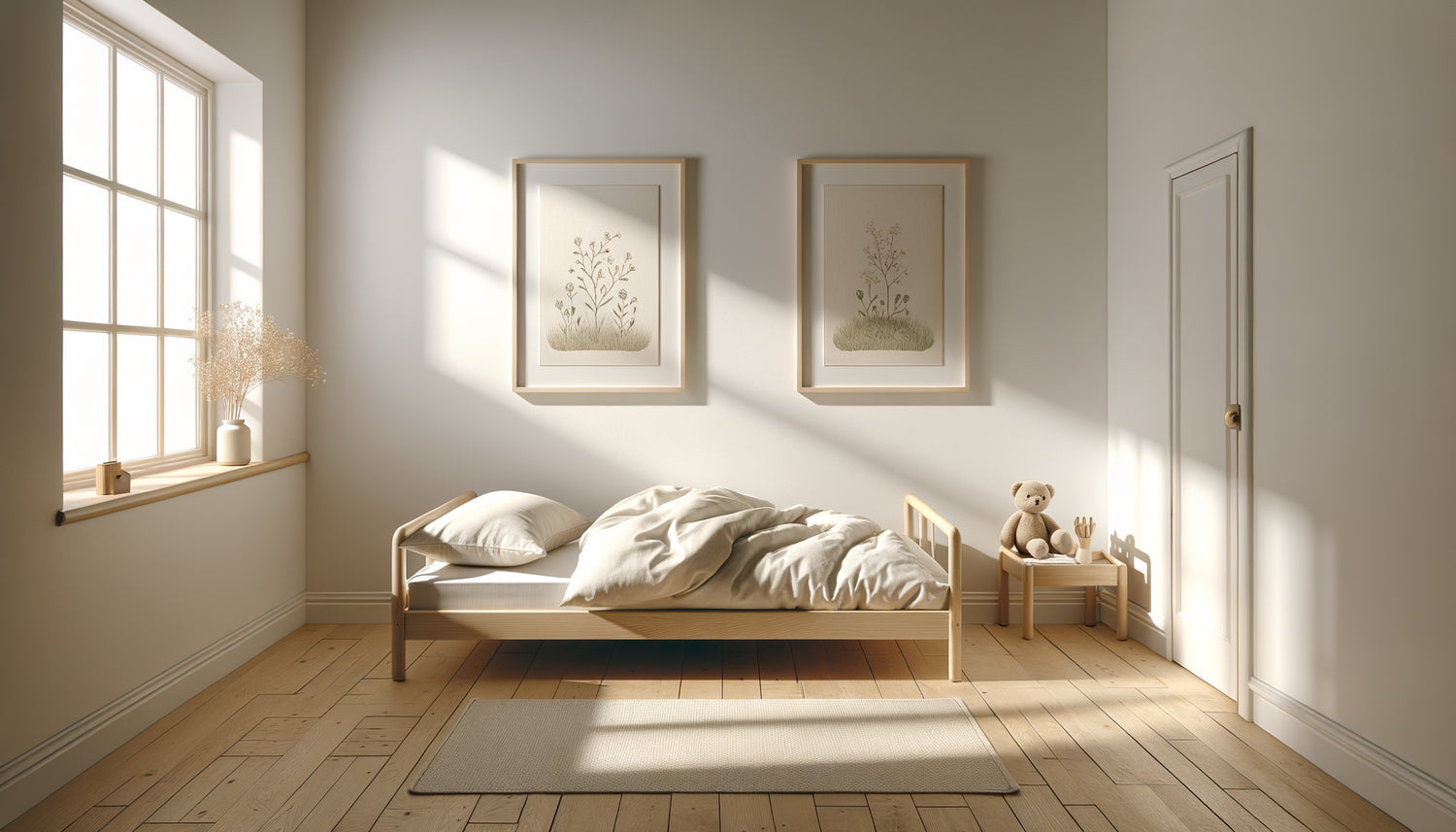
If you want to create a composition of two prints, opt for two identical formats (for example two 30x40 cm) spaced 10-15 cm apart. This repetition creates a soothing rhythm. Avoid accumulations of different formats that fragment attention. In a bedroom I recently arranged, we installed two 40x50 cm prints side by side above the floor bed: the child immediately integrated them into their imaginative play, giving them names and inventing stories.
Hanging height revolutionized
Forget the classic rule of 1m60 from the center of the frame. In a bedroom with a floor bed, the bottom of the print should be between 20 and 40 cm from the floor (or from the top of the mattress if the print is above the bed). This height corresponds to the natural field of vision of a child sitting or lying down. A 40x60 cm print with its bottom starting 30 cm from the floor will have its center at approximately 60 cm – perfect for a view from the mattress.
This rule radically transforms the look of the room. Parents I accompany often find that « it feels low ». Then they watch their child interact with the artwork – touching it, pointing at it, sitting in front of it to observe it – and understand the magic of this adaptation. The artwork is no longer just a decorative element out of reach: it becomes an everyday companion.
When proportions create autonomy
The dimensions of the artwork in a Montessori bedroom are not only an aesthetic matter: they actively participate in the development of autonomy. A 40x60 cm artwork placed low allows the child from 18 months old to point at it and communicate about it. « Look at the cat! » becomes a recurring phrase. This verbal interaction strengthens language and self-confidence.
I have observed children who, around 2-3 years old, began to « reorganize » their space by moving accessible small items. An artwork that is too large and heavy remains fixed, imposed by the adult. A 30x40 cm or 40x50 cm format, well secured but visually light, gives the impression that the space can evolve – even if the child does not actually move the artwork, they perceive the environment as adaptable, suited to them.

The dimension errors I consistently see
Error number one: choosing a panoramic artwork 70x100 cm or larger to « fill » the wall above the floor bed. These dimensions visually overwhelm the space and contradict the Montessori philosophy of simplicity. In a 10m² bedroom, such a format creates a heaviness that the child intuitively feels, even if they cannot express it. Nights are often more restless in these visually overloaded bedrooms.
Second frequent mistake: multiplying small 20x30 cm artworks thinking to respect the scale of the child. Paradoxically, these formats that are too reduced get lost on a wall and create visual clutter. The eye struggles to settle down, to contemplate. A single 40x60 cm artwork offers infinitely more serenity than four 20x30 cm artworks scattered around. Simplicity is the ultimate luxury in the Montessori approach.
Adapt dimensions to the child's evolution
The beauty of a Montessori bedroom with floor bed, is that it evolves with the child. Between 0 and 2 years old, 30x40 cm artworks are sufficient. Between 2 and 5 years old, you can gradually introduce formats of 40x60 cm or 50x70 cm. The child grows up, their gaze becomes more refined, their attention span lengthens: the dimensions naturally follow.
A particular approach I favor is to create an "evolving gallery" with easy-to-open frames. You retain the optimal dimensions (let's say 40x50 cm), but you regularly change the illustration inside. The child participates in the choice: "What animal do you want to observe this month?" This rotation maintains interest without cluttering the walls or requiring new drillings.
Transform the Montessori room into a visual awakening cocoon
Discover our exclusive collection of wall art for kids' rooms that respect the ideal proportions for Montessori spaces with floor beds.
Does the perfect dimension really exist?
After supporting so many families, I am convinced that there is no ONE universal perfect dimension, but rather an optimal range: between 30x40 cm and 50x70 cm depending on age and room size. Within this range, you can't go wrong. The determining factor remains the hanging height and respect for the line of sight from the floor.
A 40x60 cm artwork represents a balanced and lasting choice for most Montessori rooms with floor beds. It offers enough presence to become a focal point, without dominating the space. It remains legible from the mattress and from the play area. It allows for sufficiently detailed illustrations to nourish the imagination without overwhelming the eye. This is my preferred format when parents ask me for a unique recommendation.
The magic happens when you observe your child naturally interacting with the artwork. If they look at it regularly, point to it, or talk about it spontaneously, you have found the right dimensions. If the artwork goes unnoticed for weeks, it is probably undersized or poorly positioned. The child is the best indicator: their attention never lies.
Creating harmony between floor bed and wall decoration
Installing a Montessori floor bed creates a new horizontality in the room. The dimensions of the artwork should dialogue with this horizontality rather than fight it. Favor horizontal (landscape) or square formats over very vertical (portrait) formats that create visual tension.
A 50x70 cm landscape-oriented artwork above a 90x190 cm floor bed creates a harmonious continuity. Horizontal lines respond to each other, bringing calm and stability – two essential qualities for a resting space. I have seen parents install a large vertical 50x100 cm artwork: visually, it "broke" the harmony of the room, creating a verticality that contradicted the choice of floor bed.
Also consider the breathing space around the artwork. In a Montessori room, every element should be able to “breathe”. Leave at least 20-30 cm of free space around your 40x60 cm picture. This emptiness is not wasted: it allows the eye to focus on the image, to truly contemplate it. Intentional minimalism is at the heart of this approach.
Imagine your child gently waking up in their Montessori bedroom. Their gaze opens onto a picture with perfect dimensions, placed exactly within their natural field of vision. Not too big to intimidate them, not too small to disappear. Just there, like a silent friend waiting patiently to be observed. This everyday scene, repeated hundreds of times, weaves the child's relationship with their environment. The right size picture is not a decorative detail: it participates in creating a space where the child feels respected, understood, and free to grow at their own pace.
Start simple: one picture between 40x60 cm and 50x70 cm, placed low above the bed on the floor. Observe your child for a few weeks. You will immediately know if you have found the perfect balance.
Frequently asked questions about picture sizes in a Montessori bedroom
Can we put several pictures of different sizes in a Montessori bedroom with a floor bed?
The Montessori philosophy favors visual clarity and order, essential for the development of concentration in children. Mixing multiple pictures of very different sizes creates a visual fragmentation that goes against this approach. If you absolutely want to install several pictures, opt for two identical formats (for example two 30x40 cm or two 40x50 cm) spaced regularly. This repetition creates a soothing rhythm rather than a visual chaos. Ideally, limit yourself to one picture per main wall, two maximum in the whole room. Less is more: this motto applies perfectly to the dimensions and number of pictures in a Montessori bedroom with a floor bed.
Do the ideal dimensions change depending on the height of the Montessori floor bed?
Excellent question! Montessori floor beds do vary: some are directly placed on the floor (mattress thickness only, i.e. 10-15 cm), others use a low frame (total height 20-30 cm). This difference influences the positioning slightly but little the dimensions themselves. For a mattress directly on the floor, prioritize a 40x60 cm picture with the bottom starting at 20-25 cm from the floor. For a bed with a low frame at 25 cm, you can start at 30-35 cm. The recommended dimensions (30x40 cm to 50x70 cm) remain identical: it is mainly the hanging height that adjusts. The essential thing is that the child lying down can comfortably observe the picture without raising their head uncomfortably.
Should the dimensions of the artwork be adjusted if the Montessori bedroom is very small (less than 8m²) ?
Absolutely! In a compact Montessori bedroom with a floor bed, proportions become even more crucial. Artwork that is too large (50x70 cm or larger) risks visually overwhelming the space and creating a feeling of oppression contrary to the serenity sought. For bedrooms from 6 to 8m², prioritize formats of 30x40 cm or 40x50 cm maximum. These dimensions offer sufficient visual presence while preserving the essential breathing room in a small space. Paradoxically, a well-proportioned artwork in a small bedroom creates an impression of spaciousness rather than clutter. Also consider placing only one artwork in these configurations: simplicity visually expands the room and perfectly respects the Montessori spirit of a clean environment.