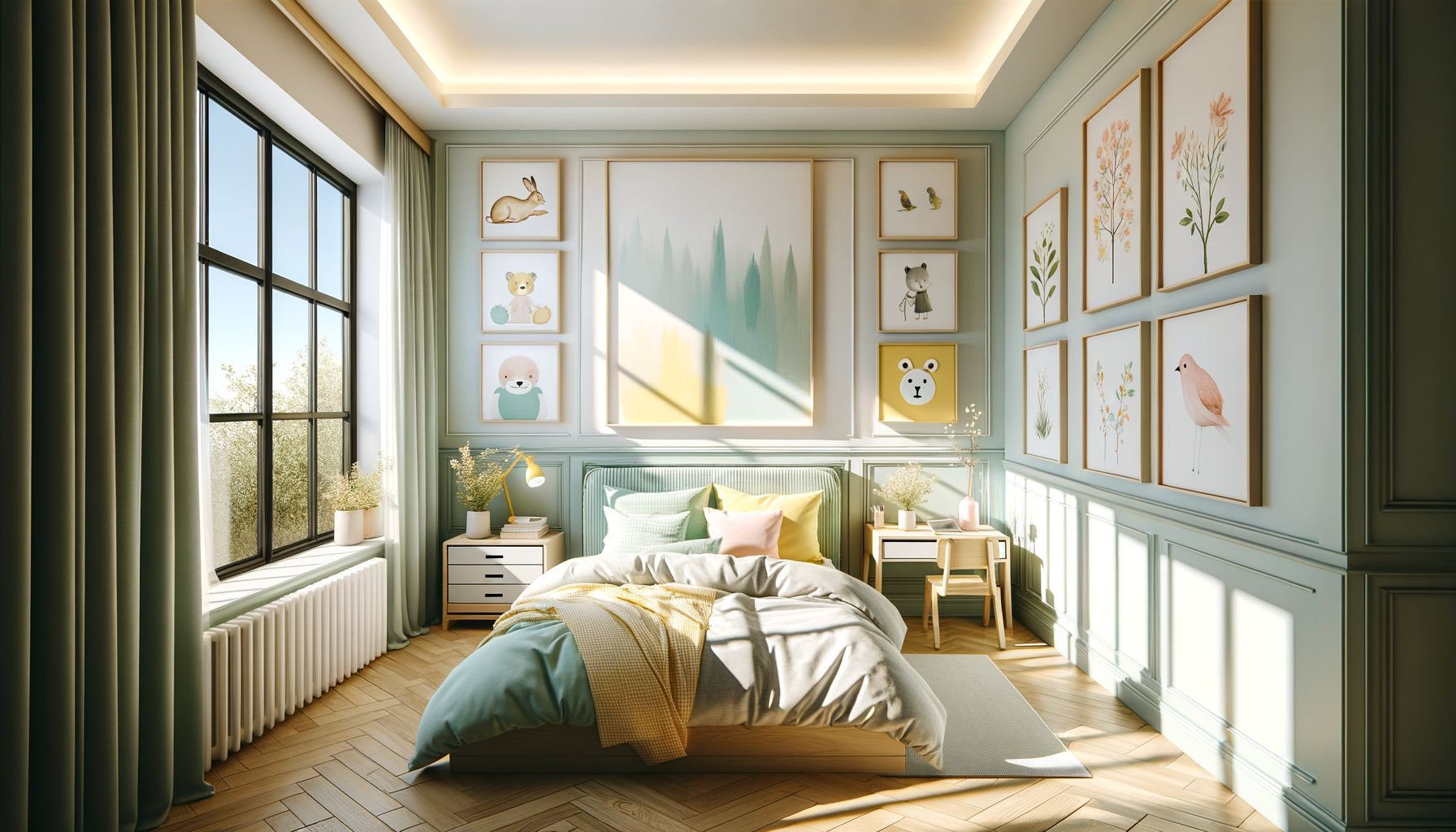
One October morning, Clara discovers her favorite watercolor spread across the parquet floor. The nail gave way during the night. Miraculously, no shards of glass, but this image still haunts her: what if my son had been sleeping just below? For fifteen years, I have accompanied families in securing their interiors, and this scene comes back up in almost every consultation. A falling picture is never insignificant.
Here's what a lightweight picture brings: unparalleled peace of mind, freedom of placement without structural constraints, and simplified installation accessible to all. Yet, between solid wood frames, thick glasses, and tempting formats, it’s difficult to distinguish what truly weighs heavily from what remains safe. We hesitate, sometimes giving up on decorating a wall for fear of doing something wrong. Rest assured: choosing a lightweight picture does not mean sacrificing aesthetics. I will show you how to combine beauty, safety, and serenity, by deciphering the materials, formats, and tips that I use daily.
Why lightness becomes your best decorative ally
In the 2000s, I mainly intervened in disasters: pictures fallen on cradles, heavy frames tearing plaster from BA13 partition walls. These accidents taught me a simple truth: a lightweight picture divides the risk of serious injury by ten. Less than 2kg is the magic threshold that I systematically recommend for children's bedrooms, hallways, and spaces above sofas.
But lightness offers more than just safety. It frees you. You can hang without a drill on rental walls, reposition your decor with the seasons, create evolving wall compositions. A lightweight picture is fixed with a simple adhesive hook, without weakening your partition wall. This simplicity transforms your relationship to decoration: you finally dare to try, move, reinvent.
The three pillars of a truly lightweight picture
To stay below the 2kg limit, three elements count: the support, the frame and the surface protection. A canvas on a wooden stretcher 40x50 cm weighs about 400g. Add an aluminum frame (200g) and acrylic glass (150g), you remain at 750g. Replace the stretcher with a standard MDF panel and the frame with solid wood, you easily climb to 2.5kg. These 300 gram difference may seem insignificant, but they change everything in terms of wall mounting.
Deciphering materials: what weighs heavily, what remains light as a feather
During a workshop with a young designer mom, we weighed about thirty identical pictures. The differences amazed us. A 50x70 cm poster under traditional glass reached 2.8kg. The same visual printed on fine canvas with an aluminum frame: 680g. The choice of material radically transforms the final weight.
The ultra-light supports to be prioritizedStretched canvas remains my absolute champion. Cotton or polyester, it offers a visual nobility for a featherweight feel. A 60x80 cm canvas rarely weighs more than 500g. Satin photo paper mounted on foam board constitutes an elegant alternative: rigid, matte, and glare-free, it is perfectly suited to graphic illustrations and photographs. For reproductions of works, 3mm aluminum dibond combines lightness and museum-quality rendering, although slightly more expensive.
Systematically avoid thick MDF panels (over 6mm) and solid wood supports. Their density explodes your budget weight. A pine board of 40x50 cm in 18mm thickness already weighs 1.2kg on its own, before even adding the print and frame.
The frame: aluminum versus wood, the weight match
An aluminum frame of 50x70 cm weighs approximately 250g. Its equivalent in solid oak: 1.1kg. Light metal divides the weight by four while offering impeccable contemporary finishes. Extruded polystyrene imitation wood frames are an interesting aesthetic compromise: 180g on average, warm appearance, correct strength for indoor use.
If you absolutely want wood, opt for light woods: poplar, paulownia, linden. Request a thin section (maximum 15x20mm). Some artisans offer hollowed-out wooden frames on the back which preserve noble aesthetics while considerably lightening the structure.

Glass or plexiglass? The protection that changes everything
This question comes up in 80% of my consultations. Traditional glass provides impeccable optical clarity, but weighs heavily: a 2mm glass pane of 40x50 cm reaches 800g. Worse, if it falls, it breaks into sharp fragments. For a lightweight painting intended for a child's room, this is prohibitive.
Plexiglass (PMMA) or polycarbonate divides this weight by two: 350g for the same format in 2mm. It absorbs impacts better, does not break into dangerous splinters, and its transparency remains excellent if you choose an anti-reflective quality. Admittedly, it scratches more easily and generates static electricity attracting dust, but for use in a sensitive area, its safety advantages outweigh these minor drawbacks.
The lightest option? No protection. Canvas prints, mounted photo prints, posters framed without glazing completely eliminate this superfluous weight. This increasingly popular Scandinavian minimalist trend is appealing: the visual breathes, reflections disappear, and the weight melts away.
Clever formats that stay below the critical threshold
A client architect recently asked me for a monumental triptych for their living room. Rather than a large format weighing 5kg, we created three 40x80 cm canvases each weighing 1.3kg. Breaking it down into several lightweight elements offers identical visual impact with maximum safety. Each module is fixed independently, distributing the load across multiple attachment points.
Naturally lightweight formats
Dimensions of 30x40 cm, 40x50 cm and 50x70 cm are standards that, when well designed, consistently remain below 2kg. A 50x50 cm square on canvas with a thin aluminum frame: 850g. An A2 format (42x59 cm) on dibond without a frame: 420g. These proportions adapt to most domestic spaces while guaranteeing easy handling.
For large formats (beyond 80 cm), prioritize printing on canvas without a stretcher, stretched directly onto the wall with a rail system. This museum technique eliminates the weight of the frame and stretcher, allowing for monumental visuals weighing less than 1.5kg.

Check the weight before purchasing: my professional techniques
Weighing a painting in store remains approximate. Always request the technical sheet with the exact weight. Serious sellers will provide it immediately. Online, this information should appear in the product specifications. Its absence is a warning sign: the painting probably weighs more than 2kg.
For custom creations, calculate yourself. Printers and professional framers know the weight per square decimeter of each material. A 320g/m² cotton canvas in 50x70 cm (0.35m²) = 112g of pure canvas. Add the stretcher (300g), the aluminum frame (200g): total 612g. This simple arithmetic avoids unpleasant surprises.
The kitchen scale test
Before final installation, I always weigh my paintings on a classic kitchen scale. This ten-second check confirms that you remain within the safety zone. If the weight exceeds 1.8kg, I systematically recommend a reinforced fixing system, even for a painting advertised as lightweight. The 200g margin absorbs variations in wood density or canvas humidity.
Offer beauty and safety to your little ones’ rooms
Discover our exclusive collection of wall art for kids’ rooms that combines tender illustrations and ultra-light design for serene nights.
Adapted hanging: permanently secure your lightweight artwork
A 3.3 lbs (1.5kg) painting poorly fixed is more risky than a 6.6 lbs (3kg) frame correctly hung. Lightness never exempts from careful hanging. For supports under 0.44 lbs (1kg), new generation adhesive hooks (type Command) hold remarkably well on smooth surfaces. Check the indicated maximum load: always take a hook supporting twice the actual weight.
Between 2.2 lbs (1kg) and 4.4 lbs (2kg), I recommend metallic X hooks on fine nails (25mm). They cleanly pierce plaster without cracking, and their geometry distributes the load. On hollow BA13 partition walls, use Molly anchors adapted: they open behind the panel, creating a solid anchoring point even in the void.
Safe hanging height
Systematically position your lightweight artworks above 4.6 ft (1.40m) from the floor in children’s rooms. This height places them out of reach of climbs while remaining within adult visual range. Above a bed, respect a minimum clearance of 9.8 inches (25cm) between the mattress and the bottom of the frame: even a lightweight artwork can cause injury in case of nocturnal fall.
In passageways, prioritize side walls rather than direct circulation areas. A fallen lightweight artwork remains an obstacle on the floor that you do not want to encounter barefoot at 3 am.
Imagine your interior transformed, with complete peace of mind
Visualize your living room bathed in light, this white wall finally dressed with a soothing watercolor. Your daughter points her finger at the tender illustration above her bed, that evening ritual where she invents stories for the characters in the artwork. You know that even if she climbs on her chair tomorrow, even if the hook fails in six months, nothing serious can happen. This peace of mind is priceless.
Start today with a single lightweight artwork in the room that needs it most. Weigh it, choose the right hook, take ten minutes to install it correctly. Then watch how this simple addition transforms the atmosphere, brings personality, tells your story. Secured decoration is not a constraint, it’s regained freedom.
Frequently asked questions about lightweight artworks
Can a 3.3 lbs (1.5kg) artwork really fall if well hung?
Yes, but the circumstances are very specific. The main causes: undersized hook (designed for a maximum of 1kg), friable plaster wall that crumbles progressively, repeated vibrations (door slamming nearby), or excessive humidity degrading the adhesive. Under normal conditions, with an appropriate hook (minimum capacity of 3kg for a 1.5kg artwork) on a healthy wall, the risk of falling becomes less than 1%. I recommend a simple annual check: gently pull the frame towards you. If it moves or if the wall shows micro-cracks around the fixing point, replace the hook preventatively. This thirty-second inspection guarantees lasting safety. The lightweight artworks I installed ten years ago for my first clients are still holding perfectly, simply because we respected the magic trio: good material, good support, good technique.
Are frameless artworks more fragile?
Counterintuitively, no. A frameless artwork eliminates one of the most vulnerable elements: corners that clash, glass cracking against wood. Canvas prints without frames absorb minor impacts better thanks to their natural flexibility. Of course, they do not resist intentional perforation or a determined cat's scratch, but in the face of common household accidents (thrown toy, lost soccer ball), they withstand remarkably well. The edges may fray slightly over time on canvases with unhemmed edges, but this weathered look is precisely what appeals to lovers of industrial or bohemian style. If raw aesthetics bother you, opt for a canvas with painted or folded edges onto the frame: the finish remains impeccable without adding the weight of a frame. I have clients who have replaced all their framed artworks with free canvases: their interior breathes, cleaning becomes easier, and the total budget has melted by 40%.
How to clean a lightweight artwork without damaging it?
Lightness requires delicate handling. For canvases, never use direct liquid products: moisture passes through and creates halos. Use a dry microfiber cloth, passed in gentle circular motions once a month. On prints under plexiglass, static electricity attracts dust like a magnet. Spray a special plastic antistatic product onto your cloth (never on the artwork), then wipe. For stubborn stains on aluminum frames, a cotton ball soaked in 70° household alcohol cleans without scratching or discoloring. Take the artwork down to clean it flat on a protected table: you control your movements better and avoid excessive pressure on the fixing point. This five-minute routine every two months preserves the brilliance of your lightweight artworks for decades. A conservative museum client passed on this golden rule to me: the less you touch a work, the longer it lasts. Lightness makes this occasional handling simple and risk-free.