

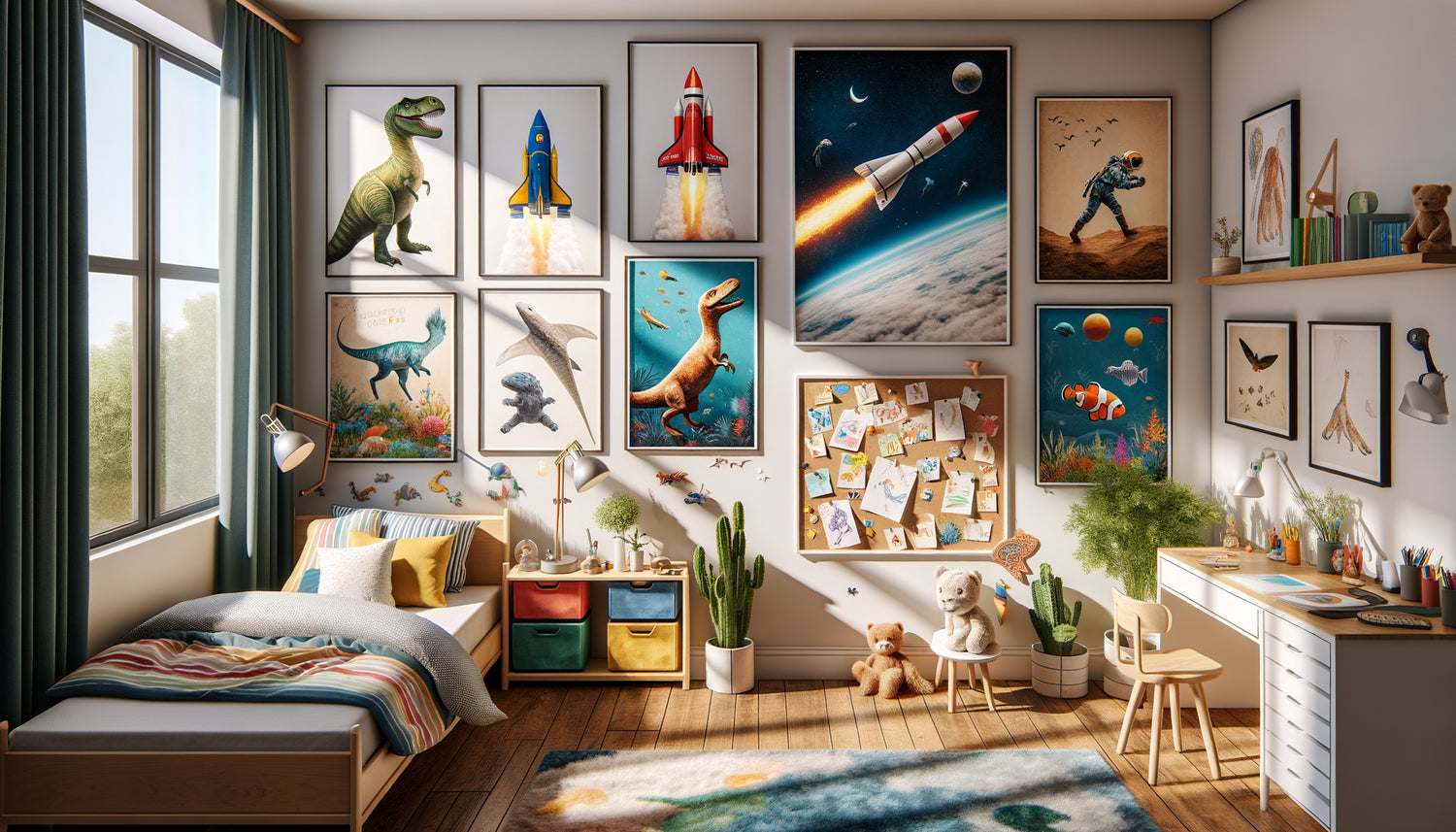
It’s bedtime. Your four-year-old is still begging you to tell the story of the Tyrannosaurus that lived in the mountains. Meanwhile, their cousin of the same age prefers to contemplate the unicorns adorning her wall. Does this scene sound familiar? The question is worth asking: are dinosaurs really a universal passion among young children, or is it a tenacious decorative myth?
Here's what observing childhood preferences in decoration reveals: the enthusiasm for dinosaur paintings actually appeals to a large proportion of children, but this fascination varies considerably according to each little one’s personality, temperament and cultural environment. Not all children resonate with prehistoric creatures.
As parents, we sometimes feel this social pressure: offering a dinosaur-themed bedroom seems like a rite of passage. Stores are full of Jurassic decorations, animated films celebrate these extinct giants, and every birthday seems to revolve around Mesozoic reptiles. Yet, your child may be turning away from these prehistoric frescoes.
Rest assured: respecting your child’s true interests is the key to successful wall decoration. A painting that authentically matches their personality will transform their room into a real personal sanctuary. Let's discover together how to identify whether dinosaurs really constitute their favorite universe, or if there are other visual horizons to explore.
The dinosaur phenomenon: anatomy of a shared fascination
Why do dinosaurs occupy such a prominent place in children's imaginations? This attraction is based on deep psychological foundations. Prehistoric creatures represent pure power, a captivating concept for little ones who still feel vulnerable in a world of imposing adults.
Paintings depicting dinosaurs also offer a stimulating cognitive dimension. Children love to memorize these complex names – brachiosaurus, parasaurolophus, ankylosaurus – which give them a feeling of intellectual mastery. This expertise makes them valued by those around them.
The fantastical dimension also plays a crucial role. Unlike contemporary animals, dinosaurs belong to a bygone world, almost mythological. A painting showing a velociraptor in a lush jungle invites time travel, risk-free adventure from the safety of their room.
Statistically, approximately 60 to 70% of children between 3 and 7 years old show a pronounced interest in dinosaurs. This percentage, although majority, means that one third of children remains relatively indifferent to these creatures. This substantial proportion deserves our attention.
Profiles of children naturally attracted to dinosaurs
Some childlike personalities are naturally drawn to dinosaur paintings. Little ones with an exploratory and curious temperament love these representations that fuel their thirst for knowledge. They ask a thousand questions, want to understand geological periods, compare the relative sizes of species.
Children who seek intense visual stimulation particularly appreciate dramatic scenes: predator battles, volcanic eruptions in the background, lush prehistoric forests. These dynamic paintings correspond to their need for strong and narrative images.
Personalities who value strength and self-affirmation easily identify with carnivorous dinosaurs. A roaring tyrannosaurus on the wall can symbolically represent the power they aspire to develop. This type of wall decoration accompanies their identity construction.
The influence of cultural environment
Media exposure significantly influences interest in dinosaurs. A child who has seen popular animated films will more easily develop a passion for these creatures. Paintings then become natural extensions of this already familiar universe.
The social circle also plays a decisive role. If classmates or schoolmates share this passion, the child will be more inclined to identify with this collective center of interest. Dinosaur paintings then become markers of belonging to a group.

These children who prefer other visual horizons
Let's now observe the other side of this reality: children who remain indifferent to dinosaurs. Contemplative and gentle personalities often seek more soothing visual universes. A painting representing tender contemporary animals – pandas, koalas, rabbits – better suits their sensitivity.
Children with an artistic and dreamy temperament frequently gravitate towards abstract compositions, poetic landscapes or fairytale scenes. Soft colors, rounded shapes and dreamlike atmospheres touch them more than prehistoric roughness.
Some little ones show very specific interests: vehicles, space, the ocean floor, music. For them, a thematic painting corresponding to their particular passion will create a much stronger emotional connection than an imposed Jurassic scene.
The Default Decorating Syndrome
Many parents choose dinosaur paintings simply because it's what everyone does. This default decoration neglects the child’s uniqueness. Observing their reactions to different images reveals authentic preferences that are sometimes surprising.
A child may seem indifferent to dinosaurs while developing a fascination for insects, robots, or musical instruments. Respecting these natural inclinations greatly enriches their daily environment.
How to Identify Your Child’s True Passions
Instead of imposing a preconceived theme, engage in a real decorative investigation. Observe the books they spontaneously browse, the toys they constantly return to, and the topics that fuel their conversations.
Offer a diversified visual exploration. Show them various images: current animals, natural landscapes, space scenes, colorful abstract compositions, and yes, also dinosaurs. Note where their gaze lingers, which images provoke questions or smiles.
Emotional reaction is a valuable indicator. A painting that spontaneously triggers stories, imaginary games, or requests for discussions has a particular resonance. This organic connection far surpasses superficial adherence to a trend.
The Evolution of Tastes with Age
Keep in mind that preferences evolve rapidly during early childhood. A child passionate about dinosaurs at four years old may completely turn away from this theme at six years old. Choosing easily interchangeable paintings allows you to accompany these natural transformations without prohibitive decorative investment.
Some children go through an intense but temporary dinosaur phase. Others develop a lasting interest that will persist for years. Observing the depth and constancy of engagement helps distinguish fleeting enthusiasm from authentic passion.

Beyond the Dinosaur: Creating an Authentically Personal Space
The ultimate goal of a painting in a child’s bedroom goes beyond simple decoration. It's about creating an environment that reflects and nurtures the developing identity of your little one. A perfectly suited dinosaur painting can accomplish this mission for some children.
For others, it will be a marine fresco, a geometric composition with bright colors, a soothing forest landscape, or a scene depicting their favorite literary hero. Relevance always trumps conformity to trends.
Consider also mixed approaches. There’s nothing stopping you from combining a dinosaur painting with other works reflecting the diversity of the child's interests. This personal gallery tells a more complete and faithful story to their multidimensional personality.
The importance of shared choice
Involving the child in selecting their painting – even at a very young age – reinforces their sense of ownership of the space. Present them with a pre-filtered selection and let them express their preference. This decision-making autonomy values their opinion and develops their aesthetic sense.
If your child spontaneously chooses a dinosaur painting among other options, you will have confirmation that this theme truly resonates within them. If their gaze lights up at another image, you will have discovered something precious about their unique sensitivity.
Ready to find the painting that will make your child’s eyes sparkle?
Discover our exclusive collection of paintings for children’s rooms that celebrate all passions, from majestic dinosaurs to the sweetest dreamlike universes.
Transforming a bedroom into a personal sanctuary
Imagine your child stepping through the doorway of their room each night. Their gaze falls on the painting hanging on the wall. If it authentically represents what they are passionate about – whether it's a triceratops in a prehistoric jungle or a completely different visual universe – this simple glance generates a feeling of recognition and belonging.
This painting becomes much more than just a decorative element. It is a mirror of their inner world, a visual validation of their legitimate interests. For some children, it will undoubtedly be a roaring dinosaur. For others, it will be a completely different composition.
The essential thing is the match between the image on the wall and the child who grows up under its gaze. Dinosaurs do fascinate most children, but that majority is not a totality. Offering your child the painting that specifically corresponds to them is one of the most beautiful decorative gifts you can give.
Take the time to observe, listen, and suggest without imposing. The right decision will naturally emerge from this kind attention. And if your little one ultimately chooses a magnificent dinosaur painting, you'll know that this choice reflects an authentic passion rather than simple conformity to parental or social expectations.
Frequently Asked Questions
At what age do children typically develop an interest in dinosaurs?
Fascination for dinosaurs typically emerges between 2 and 3 years old, when the child develops the ability to categorize animals and understand relative size concepts. This period coincides with the awakening of storytelling and symbolic play. Interest often peaks between 4 and 6 years old, a time when children love to accumulate specialized knowledge. Some maintain this passion well beyond that age, while others gradually detach from it around 7-8 years old in favor of other interests. The important thing is to respect your child's natural pace rather than anticipate or artificially prolong a phase that no longer corresponds to their personal development.
My child seems indifferent to dinosaurs, is that unusual?
Absolutely not! Around 30 to 40% of children show only moderate or no interest in dinosaurs. This indifference simply reflects a different sensitivity and alternative interests, which is perfectly normal and healthy. Each child builds their imaginary world according to their unique personality. Some are naturally drawn to gentle contemporary animals, others to colorful abstraction, vehicles, nature, space, or the arts. This diversity testifies to a psychological richness that should be celebrated rather than corrected. Offering a painting corresponding to your child's true passions, even if they stray from popular themes, is a much more beneficial approach than imposing a theme that does not speak intimately to them.
Can we combine dinosaur paintings with other themes in a bedroom?
It’s not only possible, but often desirable! Children rarely have a single interest. Creating a wall gallery that reflects the diversity of their passions offers a visually richer and psychologically more faithful environment to their multifaceted personality. You can perfectly combine a dinosaur painting with a work representing marine animals, a space landscape or an abstract composition in your child's favorite colors. The key is chromatic and stylistic consistency to avoid visual cacophony. This approach also has the advantage of facilitating transitions: when a passion fades, it’s enough to replace a painting rather than rethinking the entire decoration. This flexibility naturally accompanies the rapid evolution of children's tastes during their early years.


