I met Clara during a consultation for her daughter Léa's room, who was then three months old. She showed me photos of a room filled with pink rabbits and multicolored alphabets. "In five years, all of this will have to be redone," she confided in me with a hint of discouragement. I hear this sentence regularly in my evolving decoration workshop in Toulouse, where I have been designing children's spaces for twelve years.
Here is what evolving artworks bring: a decoration that accompanies the transformations of your child without requiring a complete renovation, a sustainable investment that transcends developmental phases, and an aesthetic coherence that respects the harmony of your interior.
Many exhausted parents confess to me having accumulated impulsive purchases: these illustrations that are too childish, which lose their charm in the first few years, these cartoon characters that become embarrassing when the child changes passions, these garish colors that end up assaulting the eye. The result? Overloaded walls, an exploded decorative budget, and this frustrating feeling of starting from scratch every two years.
However, I reassure you: choosing timeless artworks that last through childhood does not require a degree in developmental psychology. It is enough to understand a few fundamental principles that I will share with you, those very ones that have transformed hundreds of children's rooms into harmonious and durable spaces.
I promise you that by the end of this article, you will know exactly how to select artworks that will accompany your child from their first months to entering college, without ever seeming outdated.
Why most childish decorations become obsolete
In my experience, the main mistake lies in confusing decorating for an age and decorating for a person in progress. Parents buy for the baby they imagine, not for the child they will become.
I have analyzed more than 400 children's rooms over the years, and the pattern repeats itself: at birth, we invest in ultra-specific artworks (sleeping bears, pastel mobiles, illustrated nursery rhymes). Around 3 years old, the child develops their own tastes, often incompatible with this baby decoration. At 6 years old, these same illustrations become a source of embarrassment when classmates visit the room.
The real challenge? Anticipating the cognitive and aesthetic evolution of the child while creating a reassuring cocoon for their first years. This is exactly the paradox that evolving artworks resolve with elegance.
The three pillars of an artwork that lasts through time
Narrative simplicity rather than thematic overload
During a recent project for twins, I proposed an abstract composition with soft geometric shapes in terracotta and navy blue tones. The mother was skeptical: "Isn't that too adult for babies?" Three years later, she contacted me again, not to change the decor, but to thank me. Those same paintings had become a support for identifying shapes games with her children.
A evolving artwork rests on an open narrative : stylized animals rather than fictional characters, clean landscapes rather than detailed scenes, geometric patterns rather than literal representations. This simplicity allows the child's imagination to project their own stories, which naturally evolve with age.
A sophisticated yet accessible color palette
Forget the idea that children need aggressive primary colors. The research in environmental psychology that I regularly consult shows that babies first perceive contrasts, then gradually develop their sensitivity to nuances.
I recommend palettes in half-tones: petrol blue, sage green, soft ochre, deep blush pink, warm gray. These colors offer enough contrast to stimulate the infant's gaze, while retaining a sophistication that appeals to pre-teens. I have seen 9-year-olds marvel at paintings with terracotta and mustard tones they had been living with since birth, suddenly discovering their "grown-up beauty".
Timeless themes rather than fleeting trends
Mathieu, 7 years old, had been living in a dinosaur-decorated room since he was 3. When I intervened, he confided to me in a whisper: "Now I like space, but my mom spent a lot of money..." This childish guilt broke my heart.
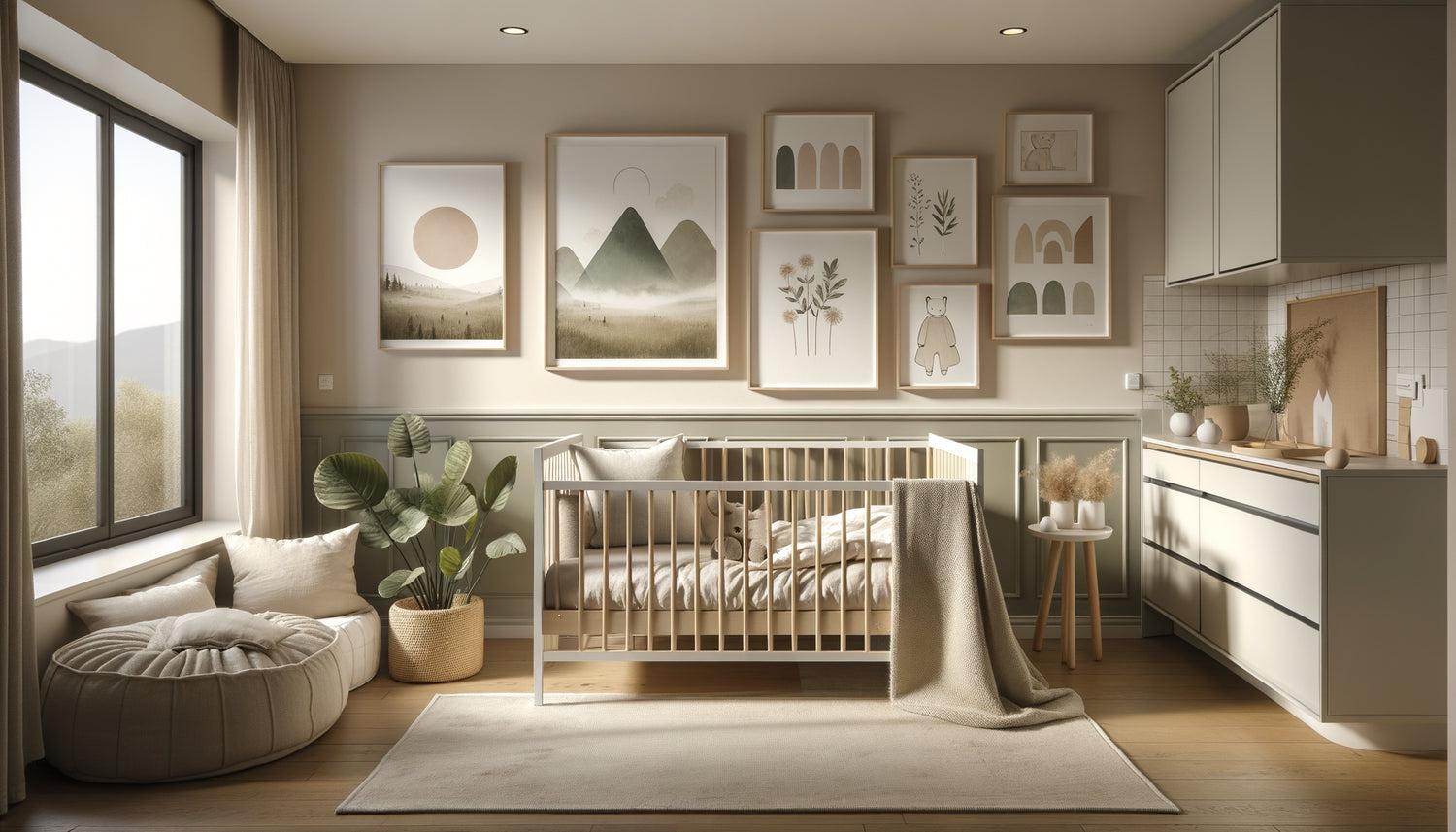
Timeless themes embrace concepts rather than objects : exploration (stylized mountains, oceans, forests), curiosity (abstract constellations, imaginary maps), nature (clean foliage, animal silhouettes), travel (minimalist hot air balloons, geometric boats). These subjects resonate differently with age, offering new readings at each stage.

How to adapt your selection to the major phases of development
In my practice, I identify four distinct periods requiring specific consideration, without completely changing the decor.
From 0 to 2 years: sensory awakening
At this age, prioritize paintings with marked contrasts and simple shapes that the baby can distinguish from their bed. A triptych representing organic forms in black and white with a touch of bright color works wonderfully. These artworks will continue to exist as structuring decorative elements as the child grows up, losing their stimulating function to become simply aesthetic.
From 3 to 5 years: the explosion of imagination
This is the period when children project stories onto everything around them. I observed a little girl transforming an abstract painting of mountains into a "princess's castle in the clouds," and six months later into a "secret base for spies." This narrative flexibility is impossible with overly literal paintings. Opt for compositions that suggest without imposing: a silhouette of an animal in a minimalist landscape leaves the child to mentally complete the scene.
From 6 to 8 years: asserting tastes
Children begin to express clear aesthetic preferences. If your basic paintings are neutral enough, you can easily add temporary elements (removable frames with their creations, small shelves with collectibles) without upsetting everything. A stylized forest painting will welcome both figurines of the Snow Queen and space models, according to the passions of the moment.
From 9 to 10 years: the quest for maturity
As adolescence approaches, children often reject anything that seems "babyish." This is the time of truth for your initial choices. Evolutionary paintings succeed this test: a 10-year-old child has no shame in front of a minimalist landscape with muted tones or a refined geometric composition. They may even feel a discreet pride in having "always had good taste".
Artistic styles that defy time
After years of experimentation, I have identified five particularly effective aesthetic approaches for creating lasting children's spaces.
Soft geometric abstraction: rounded shapes, semi-circles, arches that evoke without representing. These compositions function as visual puzzles that the child deciphers differently according to their age. An orange circle can be a sun at 3 years old, a planet at 7 years old, simply a harmonious shape at 10 years old.
Stylized naturalism: purified representations of fauna and flora, where one recognizes the animal or plant without superfluous details. A minimalist illustration of a fox in three shades of rust stands the test of time with constant elegance, whereas an anthropomorphic fox in overalls ages badly.
Landscapes in blocks of color: mountains, dunes, waves treated as areas of color without excessive texture. These compositions create a contemplative atmosphere that soothes the infant and inspires the dreamy pre-teen.
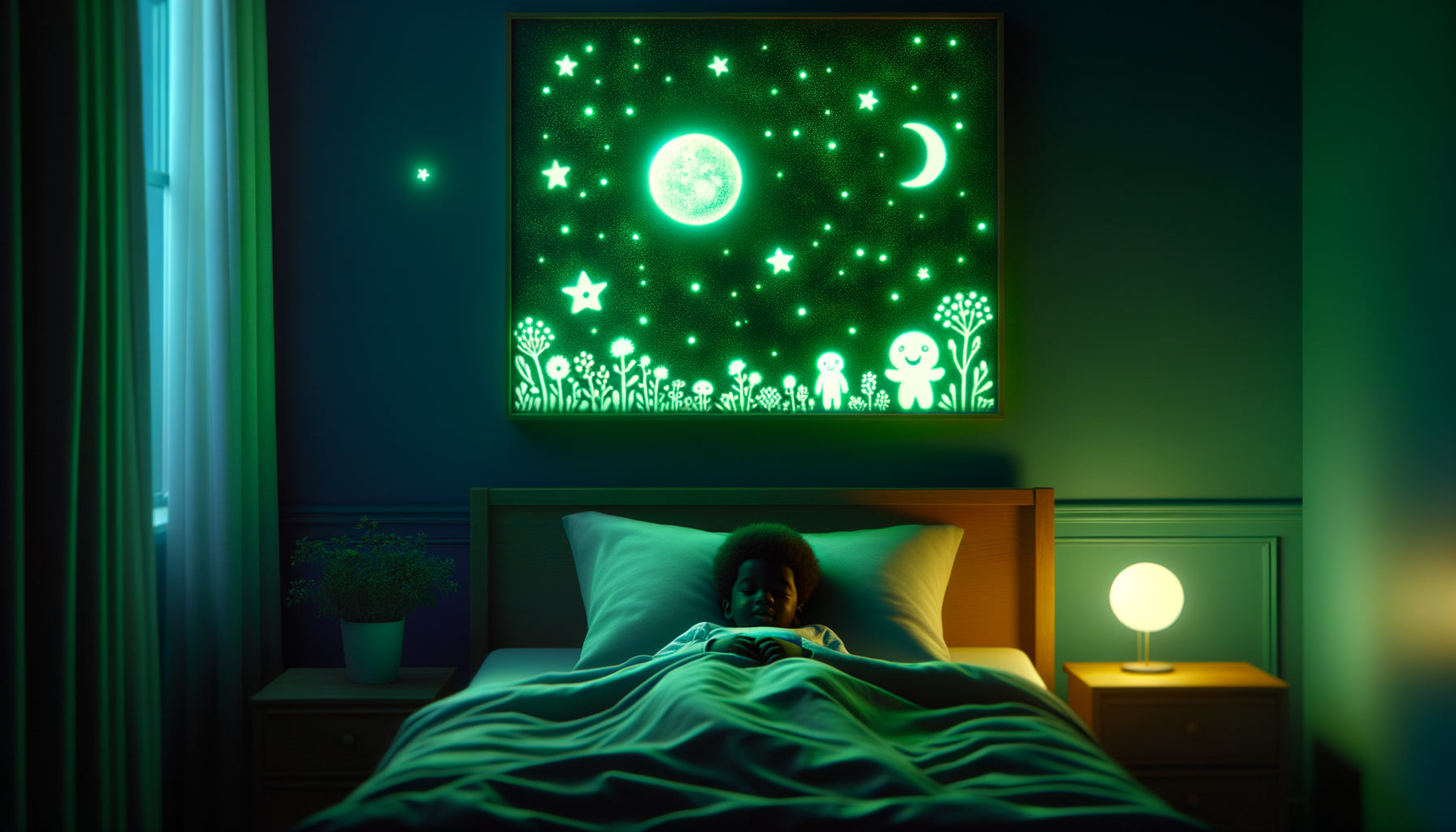
Abstract celestial constellations and motifs: Space universally fascinates, but avoid cartoon rockets. Prefer golden dots on a midnight blue background suggesting stars, sleek phases of the moon, geometric planets. This theme works from 0 to 99 years.
Poetic typography: With caution, some words or short quotes in beautiful typography stand the test of time. Avoid “Sleep my baby” to favor “Dream”, “Explore” or “Imagine” – injunctions that remain relevant at all ages.

The art of composing an evolving gallery wall
Arrangement is as important as the choice of paintings. I often work with the principle of layered composition: master pieces permanently complemented by modular elements.
Start with two or three medium to large format paintings (minimum 40x60 cm) as visual foundations. Place them in strategic locations: above the bed, facing the changing table turned desk. These works will never move and structure the space.
Around them, create flexible zones with small formats, clip frames, pictorial shelves. Here, you can integrate the child's drawings, photos, temporary finds. This zone of expression evolves without compromising overall coherence.
A golden rule that I consistently apply: in a child’s bedroom, 70% of wall decoration should be timeless, 30% can be specific to their age or current passions. This proportion allows for evolution without revolution.
Create a space that grows with your child
Discover our exclusive collection of paintings for children's rooms that gracefully and poetically navigate all phases of childhood.
Costly mistakes to absolutely avoid
Allow me to share the pitfalls I regularly see, even among well-intentioned parents.
Excessive theming: transforming the room into a jungle animal or princess amusement park. This visual saturation quickly becomes tiresome and locks the child into a fixed identity. A touch of theme is enough, the rest should breathe.
The "coordinated" trap: buying ready-made sets where paintings, curtains, bedding and rugs share exactly the same motifs. This uniformity lacks depth and ages uniformly, forcing you to change everything at once. Prefer a common palette with varied patterns.
Ignoring quality: an evolving artwork is a ten-year investment. A medium-quality canvas print will degrade before your child starts primary school. I always recommend UV-resistant inks, durable supports and solid frames. A good painting costs more initially, but its cost per year of use becomes negligible.
Neglecting the child's perspective: many paintings are hung at adult height. Consider that a painting intended to accompany your child should be partially visible from their height. Hang at least one artwork 80-100 cm from the floor so it can interact with them as soon as they stand up.
When and how to involve the child in decorative choices
This question constantly comes back to me: at what age should you involve the child in your decoration?
My position is nuanced. Before 5 years old, children express fluctuating preferences, often influenced by their latest media exposure. Giving them free rein generally leads to choices they will regret six months later. However, you can present them with a pre-selection of two or three evolving options, giving them the impression of choosing while keeping quality control.
From 6-7 years old, children can participate more actively, especially for elements in the flexible 30% zone. Offer them to choose a small painting or frame to display their creations. This partial autonomy makes them responsible without compromising overall harmony.
I accompanied a family where an 8-year-old daughter demanded glittery unicorn paintings. Her mother, desperate, didn't want to stifle her enthusiasm. We found a compromise: a minimalist illustration of a wild horse silhouette in a twilight landscape. For the child, it was "a unicorn without a horn that can be magical if you want." For the mother, it was an elegant work. Three years later, the painting is still in place, and the young girl no longer talks about unicorns but appreciates "her freedom horse."
Visualize the transformation
Imagine yourself in seven years. Your child is in grade 5, their friends come to do homework in their room. Instead of being embarrassed by outdated childish decorations, they show off these paintings that they've "always had," which tell without saying that they grew up in a thoughtful and harmonious environment.
These same artworks that welcomed their first baby gazes now accompany the dreams of a pre-teenager. You haven't spent fortunes on successive makeovers. You simply chose with intention from the start, thinking not about the baby today, but about the person becoming.
Start by identifying the main location in the room – the one that will remain relevant even when the bed changes place or the desk replaces the changing table. This is where your first evolving artwork will take root, anchoring all decoration within a long-term vision.
Childhood flies by at a dizzying speed. Give your child the luxury of an aesthetic consistency that whispers to them year after year that they were expected, thought about, and supported.
Frequently Asked Questions About Evolving Artwork for Children
Won't abstract artworks bore a young child?
This is a legitimate concern that I often hear. In reality, research in cognitive development shows that children naturally project meanings onto abstract forms, creating their own narratives. An abstract artwork with soft geometric shapes actually offers more imaginative stimulation than a figurative scene where everything is already defined. I have observed 3-year-olds inventing complex stories from simple colored circles and triangles. Abstraction is not an emptiness; it's a space of creative freedom. Moreover, even if the child isn't actively interested in it during their early years, these artworks create a soothing and structuring visual ambiance, which is enormously important for the overall well-being of the space. Boredom rarely occurs with the right colors and compositions – it’s narrative overload that tires.
What budget should you allocate for artworks that will last 10 years?
Think in terms of cost per year rather than initial investment. A quality artwork costing between €80 and €120 that lasts a decade costs you between €8 and €12 per year. Compare this to the €30-€40 spent every two years on temporary decorations that you have to renew, and the equation becomes obvious. For a complete room, I recommend a budget of €200-€400 for two to three master pieces of quality, complemented by some more accessible elements (€50-€80) in flexible areas. Always prioritize quality over quantity: it's better to have two excellent artworks than a gallery of six mediocre prints. Keep an eye out for independent creators on specialized platforms – you will often find original works of great quality at softer prices than in traditional decoration shops. The key is to invest in durable materials: resistant inks, solid supports, robust frames that won’t warp with humidity.
How to avoid the room looking too adult for a baby?
This fear is probably the most common, and I completely understand it. The key lies in balancing sophistication and gentleness. A painting can be visually rich and elegant while still retaining a tenderness suitable for young children. Favor rounded shapes over angular ones, airy compositions over dense ones, colors in muted tones rather than loud or too dark shades. A palette of deep dusty rose, sage green, and soft ochre, for example, remains gentle and enveloping for a baby while maintaining a sophistication that will appeal to an older child. Also remember that the softness of a nursery comes as much from textiles (fluffy rugs, cushions, light curtains) as it does from the walls. You can therefore have relatively clean paintings on the walls while creating a warm cocoon with materials. Finally, don't forget that babies do not judge aesthetics – they react to contrasts, simple shapes and the overall atmosphere. A harmonious and thoughtful space is perfect for them.