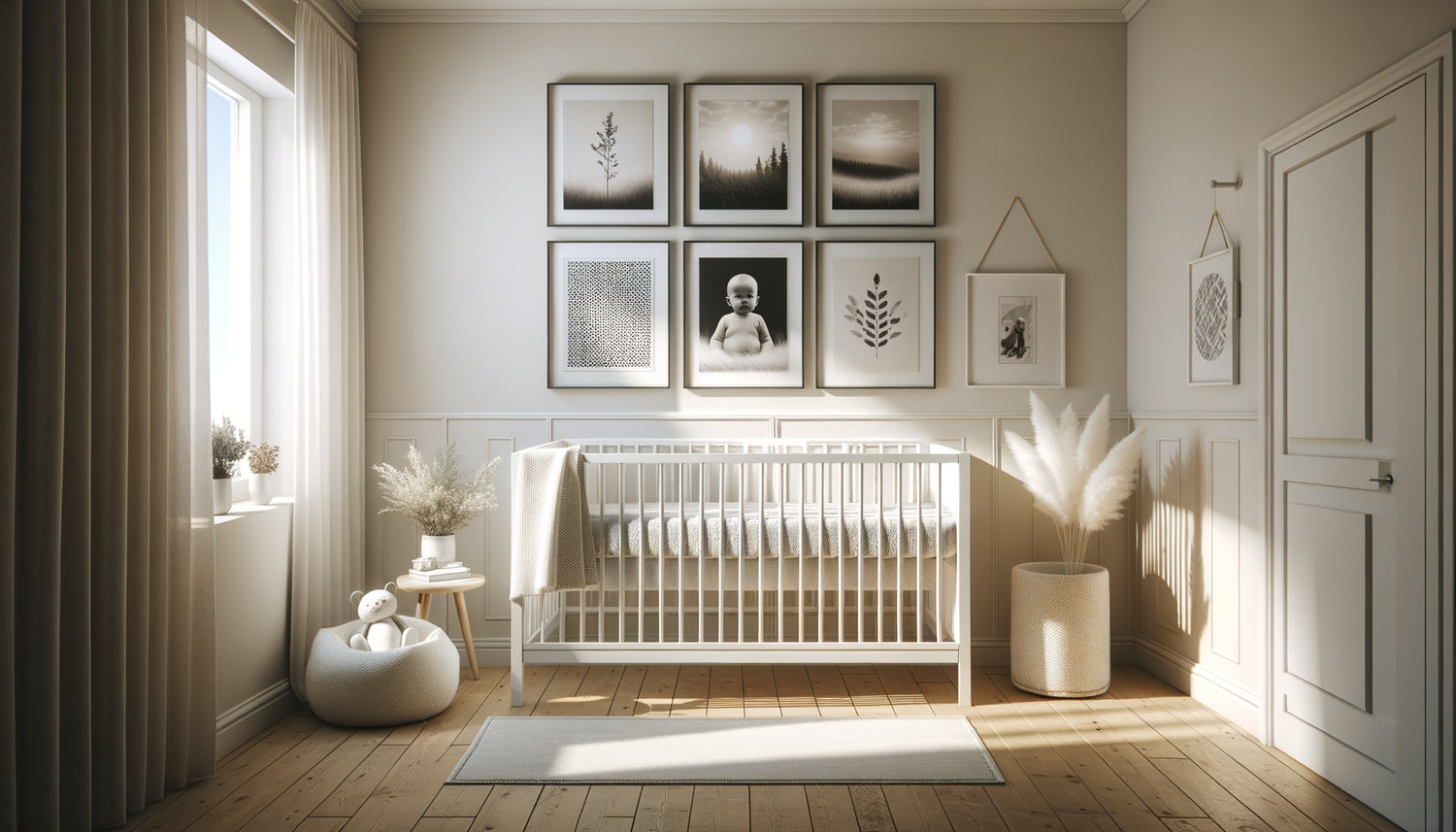
When I accompanied my first client in decorating her daughter’s nursery, she confided in me an intuition: she wanted black and white photographs on the walls but feared that this choice would be too austere for a baby. Six months later, she called me back to tell me that her little Emma spent long minutes contemplating these contrasting images, fascinated. This scene repeats itself in my profession: science and maternal instinct converge towards a surprising truth.
Here's what black and white photographs bring to a newborn’s room: optimal visual stimulation for neurological development, a soothing environment that promotes concentration, and a timeless aesthetic that evolves with the child. Contrary to popular belief that baby rooms should be overflowing with bright colors, the sharp contrasts of black and white perfectly match the immature vision of newborns.
You have probably already felt this dilemma: creating a cozy and stimulating space without falling into sensory overload. Between the conflicting advice from magazines, the well-intentioned remarks of those around you, and your own aesthetic aspirations, it is difficult to know which direction to take. Rest assured: the science of child development now sheds new light on these decorative choices.
I will guide you through the neurological, aesthetic, and practical reasons that make black and white photographs a remarkably suitable choice for the first months of life, while giving you the keys to integrate them harmoniously into an evolving decoration.
Why newborns are magnetically attracted to black and white
At birth, a baby's vision reaches only 5% of that of an adult. During the first three months, newborns mainly distinguish marked contrasts and simple geometric shapes. Black and white photographs offer precisely this visual clarity that their developing neurological system can process effectively.
Neuroscience studies on infant development demonstrate that high contrast stimulates the primary visual cortex and promotes the creation of essential neural connections. When a newborn fixates on a black and white photograph, his brain actively works to decode shapes, lines, and textures. This early neuronal gymnastics lays the foundations for more sophisticated visual abilities.
I have observed this phenomenon hundreds of times: a six-week-old baby can remain captivated for several minutes by a black and white photograph depicting a face or geometric patterns, while he seems indifferent to the pastel illustrations that are omnipresent in traditional children's rooms.
The evolution of visual perception
Between birth and four months, color vision develops gradually. Black and white photographs perfectly accompany this transition: they remain visually stimulating even as chromatic perception refines. Unlike a mobile with garish colors that can lose its interest, monochrome images retain their power of fascination thanks to the richness of their textures and compositions.
Around six months, when the baby fully distinguishes colors, black and white photographs acquire a new dimension: they become visual resting points in a world suddenly much more colorful and stimulating. This soothing function is far from anecdotal in our modern interiors often overloaded.
A timeless aesthetic that grows with the child
One of the classic pitfalls of decoration for newborns is investing in elements that are too literally childish. Black and white photographs elegantly escape this programmed obsolescence. A beautiful monochrome image of an animal, a landscape or an abstract composition will cross all phases of childhood without ever seeming outdated.
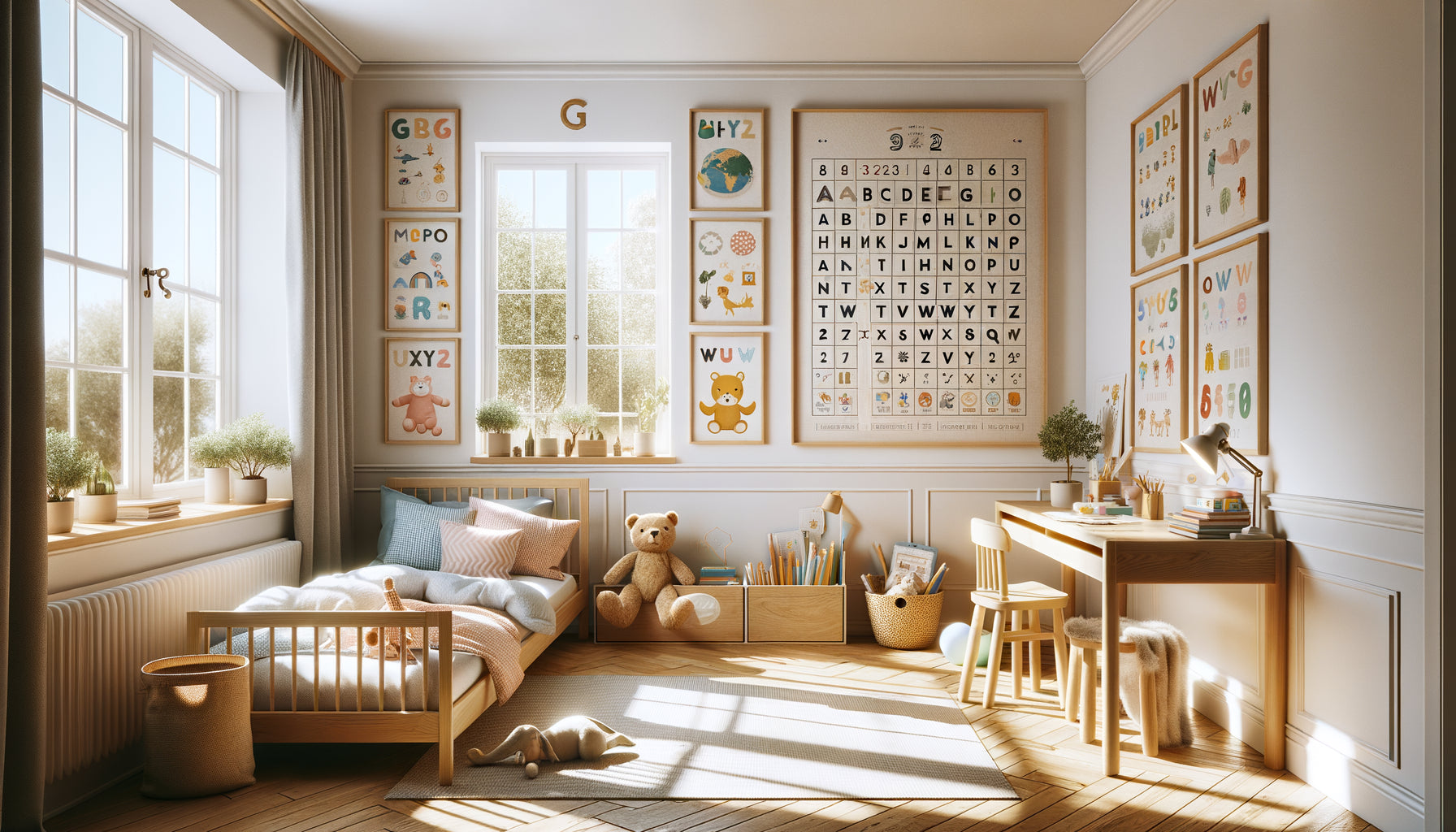
In my experience, bedrooms decorated with black and white photographs require much less successive redecorations. When the child reaches two or three years old and begins to express their preferences, these images constitute a neutral base on which you can add more personalized touches of color: cushions, rugs, toys. Black and white photography then becomes the aesthetic guiding thread that unifies the evolution of decoration.
This decorative longevity also represents an intelligent economic and ecological choice. Rather than replacing the entire wall decoration every two years, you create a durable visual foundation that naturally adapts to the transitions from childhood to adolescence.
Harmony with your stylistic choices
Black and white photographs have this rare quality of integrating harmoniously into practically all decorative styles. Whether your interior leans towards Scandinavian minimalism, classic elegance, bohemian charm or contemporary boldness, monochrome images adapt without visual friction.
This versatility allows to create a continuity of aesthetics between the newborn's room and the rest of your home. Rather than creating a totally distinct decorative universe for baby, you naturally welcome them into your family environment. This spatial coherence is important: it reflects the integration of this new being into your common life.

How to choose and arrange photographs for optimal impact
Not all black and white photographs are created equal in a newborn's room. Images with high contrast work better than subtle shades of gray to capture the attention of toddlers. Prioritize simple compositions with clearly identifiable subjects: expressive faces, silhouettes of animals, bold geometric shapes, natural elements with marked textures.
Arrangement plays a crucial role in the stimulating effectiveness of these images. Place at least one black and white photograph at eye level when the baby is in their crib or changing table. Between 30 and 60 centimeters away, which is the optimal focal distance for a newborn. This proximity transforms the simple act of changing a diaper into an enriching visual interaction.
Avoid overstimulation
Paradoxically, although black and white photographs are stimulating, they contribute to a visually restful environment when used with discernment. Limit yourself to a maximum of three or four images in an average-sized room. An entire wall covered in frames, even monochrome ones, would create counterproductive visual fatigue.
Alternate the types of images: a face photograph, a natural scene, an abstract pattern. This variety maintains interest without creating visual cacophony. The empty space around each black and white photograph is as important as the image itself: it allows the eye to rest and attention to focus.
Beyond stimulation: soothing through contrast
A lesser-known aspect of black and white photographs lies in their calming effect. While one might fear that high contrasts are too dynamic, they actually create a form of reassuring visual predictability for the immature brain of the newborn.
In a world where every stimulus is new and potentially confusing, monochrome images offer a perceptual simplicity that the baby can grasp without excessive effort. This cognitive accessibility promotes moments of calm contemplation, valuable for developing attention span.
Several parents have reported to me that their baby calmed down more easily in a room decorated with black and white photographs than in a multicolored environment. This observation finds its explanation in the reduced cognitive load: fewer variables to process means less neurological stress, therefore more serenity.
Create a soothing visual ritual
You can transform black and white photographs into an anchor for a bedtime ritual. Before placing your baby in their bed, draw their attention to a particular image for a few seconds. This simple visual routine can become a reassuring signal that announces the time of rest, a gentle transition to sleep.

The most effective photographic themes
Certain photographic subjects in black and white prove particularly captivating for newborns. Human faces, even stylized or partial, exert a magnetic attraction: the human brain is programmed from birth to recognize and be interested in facial configurations.
Close-up animal photographs are also an excellent choice, especially those with natural contrasts such as zebras, pandas or dalmatians. These images remain relevant throughout early childhood, the names of the animals then becoming a support for language learning.
Geometric compositions - concentric circles, parallel lines, checkerboards - effectively stimulate shape perception. More abstract, they also allow for imaginative projection that evolves with the child's age: what is initially a simple visual contrast gradually becomes a support for creativity.
Natural elements with pronounced textures - feathers, bark, waves, clouds - introduce an organic dimension that enriches the environment without overloading it. These black and white photographs of nature create a subtle connection with the outside world, even from within the nursery cocoon.
Give your newborn a stimulating and soothing environment
Discover our exclusive collection of wall art for kids' rooms that supports your baby’s visual development while creating an elegant and timeless space.
Introduce color gradually without starting over
Using black and white photographs as a decorative base does not mean banning color, but rather introducing it in a thoughtful and evolving way. Monochrome images create a neutral backdrop on which you can add colorful notes in small touches: a pastel mobile, textured cushions, a rug in soft tones.
This progressive approach to color respects the natural evolution of infant vision. During the first few months, black and white contrasts dominate the visual experience. Gradually, you enrich the chromatic environment according to your child's sensory awakening, without ever creating a brutal aesthetic rupture.
Around the first birthday, when color perception is fully mature, black and white photographs become visual anchors that structure the space and prevent cacophony. They implicitly teach a valuable design principle: the power of contrast, the elegance of restraint.
Imagine yourself in a few years, contemplating this room that has grown with your child. The same black and white photographs that captivated his gaze as a newborn still adorn the walls, silent witnesses to his evolution. You haven't had to redo everything at each stage, just adjust the details. Your initial choice, guided by science and intuition, proved as aesthetically sound as it was economical.
Start today by selecting two or three black and white photographs that resonate with your sensibility. Place one near where you spend most of your time with your baby. Observe his gaze linger, his nascent concentration. You are not simply decorating a room: you are creating the visual conditions for harmonious development.
Frequently Asked Questions
Won’t black and white photographs make the room sad or austere?
It's a understandable but unfounded concern. Black and white photographs do not create a sad atmosphere when well chosen and balanced with other elements. On the contrary, they bring timeless elegance and visual serenity particularly beneficial for relaxation. Austerity comes from the coldness of materials or emotional emptiness, not the absence of color. A beautiful black and white photograph of an animal, a smiling face, or a natural scene exudes as much warmth as a colorful illustration, while offering additional sophistication. Complement them with soft textiles, warm lighting, and a few touches of color in accessories: you will get a space that is both stimulating for your baby and relaxing for the whole family. The monochrome palette then becomes a canvas on which light, textures, and lived moments bring all the necessary life.
From what age should I replace black and white photographs with color images?
You actually never need to replace them completely. Black and white photographs retain their relevance and beauty well beyond early childhood. What evolves is their function: from primary visual stimulation in the newborn, they become structuring elements of decoration for the older child. From 18 months to two years, you can start introducing a few colorful illustrations or more playful works without removing existing monochrome images. This coexistence naturally teaches your child the notion of visual balance and aesthetic diversity. Many teenagers also appreciate black and white photographs for their sober elegance. By keeping these images throughout childhood, you create a reassuring decorative continuity and avoid costly renovations. Simply adapt the environment around them rather than remove them.
How many black and white photographs should I hang in my newborn's room?
Moderation is your best ally: aim for between two and four black and white photographs for a medium-sized bedroom. The goal is to create visual points of interest without overwhelming the space. Prioritize quality over quantity: it's better to have two well-placed large images than six small frames that fragment the gaze. Position your photographs strategically: one near the crib within the baby's field of vision when lying down, another near the changing table where you spend many face-to-face moments with your child, possibly a third on a wall you look at from the rocking chair. Leave empty space around each image to allow the eye to rest. Remember that in a newborn’s room, minimalism promotes calm. You can always enrich the decoration gradually as your child grows up, but starting with a clean base creates an optimal environment for these crucial first months of sensory development.